
Opinion
Could You Be Abusing Someone on Behalf of a Narcissist?


Today is World Narcissistic Abuse Awareness Day. Yes, believe it or not, it is a real thing. And it hurts.
We are all good people, right? At least, deep down, I hope we believe that; I mean, what person would intentionally, consciously, go out of their way to hurt and destroy another human being?
We probably have all been in contact with a narcissist at some point in our life. Maybe a boss. A friend. A neighbor. Or like me, even a member of your own immediate family.
Narcissists are very smart and calculating. They have had to be; they have been doing this for a very long time. They are self-absorbed, controlling, intolerant to others and their needs, and insistent that others see them as they wish to be seen, even though their front is a façade. “Victimized narcissists” can say hurtful things, but if you dare say something back to defend yourself, you are the enemy and considered abusive. There is no sense in debating with a narcissist; they will shift the blame at all costs. They will never see things through your eyes; they are incapable of reflection or feeling empathy. For this reason, sadly, they don’t have the conscious insight that we do to know that they exhibit this behavior.
Narcissists will suck the life out of you and leave you struggling to breathe. Narcissists don’t care that they pit one family member against another, even sibling against sibling if the narcissist happens to be a parent. Yes, the most excruciating pain is the reality that moms and dads can also be narcissists, leaving their children sometimes hating each other. And the one that dares to speak out to this abuse is left feeling defeated, battered, and bruised by the people they love most in this world even though the wounds are invisible to the naked eye (which is another reason why innocent people get caught in the trap of defending the narc).
And if the relationship becomes so intolerable with a narc that you are forced to make a painful decision of quitting your job, moving, ending a friendship, getting a divorce, or even going low or no contact with one or both of the people who brought you into this world, you become public enemy number one; the narc will attempt to destroy you and your reputation at all costs.
“Narcissist’s will DESTROY your life and erode your self-esteem. They do it with such PERSUASION that you are left feeling like YOU are the one letting them down.”
A narcissist’s public persona is very important to them, which is why they don’t publicly attack you—that would make them look bad. Instead, they carefully choose people in their circle to be their puppets. The narc delivers believable-sounding lies to sympathetic ears, ones that can be easily manipulated. Of course, very decent, loving, caring individuals can be caught in the trap of the narcissist and innocently become what is called “flying monkeys.”
A Flying Monkey? Up until a few months ago, I had never even heard the term. But I felt attacked from all directions and so on my quest to understand and survive this abuse I found this in Wikipedia and finally it all made perfect sense. The complicated pieces all came together in my mind: “Flying monkeys is a phrase used in popular psychology mainly in the context of narcissistic abuse. They are people who act on behalf of a narcissist to a third party, usually for an abusive purpose. Flying monkeys are distinct from enablers…. Enablers just allow or cover for the narcissist’s (abuser’s) own bad behavior.”
This is a phrase made popular by the movie The Wizard of Oz—the Wicked Witch sent her flying monkeys after Dorothy and her friends. In most cases, it is a humorous way of saying “Don’t make me come after you.” But there is nothing humorous about being hated and harassed by a flying monkey on its mission to destroy an innocent person. It is unfair, cruel and causes more pain to someone that is already struggling.
So, beware.
You may be a flying monkey if:
You find yourself believing gossip, even though the facts don’t add up.

You are an adult, yet you take sides, instead of staying impartial.
You are mad, stop speaking to someone and possibly hate someone else who has done nothing to you at all.
You accept someone’s version of the truth although you have no first-hand knowledge of the story.
You believe that the one you are defending is the only one deserving of sympathy.
You are overly involved, feeling the need to defend at all costs.
You are attacking someone else over something that quite frankly is none of your business.
And what should you do if you are on the receiving end of this hatred and smear campaign either from a narcissist or their flying monkey?
It is easier said than done sometimes, but keep calm and do not engage. DON’T ENGAGE. The narc is looking for you to react. It gives them fuel. Strength. Power. And they hate nothing more than the silent treatment, as they are then not getting their narcissistic supply.
Breathe. Ignore it. Read books and articles on narcissism. See a therapist. Write. Cry (it does make you feel better). Cry some more if you have to. Heal. Keep breathing.
Live a beautiful, healthy, productive, and happy life and don’t look back. Narcissists hate that and it does make them angrier. But don’t do it out of spite; do it because you are entitled to that. You are. And never let anyone make you feel guilty or beaten down or ashamed that you choose to do what is best for your life.
We are all responsible for our choices and behaviors and the consequences. Knowledge is a gift and you can always change. Say sorry. Forgive. So, if you believe that you have unintentionally been used by a narcissist as their flying monkey, what you do with that knowledge is up to you.
But know that, moving forward, what you do now IS intentional and conscious.
Jodee Prouse is a Sister. Wife. Mom. Friend. And outspoken advocate to help empower ACOA’s through their journey of life; trauma, truth, addiction & breaking free from family chaos to live YOUR best life. She is the author of the powerful memoir, The Sun is Gone: A Sister Lost in Secrets, Shame, and Addiction and How I Broke Free. To learn more visit www.jodeeprouse.com

Crime
The Uncomfortable Demographics of Islamist Bloodshed—and Why “Islamophobia” Deflection Increases the Threat

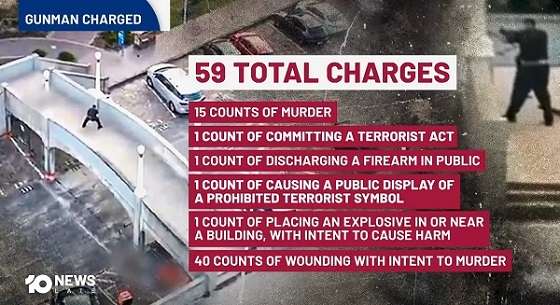

Addressing realities directly is the only path toward protecting communities, confronting extremism, and preventing further loss of life, Canadian national security expert argues.
After attacks by Islamic extremists, a familiar pattern follows. Debate erupts. Commentary and interviews flood the media. Op-eds, narratives, talking points, and competing interpretations proliferate in the immediate aftermath of bloodshed. The brief interval since the Bondi beach attack is no exception.
Many of these responses condemn the violence and call for solidarity between Muslims and non-Muslims, as well as for broader societal unity. Their core message is commendable, and I support it: extremist violence is horrific, societies must stand united, and communities most commonly targeted by Islamic extremists—Jews, Christians, non-Muslim minorities, and moderate Muslims—deserve to live in safety and be protected.
Yet many of these info-space engagements miss the mark or cater to a narrow audience of wonks. A recurring concern is that, at some point, many of these engagements suggest, infer, or outright insinuate that non-Muslims, or predominantly non-Muslim societies, are somehow expected or obligated to interpret these attacks through an Islamic or Muslim-impact lens. This framing is frequently reinforced by a familiar “not a true Muslim” narrative regarding the perpetrators, alongside warnings about the risks of Islamophobia.
These misaligned expectations collide with a number of uncomfortable but unavoidable truths. Extremist groups such as ISIS, Al-Qaeda, Hamas, Hezbollah, and decentralized attackers with no formal affiliations have repeatedly and explicitly justified their violence through interpretations of Islamic texts and Islamic history. While most Muslims reject these interpretations, it remains equally true that large, dynamic groups of Muslims worldwide do not—and that these groups are well prepared to, and regularly do, use violence to advance their version of Islam.
Islamic extremist movements do not, and did not, emerge in a vacuum. They draw from the broader Islamic context. This fact is observable, persistent, and cannot be wished or washed away, no matter how hard some may try or many may wish otherwise.
Given this reality, it follows that for most non-Muslims—many of whom do not have detailed knowledge of Islam, its internal theological debates, historical divisions, or political evolution—and for a considerable number of Muslims as well, Islamic extremist violence is perceived as connected to Islam as it manifests globally. This perception persists regardless of nuance, disclaimers, or internal distinctions within the faith and among its followers.
THE COST OF DENIAL AND DEFLECTION
Denying or deflecting from these observable connections prevents society from addressing the central issues following an Islamic extremist attack in a Western country: the fatalities and injuries, how the violence is perceived and experienced by surviving victims, how it is experienced and understood by the majority non-Muslim population, how it is interpreted by non-Muslim governments responsible for public safety, and how it is received by allied nations. Worse, refusing to confront these difficult truths—or branding legitimate concerns as Islamophobia—creates a vacuum, one readily filled by extremist voices and adversarial actors eager to poison and pollute the discussion.
Following such attacks, in addition to thinking first of the direct victims, I sympathize with my Muslim family, friends, colleagues, moderate Muslims worldwide, and Muslim victims of Islamic extremism, particularly given that anti-Muslim bigotry is a real problem they face. For Muslim victims of Islamic extremism, that bigotry constitutes a second blow they must endure. Personal sympathy, however, does not translate into an obligation to center Muslim communal concerns when they were not the targets of the attack. Nor does it impose a public obligation or override how societies can, do, or should process and respond to violence directed at them by Islamic extremists.
As it applies to the general public in Western nations, the principle is simple: there should be no expectation that non-Muslims consider Islam, inter-Islamic identity conflicts, internal theological disputes, or the broader impact on the global Muslim community, when responding to attacks carried out by Islamic extremists. That is, unless Muslims were the victims, in which case some consideration is appropriate.
Quite bluntly, non-Muslims are not required to do so and are entitled to reject and push back against any suggestion that they must or should. Pointedly, they are not Muslims, a fact far too many now seem to overlook.
The arguments presented here will be uncomfortable for many and will likely provoke polarizing discussion. Nonetheless, they articulate an important, human-centered position regarding how Islamic extremist attacks in Western nations are commonly interpreted and understood by non-Muslim majority populations.
Non-Muslims are free to give no consideration to Muslim interests at any time, particularly following an Islamic extremist attack against non-Muslims in a non-Muslim country. The sole exception is that governments retain an obligation to ensure the safety and protection of their Muslim citizens, who face real and heightened threats during these periods. This does not suggest that non-Muslims cannot consider Muslim community members; it simply affirms that they are under no obligation to do so.
The impulse for Muslims to distance moderate Muslims and Islam from extremist attacks—such as the targeting of Jews in Australia or foiled Christmas market plots in Poland and Germany—is understandable.
Muslims do so to protect their own interests, the interests of fellow Muslims, and the reputation of Islam itself. Yet this impulse frequently collapses into the “No True Scotsman” fallacy, pointing to peaceful Muslims as the baseline while asserting that the attackers were not “true Muslims.”
Such claims oversimplify the reality of Islam as it manifests globally and fail to address the legitimate political and social consequences that follow Islamic extremist attacks in predominantly non-Muslim Western societies. These deflections frequently produce unintended effects, such as strengthening anti-Muslim extremist sentiments and movements and undermining efforts to diminish them.
The central issue for public discourse after an Islamic extremist attack is not debating whether the perpetrators were “true” or “false” Muslims, nor assessing downstream impacts on Muslim communities—unless they were the targets.
It is a societal effort to understand why radical ideologies continue to emerge from varying—yet often overlapping—interpretations of Islam, how political struggles within the Muslim world contribute to these ideologies, and how non-Muslim-majority Western countries can realistically and effectively confront and mitigate threats related to Islamic extremism before the next attack occurs and more non-Muslim and Muslim lives are lost.
Addressing these realities directly is the only path toward protecting communities, confronting extremism, and preventing further loss of life.
Ian Bradbury, a global security specialist with over 25 years experience, transitioned from Defence and NatSec roles to found Terra Nova Strategic Management (2009) and 1NAEF (2014). A TEDx, UN, NATO, and Parliament speaker, he focuses on terrorism, hybrid warfare, conflict aid, stability operations, and geo-strategy.
The Bureau is a reader-supported publication.
To receive new posts and support my work, consider becoming a free or paid subscriber.
Censorship Industrial Complex
How Wikipedia Got Captured: Leftist Editors & Foreign Influence On Internet’s Biggest Source of Info

Fr0m Stossel TV
I once reported how great Wikipedia is. But now, it’s manipulated by leftists. That’s a big problem because its bad information corrupts AI and search results. Even c0-founder Larry Sanger agrees.
But that’s just the beginning of the problem because “Wikipedia’s information spreads into everything online,” says @ashleyrindsbergmedia of @NPOVmedia .
That means when your ask ChatGPT, Google, or your phone a question, it’ll likely to take leftist spin straight from Wikipedia. Wikipedia bans most right-wing news sources and suggests Donald Trump is an authoritarian fascist (but they don’t even call Fidel Castro’s successor authoritarian).
They’ve turned my Wikipedia page into a smear against me.
I explain in this video.
_ _ _ _ _ _
To make sure you receive the weekly video from Stossel TV, sign up here:
https://www.johnstossel.com/#subscrib…
_ _ _ _ _ _


Death by a thousand clicks – government censorship of Canada’s internet

Chinese Billionaire Tried To Build US-Born Baby Empire As Overseas Elites Turn To American Surrogates
Viral TikTok video shows 7-year-old cuddling great-grandfather before he’s euthanized

Politicians should be honest about environmental pros and cons of electric vehicles
-
Censorship Industrial Complex2 days ago
Death by a thousand clicks – government censorship of Canada’s internet
-
 Digital ID2 days ago
Canada releases new digital ID app for personal documents despite privacy concerns
-
 Community2 days ago
Charitable giving on the decline in Canada
-
 Alberta20 hours ago
Alberta’s huge oil sands reserves dwarf U.S. shale
-
 Bruce Dowbiggin2 days ago
NFL Ice Bowls Turn Down The Thermostat on Climate Change Hysteria
-
 Alberta23 hours ago
Canada’s New Green Deal
-
 Energy16 hours ago
Canada’s sudden rediscovery of energy ambition has been greeted with a familiar charge: hypocrisy
-
 armed forces24 hours ago
Ottawa’s Newly Released Defence Plan Crosses a Dangerous Line