
Business
My European Favourites: Český Krumlov

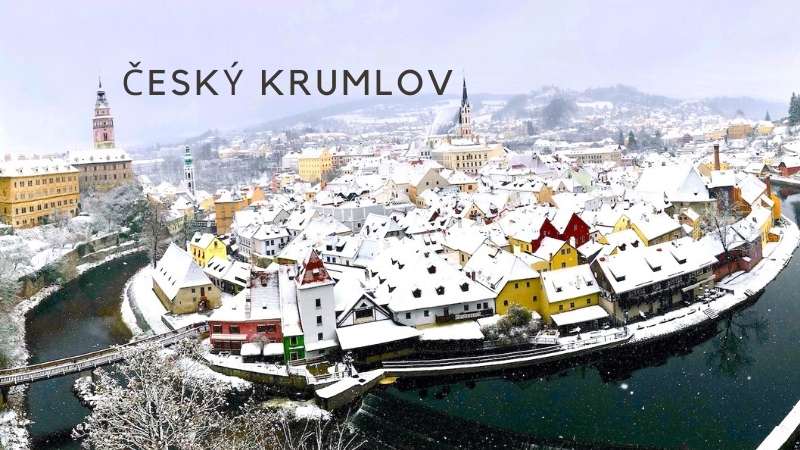

Český Krumlov is the most picturesque medieval town in the Czech Republic, and one of the best small town destinations in Central Europe. Český Krumlov is located in the South Bohemia Region of the Czech Republic about a two hour drive directly south from Prague and only thirty minutes from the nearby city of Ceske Budejovice. It is only about thirty kilometers from the Austrian border, and Linz is only an hour away. It is a natural stop from Prague to Salzburg, and we frequently stay in Ceske Budejovice, where many of our hockey groups play games or train at former NHL and Czech hockey star, Jaroslav Pouzar’s arena.
Český Krumlov’s old town, a UNESCO World Heritage Site, is nestled in between a meandering river and is surrounded by lush green hills and a towering castle above. With narrow cobblestone streets and a mixture of baroque and renaissance architecture, this could be the backdrop to any fairytale.
After we enter the town, we will park our bus across the street from a little park, called the Deer Garden, that is dwarfed by the back side of the Český Krumlov Castle. To get up to the castle, there is a path at an incline just on the right of the park or there are stairs up to the castle located at the back right of the park.
Once you reach the top, on the right you will find the eleven hectare castle garden. The garden includes a cascade fountain, an outdoor amphitheatre with a revolving auditorium, the Bellaria summer palace and the castle’s winter riding hall, which is now used to host special events.
If we go left instead of going into the park, a few steps away is a small gated entrance to a terrace that you should not miss. The terrace offers a spectacular panorama of the river, the town below, the castle on the left and the surrounding area. Your camera will be busy here and, at times, you will have numerous people jockeying for position to get that perfect shot. Please note that the terrace is not always open in the evening.

Cesky Krumlov Castle from the photo terrace and from the Lavka pod Zamkem wooden bridge.
Český Krumlov Castle
The Český Krumlov Castle dates back to 1240 when it was built by the Witigonen (Vitkovci) dynasty. In 1302, the Rosenberg dynasty became owners of the castle, and you will see their family’s five petalled rose logo at various locations throughout the city. In 1622, the castle was transferred to the Austrian Eggenberg family who expanded the castle, including adding the unique baroque theatre that bears their name. Today, the local brewery in Český Krumlov is named after the Eggenbergs. The Schwarzenberg family took over the castle from 1719 until 1947 when it was transferred to the Czechoslovak state. The castle complex, with five courtyards, is listed as a Czech National Monument and is listed on the UNESCO World Heritage List.
What would an old castle be without a good ghost story? In medieval times, the appearance of a White Lady during the day or night was an omen that someone in the family would soon die. At the Český Krumlov Castle, legend has it that the castle is haunted by their own White Lady, Perchta of Rosenberg. Her husband treated her poorly and on his death bed he asked her for forgiveness. She refused and her husband cursed her. Since her death, her ghost has haunted her former husband’s estates including the castle.

Cloak bridge, entrance into the 4th courtyard and frescoes on the courtyard walls.
When we leave the photo terrace, we cross the fifth castle courtyard surrounded by the baroque castle theatre and the renaissance house to the white and grey Cloak Bridge. The bridge, which offers more great views of the old town and river, has three stories above the arched walkway that connect the castle to the theatre.
Entering the area called the Upper Castle, we pass through two small courtyards, named the fourth and third castle courtyards. The courtyards’ facades were painted in the 16th and 17th centuries. The frescoes painted on flat walls use the “trompe–l’oeil” technique to create the optical illusion that the walls are three-dimensional brick with intricate stone decorations and inlayed statues. The “Upper Castle’s” renaissance interiors are palatial with an important collection of paintings, tapestries and furniture. The castle’s underground foundations, called the Wenceslas Cellars, are a labyrinth of pillars and arches. Exiting the third courtyard, we go down a steep and windy passage way, which may have been used for vehicles.

A sundial, the second courtyard fountain and tower. The first courtyard and the red gate.
Arriving at the second castle courtyard, we find the Burgrave’s house from 1578. The Burgrave, or “Count”, was the governor of the town, with judicial and military powers bestowed on him by the Holy Roman Emperor. From 1742-1948, the lower floor of the Burgrave’s house was used to house the Schwarzenberg grenadier guard.
The courtyard has a stone fountain from 1641 in the middle and the colorful castle tower in the corner. The tower and the adjoining “Hradek” building are the two oldest parts of the castle. If you climb the tower, you will get amazing views of the castle and the town.

The castle Bear Moat with bears enjoying bread, vegetables, apples and watermelon snacks.
To access the first courtyard, we cross a small bridge that has a Bear Moat below. There have been bears in the moat since 1707, and most times we can see them walking around or eating their vegetables and fruit. Unfortunately, we don’t always see them as they like the area under the bridge. This is the largest courtyard and was used as an agricultural area and animal enclosure. We leave the castle through the Red Gate and continue until we reach the Latrán street where we turn right. A few meters away on your left is the entrance to the Monastery.
Monastery of the Minorites
After the castle, the monastery is the second largest historic complex in Český Krumlov. The medieval monastery was founded for the brothers and sisters of the order of St. Francis of Assisi in 1350. St. Francis gave the name “Friar Minor” or “Minorites” to the Franciscans. The order of St. Clare, “Poor Claires” or the “Clarissas,” is the name of the female branch of the Franciscans. The monastery church located in the center of the complex separates the convents of the Minorites (here from 1357-1950) and Clarissas (here from 1361-1782).

The Latrán street, a Trdelník vendor and the crucifix on Lazebnicky bridge.
Latrán Street and Lazebnicky Most
The renaissance area just outside the castle and across the river from the old town center was once the home of castle servants. Today the cobble stone Latrán Street’s colorful houses are full of shops, cafes, restaurants and artist galleries. Just off the Latrán, you will find artist workshops featuring paintings, iron works, statues and furniture. Some of these artist workshops are decorated with interesting murals.
Undoubtably, you will be hit by the sweet aroma of the chimney cake or Trdelník. The Trdelník is a rolled dough which is wrapped around a thick spit, baked over hot coals and topped with sugar, walnuts and sometimes cinnamon. You can find variations of this treat throughout the Czech Republic, Slovakia and Hungary.
Connecting the Latrán street to the old town is the wooden Lazebnicky bridge with a large crucifix in the middle. Form the bridge, you have a magnificent view of the castle above, the Vltava river meandering its way around the town, and the riverfront houses and restaurant patios of the old town.

The Český Krumlov old town square with the Marian Plague column and city hall.
Historic Old Town
Once you cross the bridge, if you go forward on the Radniční street for about a hundred meters you will arrive at the Town Square. Instead, we will turn right and take the curved Dlouhá Street with interesting cafes, restaurants and hotels. At the end of the Dlouhá street, we arrive at the Široká street. Turning right we will come to the old mill where we can see the waterwheel still turning and we get another great view of the castle. We continue in the other direction leisurely making our way down the wide and vibrant Široká street until we reach a junction where three streets meet. This is a very picturesque little square with colorful buildings decorated with frescoes.
Only a few meters away from this junction, we find ourselves in the Český Krumlov town square or Náměstí Svornosti. The square has served not only as a market in medieval times, but also as a place of execution. The large white building with renaissance arcades is the 16th century Český Krumlov Town Hall. The four coats-of-arms painted on the façade of the building are those of the Eggenbergs, the Schwarzenbergs, the town and of the Czech state of Bohemia. Like many towns in the Czech Republic, the square has a Marian Plague Column with a fountain at the center. The plague columns give thanks to the Virgin Mary for the end of the plague that killed many throughout Europe in the 17th century. The beautiful buildings adorned with stucco decorations and frescoes around the square once belonged to the town’s upper class and have been restored to their original splendor.

The St. Vitus church from the river, the old town’s Široká street and the three street junction.
Church of St. Vitus
From the town square you will see the 19th century spire and tall roof of the Roman Catholic church of St. Vitus. A short climb up Horní Ulice street you will reach the church entrance. The gothic church has a white interior with an impressive vaulted ceiling supported by stone columns. The tall but clear gothic windows allow light to flood the nave and they push your eyes upwards to the magnificent ceiling. Dating back to the 13th century when the site became a place of worship, the church has undergone a few additions and changes over the years. The church is the burial place of notable Bohemian families including generations of the aforementioned Rosenbergs and Schwartzenbergs.
Not far from the church is a little garden called the Seminární Zahrada, or the Seminary Garden. The garden is part of the Regional Museum, which used to be a seminary for the Jesuits. Like the terrace by the castle, this garden is one of the best spots in town to get that spectacular panoramic photo. The castle and tower are prominent in the background, seemingly rising above a sea of the red tiled roofs below.

Panoramic view from the Seminary Garden and buskers on the Latrán Street.
Rafting on the Vltava
As you leave the old town back to the parking area, you will cross the Lavka pod Zamkem wooden bridge which leads to the Deer Garden. The bridge offers a few more photo opportunities of the river, the castle and the Cloak Bridge. One of the most interesting things to see from the bridge is the wier on the Vltava River that has a spot on the right for rafters to slide down from the higher water level to the lower level. Rafting is very popular, and in summer months you will see raft after raft leisurely floating down the river. The Malecek Rafting company offers canoe and raft rentals with trips of various durations from a thirty-minute trip in the city center all the way to half-day and full-day trips further down the river. They also offer a fifty-minute historical cruise on a twelve-person wooden raft. In the middle ages and beyond raftsmen used the Vltava to transport goods and raw materials like wood and salt. Today, people can enjoy this experience in amazing surroundings.

Rafters and canoers going down the Vltava Rivers’ weir and leisurely past the castle.
Český Krumlov has many small museums worth visiting. My favourite is the Museum of Commerce (Muzeum Obchodu) located in the old town just as you cross the Lazebnicky bridge. The museum has recreated shop interiors, shop machinery and advertising from the early 1900s. Individual packaging of products, like we are used to today, was non-existent. They have a great display of metal dispensary containers where customers would get their coffee beans, sugar, flour or other goods. They also have old style metallic advertising signs for sale. Across from that museum, there is an antique shop with very unique items and next door is the Fairytale House & Puppet Museum.
Other museums you may want to visit in Český Krumlov include the Museum Fotoatelier Seidel, the Egon Schiele Art Centrum, the Moldavite Museum (Muzeum Vltavinu), the Regional Museum and the Torture Museum. There are many other little museums around town worth visiting. Nearby, hikers enjoy climbing the 1,084 meter high Mount Klet’ and guided tours of the Graphite Mine.
Český Krumlov is the second most popular tourist destination in the Czech Republic. I have been to this medieval town numerous times with my tour groups and I am always excited to include it in my itineraries.

Explore Europe With Us
Azorcan Global Sport, School and Sightseeing Tours have taken thousands to Europe on their custom group tours since 1994. Visit azorcan.net to see all our custom tour possibilities for your group of 26 or more. Individuals can join our “open” signature sport, sightseeing and sport fan tours including our popular Canada hockey fan tours to the World Juniors. At azorcan.net/media you can read our newsletters and listen to our podcasts.
Images compliments of Paul Almeida and Azorcan Tours.
(This article was originally published on April 11, 2021).
Click below to read Paul’s sobering story about Canada’s role in WWI.




We’ve all seen the headlines — such as the below — loudly proclaiming that due to climate change the insurance industry is in crisis, and even that total economic collapse may soon follow. For instance, since 2019, the New York Times, one of the primary champions of this narrative, has published more than 1,250 articles on climate change and insurance.
 |
Climate advocates have embraced the idea of a climate-fueled insurance crisis as it neatly ties together the hyping of extreme weather and alleged financial consequences for ordinary people. The oft-cited remedy to the claimed crisis is, of course, to be found in energy policy: “The only long-term solution to preserve an insurable future is to transition from fossil fuels and other greenhouse-gas-emitting industries.”
However, it is not just climate advocates promoting the notion that climate change is fundamentally threatening the insurance industry. A climate-risk industrial complex has emerged in this space and a lot of money is being made by a lot of people. The virtuous veneer of climate advocacy serves to discourage scrutiny and accountability.
In this series, I take a deep dive into the “crisis,” its origins, its politics, and its tenuous relationship with actual climate science.¹ Today, I kick things off by sharing three fundamental, and perhaps surprising, facts that go a long way to explaining why insurance prices have increased and who benefits:
- Property/casualty insurance is raking in record profits;
- Insurance underwriting returns vary year-to-year but show no trend;
- “Climate” risk assessments are unreliable and a cause of higher insurance prices.
Grab a cup of coffee, settle in, and let’s go . . .
If you value the deep dives such as this one, which you will find no where else,
please consider supporting THB with a paid subscription!
Property/casualty insurance is raking in record profits
This year is shaping up to be an extremely profitable year for the property/casualty (P/C) insurance industry. In a report covering the first six months of 2025, the National Association of Insurance Commissioners (NAIC) shares the good news (emphasis added):
Despite heavy catastrophe losses, including the costliest wildfires on record, the U.S. Property & Casualty (P&C) industry recorded its best mid-year underwriting gain in nearly 20 years.
In the second half of 2025, returns got even better for the P/C industry. According to a new report from S&P Global Intelligence, as reported by Carrier Management (emphases added):
For U.S. P/C insurers, it just doesn’t get any better than this. . . With a combined ratio of 89.1 for third-quarter 2025, the U.S. property/casualty insurance industry had its best quarter in at least a quarter of a century—and maybe longer, S&P Market Intelligence said.
Taking a longer view, the extremely profitable 2025 follows significant industry profitability in 2023 and 2024, according to the National Association of Insurance Commissioners (NAIC), as shown in the figure below.
 |
What accounts for the high profits?
The NAIC explains:
Strong premium growth, driven largely by rate increases, coupled with abating economic inflation . . . Net income nearly doubled compared to last year, attributed to the underwriting profit and healthy investment returns.
Below, I’ll pick up the issue of rate increases and explore one big reason why they have occurred.
If there is a P/C insurance crisis, it may be in figuring out how to explain its impressive returns at the same time that the climate lobby is telling everyone that the industry is collapsing.
Insurance underwriting returns vary year-to-year but show no trend
The P/C industry makes money primarily in two ways — underwriting of insurance policies and investment income. Typically, insurance companies seek to break even, or lose little, on insurance underwriting and earn profits on investment income.
Warren Buffet, in his 2009 letter to Berkshire Hathaway shareholders, explained concisely how the P/C industry works:
Our property-casualty (P/C) insurance business has been the engine behind Berkshire’s growth and will continue to be. It has worked wonders for us. We carry our P/C companies on our books at $15.5 billion more than their net tangible assets, an amount lodged in our “Goodwill” account. These companies, however, are worth far more than their carrying value– and the following look at the economic model of the P/C industry will tell you why.
Insurers receive premiums upfront and pay claims later. In extreme cases, such as those arising from certain workers’ compensation accidents, payments can stretch over decades. This collect-now, pay-later model leaves us holding large sums– money we call “float”– that will eventually go to others. Meanwhile, we get to invest this float for Berkshire’s benefit. Though individual policies and claims come and go, the amount of float we hold remains remarkably stable in relation to premium volume. Consequently, as our business grows, so does our float.
If premiums exceed the total of expenses and eventual losses, we register an underwriting profit that adds to the investment income produced from the float. This combination allows us to enjoy the use of free money– and, better yet, get paid for holding it. Alas, the hope of this happy result attracts intense competition, so vigorous in most years as to cause the P/C industry as a whole to operate at a significant underwriting loss. This loss, in effect, is what the industry pays to hold its float. Usually this cost is fairly low, but in some catastrophe-ridden years the cost from underwriting losses more than eats up the income derived from use of float.
The figure below, using data from the Insurance Information Institute, shows the underwriting performance of the P/C industry from 2004 to 2024.

The time series shows lots of ups and downs, but no trend — by design, as Buffet explained. There are certainly no signs of an underwriting crisis, much less indications of a coming collapse. The P/C industry looks both well-managed and healthy.
“Climate” risk assessments are unreliable and a cause of higher insurance prices
 |
If profits are high and underwriting is steady, then what then accounts for increasing insurance prices — which, as of the end of 2024, increased 29 consecutive quarters in a row (above)?
A big part of the answer is Climate Change. But not how you might think.
A decade ago, Mark Carney — then Governor of the Bank of England and today Prime Minister of Canada — gave an influential speech titled, Breaking the Tragedy of the Horizon – climate change and financial stability.
Carney argued that the insurance industry was at risk due to changes in the climatology of extreme events that were not properly understood by experts in the industry:
[T]here are some estimates that currently modelled losses could be undervalued by as much as 50% if recent weather trends were to prove representative of the new normal. . . Such developments have the potential to shift the balance between premiums and claims significantly, and render currently lucrative business non-viable.
Coincident with Carney’s 2015 speech, the Bank of England released a report on the impacts of climate change on the insurance industry, and noted that conventional catastrophe modeling did not effectively consider a changing climate. The Bank of England kicked off a longstanding campaign to convince people that extreme weather events were changing dramatically in the near term.
Subsequently, in 2019, the Bank of England required firms to assess their “climate risks.” This guidance was updated last week. In (a coordinated) parallel effort, national and international organizations focused on “climate risk” to the financial sector started multiplying — such as the Climate Financial Risk Forum and the Network for Greening the Financial System.
The climate-risk industry was born circa 2019.
There is an incredible story to be told here (and Jessica Weinkle is the go-to expert), but for today, the key takeaways are that (a) the notion of “climate risk” to finance, including insurance, led to the creation of a “climate risk” industry, and (b) within this industry, a new family of risk assessment vendors emerged, promising to satisfy the new demands for climate risk disclosure and risk modeling.
The Global Association of Risk Professionals (GARP) explains:
As this [“climate risk”] was a new discipline for most financial firms, many turned to third party providers (“vendors”) to help them with different areas of expertise. There are now many physical risk data vendors, which offer a variety of services to financial institutions. While vendor offerings often sound alike — providing projections of how physical risk could evolve for locations across a range of risks and climate scenarios — they can differ significantly in terms of features, approach, or suitability for specific needs, and the underlying models that these providers use differ in methodology and assumptions.
GARP just published an incredibly important study that assessed how 13 different “climate risk” vendors modeled physical risk and risk of loss across 100 individual structures around the world.²
The results are shocking — given how they are used in industry, but should not be surprising — given what we know about modeling.
There is absolutely no consensus across vendors about “climate risk” in terms of either physical risks or risks of loss.
The figure below shows, for 100 different properties around the world, the differences in modeled 200-year flood risk across the 13 vendors, as refelcted in modeled flood heights. The maximum difference among the properties across vendors is about 12 meters and the median difference is about 2.7 meters — These are huge differences.
 |
In terms of risk of loss, the models have an even greater spread. The figure below shows that for a modeled 200-year flood, 10 properties are modeled by at least one vendor to have total losses (100%) while another vendor models the same properties to have no losses, under the exact same event. The median difference between minimum and maximum modeled loss ratio is 30% — Another huge number.³
 |
Insurance pricing does not scale linearly with increasing modeled loss ratios. Consider that the difference between a modeled 10% loss ratio and a 40% loss ratio (i.e., the 30% median difference across vendors from above) might result in a 10x increase in insurance rates. Risk adverse insurers have incentives to price at the most extreme modeled loss.
Model inaccuracies, unceratinties, spread, and ambiguity are feature not flaws when it comes to making money. “Climate risk” modeling has resulted in a financial windfall not just for the newly created climate analytics industry, but also for insurers and reinsurers who have seen the envelope of modeled losses expand. The need for new models, of questionabl fidelity, are necessary to satisfy industry guidance and government regulators.
The net result has been a seemingly scientific justification for increasing insurance rates.⁴
There are of course real changes in physical risk, exposure, and vulnerability as well as the regulatory and political contexts within which the P/C industry must operate. The discipline of catastrophe modeling has long integrated these factors to assess risks. As insurance policies and reinsurance contracts are typically implemented on a one-year basis, and this well-positioned to incorporate changng perceptions of risk, this series will explore why a new “climate risk” assessment industry was even needed in the first place.
What about that “climate risk”? THB readers will be very familiar with the science of extreme events and climate change, which, as reported here, happens to be consistent with both the Intergovernmental Panel on Climate Change and those in the legacy catastrophe modeling community.
One of those modeling firms, Verisk, gets the last word for today:
We estimate about 1% of year-on-year increases in AAL [Average Annual Loss] are attributable to climate change. Such small shifts can easily get lost behind other sources of systematic loss increase discussed in this report, such as inflation and exposure growth. The random volatility from internal climate variability also dwarfs the small positive climate change signal.
Before you go — If you learned something from this post, please click that “ Like” button — More likes mean that THB rises in the Substack algorithm and gets in front of more readers. More readers mean that THB reaches more people in more places, broadening understandings and discussions of complex issues where science meets politics. Thanks!
Comments, questions, discussion, critique — all welcome!
If you value THB please consider subscribing. Paid subscribers make THB go and also have access to THB Pro, with PDFs of some of my books, THB Insider, Five Figures, and paywalled THB posts. Plus you get to participate in the lively, diverse, and informed discussions under every post. Thank you!
Subscribe to The Honest Broker.
For the full experience, upgrade your subscription.

““He knows nothing; and he thinks he knows everything. That points clearly to a political career.” George Bernard Shaw
In the days immediately following Donald Trump’s rude intervention into the 2025 Canadian federal election— suggesting Canada might best choose American statehood— two schools of thought emerged.
The first and most impactful school in the short term was the fainting-goat response of Canadian’s elites. Sensing an opening in which to erode Pierre Poilievre’s massive lead in the 2024 polls over Justin Trudeau, the Laurentian elite concocted Elbows Up, a self-pity response long on hurt feelings and short on addressing the issues Trump had cited in his trashing of the Canadian nation state.
In short order they fired Trudeau into oblivion, imported career banker Mark Carney as their new leader in a sham convention and convinced Canada’s Boomers that Trump had the tanks ready to go into Saskatchewan at a moment’s notice. The Elbows Up meme— citing Gordie Howe— clinched the group pout.

(In fact, Trump has said that America is the world’s greatest market, and if those who’ve used it for free in the past [Canada] want to keep special access they need to pay tariffs to the U.S. or drop protectionist charges on dairy and more against the U.S.)
The ruse worked out better than they could have ever imagined with Trump even saying he preferred to negotiate with Carney over Poilievre. In short order the Tories were shoved aside, the NDP kneecapped and the pet media anointed Carney the genius skewing Canada away from its largest trade partner to the Eurosphere. We remain in that bubble, although the fulsome promises of Carney’s first days are now coming due.
Which brings us to the second reaction. That was Alberta premier Danielle Smith bolting to Mar A Lago in the days following Trump’s comments. Her goal was to put pride aside and accept that a new world order was in play for Canada. She met with U.S. officials and, briefly, with Trump to remind them that Canada’s energy industry was integral to American prosperity and Canadian stability.
Needless to say, the fainting goats pitched a fit that not everyone was clutching pearls and rending garments in the wake of Trump’s dismissive assessment of his northern neighbours. Their solution to Trump was to join China in retaliatory tariffs— the only two nations to do so— and to boycott American products and travel. Like the ascetic monks they cut themselves off from real life. Trump has yet to get back to Carney the Magnificent

And Smith? She was a “traitor” or a “subversive” who should be keel hauled in the North Saskatchewan. For much of the intervening months she has been attacked at home in Alberta by the N-Deeps and in Ottawa by just about everyone on CBC, CTV, Global and the Globe & Mail. “How could she meet with the Cheeto?”
Nonetheless conservatives in the province moved toward a more independence within Canada. Smith articulated her demands for Alberta to prevent a referendum on whether to remain within Confederation. At the top of her list were pipelines and access to tidewater. Ergo, a no-go for BC’s squish premier David Eby who is the process of handing over his province to First Nations.
It became obvious that for all of Carney’s alleged diplomacy in Europe and Asia (is the man ever home?) he had a brewing disaster in the West with Alberta and Saskatchewan growing restless. In a striking move against the status quo, Nutrien announced it would ship its potash to tidewater via the U.S., thereby bypassing Vancouver’s strike-prone, outdated port and denying them billions.

Suddenly, Smith’s business approach began making eminent good sense if the goal is to keep Canada as one. So we saw last week’s “memorandum of understanding” between Alberta and Ottawa trading off carbon capture and carbon taxes for potential pipelines to tidewater on the B.C. coast. A little bit of something for everyone and a surrender on other things.
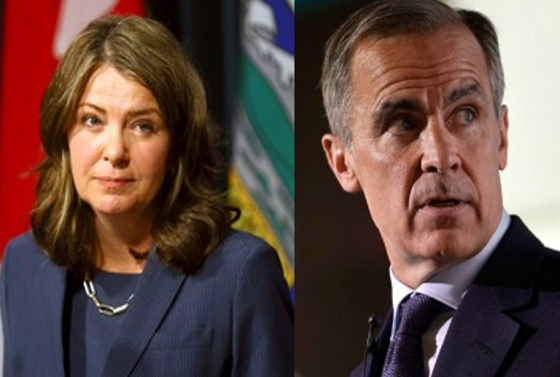
The most amazing feature of the Mark Carney/Danielle Smith MOU is that both politicians probably need the deal to fail. Carney can tell fossil-fuel enemy Quebec that he tried to reason with Smith, and Smith can say she tried to meet the federalists halfway. Failure suits their larger purposes. Which is for Carney to fold Canada into Euro climate insanity and Smith into a strong leverage against the pro-Canada petitioners in her province.
Soon enough, at the AFN Special Chiefs Assembly, FN Chief Cindy Woodhouse Nepinak told Carney that “Turtle Island” (the FN term for North America popularized by white hippy poet Gary Snyder) belongs to the FN people “from coast to coast to coast.” The pusillanimous Eby quickly piped up about tanker bans and the sanctity of B.C. waters etc.
Others pointed out the massive flaw in a plan to attract private interests to build a vital bitumen pipeline if the tankers it fills are not allowed to sail through the Dixon Entrance to get to Asia.
But then Eby got Nutrien’s message that his power-sharing with the indigenous might cause other provinces to bypass B.C. (imagine California telling Texas it can’t ship through its ports over moral objections to a product). He’s now saying he’s open to pipelines but not to lift the tanker ban along the coast. Whatever.
Meanwhile the kookaburras of isolation back east continue with virtue signalling on American booze— N.S. to sell off its remains stocks — while dreaming that Trump’s departure will lead to the good-old days of reliance on America’s generosity.
But Smith looks to be wining the race. B.C.’s population shrank 0.04 percent in the second quarter of 2025, the only jurisdiction in Canada to do so. Meanwhile, Alberta is heading toward five million people, with interprovincial migrants making up 21 percent of its growth.
But what did you expect from the Carney/ Eby Tantrum Tandem? They keep selling fear in place of GDP. As GBS observed, “You have learnt something. That always feels at first as if you have lost something.”
Bruce Dowbiggin @dowbboy is the editor of Not The Public Broadcaster A two-time winner of the Gemini Award as Canada’s top television sports broadcaster, his new book Deal With It: The Trades That Stunned The NHL And Changed hockey is now available on Amazon. Inexact Science: The Six Most Compelling Draft Years In NHL History, his previous book with his son Evan, was voted the seventh-best professional hockey book of all time by bookauthority.org . His 2004 book Money Players was voted sixth best on the same list, and is available via brucedowbigginbooks.ca.

Media bound to pay the price for selling their freedom to (selectively) offend

Sometimes An Ingrate Nation Pt. 2: The Great One Makes His Choice

Recent price declines don’t solve Toronto’s housing affordability crisis
From Exception to Routine. Why Canada’s State-Assisted Suicide Regime Demands a Human-Rights Review
-
 Business2 days ago
Carney government should privatize airports—then open airline industry to competition
-
 Business2 days ago
What’s Going On With Global Affairs Canada and Their $392 Million Spending Trip to Brazil?
-
 Energy2 days ago
Canada following Europe’s stumble by ignoring energy reality
-
Bruce Dowbiggin16 hours ago
Integration Or Indignation: Whose Strategy Worked Best Against Trump?
-
 COVID-1917 hours ago
University of Colorado will pay $10 million to staff, students for trying to force them to take COVID shots
-
 Banks2 days ago
To increase competition in Canadian banking, mandate and mindset of bank regulators must change
-
 Business2 days ago
Loblaws Owes Canadians Up to $500 Million in “Secret” Bread Cash
-
 Focal Points1 day ago
Common Vaccines Linked to 38-50% Increased Risk of Dementia and Alzheimer’s