
Alberta
History of Red Deer’s Second Courthouse

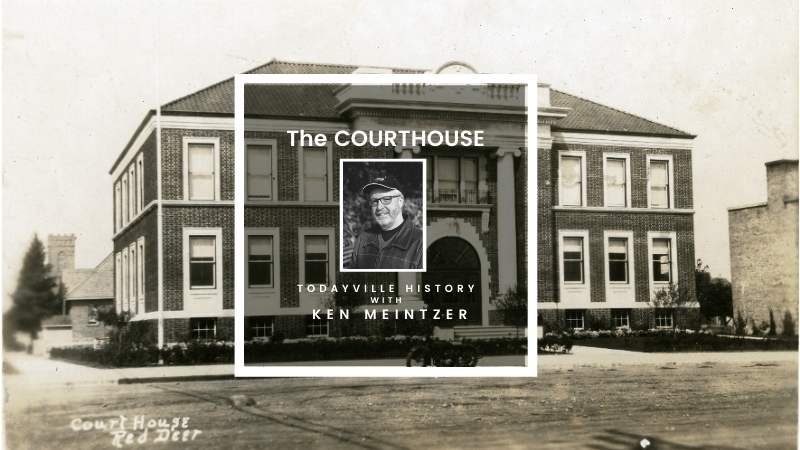
 It has been witness to a great many events and stories in the 90 years it has stood on the corner of Ross Street and 49th Avenue in Red Deer.

The Gaetz Company building as seen in 1912. It was the courthouse for the region from 1916-1931. It is the current site of Mason Martin Homes. Canada’s first female juror served in this courthouse in 1922. Photo courtesy City of Red Deer Archives photo.
As the solidly constructed anchor for both provincial and the Court of Queens Bench for 52 years, this sturdy structure has also been a sanctuary for artists, the setting for movie productions and most recently home to numerous professional offices. It also was the backdrop for the last murder trial in Alberta which saw the defendant sentenced and hanged under capital punishment in the province.

Construction of the new courthouse well underway. City of Red Deer Archives photo P2610
This readily recognizable icon celebrated the anniversary of its official opening earlier this month and is showing no signs of retiring any time soon.

View of the Lyndall Limestone columns in the Palladian Style entrance. Photo by Duane Rolheiser.
This was the second courthouse for the steadily expanding central Alberta city. The earlier one had opened in 1916 after having been converted from a coverall factory. Talk about being adaptive and creative!
Construction of the “new” courthouse was significant for many reasons. The Great Depression was in full swing so this project provided a much-needed injection of both money and jobs into the community along with a sense of pride that such a fine building would bring to the region.

Brick exterior with Lyndall Limestone detailing. Photo by Duane Rolheiser
This would be the last courthouse built in the province until the 1950s, the final version of a series of Alberta courthouses built in the classical revival style. Both Wetaskiwin and Medicine Hat received similar structures during this era.
Testament to the quality of the design and materials used in construction of the building is the fact that it remains steadfast after more than 8 decades of use.
Constructed using hot riveted steel beams, brick and mortar, then graced with pillars shaped from the legendary Lyndall Limestone from Manitoba, this grand historical resource will stand for a great many more years to come.

Original 1912 era boiler. Converted from coal to natural gas.
Photo by Duane Rolheiser.
In the spirit of the type of practicality and resourcefulness often seen during the depression, heating for the building would be provided by a boiler built in 1912 and repurposed from a ship!
It was converted from coal burning to natural gas in 1949 and has since been replaced by modern, efficient boilers yet it still remains in the building as evidence of a different era.
Every building of a certain vintage usually carries a story or two about otherworldly spirits or energies. Why not the old Courthouse? It was thought that the ghost of Robert Raymond Cook inhabited the building.
On one particular evening, the caretaker for the courthouse was heading into the boiler room to grab some tools. When he flicked on the lights, they popped briefly and went dark. Despite this, the caretaker walked alongside the boiler in the direction of his tools when suddenly he was slapped in the face by an unexpected soft force! Was it the apparition of the hanged murderer?
When he had regained his composure a time later, the caretaker investigated the boiler room once more to discover the source of the slap in the dark. A frightened pigeon had flown up in his face when startled in the boiler room!

Judge bench in the original courtroom. Photo by Duane Rolheiser
This magnificent building was the home of the judicial branch of the province for the Red Deer region from 1931 to 1983 when its replacement was constructed just down Ross Street to the east.

A law office has made good use of the original architecture. Photo by Duane Rolheiser.
The courthouse was the venue for a great many legal tales over the years but probably none more famous than the 1959 murder trial for 21 year old Robert Raymond Cook of Stettler, AB who was accused of murdering all 7 members of his family in a most violent manner.

RCMP mugshot of Robert Raymond Cook, 1959. Photo used with permission by Legal Archives Society of Alberta.
His trial began on November 30th, 1959 and Cook was found guilty and sentenced to hang for his crimes. His defense appealed the conviction and a second trial was held in Edmonton but his conviction was upheld on June 20th, 1960.
On November 14, 1960, Robert Raymond Cook was hanged. His death sentence was the last ever carried out in the province of Alberta.

the actual witness bench where Robert Raymond Cook would have sat Photos by Duane Rolheiser.
Numerous books were written about this trial as the murders captivated and horrified the population who followed the course of the investigation and trials.
Even a dramatic play was created, called “The End of the Rope”, reenacting this historic trial which was developed and was even staged in the actual courtroom where the all too real drama actually took place all those years ago.

exterior of the courthouse while it was home to the Community Arts Centre in the 1980s. Photo courtesy Red Deer Archives.
In 1983, the building was sold to the city of Red Deer for a dollar and turned into the Old Courthouse Community Arts Centre. The grand structure housed painters and potters among numerous artistic pursuits for 18 years

An artist displaying his works during a Christmas arts fair in the courthouse, 1987. Photos courtesy City of Red Deer Archives.
The old courthouse has seen real life dramas and reenactments of legal dramas including being the location for filming scenes from the TV Movie, “While Justice Sleeps” starring Cybil Shepherd in 1994.
Even a dramatic one-man play was created by Aaron Coates called “The End of the Rope” in 2003, re-enacting this historic trial. It was developed and staged in the actual courtroom where the all too real drama actually took place all those years ago. Cook’s lawyer, David MacNaughton even answered questions from the crowd after the performance.

Promotional ad for the TV movie “While Justice Sleeps” starring Cybil Shepherd. Photo from IMDB
The old courthouse made its most recent transformation in 2001 when it was purchased by Jim Dixon and Dick McDonell.

Interior details.
Photos by Duane Rolheiser.
The new owners invested close to a quarter of a million dollars in upgrading the building including installation of new boilers, restored doors, energy efficient windows and new flooring throughout. 1930s era lighting was sourced to replace fluorescent fixtures, giving the rejuvenated structure a proper historical feel.


Today this 90-year-old icon of downtown Red Deer proudly carries on as the home to numerous professional organizations from lawyers to architects and with its new owners and numerous upgrades, this beautiful structure should be proudly welcoming people to downtown for a great many more years to come.
Red Deer’s old courthouse sits as the centrepiece of Red Deer’s historic downtown and is celebrating its 90th birthday. Come spend some time downtown. Visit the city’s unique Ghost Collection, many of which are within a few blocks of the Old Courthouse. For more information on leasing opportunities in this beautiful building, please email Davin Kemshead or phone 403-318-6479.


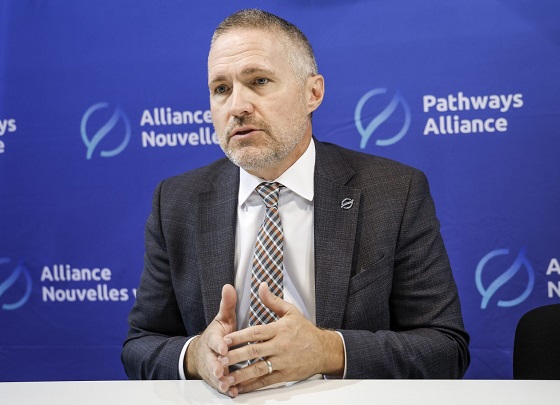
Pathways Alliance CEO Kendall Dilling is interviewed at the World Petroleum Congress in Calgary, Monday, Sept. 18, 2023.THE CANADIAN PRESS/Jeff McIntosh
From Resource Works
Carbon capture gives biggest bang for carbon tax buck CCS much cheaper than fuel switching: report
Canada’s climate change strategy is now joined at the hip to a pipeline. Two pipelines, actually — one for oil, one for carbon dioxide.
The MOU signed between Ottawa and Alberta two weeks ago ties a new oil pipeline to the Pathways Alliance, which includes what has been billed as the largest carbon capture proposal in the world.
One cannot proceed without the other. It’s quite possible neither will proceed.
The timing for multi-billion dollar carbon capture projects in general may be off, given the retreat we are now seeing from industry and government on decarbonization, especially in the U.S., our biggest energy customer and competitor.
But if the public, industry and our governments still think getting Canada’s GHG emissions down is a priority, decarbonizing Alberta oil, gas and heavy industry through CCS promises to be the most cost-effective technology approach.
New modelling by Clean Prosperity, a climate policy organization, finds large-scale carbon capture gets the biggest bang for the carbon tax buck.
Which makes sense. If oil and gas production in Alberta is Canada’s single largest emitter of CO2 and methane, it stands to reason that methane abatement and sequestering CO2 from oil and gas production is where the biggest gains are to be had.
A number of CCS projects are already in operation in Alberta, including Shell’s Quest project, which captures about 1 million tonnes of CO2 annually from the Scotford upgrader.
What is CO2 worth?
Clean Prosperity estimates industrial carbon pricing of $130 to $150 per tonne in Alberta and CCS could result in $90 billion in investment and 70 megatons (MT) annually of GHG abatement or sequestration. The lion’s share of that would come from CCS.
To put that in perspective, 70 MT is 10% of Canada’s total GHG emissions (694 MT).
The report cautions that these estimates are “hypothetical” and gives no timelines.
All of the main policy tools recommended by Clean Prosperity to achieve these GHG reductions are contained in the Ottawa-Alberta MOU.
One important policy in the MOU includes enhanced oil recovery (EOR), in which CO2 is injected into older conventional oil wells to increase output. While this increases oil production, it also sequesters large amounts of CO2.
Under Trudeau era policies, EOR was excluded from federal CCS tax credits. The MOU extends credits and other incentives to EOR, which improves the value proposition for carbon capture.
Under the MOU, Alberta agrees to raise its industrial carbon pricing from the current $95 per tonne to a minimum of $130 per tonne under its TIER system (Technology Innovation and Emission Reduction).
The biggest bang for the buck
Using a price of $130 to $150 per tonne, Clean Prosperity looked at two main pathways to GHG reductions: fuel switching in the power sector and CCS.
Fuel switching would involve replacing natural gas power generation with renewables, nuclear power, renewable natural gas or hydrogen.
“We calculated that fuel switching is more expensive,” Brendan Frank, director of policy and strategy for Clean Prosperity, told me.
Achieving the same GHG reductions through fuel switching would require industrial carbon prices of $300 to $1,000 per tonne, Frank said.
Clean Prosperity looked at five big sectoral emitters: oil and gas extraction, chemical manufacturing, pipeline transportation, petroleum refining, and cement manufacturing.
“We find that CCUS represents the largest opportunity for meaningful, cost-effective emissions reductions across five sectors,” the report states.

Fuel switching requires higher carbon prices than CCUS.
Measures like energy efficiency and methane abatement are included in Clean Prosperity’s calculations, but again CCS takes the biggest bite out of Alberta’s GHGs.
“Efficiency and (methane) abatement are a portion of it, but it’s a fairly small slice,” Frank said. “The overwhelming majority of it is in carbon capture.”

From left, Alberta Minister of Energy Marg McCuaig-Boyd, Shell Canada President Lorraine Mitchelmore, CEO of Royal Dutch Shell Ben van Beurden, Marathon Oil Executive Brian Maynard, Shell ER Manager, Stephen Velthuizen, and British High Commissioner to Canada Howard Drake open the valve to the Quest carbon capture and storage facility in Fort Saskatchewan Alta, on Friday November 6, 2015. Quest is designed to capture and safely store more than one million tonnes of CO2 each year an equivalent to the emissions from about 250,000 cars. THE CANADIAN PRESS/Jason Franson
Credit where credit is due
Setting an industrial carbon price is one thing. Putting it into effect through a workable carbon credit market is another.
“A high headline price is meaningless without higher credit prices,” the report states.
“TIER credit prices have declined steadily since 2023 and traded below $20 per tonne as of November 2025. With credit prices this low, the $95 per tonne headline price has a negligible effect on investment decisions and carbon markets will not drive CCUS deployment or fuel switching.”
Clean Prosperity recommends a kind of government-backstopped insurance mechanism guaranteeing carbon credit prices, which could otherwise be vulnerable to political and market vagaries.
Specifically, it recommends carbon contracts for difference (CCfD).
“A straight-forward way to think about it is insurance,” Frank explains.
Carbon credit prices are vulnerable to risks, including “stroke-of-pen risks,” in which governments change or cancel price schedules. There are also market risks.
CCfDs are contractual agreements between the private sector and government that guarantees a specific credit value over a specified time period.
“The private actor basically has insurance that the credits they’ll generate, as a result of making whatever low-carbon investment they’re after, will get a certain amount of revenue,” Frank said. “That certainty is enough to, in our view, unlock a lot of these projects.”
From the perspective of Canadian CCS equipment manufacturers like Vancouver’s Svante, there is one policy piece still missing from the MOU: eligibility for the Clean Technology Manufacturing (CTM) Investment tax credit.
“Carbon capture was left out of that,” said Svante co-founder Brett Henkel said.
Svante recently built a major manufacturing plant in Burnaby for its carbon capture filters and machines, with many of its prospective customers expected to be in the U.S.
The $20 billion Pathways project could be a huge boon for Canadian companies like Svante and Calgary’s Entropy. But there is fear Canadian CCS equipment manufacturers could be shut out of the project.
“If the oil sands companies put out for a bid all this equipment that’s needed, it is highly likely that a lot of that equipment is sourced outside of Canada, because the support for Canadian manufacturing is not there,” Henkel said.
Henkel hopes to see CCS manufacturing added to the eligibility for the CTM investment tax credit.
“To really build this eco-system in Canada and to support the Pathways Alliance project, we need that amendment to happen.”
Resource Works News

From the Fraser Institute
By Tegan Hill
Last Friday, less than a week before Christmas, the Smith government quietly released the final report from its Alberta Next Panel, which assessed Alberta’s role in Canada. Among other things, the panel recommends that the federal government transfer some of its tax revenue to provincial governments so they can assume more control over the delivery of provincial services. Based on Canada’s experience in the 1990s, this plan could deliver real benefits for Albertans and all Canadians.
Federations such as Canada typically work best when governments stick to their constitutional lanes. Indeed, one of the benefits of being a federalist country is that different levels of government assume responsibility for programs they’re best suited to deliver. For example, it’s logical that the federal government handle national defence, while provincial governments are typically best positioned to understand and address the unique health-care and education needs of their citizens.
But there’s currently a mismatch between the share of taxes the provinces collect and the cost of delivering provincial responsibilities (e.g. health care, education, childcare, and social services). As such, Ottawa uses transfers—including the Canada Health Transfer (CHT)—to financially support the provinces in their areas of responsibility. But these funds come with conditions.
Consider health care. To receive CHT payments from Ottawa, provinces must abide by the Canada Health Act, which effectively prevents the provinces from experimenting with new ways of delivering and financing health care—including policies that are successful in other universal health-care countries. Given Canada’s health-care system is one of the developed world’s most expensive universal systems, yet Canadians face some of the longest wait times for physicians and worst access to medical technology (e.g. MRIs) and hospital beds, these restrictions limit badly needed innovation and hurt patients.
To give the provinces more flexibility, the Alberta Next Panel suggests the federal government shift tax points (and transfer GST) to the provinces to better align provincial revenues with provincial responsibilities while eliminating “strings” attached to such federal transfers. In other words, Ottawa would transfer a portion of its tax revenues from the federal income tax and federal sales tax to the provincial government so they have funds to experiment with what works best for their citizens, without conditions on how that money can be used.
According to the Alberta Next Panel poll, at least in Alberta, a majority of citizens support this type of provincial autonomy in delivering provincial programs—and again, it’s paid off before.
In the 1990s, amid a fiscal crisis (greater in scale, but not dissimilar to the one Ottawa faces today), the federal government reduced welfare and social assistance transfers to the provinces while simultaneously removing most of the “strings” attached to these dollars. These reforms allowed the provinces to introduce work incentives, for example, which would have previously triggered a reduction in federal transfers. The change to federal transfers sparked a wave of reforms as the provinces experimented with new ways to improve their welfare programs, and ultimately led to significant innovation that reduced welfare dependency from a high of 3.1 million in 1994 to a low of 1.6 million in 2008, while also reducing government spending on social assistance.
The Smith government’s Alberta Next Panel wants the federal government to transfer some of its tax revenues to the provinces and reduce restrictions on provincial program delivery. As Canada’s experience in the 1990s shows, this could spur real innovation that ultimately improves services for Albertans and all Canadians.

Tegan Hill
Director, Alberta Policy, Fraser Institute

Why is Canada paying for dairy ‘losses’ during a boom?

Ottawa’s Newly Released Defence Plan Crosses a Dangerous Line

Hunting Poilievre Covers For Upcoming Demographic Collapse After Boomers

Carney Floor Crossing Raises Counterintelligence Questions aimed at China, Former Senior Mountie Argues
-
 International16 hours ago
Ottawa is still dodging the China interference threat
-
 Business14 hours ago
There’s No Bias at CBC News, You Say? Well, OK…
-
 Automotive13 hours ago
Canada’s EV gamble is starting to backfire
-
 International15 hours ago
2025: The Year The Narrative Changed
-
 Fraser Institute1 day ago
Carney government sowing seeds for corruption in Ottawa
-
 Business1 day ago
Residents in economically free states reap the rewards
-
 Daily Caller1 day ago
While Western Nations Cling to Energy Transition, Pragmatic Nations Produce Energy and Wealth
-
Alberta1 day ago
Alberta Next Panel calls for less Ottawa—and it could pay off