
Business
Business Spotlight – Calgary Entrepreneurs Bring The Gig Economy To Alberta


Gig work has been a popular subject as of late, interesting that younger generations of Albertans are up against a lot, including a historical economic downturn, a major decrease in unionized and salary jobs, competing with experienced furloughed workers and are simply left scratching their head after putting in thousands of hours and dollars to get a formal education. Combine that with an unemployment rate of 15.5% reported as of May 2020, up from 6.7% the same time last year, we are left with a pretty grim outlook for younger generations of Albertans.
What Is Gig Work?
Gig work can be referred to as self employed or simply contract, consulting or freelance work, where you as the service provider offer your skills at a preferred rate. This type of work is not new, but not only does it already consist of thousands of Canadian workers, Statistics Canada’s most recent data reported 1.7 million gig workers in Canada in 2016. Not the security we were taught to seek in our youth, but can offer a new level of freedom for those who wish to choose their work schedule, offer their skillset and grow their own personal brand.

Source: The Accelerator – From Left: CEO, Karshil Desai, CCO, Sara Mir, CSO, Shawn Moghaddami and CMO, Ankit Patel.
Incredible Minds Can Do Incredible Things
Meet the Skilli team, a group of four like minded entrepreneurs collaborating to bring the gig economy to Alberta. Having worked in Fort McMurray in Alberta, they experienced the extent of what ‘hard work’ means for our citizens while spending time working in the Alberta Oil and Gas industry. Respect to the many hard working individuals who have overcome fires and floods in that area over the last number of years, their community resilience is inspirational. CEO Karshil Desai speaks about witnessing an opportunity while living there that would prove to be the foundation for Skilli:
“…working in software and automation in the oil and gas sector in Fort MacMurray, I was around a lot of people who made good money offering their unique skills and services…due to the economic downturn, it was unfortunate to see so many people getting laid off, but still needed to pay their bills…I noticed a huge gap in how skilled services were offered and how they were hired by the consumer..”
Skilli is a mobile platform that provides freelancers, contractors and service providers a place to market themselves as their own brand. There can be many challenges with traditional methods of gig work, such as finding who can provide the service you need, getting their contact details, scheduling the service, quality control of the work and invoicing for payment after the fact. I am sure there has been millions of dollars spent from word of mouth referrals for what was actually a poor quality deliverable on too many occasions. Validation is a crucial part of the Skilli process for those offering their service, as part of that process, they put the service provider first, thus providing the highest level of customer satisfaction to the end user. CSO for Skilli, Shawn Moghaddami mentions:
“…we see the value of the gig economy in Alberta, with such a large talented workforce here…for us, it is ultimately about putting the service provider first so the customer is the one that benefits…we provide the tools they need, they have the platform behind them and the support to build their own brand.”
The Skilli App You Need To Watch Out For
Combining passion to help a wider community, their experience around contract work and their education on the gig economy, the team have developed their app where the platform can be utilized from anywhere. As mentioned, this type of self employment can offer a higher level of freedom than the traditional 40 hour nine-to-five. Work for yourself and lean on their knowledge base for resources on how to establish your profile, process payments, professional validation and build your confidence as a freelancer or contractor. Unfortunately the app is not available yet in Alberta, however they are proactively validating service providers for the launch of their newest version in early July. There is hope for those who can offer services and are having difficulty finding employment. Something we can all look forward to in these trying times.

Invest In Yourself
Want to be a part of what will be established as the ‘new economy’? Now is the time to re-evaluate the value you possess. Take a course, improve your skills, invest in supplies you need to offer a service as an individual or begin to construct a portfolio of previous work. Contract work has been around for a very long time, the stigma of it not being a successful career choice for your whole life is dying. Take control of your future by working for yourself. The gig economy is here and will continue to become a major part of what we call the ‘new normal’, to that point everyone here at Todayville wishes the Skilli team the best of success with the launch of their new app and look forward to their launch in early July.
Considering becoming a service provider or seeking information?
If you would like to learn more about Skilli or their new app. Visit their website here or social media links below.

For more stories, visit Todayville Calgary


 Dan Knight
Brookfield. The PMO. Eurasia Group. One Green Agenda, Billions in Conflicts.
Well, it finally happened. After months of dodging questions and hiding behind vague platitudes about “climate leadership,” Prime Minister Mark Carney’s official conflict-of-interest screen has been released by the Ethics Commissioner—and what it reveals is nothing short of staggering. Not five entities. Not a dozen. One hundred and three. That’s how many corporate and financial interests Carney has quietly acknowledged are too conflicted for him to touch.
At the center of this web? Brookfield Asset Management, the $1 trillion global investment firm where Carney was Vice-Chair before walking straight into Canada’s top political office. The very same Brookfield that owns energy projects, pipelines, nuclear companies, real estate empires, carbon offset schemes you name it, they’ve got a piece of it. And now, they’ve got a former executive running the country.
We’re told it’s all perfectly legal. We’re told Carney has “recused himself.” But what this disclosure actually shows is something much bigger: a government captured by finance, a prime minister with deep, ongoing entanglements in the very sectors his policies now enrich, and a climate agenda that’s beginning to look a whole lot like a money-printing operation for the global elite.
The deeper one digs into Prime Minister Mark Carney’s ethics disclosure, the clearer the picture becomes: what’s been framed as a climate leadership story is, in reality, a tightly wound web of commercial interest wrapped in green rhetoric. The 103-entity conflict-of-interest screen, ostensibly a shield against impropriety, instead serves as a road map of how thoroughly Canada’s top political office is entangled in the global green finance complex centered around Brookfield Asset Management.
As of Q1 2025, Brookfield reports $125 billion in assets under management (AUM) in its Renewable Power & Transition segment, a figure representing 12.5% of its overall $1 trillion portfolio. This segment alone encompasses most of the entities on Carney’s ethics screen: nearly 60 out of 103, even after accounting for duplicates. These aren’t passive holdings they’re the very projects, technologies, and subsidy-eligible vehicles Carney once oversaw directly as vice-chair of Brookfield and as co-lead of its $15 billion Global Transition Fund.
Brookfield’s renewables portfolio is vast: over 41.8 GW in installed capacity globally across wind, solar, hydro, and storage, with a 200+ GW development pipeline. A significant portion of this is owned or operated through the same SPVs and subsidiaries now appearing on the conflict list. Notable entries include Scout Clean Energy ($1B), Urban Grid ($650M), and Standard Solar ($540M). These acquisitions were all completed while Carney was at Brookfield, and they continue to generate revenue from U.S. and Canadian subsidy frameworks programs now shaped by the very government he leads.
Brookfield Renewable Partners L.P., the sector flagship, holds approximately $95 billion in total assets and generated $315 million in funds from operations in Q1 2025 alone. The firm is planning to add another 8 GW in capacity this year expansion that is, in part, subsidized through the same green transition policies Carney has promoted both in office and as a climate finance advocate.
The line between public and private interest blurs even further when examining the entities categorized under the “energy transition” banner; nuclear, CCS (carbon capture and storage), and so-called e-fuels. Carney’s screen includes Brookfield’s recent $8 billion acquisition of Westinghouse Electric Company, a nuclear power behemoth now positioned to benefit from Canada’s federal nuclear incentives and SMR (small modular reactor) program. Other flagged investments like Entropy and Carbon TerraVault fall directly into carbon credit and offset schemes—markets heavily influenced by federal regulation and incentive design.
Let’s stop pretending. What we’re witnessing here isn’t just conflict of interest, it’s a complete merger of state power and corporate ambition, all dressed up in the language of moral urgency. The Ethics Commissioner’s so-called “screen” for Mark Carney? It’s a joke. A checklist. A bureaucratic fig leaf meant to reassure you that everything’s above board. But it’s not.
Because here’s the truth: Carney is policing himself. He’s supposed to recuse himself from decisions that benefit the 103 entities he’s tied to many of which he helped create or oversee as Vice-Chair of Brookfield Asset Management. But who decides if he’s in conflict? He does. Or more accurately, the PMO does. The same PMO now drafting Dominion Barton-style focus groups to figure out how best to sell you the green grift. There’s no third-party oversight, no transparency on what’s actually in his so-called blind trust, and no disclosure of the carried interest he may still be entitled to from Brookfield’s billions in funds.
Meanwhile, the policy levers of government are being pulled in exactly the direction Brookfield bet on. Wind, solar, carbon capture, nuclear, every so-called “transition” sector that Brookfield spent years buying into is now flush with green subsidies, ESG guarantees, and taxpayer-backed investment shields. This isn’t the free market at work, it’s a strategic payoff, engineered by someone who’s now running one of the most powerful G7 economies.
And again, none of it is illegal. That’s the most damning part. Because legality isn’t the standard here. The standard is integrity, and that’s nowhere to be found. The scale of this overlap isn’t just large. It’s systemic. It’s built into the very foundation of the Carney government’s climate policy. The same man who structured these funds is now the man signing off on the policies that make them profitable.
Diana Fox Carney’s Quiet Role in the Climate Cash Machine
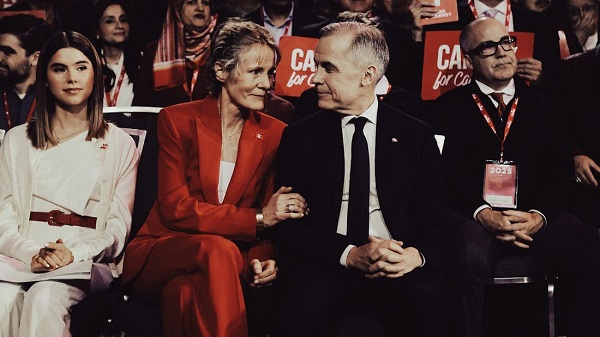
And just when you thought the web of influence stopped at the Prime Minister himself, along comes Diana Fox Carney, economist, climate consultant, and spouse of the most well-connected man in Canadian politics. While Mark Carney’s direct financial entanglements with Brookfield Asset Management are now public record, his wife’s career trajectory paints an equally troubling picture of how the same elite networks driving Canada’s green spending are profiting in parallel, behind the curtain.
Diana Fox Carney currently holds a senior advisory role at Eurasia Group, the New York-based geopolitical risk consultancy that’s become a quiet powerhouse in shaping global ESG narratives. It’s also the same firm where Gerald Butts—Trudeau’s longtime fixer and architect of the federal climate playbook—now serves as vice chair. Add in former journalist Evan Solomon and even Conservative stalwart John Baird, and you’ve got a bipartisan consultancy stacked with Canadian political operators. Convenient? Maybe. Coordinated? You decide.
And what has this firm staffed with Liberal-era insiders received in return? Millions in untendered government contracts, including a $446,210 deal from Natural Resources Canada in 2024 for vaguely defined “geopolitical research.” That’s nearly half a million dollars in taxpayer money handed out without competition, to a firm employing the sitting Prime Minister’s wife—and his former colleagues. Just coincidence, right?
But Eurasia Group is only the start. Diana’s reach extends far beyond advisory calls. She’s connected to:
- BeyondNetZero, a climate equity fund backed by U.S. private capital giant General Atlantic.
- Helios CLEAR, investing in African climate “resilience.”
- ClientEarth U.S. and the Shell Foundation, both pushing aggressive environmental litigation and policy influence.
- Canada 2020, a Trudeau-aligned think tank that’s pocketed over $1 million in federal grants.
Throw in indirect ties to Gates Foundation funding, Save the Children, and research networks influencing African agriculture, and you’re looking at a network of transnational climate consultants with deep, ongoing influence over the exact climate policies the federal government is now implementing under her husband’s leadership.
Now, legally, Diana is in the clear. She’s not a public office holder. But that’s the point. The rules weren’t designed for this new class of political operator—the dual-career globalist power couple, where one side signs the climate cheques while the other cashes them. No formal disclosure is required. No recusals. No transparency. Yet the influence is there. The access is there. The money is flowing.
Opposition Reaction: Pierre Poilievre Slams Carney’s Hidden Conflicts, Demands Real Transparency
Conservative Leader Pierre Poilievre wasted no time responding to the bombshell ethics screen showing Prime Minister Mark Carney is recusing himself from dealings with over 100 companies, many tied to his former employer, Brookfield Asset Management. In a pair of direct and widely shared posts, Poilievre accused Carney of concealing critical financial entanglements from voters during the 2025 election, and warned that the Liberal leader is now either positioned to profit from federal decisions or paralyzed from making them.
“Mark Carney must explain why he kept these conflicts secret from voters until after the election,” Poilievre wrote. “Now he will be in a position to profit from big decisions or will be forced to sit out those decisions altogether. Either way, Canadians will pay the price.”
In a second post earlier that morning, Poilievre challenged the credibility of Carney’s so-called blind trust, urging the Prime Minister to liquidate his holdings entirely and hand the cash to a trustee who can invest it without Carney’s knowledge or influence:
“Otherwise, he will always know how political decisions can affect his personal wealth.”
These statements mark the strongest opposition rebuke yet of the Carney government’s financial entanglements. Poilievre’s message echoes growing public criticism that the ethics screen is little more than window dressing, lacking third-party oversight, and that it fails to address indirect benefit through carried interest, deferred compensation, or spousal affiliations.
While Carney has claimed he is in full compliance with federal ethics laws, the fact that the disclosures were released only after the election is fueling outrage—not just among Conservatives but from broader accountability watchdogs. With over 100 entities flagged, many of them tied to green energy, infrastructure, and climate finance—the same sectors receiving billions in federal spending—the Conservative leader has positioned himself as the voice of those demanding a full forensic audit of the Prime Minister’s interests.
The message from the opposition is clear: if this were a Conservative leader, the media would be calling it a scandal. But because it’s Carney—the global banker, the climate envoy, the Liberal savior—the establishment is looking the other way. Poilievre’s Conservatives aren’t. And they’re turning this into a defining issue of integrity and accountability in Canadian politics.
Let’s Call This What It Is
This isn’t subtle. This isn’t nuanced. This is what a grift looks like—on paper, in public, in black and white. Over one hundred conflicts of interest tied directly to Mark Carney. Entire portfolios of foreign and domestic holdings, billions in green investments, shell companies in Bermuda—and that’s before we even get to his wife’s global consultancy work, advising firms that quietly gobble up federal contracts without a single public tender.
And here’s the thing: we weren’t told any of this during the election. There was no press conference, no headline, no public vetting of the sprawling web of corporate and climate interests now tied to the highest office in the country. Why? Because it would have compromised the Liberal grip on power. Because the last thing this party wanted Canadians to know was that their new leader wasn’t just a banker—but a banker with a boardroom’s worth of financial strings still attached.
Now imagine—just for a moment—if it had been Pierre Poilievre. Or Andrew Scheer. Or any Conservative leader with over a hundred screened entities, global finance ties, offshore SPVs, and a spouse employed by a company collecting millions in government money. The press would be in a frenzy. The CBC would be running specials. They’d be calling him compromised, unfit, a foreign agent.
But because it’s their guy—because it’s the Liberal elite’s banker-in-chief—we’re told it’s fine. It’s all above board. Move along, nothing to see here.
Nonsense. Absolute nonsense.
This is not leadership. This is ideological grifting at the highest level. The Liberal Party, once the party of national unity and democratic accountability, has become a hollowed-out machine for elite interests. They’re not liberals. They’re grifters—grifting for green subsidies, globalist contracts, and personal access to power. They have no principle left. Just consultants, contracts, and a taxpayer-funded narrative to keep the game going.
Enough. Canadians didn’t vote for this. They weren’t told the truth. And now the entire climate agenda, the whole “just transition,” looks more like a get-rich scheme for the political class than any serious public mission.
It’s time for an election. Time to clear house. Time to drain this toxic, green-glossed swamp once and for all.
Subscribe to The Opposition with Dan Knight
Invite your friends and earn rewards
Business
Most Canadians say retaliatory tariffs on American goods contribute to raising the price of essential goods at home



- 77 per cent say Canada’s tariffs on U.S. products increase the price of consumer goods
- 72 per cent say that their current tax bill hurts their standard of living
A new MEI-Ipsos poll published this morning reveals a clear disconnect between Ottawa’s high-tax, high-spending approach and Canadians’ level of satisfaction.
“Canadians are not on board with Ottawa’s fiscal path,” says Samantha Dagres, communications manager at the MEI. “From housing to trade policy, Canadians feel they’re being squeezed by a government that is increasingly an impediment to their standard of living.”
More than half of Canadians (54 per cent) say Ottawa is spending too much, while only six per cent think it is spending too little.
A majority (54 per cent) also do not believe federal dollars are being effectively allocated to address Canada’s most important issues, and a similar proportion (55 per cent) are dissatisfied with the transparency and accountability in the government’s spending practices.
As for their own tax bills, Canadians are equally skeptical. Two-thirds (67 per cent) say they pay too much income tax, and about half say they do not receive good value in return.
Provincial governments fared even worse. A majority of Canadians say they receive poor value for the taxes they pay provincially. In Quebec, nearly two-thirds (64 per cent) of respondents say they are not getting their money’s worth from the provincial government.
Not coincidentally, Quebecers face the highest marginal tax rates in North America.
On the question of Canada’s response to the U.S. trade dispute, nearly eight in 10 Canadians (77 per cent) agree that Ottawa’s retaliatory tariffs on American products are driving up the cost of everyday goods.
“Canadians understand that tariffs are just another form of taxation, and that they are the ones footing the bill for any political posturing,” adds Ms. Dagres. “Ottawa should favour unilateral tariff reduction and increased trade with other nations, as opposed to retaliatory tariffs that heap more costs onto Canadian consumers and businesses.”
On the issue of housing, 74 per cent of respondents believe that taxes on new construction contribute directly to unaffordability.
All of this dissatisfaction culminates in 72 per cent of Canadians saying their overall tax burden is reducing their standard of living.
“Taxpayers are not just ATMs for government – and if they are going to pay such exorbitant taxes, you’d think the least they could expect is good service in return,” says Ms. Dagres. “Canadians are increasingly distrustful of a government that believes every problem can be solved with higher taxes.”
A sample of 1,020 Canadians 18 years of age and older was polled between June 17 and 23, 2025. The results are accurate to within ± 3.8 percentage points, 19 times out of 20.
The results of the MEI-Ipsos poll are available here.
* * *
The MEI is an independent public policy think tank with offices in Montreal, Ottawa, and Calgary. Through its publications, media appearances, and advisory services to policymakers, the MEI stimulates public policy debate and reforms based on sound economics and entrepreneurship.



FDA requires new warning on mRNA COVID shots due to heart damage in young men

Before Trudeau average annual immigration was 617,800. Under Trudeau number skyrocketted to 1.4 million annually

Carney’s new agenda faces old Canadian problems

Internal emails show Canadian gov’t doubted ‘mass graves’ narrative but went along with it
-
COVID-1922 hours ago
FDA requires new warning on mRNA COVID shots due to heart damage in young men
-
Business20 hours ago
Carney’s new agenda faces old Canadian problems
-
Indigenous21 hours ago
Internal emails show Canadian gov’t doubted ‘mass graves’ narrative but went along with it
-
 Daily Caller17 hours ago
Blackouts Coming If America Continues With Biden-Era Green Frenzy, Trump Admin Warns
-
 Bruce Dowbiggin23 hours ago
Eau Canada! Join Us In An Inclusive New National Anthem
-
 Business2 days ago
CBC six-figure salaries soar
-
 Brownstone Institute2 days ago
Net Zero: The Mystery of the Falling Fertility
-
 Addictions2 days ago
Can addiction be predicted—and prevented?