
Education
Emily Liu honoured as 2021 Hunting Hills High School Valedictorian



Hunting Hills Valedictorian looks to pursue career in the medical field
This year has been like no other for the Graduating Class of 2021, but the valedictorian at Hunting Hills High School is not letting the pandemic stop her from achieving her goals.
Grade 12 student Emily Liu has been named this year’s Valedictorian at Hunting Hills High School.
“It’s an incredible honour to be named valedictorian. I was very proud of myself when I learned that I was going to be this year’s valedictorian,” she said. “In Grade 9 when I first received the honour of being the top academic student in my class, that really came as a huge shock to me because I always knew I performed well in school, but I never imagined I could be the top academic student. After that, it was something that I was really inspired to work towards, and it’s kept me motivated ever since.”
Emily added when she reflects on her high school experience, she could never have predicted we would be in the midst of a global pandemic.
“I don’t know if it necessarily took away from my high school experience, but it’s definitely hindered me in my day-to-day life whether it’s trying to pay attention during online school, or being able to hang out with my friends,” she said.
Graduation ceremonies for Hunting Hills High School will take place on June 25 at the Centrium. The day will include staggered ceremonies with three groups of graduates at a time in compliance with Alberta Health Services guidelines.

Emily said her message to fellow graduates is one they can carry into the future.
“If there’s one thing that this pandemic has taught me it’s that the relationships we have in our lives are so incredibly precious. When your only way of communicating with your friends or your family is through a screen or a phone call, there’s aspects of simple physical interaction that you really can’t get through in an online medium,” she said. “We need to treasure the relationships we have in our lives, maybe a little more. It may be a little clichè, but you really don’t appreciate what you have in your life until they are gone.”
Looking to the future, Emily said she hopes to soon be able to explore the world once restrictions allow. She has also been accepted to the University of Alberta.
“I’m going to study biochemistry. It’s one of my hopes to pursue a career in the medical field in the future,” she said, adding her volunteer work has given her an interest in that field. “I have been volunteering at the Red Deer Hospital for the past four years, and I’ve also been volunteering as a piano player at the Red Deer Hospice. I think my time at the hospital and hospice has been really enriching in the way that I am able to interact with people and learn more about people’s lives and maybe provide them some kind of comfort or support when they are in a really vulnerable moment.”
Christine Chappell, Vice Principal at Hunting Hills High School, said she is proud of Emily’s achievements.
“An accomplished pianist, community volunteer, and HHHS Leadership student, Emily possesses an incredible work ethic. In every endeavour, whether it be academics or extracurricular activities, she embodies kindness, determination, and tenacity,” she said. “Along with excelling in academics, Emily has completed her Grade 10 Piano with First Class Honours (Royal Conservatory). As a Leadership student, she has dedicated countless hours to our Bikeathon, Enviro Club and school activities. HHHS is honoured to recognize Emily as our 2021 Valedictorian and Governor General’s Medal recipient.”



From the Daily Caller News Foundation
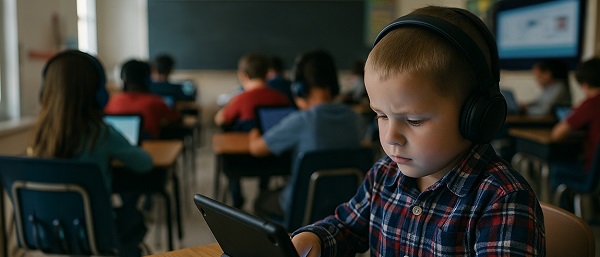
Parents are growing increasingly concerned about the prevalence of technology in classrooms, and the negative side effects that change is fueling among children nationwide.
Ever since the COVID-19 pandemic pushed schools to remote learning, many have only grown increasingly reliant on technology, shifting assignments into digital forms and handing every student a computer or tablet to aid their education in the classroom. But after seeing their kids become angrier, less sociable and less educated, parents are asking where the teachers have gone.
“What are we doing with an iPad all day, for eight hours a day in our kids’ hands?” Patricia McCoy, a mother of four in Wyoming, told the Daily Caller News Foundation. “Honestly, it’s disturbing. They give your kids worksheets on the iPad. There’s no actual critical thinking happening because they’re given apps to replace the teachers.”
Even when parents ask for additional help for their struggling children, the solution at some schools always comes back to more technology.
“If your kid is struggling in math, instead of giving them tutoring, they’re going to recommend to you that your child use this app on their iPad to help teach them how to do this math,” McCoy continued. “But that app doesn’t teach them how to do the math. They enter the problem and it gives them the solution all written out and worked out, so there’s no critical thinking being done. The answer is being given to them. They have ChatGPT at the ready, and other things similar to ChatGPT, which, again, does all the thinking for them. And all they have to do is show up, log into the iPad, get the answers from one app, put it into another app and get the grade.”
This has some parents wondering where the teachers have gone and whether they are teaching their students at all.
“THEY DON’T WANT TO TEACH”
“Covid did create a lot of this, and it made it a lot easier for some of the teachers now to just place these kids in front of a screen,” Mike Maldonado, a California father of five, told the DCNF. “And it makes it easier for some of these teachers because they don’t want to teach. They’re just there for a job.”
“We can’t ignore the fact that all this stuff makes it easier on the teacher, which actually, I think produces a worse result, “Jaime Brennan, member of the Frederick County Board of Education who spoke on behalf of herself and not the board, told the DCNF. “When a teacher can go online and make up an assignment using AI, now they haven’t thought. Now they’re not using their brainpower, and it’s like a trickle down effect. We’ve already introduced screens and technology to the level that as humans, I don’t think we were designed to use, and we haven’t adapted to it very well.”
Critically, Brennan said, the use of AI has prevented students from developing automaticity, the skill of memorizing basic solutions, such as simple addition, to the point that you do not even think about it, which is a foundational skill students carry on throughout their education and adult life.
McCoy told the DCNF that the digital learning environment has left her youngest son academically “two to three years behind” his siblings, who did not go through this new screen-based school system.
“He is drastically farther behind academically,” McCoy said. “He does what he needs to to pass, but intellectually and academically, he is years behind his two brothers and his sister at this age, and that is sad and heartbreaking as a mother to know that I probably failed my child because I went along with what the school said was going to help them.”
Despite being “years behind,” McCoy’s son is on track to graduate on time.
“We graduate kids who have to go to community college and take remedial math,” Brennan mentioned. “Our kids leave 12th grade and they go to 13th grade. So we’re putting out kids that are not ready to operate in the regular world.”
POSSESSED BY THE SCREEN
Not only is she worried about his education, the concerned mom has seen a noticeable shift in her son’s mood as he is forced to rely on more and more screen time.
“I tried to take my son’s phone away one time, and it looked like a demon was looking back at me. My son was not looking at me,” McCoy recalled. “His eyes were completely black and cold. It was like he was a totally other person, like a drug addict, and you’re taking their drug from them. And he was 15 at the time.”
Without his phone, McCoy said her son was a new person.
“That week, he was a totally different person. He wasn’t overly tired and drowsy all day. He was actually interacting with the family and spending time with us. Instead of being shut down and closed off in his room, he was playing with our dogs more,” McCoy said.
Maldonado thinks these behavioral issues stem partly from the lack of human interaction children experience in increasingly screen-dependent classrooms.
“Part of the problem is that they’ve lost a lot of the interaction,” Maldonado said. “This is why some of these kids I think act out, because they don’t want to listen to the teacher. There has to be that communication between two people, two humans, and not a screen where they can’t really interact and get the tone, the voice inflection of a response.”
“That is a major issue,” Maldonado continued. “Without social skills, how do you function in society? And we see it all the time. Social skills are definitely learned, it’s a trait that you pick up from interacting with people when you’re young. And that’s the big thing, people don’t realize that if there’s no interaction, that person is going to be withdrawn, not just from the classroom, but from the home and from society.”
The issue is especially apparent in children who were younger during the Covid year, Maldonado said. The so-called “Covid babies” are typically “the ones who you can see have the majority of the behavioral issues.”
“It is hard to get some of these kids to actually look you in the eye and make eye contact. They don’t know human interaction,” Brennan concurred, adding that students today are not even dating as much as they used to. “I’m really concerned where that’s going to lead, and what our kids are going to be like. We’re already seeing negative impacts of kind of this disintegration, people are waiting till later to getting married. They’re not getting married.”
THE PRICE AMERICA IS PAYING
Meanwhile, as the use of artificial intelligence (AI) among youth increases, more data and stories are coming out revealing the tool often exposes children to inappropriate content, damages the development of critical thinking skills, and at times, drives kids to suicide by explicitly coaching them to do so. Brain scans from the Massachusetts Institute of Technology (MIT) revealed that brain engagement was severely diminished under participants who used AI compared to those who used a traditional search engine, and memory recall following assignments completed with AI tanked.
Interestingly, schools that struggle with budget concerns and often fail to see promised district-wide staff raises somehow find funds to buy brand-new devices for every student — even when they already had slightly older, but still functional devices.
“Most of [the money goes] to administration and fees and other things that have nothing to do with the education of our kids, or they spend it on these expensive iPads and technology that shouldn’t even be in the classrooms, and then they go to the state and say, ‘You’re not giving us enough money. We need more money,’” McCoy told the DCNF. “Well, we keep throwing money at the problem, but the problem doesn’t get better or go away. It gets worse every year. So clearly, money isn’t solving the issue on why our kids can’t read, write and do math.”
“Stop spending the money on the iPads and put that money back in the classrooms instead,” McCoy continued. “Give it to the teachers.”
While Tina Descovich, co-founder and CEO of parental advocacy group Moms for Liberty, mirrors the concerns of many parents, she also told the DCNF there could be a place for technology in the classroom.
“I think they have to be used in a very responsible fashion,” Descovich said. “There’s so many wonderful teachers that would like to use AI in a way to help enhance their skills and teach their children better.”
Moms for Liberty signed a pledge with the White House in September to help foster innovation and interest in AI with America’s youth.
Brennan remains concerned that technology in the classroom prevents kids from thinking independently and may harm future skill building rather than facilitate an interest or expertise in technology.
“Are you trying to keep pace with the kids who are learning to use the technology, or are you trying to create the kids who are going to develop the technology? Because those are two different things,” Brennan said. “So if we’re just teaching our kids to be technology consumers, then sure, the easy way out is to do everything on the technology. If you’re trying to keep teach kids to be the technology developers, they need to learn to think and process away from the technology. They need to have other skills that are not technology based.”
PARENTS STILL HAVE POWER
For parents concerned about the technological takeover of their children’s classrooms who feel like their schools aren’t listening to them, Descovich said that along with helping their kids at home when possible, parents should “rally with like minded parents.”
“Start educating your community,” Descovich said. “I think when parents really understand what’s happening and what the concerns are and what the risks are, they will want to take action. And when you have enough parents showing up at school board meetings and speaking about an issue we have, as we know, you definitely can make an impact, and they will listen.”
From the Daily Caller News Foundation
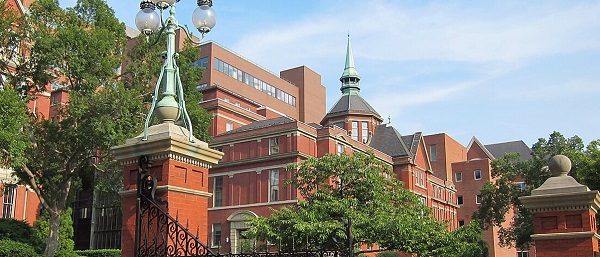
Johns Hopkins University (JHU) announced on Thursday it is making tuition free for families earning less than $200,000 and will waive both tuition and living expenses for those making less than $100,000.
The university stated that “a majority of American families” will qualify for the fee exemption, allowing most students to attend without contributing a single dollar. The decision is meant to help recruit “the best and brightest students to Johns Hopkins irrespective of their financial wherewithal.”
“Trying to understand financial aid offers can be overwhelming,” David Phillips, vice provost for admissions and financial aid at JHU, said in the announcement. “A big goal here is to simplify the process. We especially want to reach students and families from disadvantaged backgrounds, rural locations, and small towns across America who may not know that a Hopkins degree is within reach.”
Dear Readers:
As a nonprofit, we are dependent on the generosity of our readers.
Please consider making a small donation of any amount here.
Thank you!
In 2018, Michael Bloomberg donated nearly $2 billion to the university, the largest ever single gift to a U.S. university. JHU said it used this money “to become permanently need blind and no-loan in financial aid.”
The university also receives the most federal funding of any university, raking in more than $3 billion from the government in fiscal year 2023 for research and development alone. This is more than double what the next highest recipient of federal funding that year, the University of Washington, received.
Despite this, JHU in June complained that federal funding cuts forced it to institute a hiring freeze and pause annual pay increases for employees. In its message to the community at the time, the university also mentioned its disagreement with “recent efforts to limit or withhold visas from the international students and scholars.”
Some universities admit mass numbers of foreign students in order to pad their pockets, as such students often pay full tuition and fee costs without financial assistance.


Is there a cure for Alzheimer’s Disease?
Google denies scanning users’ email and attachments with its AI software

Learning the Truth about “Children’s Graves” and Residential Schools is More Important than Ever

The Unmasking of Vaccine Science
-
 MAiD2 days ago
From Exception to Routine. Why Canada’s State-Assisted Suicide Regime Demands a Human-Rights Review
-
 Energy2 days ago
Unceded is uncertain
-
 Business2 days ago
Carney government should privatize airports—then open airline industry to competition
-
 Alberta1 day ago
Carney’s pipeline deal hits a wall in B.C.
-
 Alberta1 day ago
Alberta Sports Hall of Fame Announces Class of 2026 Inductees
-
 Censorship Industrial Complex1 day ago
Conservative MP Leslyn Lewis slams Liberal plan targeting religious exemption in hate speech bil
-
 Business2 days ago
What’s Going On With Global Affairs Canada and Their $392 Million Spending Trip to Brazil?
-
 Business2 days ago
Is Carney Falling Into The Same Fiscal Traps As Trudeau?