
Frontier Centre for Public Policy
UNDRIP’s false promise of Indigenous Nationhood threatens individual Indigenous Canadians



From the Frontier Centre for Public Policy
By Peter Best
All societies need to make use of force, both to preserve internal order and to protect themselves from external enemies. A liberal society does this by creating a powerful state, but then constraining that power under a rule of law. The state’s power is based on a social contract between autonomous individuals who agree to give up their rights to do as they please in return for the state’s protection. It is legitimated both by the common acceptance of the law, and, if it is a liberal democracy, through popular elections. Liberal rights are meaningless if they cannot be enforced by a state, which, by Max Weber’s famous definition, is a legitimate monopoly of force over a defined territory…Ultimate power, in other words, continues to be the province of national states, which means that control of this power at this level remains critical.
-Francis Fukuyama – Liberalism and its Discontents
Our Canadian elites, led by Justin Trudeau’s Liberal government, continue to advance the idea that Canada should be a race-based nation. This is reflected in the Trudeau government’s enactment of the racist United Nations Declaration on the Rights of Indigenous People (UNDRIP) laws and policies. (The UNDRIP Action Plan.)
These laws and policies are partly based on the premise that Indigenous peoples in Canada still have distinct cultures that give them the right to exist as separate groups within the Canadian nation, living parallel to the rest of Canadians, and only optionally being subject to the laws of Canada.
Under the heading “Cultural, religious and linguistic rights,” the UNDRIP Action Plan sets out the Trudeau government’s goal of creating a country where:
Indigenous peoples fully enjoy and exercise their distinct rights to maintain, control, develop, protect, and transmit their cultural heritage, indigenous knowledge, languages, food systems, sciences, and technologies, without discrimination…. Indigenous peoples are thriving, including through connection to culture and community, the use of their languages and the expression of their spiritual heritage.
Also, the UNDRIP Action Plan prescribes that these “distinct rights” are to be exercised and enhanced by treating “Indigenous peoples” as independent, self governing, “nations,” representing over 630 race-based nations existing within the boundaries of Canada.
The premise underlying the UNDRIP Action Plan is that authentic, pre-contact Indigenous cultures still exist, and that they have the right to be preserved at the expense of Canadian taxpayers. In other words, these nations will be dependent on other Canadians.
The last vestiges of authentic, distinct, pre-contact Indigenous cultures disappeared about 150 years ago. As Assembly of First Nations co-founder William Wuttunee wrote in 1971 in his book Ruffled Feathers: “Real Indian culture is just about dead on the reserves.” Now, over 50 years later, native traditional cultures have been replaced by re-imagined cultures, even if a declining few Indigenous people still speak their traditional languages.
There can be no going back to any part of Indigenous pre-contact cultures, nor would Indigenous peoples want to. In this respect, Iroquois writer Sachem Ely S. Parker says:
Do you know or can you believe that sometimes the idea obtrudes…whether it has been well that I have sought civilization with its bothersome concomitants and whether it would not be better even now…to return to the darkness and most sacred wilds (if any such can be found) of our country and there to vegetate and expire silently, happily and forgotten as do the birds of the air and the beasts of the field. The thought is a happy one but perhaps impracticable.
When trade with Europeans began in the early 1600’s, Indigenous peoples began the long, irreversible process of appropriating European goods and technologies, modern economic practices, Christianity, and Western norms and values, with the consequence that, by the late 19th century, their paleolithic, pre-contact cultures had become almost extinct.
All that remained was what William Wuttunee described as “touristy” and “museum pieces of buckskin and feathers,” the ceremonial remnants justly celebrated on special occasions but, less innocently, now used by their current leaders as symbolism in their endless political campaigns for more money and power.
Indigenous peoples cannot turn back from the modern, high-tech, globalist culture that is systematically enveloping all Canadians. In this respect, Yuval Noah Harari wrote in Sapiens:
Today almost all humans share the same geopolitical system (the entire planet is divided into internationally recognized states); the same economic system (capitalist market forces shape even the remotest corners of the globe); the same legal system (human rights and international law are valid everywhere, at least theoretically); and the same scientific system (experts in Iran, Israel, Australia, and Argentina have exactly the same views about the structure of atoms or the treatment of tuberculosis…. We still talk a lot about “authentic” cultures, but if by “authentic” we mean something that developed independently, and that consists of ancient local traditions free of external influences, then there are no authentic cultures left on earth. Over the last few centuries, all cultures were changed almost beyond recognition by a flood of global influences.
But ironically, the rise of globalism has counterintuitively led to the increase of parochial, tribalist feelings.
Historian Robert Kaplan, in his latest book The Loom of Time – Between Empire and Anarchy, From the Mediterranean to China, argues that the cultural shock caused by modernism and globalism–by their annihilation of traditional tribal life–has resulted in an emotionally compensating reaction on the part of those affected to “reinvent their primordial selves in more abstract and extreme forms in order to cope with impersonal settings,” and, in addition, to achieve worldly gains.
Kaplan explains that the anonymity and the loss of pride and identity on the part of tribal societies resulting from urbanization and other globalist influences led to the psychological need for a compensating, “emotional grounding,” which now manifests itself in intense, albeit fictional, assertions of political, ethnic, religious, and racial exceptionalism, and opportunistic demands for favored treatment by the state.
Ironically, the more modern, urban, and globally integrated the former pre-contact tribe becomes, the greater its “primordial” racial sentiments become and the greater and more inherently baseless are its ethnic or race-based claims to be favored by the state.
Pre-contact tribal cultures were relatively static and fatalistic. There was little belief in “progress,” human rights, money, wealth, or job creation. There was no belief that people had a right to material things like housing, education, medical care, constitutions, courts, judges, welfare, policing, or clean water. These are all modern Western ideas and practices that were inconceivable to pre-contact tribal cultures.
Kaplan writes:
Cultural consciousness is enhanced rather than submerged by modernization, because of the ability of modern states and societies to offer jobs, status, and other spoils for which individuals of different ethnic, religious and sectarian identities compete. Through education, modernization also makes people more aware of their collective pasts and their differences with other peoples. Such phenomena have been the forerunners to the identity politics of the post-modern era.
This is what has happened to Canadian Indigenous tribes.
Modernity, urbanization, and globalism, as William Wuttunee confirmed, have destroyed their pre-contact cultures and, as an ironic consequence, have led to abstract and entirely fantasy-based claims of present Indigenous cultural authenticity and “difference.” The more obvious it is that authentic pre-contact Indigenous cultures have vanished, the more their current Indigenous leaders opportunistically claim that they are alive and thriving.
The unprecedented, radical Indigenous political and legal demands now being routinely made by Indigenous groups are, in ironic fact, completely rooted in Western political ideas and practices.
Their demands for quasi- separatist “nation-to-nation” status, for veto powers over federal and provincial laws possibly affecting their “aboriginal rights and territories,” for reparations, for ownership stakes in resource projects and for co-management with the Crown of public lands and natural resources, are all demands that would be inconceivable to pre-contact Indigenous tribal cultures.
The Western philosophical nature of these demands is proof positive of the extinguishment of pre-contact Indigenous cultures.
Canadian Indigenous groups cannot form viable nation-states, and the UNDRIP Action Plan’s attempts to do this impossible task threatens the civic well being of individual Indigenous Canadians.
In referring to the endless squabbling between the various ethnic tribes that make up the many failed states of the Middle East and Africa, Kaplan reminds us that legitimate nation-states are more than artificial communities created by politics, as were the First Nations reserves in Canada. Rather, they are natural, “practical communities…entities of geographic and historical association.”
Kaplan also says that legitimate nation-states have hierarchical, coherent governing structures, and rules-based laws developed organically over time. They are supported by “organized bureaucratic systems interacting with each other on an impersonal, secular basis.”
None of these basic requirements of nationhood are present to any sufficient degree on First Nations reserves, which, as organized groups, are mostly strangers to the civic values, practices, and traditions of modern liberal democracies.
First Nations reserves, like the “institutionally flimsy” Arab and African tribal groups referred to by Kaplan, “have imported the fruits of science without as societies ever producing them themselves… They have experienced the West only as “things.” … They have possessed the techniques of Europe without intuiting the centuries-long cultural processes that had made the West what it was…”.
In other words, Indigenous tribal groups are “modern” only in the culturally appropriated material sense, and because of the Indian Act and the reserve system, they tend to be illiberal in their political culture and governing practices. The proposed Indigenous nation-states that are envisioned by the UNDRIP Action Plan will be, in Kaplan’s words, just as institutionally-flimsy as other failed states are.
This reality is at the core of the threat posed by the UNDRIP Action Plan to the civic well-being of individual Indigenous Canadians. In this regard Kaplan reminds us that: “…where institutions are weak then personalities…who milk and misgovern…perforce dominate.”
On Canadian Indigenous reserves, governance is prone to family-based self-dealing. (Kaplan’s phrase is “republics of cousins.”) There is no reason to believe that such governments will be better under the UNDRIP Action Plan. In fact, governance will probably get worse because, as Kaplan shows, tribalism and illiberalism are worsened when politically unprepared people achieve self-rule.
Indigenous lawyer and businessman, Calvin Helin, in his seminal book Dances With Dependency: Out of Poverty Through Self- Reliance, compares illiberal First Nations reserve governance to “banana republics.” He referred to Chiefs and Band Councils as “colonizers of their own disempowered people.”
Indigenous scholar Rob Louis adds:
What realistic chance do band members have against chief and council who control their money and resources? For many band members in Canada, the battle is not just with the Crown, it is also with their own leadership… Perhaps reconciliation within Indigenous communities needs to take place before reconciliation can happen with Canada.
Until recently, vulnerable, and powerless Indigenous Canadians had the federal and provincial governments, the courts, and human rights commissions to protect them. But that is no longer true. All these state institutions have shamefully abandoned their role of protectors of weak and vulnerable Indigenous Canadians.
The Supreme Court of Canada is just as much of a threat to the civic well-being of Indigenous Canadians as is the UNDRIP Action Plan.
In its Vuntut Gwitchin decision, purportedly to preserve Indigenous “difference,” the Court ruled that in the event of an irreconcilable conflict, a First Nations Band’s “collective rights,” resting on its right to protect “Indigenous difference,” will now prevail over an individual Indigenous Canadian’s rights as guaranteed by the Canadian Charter of Rights and Freedoms. As such, the Charter can now be effectively ignored by Band Councils, depriving countless Indigenous Canadians of Charter protection on their home reserves and territories.
The Vuntut Gwitchin First Nation (VGFN) is described by the Supreme Court as a “self-governing nation” in the Yukon comprising of about 560 “citizens,” only about 260 of whom live in the “main community” of Old Crow, which is the so-called “seat of government.” The other 300 odd “citizens” live mostly in Whitehorse, 800 kilometres south. There are no roads into Old Crow. Students cannot graduate from high school in that community, and there no adequate medical facilities in Old Crow.
Cindy Dickson, a VGFN citizen living in Whitehorse, claimed that a VGFN law that said that a “citizen” had to live in Old Crow to qualify to run for VGFN Council violated her Canadian Charter rights not to be discriminated against based on her residency.
She lost her case.
The Supreme Court asserted the existence of “Indigenous legal orders” that prevailed over Canadian law. There was an anti-discrimination provision in the 1993 VGFN Constitution. The Court told her to rely on that and “pursue a similar claim under the VGFN Constitution.”
The problem with this is that there is no VGFN court and no VGFN judge or lawyers. In fact, there is no VGFN institutional justice system whatsoever through which Cindy Dickson could pursue her claim. How could there be? VGFN, like most First Nations, is a mere tribal village, with a population so tiny that the creation of any such state institutions is impossible.
The Supreme Court knew this, and, to its discredit, preferred giving Ms. Dickson empty words over telling her the harsh truth that while she may have rights in the abstract, in VGFN because of its lack of institutions, she could not pursue those rights. A right without institutional support is, in fact, no right at all.
Another harsh truth that the Court avoided telling Ms. Dickson is that now, VGFN, like all Canadian First Nations, have been shamefully declared Charter-free zones by the Supreme Court of Canada. The Vuntut Gwitchin decision, along with the UNDRIP Action Plan, means that victims of corrupt or discriminatory First Nations reserve leadership practices will now have no one to turn to for protection and relief.
In fact, the Vuntut Gwitchin decision illustrates the absurdity of the Indigenous nation-state pretensions of the Canadian UNDRIP Action Plan.
The joint efforts of the Supreme Court and the federal government’s UNDRIP Action Plan have made individual Indigenous Canadians, in terms of having the guaranteed protection of the rule of law, effectively unprotected on their new, UNDRIP “nation-state” reserves.
Robert Kaplan writes a great deal about the multi-ethnic, multi-racial empires, the most generic form of governance in world history, where the strong hand of the emperor kept order and protected vulnerable minorities from the depredations of majorities. He cites the example of the Ottoman empire, where, with its breakup, the strong power of the sovereign in those territories was lost. Power was then transferred to tribalistic ethnic and religious groups that have little regard for the rights of minorities. This has resulted in over a century of anarchic tribal, ethnic and religious persecution and warfare in the Middle East.
Since Confederation, Canada has protected powerless and vulnerable Indigenous people from the mainly illiberal governance systems that are typical of First Nations reserves. Now, the Canadian state is abandoning this protective role. By doing so Canada is betraying the vast majority of powerless and vulnerable Indigenous Canadians, leaving them defenceless against the power and potential injustice of their tribal leaders.
What has happened echoes Frances Fukuyama’s warning that rights are meaningless unless they are created and can be enforced by a powerful state. The UNDRIP Action Plan and the Supreme Court’s rulings like Vuntut Gwitchin will not create viable and strong Indigenous nation-states. All they will do is weaken the Canadian state, causing harm to all Canadians and depriving the vast majority of vulnerable, powerless Indigenous Canadians of the protective rule of Canadian law.
Peter Best is a retired Sudbury lawyer. He is the author of There Is No Difference – An Argument for the Abolition of the Indian Reserve System and Special Race-based Laws and Entitlements for Canada’s Indians.

From the Frontier Centre for Public Policy
Madrid knew solar and wind power were unreliable but pressed ahead anyway
When a grid failure plunged 55 million people in Spain and Portugal into darkness at the end of April, it should have been a wake-up call on green energy. Climate activists promised that solar and wind power were the future of cheap, dependable electricity. The massive half-day blackout shows otherwise. The nature of solar and wind generation makes grids that rely on them more prone to collapse—an issue that’s particularly expensive to ameliorate.
As I wrote in these pages in January, the data have long shown that environmentalists’ vision of cheap, reliable solar and wind energy was a mirage. The International Energy Agency’s latest cost data continue to underscore this: Consumers and businesses in countries with almost no solar and wind on average paid 11 U.S. cents for a kilowatt hour of electricity in 2023, but costs rise by more than 4 cents for every 10% increase in the portion of a nation’s power generation that’s covered by solar and wind. Green countries such as Germany pay 34 cents, more than 2.5 times the average U.S. rate and nearly four times China’s.
Prices are high in no small part because solar and wind require a duplicate backup energy system, often fossil-fuel driven, for when the sun doesn’t shine or the wind doesn’t blow. The Iberian blackout shows that the reliability issues and costs of solar and wind are worse than even this sort of data indicates.
Grids need to stay on a very stable frequency—generally 50 Hertz in Europe—or else you get blackouts. Fossil-fuel, hydro and nuclear generation all solve this problem naturally because they generate energy by powering massive spinning turbines. The inertia of these heavy rotating masses resists changes in speed and hence frequency, so that when sudden demand swings would otherwise drop or hike grid frequency, the turbines work as immense buffers. But wind and solar don’t power such heavy turbines to generate energy. It’s possible to make up for this with cutting-edge technology such as advanced inverters or synthetic inertia. But many solar and wind farms haven’t undergone these expensive upgrades. If a grid dominated by those two power sources gets off frequency, a blackout is more likely than in a system that relies on other energy sources.
Spain has been forcing its grid to rely more on unstable renewables. The country has pursued an aggressive green policy, including a commitment it adopted in 2021 to achieve “net zero” emissions by 2050. The share of solar and wind as a source of Spain’s electricity production went from less than 23% in 2015 to more than 43% last year. The government wants its total share of renewables to hit 81% in the next five years—even as it’s phasing out nuclear generation.
Just a week prior to the blackout, Spain bragged that for the first time, renewables delivered 100% of its electricity, though only for a period of minutes around 11:15 a.m. When it collapsed, the Iberian grid was powered by 74% renewable energy, with 55% coming from solar. It went down under the bright noon sun. When the Iberian grid frequency started faltering on April 28, the grid’s high proportion of solar and wind generation couldn’t stabilize it. This isn’t speculation; it’s physics. As the electricity supply across Spain collapsed, Portugal was pulled along, because the two countries are tightly interconnected through the Iberian electricity network.
Madrid had been warned. The parent company of Spain’s grid operator admitted in February: “The high penetration of renewable generation without the necessary technical capabilities in place to keep them operating properly in the event of a disturbance . . . can cause power generation outages, which could be severe.”
Yet the Spanish government is still in denial. Even while admitting that he didn’t know the April blackout’s cause, Prime Minister Pedro Sánchez insisted that there was “no empirical evidence” that renewables were to blame and that Spain is “not going to deviate a single millimeter” from its green energy ambitions.
Unless the country—and its neighbors—are comfortable with an increased risk of blackouts, this will require expensive upgrades. A new Reuters report written with an eye to the Iberian blackout finds that for Europe as a whole this would cost trillions of dollars in infrastructure updates. It’s possible that European politicians can talk voters into eating that cost. It’ll be impossible for India or nations in Africa to follow suit.
That may be unwelcome news to Mr. Sánchez, but even a prime minister can’t overcome physics. Spain’s commitment to solar and wind is forcing the country onto an unreliable, costly, more black-out-prone system. A common-sense approach would hold off on a sprint for carbon reductions and instead put money toward research into actually reliable, affordable green energy.
Unfortunately for Spain and those countries unlucky enough to be nearby, the Spanish energy system—as one Spanish politician put it—“is being managed with an enormous ideological bias.”
Bjorn Lomborg is president of the Copenhagen Consensus, a visiting fellow at Stanford University’s Hoover Institution and author of “Best Things First.”
From the Frontier Centre for Public Policy
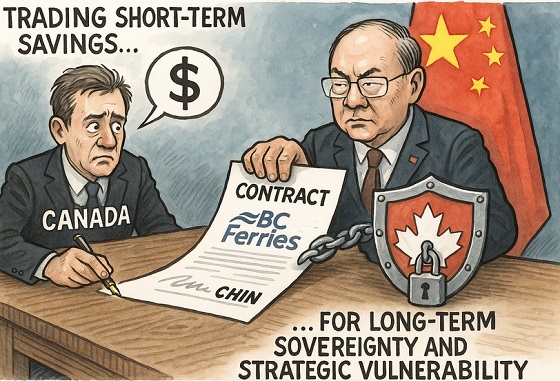
Scott McGregor warns BC Ferries’ contract with a Chinese state-owned shipbuilder reveals Canada’s failure to align procurement with national security. It is trading short-term savings for long-term sovereignty and strategic vulnerability.
BC Ferries’ recent decision to award the construction of four new vessels to China Merchants Industry (Weihai), a state-owned shipyard under the Chinese Communist Party (CCP), is a cautionary tale of strategic policy failure. While framed as a cost-effective solution to replace aging vessels, the agreement reveals a more critical issue: Canada’s persistent failure to align vital infrastructure procurement with national security and economic resilience.
The situation goes beyond transportation. It is a governance failure at the intersection of trade, security, and sovereignty.
Outsourcing Sovereignty
China Merchants Industry is part of a sprawling state-owned conglomerate, closely connected to the CCP. It is not merely a commercial player; it is a geopolitical actor. In China, these organizations thrive on a unique blend of state subsidies, long-term strategic direction, and complex corporate structures that often operate in the shadows. This combination grants them a significant competitive edge, allowing them to navigate the business landscape with an advantage that many try to replicate but few can match.
The same firms supplying ferries to BC are also building warships for the People’s Liberation Army Navy. That alone should give pause.
Yet BC Ferries, under provincial oversight, proceeded without meaningful scrutiny of these risks. No Canadian shipyards submitted bids due to capacity constraints and a lack of strategic investment. But choosing a Chinese state-owned enterprise by default is not a neutral act. It is the consequence of neglecting industrial policy.
Hybrid Risk, Not Just Hybrid Propulsion
China’s dominance in shipbuilding, now over 60% of global orders, has not occurred by chance. It is the result of state-driven market distortion, designed to entrench foreign dependence on Chinese industrial capacity.
Once that dependency forms, Beijing holds leverage. It can slow parts shipments, withhold technical updates, or retaliate economically in response to diplomatic friction. This is not speculative; it has already happened in sectors such as canola, critical minerals, and telecommunications.
Ordering a ferry, on its face, might seem apolitical. But if the shipbuilder is state-owned, its obligations to the CCP outweigh any commercial contract. That is the nature of hybrid threats to security: they appear benign until they are not.
Hybrid warfare combines conventional military force with non-military tactics (such as cyber attacks, disinformation, economic coercion, and the use of state-owned enterprises) to undermine a target country’s stability, influence decisions, or gain strategic control without resorting to open conflict. It exploits legal grey zones and democratic weaknesses, making threats appear benign until they’ve done lasting damage.
A Policy Void, Not Just a Procurement Gap
Ottawa designed its National Shipbuilding Strategy to rebuild Canadian capability, but it has failed to scale quickly enough. The provinces, including British Columbia, have been left to procure vessels without the tools or frameworks to evaluate foreign strategic risk. Provincial procurement rules treat a state-owned bidder the same as a private one. That is no longer defensible.
Canada must close this gap through deliberate, security-informed policy. Three steps are essential for the task:
Ottawa should mandate National Security reviews for critical infrastructure contracts. Any procurement involving foreign state-owned enterprises must trigger a formal security and economic resilience assessment. This should apply at the federal and provincial levels.
Secondly, when necessary, Canada should enhance its domestic industrial capabilities through strategic investments. Canada cannot claim to be powerless when there are no local bids available. Federal and provincial governments could collaborate to invest in scalable civilian shipbuilding, in addition to military contracts. Otherwise, we risk becoming repeatedly dependent on external sources.
Canada should enhance Crown oversight by implementing intelligence-led risk frameworks. This means that agencies, such as BC Ferries, must develop procurement protocols that are informed by threat intelligence rather than just cost analysis. It also involves incorporating security and foreign interference risk indicators into their Requests for Proposals (RFPs).
The Cost of Strategic Amnesia
The central point here is not only about China; it is primarily about Canada. The country needs more strategic foresight. If we cannot align our economic decisions with our fundamental security posture, we will likely continue to cede control of our critical systems, whether in transportation, healthcare, mining, or telecommunications, to adversarial regimes. That is a textbook vulnerability in the era of hybrid warfare.
BC Ferries may have saved money today. But without urgent policy reform, the long-term cost will be paid in diminished sovereignty, reduced resilience, and an emboldened adversary with one more lever inside our critical infrastructure.
Scott McGregor is a senior security advisor to the Council on Countering Hybrid Warfare and Managing Partner at Close Hold Intelligence Consulting Ltd.


What Connor Should Say To Oilers: It’s Not You. It’s Me.
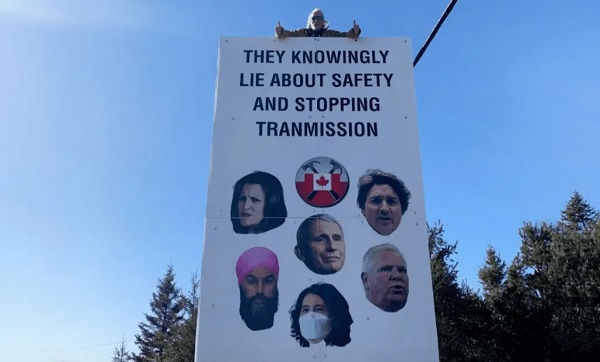
Ontario man launches new challenge against province’s latest attempt to ban free expression on roadside billboards
Federal fiscal anchor gives appearance of prudence, fails to back it up
The Passage of Bill C-5 Leaves the Conventional Energy Sector With as Many Questions as Answers
-
COVID-192 days ago
Ontario man launches new challenge against province’s latest attempt to ban free expression on roadside billboards
-
 Energy2 days ago
This Canada Day, Celebrate Energy Renewal
-
 COVID-1916 hours ago
New Peer-Reviewed Study Affirms COVID Vaccines Reduce Fertility
-
 Business12 hours ago
Ottawa Funded the China Ferry Deal—Then Pretended to Oppose It
-
 Alberta2 days ago
Alberta Next Takes A Look At Alberta Provincial Police Force
-
 Alberta2 days ago
Canadian Oil Sands Production Expected to Reach All-time Highs this Year Despite Lower Oil Prices
-
 MAiD14 hours ago
Canada’s euthanasia regime is not health care, but a death machine for the unwanted
-
 International2 days ago
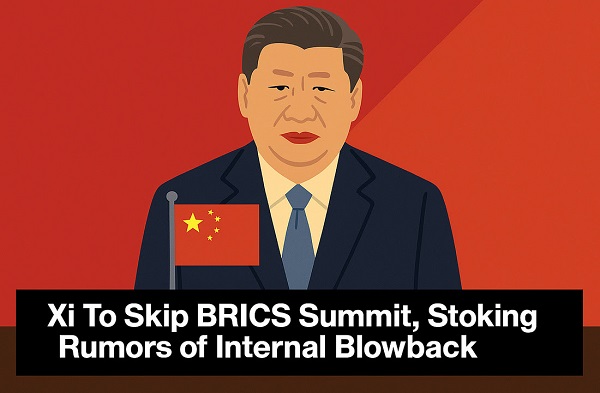
President Xi Skips Key Summit, Adding Fuel to Ebbing Power Theories