
Business
“Red Deer Revitalization Society” urges city to move homeless population away from downtown

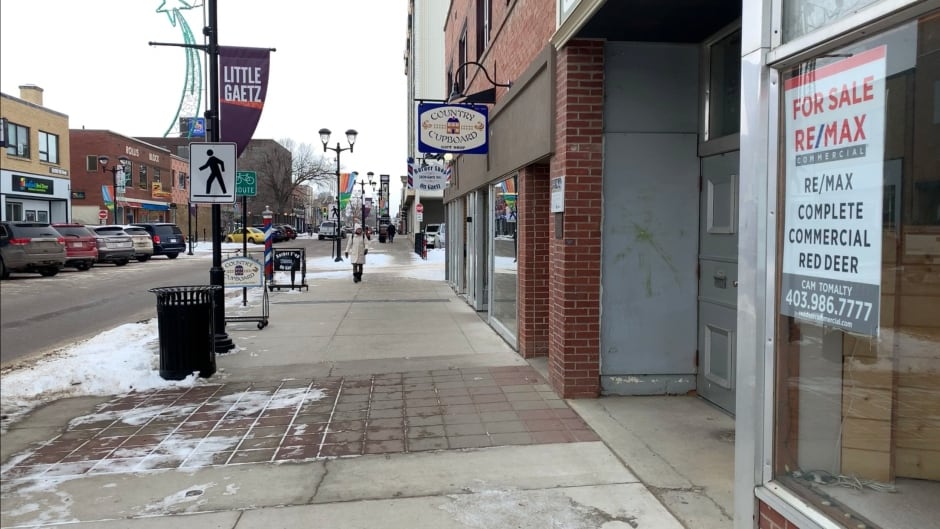

This letter submitted by the Red Deer Revitalization Society
The Red Deer Revitalization Society is a group of approximately 40 concerned Red Deer business people.
A few years ago, a collection of concerned members of the Downtown Red Deer Business Community came together after the drug-addicted and homeless population were crippling their operations. These meetings took place concurrently with the City and Provincial initiatives to establish safe injection sites, permanent shelters, and other similar institutions. The volume of people in Red Deer who require assistance makes it obvious that there is a need for these services. The problem however is with their location. We write this to help motivate the relocation of the permanent shelter from the proposed 4934 54 th Ave site.
We are of the view that this proposed site will have two disastrous consequences. First, an increase in residential property tax rates. Second, the slaying of the City’s Capstone Development. A recent history of the Downtown shows that the business community and the homeless and drug-addicted community cannot peacefully coexist. This is – and has been – an underappreciated concern that affects everyone in the City of Red Deer. Over the last 15 years, Downtown Red Deer has witnessed a mass exodus of businesses. The once thriving Downtown core has become repulsive. In speaking with colleagues who have vacated the Downtown, their motivation is always taxes and vagrancy. Who can
blame them? It is difficult to attract enough customers to cover the tax bill (and other costs) when their front door is littered with drug paraphernalia and loiterers. The trend shows that a concentration of social services forsakes the area where they are located and thus surrounding businesses will take their investments elsewhere. This exclusion of business is dangerous for all of us.
Most people do not appreciate how the City makes ends meet. We all know that taxes must be collected – but how does the City determine which property owner pays what? The owners of all properties, whether commercial or residential, pay tax at an amount that is determined using various formulae which all boil down to the property’s true value. Historically, the commercial properties in Downtown Red Deer were valuable enough and producing enough revenue that they bore the brunt of the taxes. But what happens now? The exodus of business replaced with social chaos renders the Downtown Properties valueless. If the owners of these properties cannot be asked to maintain the City’s reserves, the City will have no choice but to look elsewhere. Unfortunately, residential owners will have to see their property taxes increase dramatically for the City to run. The proposed permanent shelter location is yet another mainstay for drug use and vagrancy in a downtown that is nearly dead. This will likely be the last nail in Downtown’s coffin and a direct cause of increased residential property taxes.

Another underappreciated concern is the viability of the City’s Capstone Development. The perpetual bare piece of prime real estate is the City’s crown jewel. It presents a unique opportunity to rejuvenate the Downtown and neglected Red Deer Riverfront (another letter to the editor is required to discuss the City’s squandering of opportunity in the Capstone area over the past 25 years). The proposed permanent shelter is in the shadow of the Capstone Development – where the City has invested a tremendous amount of money. In fact, some say that the City has already invested upwards of $42 Million in the Capstone Development, which is being branded as a business and family-driven part of
town. If that’s the goal, how could it possibly make sense to put a permanent shelter right beside it? We appreciate that services like homeless shelters and safe injection sites are unfavourable, and people generally have the “not in my back yard sentiment”. However, if you sit back and allow City Council to locate the shelter at 4934 54 th Ave., you will see Capstone remain undeveloped, you will continue to see the mass exodus of businesses from downtown Red Deer and you will see a significant increase in your residential property taxes.
How can you ensure that your residential property taxes decrease instead of increase? Contact City Council and your elected MLA’s and tell them that you disapprove of 4934 54 th Ave., and any other downtown location, being chosen for the permanent shelter. Time is of the essence.
Sincerely,
Red Deer Revitalization Society

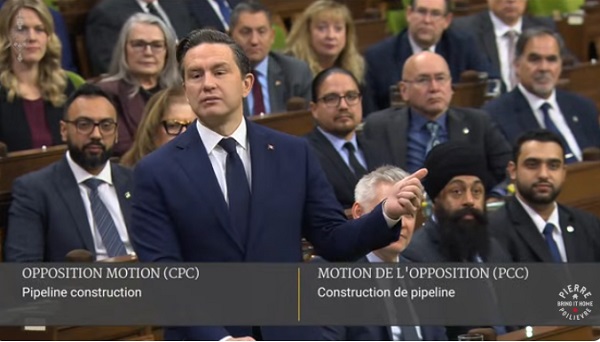
From Pierre Poilievre
From the Frontier Centre for Public Policy
By Ian Madsen
Canada’s growing LNG exports are opening global markets and reducing dependence on U.S. prices, if Ottawa allows the pipelines and export facilities needed to reach those markets
Canada’s LNG advantage is clear, but federal bottlenecks still risk turning a rare opening into another missed opportunity
Canada is finally in a position to profit from global LNG demand. But that opportunity will slip away unless Ottawa supports the pipelines and export capacity needed to reach those markets.
Most major LNG and pipeline projects still need federal impact assessments and approvals, which means Ottawa can delay or block them even when provincial and Indigenous governments are onside. Several major projects are already moving ahead, which makes Ottawa’s role even more important.
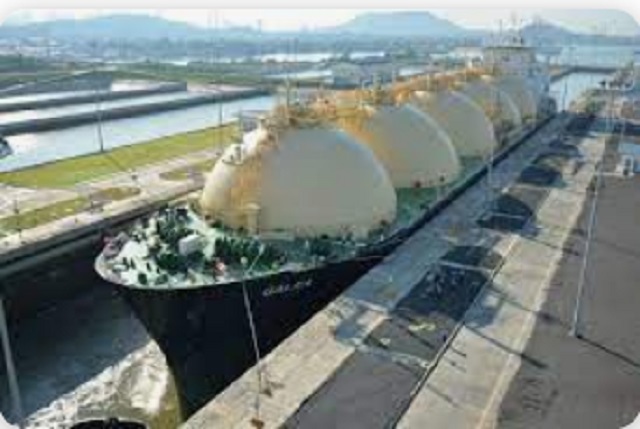
The Ksi Lisims floating liquefaction and export facility near Prince Rupert, British Columbia, along with the LNG Canada terminal at Kitimat, B.C., Cedar LNG and a likely expansion of LNG Canada, are all increasing Canada’s export capacity. For the first time, Canada will be able to sell natural gas to overseas buyers instead of relying solely on the U.S. market and its lower prices.
These projects give the northeast B.C. and northwest Alberta Montney region a long-needed outlet for its natural gas. Horizontal drilling and hydraulic fracturing made it possible to tap these reserves at scale. Until 2025, producers had no choice but to sell into the saturated U.S. market at whatever price American buyers offered. Gaining access to world markets marks one of the most significant changes for an industry long tied to U.S. pricing.
According to an International Gas Union report, “Global liquefied natural gas (LNG) trade grew by 2.4 per cent in 2024 to 411.24 million tonnes, connecting 22 exporting markets with 48 importing markets.” LNG still represents a small share of global natural gas production, but it opens the door to buyers willing to pay more than U.S. markets.
LNG Canada is expected to export a meaningful share of Canada’s natural gas when fully operational. Statistics Canada reports that Canada already contributes to global LNG exports, and that contribution is poised to rise as new facilities come online.
Higher returns have encouraged more development in the Montney region, which produces more than half of Canada’s natural gas. A growing share now goes directly to LNG Canada.
Canadian LNG projects have lower estimated break-even costs than several U.S. or Mexican facilities. That gives Canada a cost advantage in Asia, where LNG demand continues to grow.
Asian LNG prices are higher because major buyers such as Japan and South Korea lack domestic natural gas and rely heavily on imports tied to global price benchmarks. In June 2025, LNG in East Asia sold well above Canadian break-even levels. This price difference, combined with Canada’s competitive costs, gives exporters strong margins compared with sales into North American markets.
The International Energy Agency expects global LNG exports to rise significantly by 2030 as Europe replaces Russian pipeline gas and Asian economies increase their LNG use. Canada is entering the global market at the right time, which strengthens the case for expanding LNG capacity.
As Canadian and U.S. LNG exports grow, North American supply will tighten and local prices will rise. Higher domestic prices will raise revenues and shrink the discount that drains billions from Canada’s economy.
Canada loses more than $20 billion a year because of an estimated $20-per-barrel discount on oil and about $2 per gigajoule on natural gas, according to the Frontier Centre for Public Policy’s energy discount tracker. Those losses appear directly in public budgets. Higher natural gas revenues help fund provincial services, health care, infrastructure and Indigenous revenue-sharing agreements that rely on resource income.
Canada is already seeing early gains from selling more natural gas into global markets. Government support for more pipelines and LNG export capacity would build on those gains and lift GDP and incomes. Ottawa’s job is straightforward. Let the industry reach the markets willing to pay.
Ian Madsen is a senior policy analyst at the Frontier Centre for Public Policy.


Media bound to pay the price for selling their freedom to (selectively) offend

Sometimes An Ingrate Nation Pt. 2: The Great One Makes His Choice

Recent price declines don’t solve Toronto’s housing affordability crisis

From Exception to Routine. Why Canada’s State-Assisted Suicide Regime Demands a Human-Rights Review
-
 COVID-191 day ago
University of Colorado will pay $10 million to staff, students for trying to force them to take COVID shots
-
 Bruce Dowbiggin1 day ago
Integration Or Indignation: Whose Strategy Worked Best Against Trump?
-
 Focal Points2 days ago
Common Vaccines Linked to 38-50% Increased Risk of Dementia and Alzheimer’s
-
 espionage1 day ago
Western Campuses Help Build China’s Digital Dragnet With U.S. Tax Funds, Study Warns
-
 Opinion2 days ago
The day the ‘King of rock ‘n’ roll saved the Arizona memorial
-
 Bruce Dowbiggin1 day ago
Wayne Gretzky’s Terrible, Awful Week.. And Soccer/ Football.
-
 Agriculture1 day ago
Canada’s air quality among the best in the world
-
 Censorship Industrial Complex2 days ago
US Condemns EU Censorship Pressure, Defends X