
Economy
Obama chief scientist cools on climate crisis news coverage


Article originally published at CFACT.org
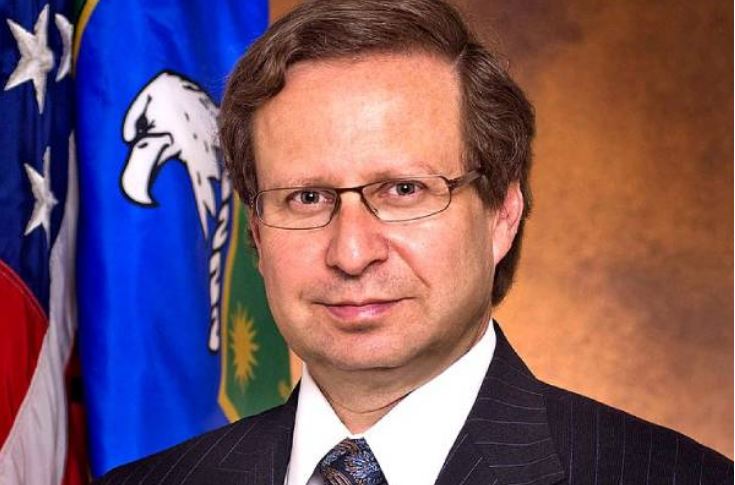
President Barack Obama’s Energy Department Chief Scientist Steven Koonin’s soon-to-be-published book will discuss information that the public really needs to have regarding grossly overheated “climate crisis” media hype.
Titled “Unsettled: What Climate Science Tells Us, What it Doesn’t, and Why It Matters,” a preview of it’s contents is provided in an April 16 Wall Street Journal interview with the author posted by Holman Jenkins, Jr.
Jenkins’ piece is titled “How a Physicist Became a Climate Truth Teller,” and I recommend it to readers who are interested in a fuller book content and author background account.
Having followed the science over more than a decade — and written a couple of pretty good books and likely a hundred or so articles on the subject — I find Koonin’s descriptive accuracy and candor enormously refreshing.
Sadly, few — if any — others in the Obama-Biden White House really cared about facts, paid attention, or learned anything from him at all.
First, because this is particularly relevant to me, Steven Koonin’s background as a physicist combines his technical understanding of applications and limitations of computer modeling of complex systems and practical experience in dealing with real-world realities such as assessing how we can most effectively and efficiently apply fundamental energy principles to meet complex human conditions and requirements.
Koonin taught physics at Caltech for nearly three decades, where he also served as provost; was recruited by the non-profit Institute for Defense Analysis which provided advisory services to military and congressional leaders; worked at JASON, another private scientific organization where he conducted and supervised cold-fusion energy and human genome mapping research; and later worked as chief scientist for British Petroleum (BP) which was later rebranded as “Beyond Petroleum.”
While at BP, Koonin created the multidisciplinary Energy Biosciences Institute at Berkeley which studies a wide range of scientific issues ranging from the isotopic composition of micro-fossils in the sea floor through regulation of industrial power plants.
Steven Koonin’s research into the world’s energy system led him to become convinced that the only “real climate crisis was a crisis of political and scientific candor,” and that the world “isn’t going to be able to reduce [greenhouse gas] emissions enough to make much difference.”
Koonin argues that while he supports responsible climate science, his issue is that what media and activist say about climate science has drifted so far out of touch with the actual science as to be absurdly, demonstrably false.
With reference to a 2019 report by presidents of the National Academy of Sciences which asserted that the “magnitude and frequency of certain extreme events are increasing,” for example, he notes that the “United Nations Intergovernmental Panel on Climate Change (IPCC), which is deemed to compile the best science, advised that all such claims should be treated with “low confidence.”
The U.S. government’s 2017 Climate Science Special Report had claimed that, in the lower 48 states, the “number of high temperature records set in the past two decades far exceeds the number of low temperature records.” On closer inspection, Koonin points out, “that’s because there’s been no increase in the rate of new record highs since 1900, only a decline in the number of new lows.”
A 2018 U.S. Fourth National Climate Assessment which relied on such “ovegged” worst-case emissions and temperature projections, Koonin concludes, “was written more to persuade than to inform.” He says, “It masquerades as objective science but was written — all right, I’ll use the word — propaganda.”
Koonin emphasizes the absurdity of basing climate change alarm on century-long forecasts claiming to know how 1% shifts in poorly understood variables will affect a future global climate that we don’t understand with anything even resembling that precision.
Nevertheless, the IPCC will issue a report next year that will purport to determine how much warming to expect by the end of this century based upon 40-plus computer model simulations which have been diverging in projections — not converging — coming together — as one would hope to enable determination of which one should be trusted.
Without tweaking, the modelers can’t even agree on a current simulated global average surface temperature — varying by 3 degrees Celsius – three times the observed change over the past century.

Koonin, both an experienced computer practitioner and modeling enthusiast, recognizes that they are wonderful where the simulation variables and their interactions being projected are well known and results can be empirically tested.
“But these are more controlled, engineered situations,” he adds, “whereas the climate is a natural phenomenon. It’s going to do whatever it’s going to do. And it’s hard to observe. You need long, precise observations to understand its natural variability and how it responds to external influences.”
Koonin, who has been building models and watching others do so over 45 years, cautions that climate models “are not to the standard you would trust your life or even trillions of dollars to.”
For the record, Koonin agrees — as many of my well-informed climate scientist friends also do — that the world has warmed by about 1 degree Celsius since 1900, and it will likely warm by another degree by the end of this century.
There is no dispute I’m aware of that temperatures began warming at the end of the last “Little Ice Age” in the mid-1800s — before the Industrial Revolution — and will likely continue to do so in fits-and-starts with little or no influence from us until Mother Nature once again changes her mind.
Neither Koonin nor any real-world scientific climate or economic studies, however, have seen anything in the offing which he says “would justify the rapid and wholesale abandoning of fossil fuels, even if China, India, Brazil, Indonesia and others could be dissuaded from pursuing prosperity.”
Even John Kerry, Joe Biden’s “climate czar,” recently admitted that the current administration’s “net-zero” climate plan will have zero effect if developing countries don’t go along, and as Koonin notes, “they have little incentive to do so.”
In any case, Koonin believes that any warming that occurs will emerge slowly and with modest effect — not a runaway crisis that alarmists such as Al Gore and John Kerry hype. To the extent that reduced CO2emissions will make any measurable difference, the solutions should let technology and markets work together at their own pace.
“The climate might to continue to change at a pace that’s hard to perceive, but society will adapt.”
Konnin adds, “As a species, we’re very good at adapting.”
Perhaps the biggest challenge will be to survive the current political climate crisis.
Author: CFACT Advisor Larry Bell heads the graduate program in space architecture at the University of Houston. He founded and directs the Sasakawa International Center for Space Architecture. He is also the author of “Climate of Corruption: Politics and Power Behind the Global Warming Hoax.”
Article originally published at CFACT.org
In 1985, the Committee For A Constructive Tomorrow (CFACT) was founded to promote a much-needed, positive alternative voice on issues of environment and development. Its co-founders, David Rothbard and Craig Rucker, strongly believed the power of the market combined with the applications of safe technologies could offer humanity practical solutions to many of the world’s most pressing concerns. A number of leading scientists, academics, and policy leaders soon joined them, along with thousands of citizens from around the U.S. and around the world.
Today, CFACT is a respected Washington D.C.-based organization whose voice can be heard relentlessly infusing the public-interest debate with a balanced perspective on environmental stewardship and other important issues. With an influential and impressive scientific advisory board, effective collegiate program on U.S. college campuses, CFACT Europe, official United Nations’ NGO representation, Adopt-A-Village project, Global Social Responsibility program, and “Just the Facts” daily national radio commentary, CFACT continues to offer genuine solutions to today’s most important global challenges.
CFACT has been termed “invaluable” by the Arizona Republic, it has been lauded for its “effort to bring sound science to the environmental debate” by a former president of the National Academy of Sciences, and has been praised by a respected Boston Herald columnist for “a record of supplying absolutely solid information.”


““He knows nothing; and he thinks he knows everything. That points clearly to a political career.” George Bernard Shaw
In the days immediately following Donald Trump’s rude intervention into the 2025 Canadian federal election— suggesting Canada might best choose American statehood— two schools of thought emerged.
The first and most impactful school in the short term was the fainting-goat response of Canadian’s elites. Sensing an opening in which to erode Pierre Poilievre’s massive lead in the 2024 polls over Justin Trudeau, the Laurentian elite concocted Elbows Up, a self-pity response long on hurt feelings and short on addressing the issues Trump had cited in his trashing of the Canadian nation state.
In short order they fired Trudeau into oblivion, imported career banker Mark Carney as their new leader in a sham convention and convinced Canada’s Boomers that Trump had the tanks ready to go into Saskatchewan at a moment’s notice. The Elbows Up meme— citing Gordie Howe— clinched the group pout.

(In fact, Trump has said that America is the world’s greatest market, and if those who’ve used it for free in the past [Canada] want to keep special access they need to pay tariffs to the U.S. or drop protectionist charges on dairy and more against the U.S.)
The ruse worked out better than they could have ever imagined with Trump even saying he preferred to negotiate with Carney over Poilievre. In short order the Tories were shoved aside, the NDP kneecapped and the pet media anointed Carney the genius skewing Canada away from its largest trade partner to the Eurosphere. We remain in that bubble, although the fulsome promises of Carney’s first days are now coming due.
Which brings us to the second reaction. That was Alberta premier Danielle Smith bolting to Mar A Lago in the days following Trump’s comments. Her goal was to put pride aside and accept that a new world order was in play for Canada. She met with U.S. officials and, briefly, with Trump to remind them that Canada’s energy industry was integral to American prosperity and Canadian stability.
Needless to say, the fainting goats pitched a fit that not everyone was clutching pearls and rending garments in the wake of Trump’s dismissive assessment of his northern neighbours. Their solution to Trump was to join China in retaliatory tariffs— the only two nations to do so— and to boycott American products and travel. Like the ascetic monks they cut themselves off from real life. Trump has yet to get back to Carney the Magnificent

And Smith? She was a “traitor” or a “subversive” who should be keel hauled in the North Saskatchewan. For much of the intervening months she has been attacked at home in Alberta by the N-Deeps and in Ottawa by just about everyone on CBC, CTV, Global and the Globe & Mail. “How could she meet with the Cheeto?”
Nonetheless conservatives in the province moved toward a more independence within Canada. Smith articulated her demands for Alberta to prevent a referendum on whether to remain within Confederation. At the top of her list were pipelines and access to tidewater. Ergo, a no-go for BC’s squish premier David Eby who is the process of handing over his province to First Nations.
It became obvious that for all of Carney’s alleged diplomacy in Europe and Asia (is the man ever home?) he had a brewing disaster in the West with Alberta and Saskatchewan growing restless. In a striking move against the status quo, Nutrien announced it would ship its potash to tidewater via the U.S., thereby bypassing Vancouver’s strike-prone, outdated port and denying them billions.

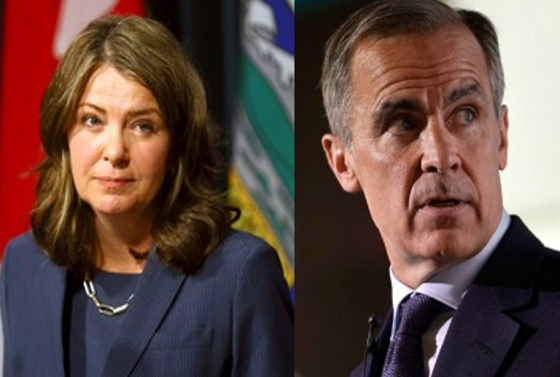
Suddenly, Smith’s business approach began making eminent good sense if the goal is to keep Canada as one. So we saw last week’s “memorandum of understanding” between Alberta and Ottawa trading off carbon capture and carbon taxes for potential pipelines to tidewater on the B.C. coast. A little bit of something for everyone and a surrender on other things.
The most amazing feature of the Mark Carney/Danielle Smith MOU is that both politicians probably need the deal to fail. Carney can tell fossil-fuel enemy Quebec that he tried to reason with Smith, and Smith can say she tried to meet the federalists halfway. Failure suits their larger purposes. Which is for Carney to fold Canada into Euro climate insanity and Smith into a strong leverage against the pro-Canada petitioners in her province.
Soon enough, at the AFN Special Chiefs Assembly, FN Chief Cindy Woodhouse Nepinak told Carney that “Turtle Island” (the FN term for North America popularized by white hippy poet Gary Snyder) belongs to the FN people “from coast to coast to coast.” The pusillanimous Eby quickly piped up about tanker bans and the sanctity of B.C. waters etc.
Others pointed out the massive flaw in a plan to attract private interests to build a vital bitumen pipeline if the tankers it fills are not allowed to sail through the Dixon Entrance to get to Asia.
But then Eby got Nutrien’s message that his power-sharing with the indigenous might cause other provinces to bypass B.C. (imagine California telling Texas it can’t ship through its ports over moral objections to a product). He’s now saying he’s open to pipelines but not to lift the tanker ban along the coast. Whatever.
Meanwhile the kookaburras of isolation back east continue with virtue signalling on American booze— N.S. to sell off its remains stocks — while dreaming that Trump’s departure will lead to the good-old days of reliance on America’s generosity.
But Smith looks to be wining the race. B.C.’s population shrank 0.04 percent in the second quarter of 2025, the only jurisdiction in Canada to do so. Meanwhile, Alberta is heading toward five million people, with interprovincial migrants making up 21 percent of its growth.
But what did you expect from the Carney/ Eby Tantrum Tandem? They keep selling fear in place of GDP. As GBS observed, “You have learnt something. That always feels at first as if you have lost something.”
Bruce Dowbiggin @dowbboy is the editor of Not The Public Broadcaster A two-time winner of the Gemini Award as Canada’s top television sports broadcaster, his new book Deal With It: The Trades That Stunned The NHL And Changed hockey is now available on Amazon. Inexact Science: The Six Most Compelling Draft Years In NHL History, his previous book with his son Evan, was voted the seventh-best professional hockey book of all time by bookauthority.org . His 2004 book Money Players was voted sixth best on the same list, and is available via brucedowbigginbooks.ca.

This article supplied by Troy Media.
 By Gwyn Morgan
Canada is paying a steep economic price for climate policies that have delivered little real environmental progress
In 2015, the newly elected Trudeau government signed the Paris Agreement. The following year saw the imposition of the Pan-Canadian Framework on Clean Growth and Climate Change, which included more than 50 measures aimed at “reducing carbon emissions and fostering clean technology solutions.” Key among them was economy-wide carbon “pricing,” Liberal-speak for taxes.
Other measures followed, culminating last December in the 2030 Emissions Reduction Plan, targeting emissions of 40 per cent below 2005 levels by 2030 and net-zero emissions by 2050. It included $9.1 billion for retrofitting structures, subsidizing zero-emission vehicles, building charging stations and subsidizing solar panels and windmills. It also mandated the phaseout of coal-fired power generation and proposed stringent emission standards for vehicles and buildings.
Other “green initiatives” included the “on-farm climate action fund,” a nationwide reforestation initiative to plant two billion trees, the “Green and Inclusive Community Buildings Program” to promote net-zero standards in new construction, and a “Green Municipal Fund” to support municipal decarbonization. That’s a staggering list of nation-impoverishing subsidies, taxes and restrictions.
Those climate measures come at a real cost to the industry that drives the nation’s economy.
The Trudeau government cancelled the Northern Gateway oil pipeline to the northwest coast, which had been approved by the Harper government, costing sponsors hundreds of millions of dollars in preconstruction expenditures. The political and regulatory morass the Liberals created eventually led to the cancellation of all but one of the 12 LNG export proposals.
Have all those taxes and regulatory measures reduced Canada’s fossil-fuel consumption? No. As Bjorn Lomborg has reported, between the election of the Trudeau government in 2015 through 2023, fossil fuels’ share of Canada’s energy supply increased from 75 to 77 per cent.
That dismal result wasn’t for lack of trying. The Fraser Institute has found that Ottawa and the four biggest provinces have either spent or forgone a mind-numbing $158 billion to create just 68,000 “clean” jobs, increasing the “green economy” by a minuscule 0.3 percentage points to 3.6 per cent of GDP at an eye-watering cost of more than $2.3 million per job.
That’s Canada’s emissions reduction debacle. What’s the global picture? A decade after Paris, 80 per cent of the world’s energy still comes from fossil fuels. World energy demand is up 150 per cent. Canada, which produces roughly 1.5 per cent of global emissions, cannot influence that trajectory. And, as Lomborg writes: “achieving net zero emissions by 2050 would require the removal of the equivalent of the combined emissions of China and the United States in each of the next five years. This puts us in the realm of science fiction.”
Does this mean our planet will become unlivable? A U.S. Department of Energy report issued in July is grounds for optimism. It finds that “claims of increased frequency or intensity of hurricanes, tornadoes, floods and droughts are not supported by U.S. historical data.” And it goes on: “CO2-induced warming appears to be less damaging economically than commonly believed and aggressive mitigation policies could be more detrimental than beneficial.”
U.S. Secretary of Energy Chris Wright responded to the report by saying: “Climate change is real … but it is not the greatest threat facing humanity … (I)mproving the human condition depends on access to reliable, affordable energy.”
That leaves no doubt as to where our largest trading partner stands on carbon emissions. But don’t expect Prime Minister Mark Carney, who helped launch the Glasgow Financial Alliance for Net Zero (GFANZ) at COP 26 in that city in 2021 and co-chaired it until this January, to soften his stand on carbon taxes. His just-released budget imposes carbon tax increases of $80 to $170 per ton by 2030 on our already struggling industries.
Doing so increases Canadian businesses’ competitive disadvantage with our most important trading partner while doing essentially nothing to help the environment.
Gwyn Morgan is a retired business leader who has been a director of five global corporations.
Troy Media empowers Canadian community news outlets by providing independent, insightful analysis and commentary. Our mission is to support local media in helping Canadians stay informed and engaged by delivering reliable content that strengthens community connections and deepens understanding across the country.


Health Canada pauses plan to sell unlabeled cloned meat

Is there a cure for Alzheimer’s Disease?

Google denies scanning users’ email and attachments with its AI software

Learning the Truth about “Children’s Graves” and Residential Schools is More Important than Ever
-
 Alberta2 days ago
This new Canada–Alberta pipeline agreement will cost you more than you think
-
 MAiD1 day ago
From Exception to Routine. Why Canada’s State-Assisted Suicide Regime Demands a Human-Rights Review
-
 Automotive2 days ago
Power Struggle: Governments start quietly backing away from EV mandates
-
 Business2 days ago
New Chevy ad celebrates marriage, raising children
-
 Business1 day ago
Carney government should privatize airports—then open airline industry to competition
-
 Energy2 days ago
Unceded is uncertain
-
 Alberta1 day ago
Carney’s pipeline deal hits a wall in B.C.
-
 Alberta1 day ago
Alberta Sports Hall of Fame Announces Class of 2026 Inductees