
Alberta
List of “non-essential businesses” – Alberta COVID-19 update


Update 14: COVID-19 pandemic in Alberta (March 27 at 8:30 p.m.)
From the Province of Alberta
Fifty-six additional cases of COVID-19 have been confirmed, bringing the total number of cases in the province to 542.
To protect Albertans and prevent the spread of COVID-19, the province has introduced new restrictions on mass gatherings and specific types of businesses.
Latest updates
- Cases have been identified in all zones across the province:
- 337 cases in the Calgary zone
- 120 cases in the Edmonton zone
- 30 cases in the North zone
- 43 cases in the Central zone
- 12 cases in the South zone
- Of these cases, 23 are currently hospitalized, including 10 admitted to intensive care units (ICU).
- In total, there have been 34 hospitalizations, with 11 admissions to an ICU.
- Two deaths have been reported.
- Up to 42 of the 542 cases may be due to community transmission.
- A COVID-19 outbreak was confirmed March 24 at the Nelson Home, a Calgary group home for persons with developmental disabilities. Two care workers and a resident have tested positive for COVID-19, and two other residents have been tested, with one negative result and no results available yet on a second. All individuals are self-isolating.
- To date, 20 cases have been identified in staff and residents of continuing care facilities, including 15 in McKenzie Towne Long Term Care, one case in Rosedale on the Park and four at Shepherd’s Care Kensington Village.
- There are six new confirmed recovered cases, bringing the total to 33.
- Aggregate data, showing cases by age range and zone, as well as by local geographical areas, is available online at alberta.ca/covid19statistics.
- All Albertans need to work together to help prevent the spread and overcome COVID-19.
- Public access to all courthouses in Alberta is restricted, and the Court of Queen’s Bench has updated the process of requesting emergency/urgent hearings.
Increased security for Alberta renters
A new package of direct supports and deferrals is being provided to provide security for residential renters amid the financial burden brought on by the COVID-19 crisis. Tenants will be protected from eviction for non-payment before May 1, 2020, rents will not increase during the state of public health emergency and late fees cannot be applied to rent payments for three months.
Vehicle restrictions in parks and recreation areas
Automobile access is temporarily suspended at all provincial park and recreation area access points. This matches the restrictions currently in place at national parks.
New restrictions on non-essential businesses
New restrictions are in place for close contact businesses, dine-in restaurants and non-essential retail services.
Non-essential retail services include:
- Gift and specialty stores
- Jewellery & accessories
- Non-essential health and beauty care
- Luggage
- Art and framing
- Mens’, ladies’ and children’s wear
- Shoes
- Bridal
- Computers & gaming
- Hobby & Toy
- Photo, music and books
- Sporting goods
List of essential workplaces
The list of essential workplaces that can continue to operate in Alberta can be found here.
New restrictions on mass gatherings
In addition, Albertans are prohibited from attending gatherings of more than 15 people, and they must continue to observe two metres of social distancing. Additional information can be found in this news release.
Recruiting physicians
The College of Physicians and Surgeons of Alberta has developed an online tool for Alberta physicians to self-report their ability to be redeployed to help with the COVID-19 pandemic. Once the College has identified doctors who can provide additional services, AHS will help with recruitment and ensure the doctors are deployed to the areas of greatest need where they will have the most impact.
Operating guide for continuing care
A new guide with mandated directions on how to respond to and prevent COVID-19 concerns and cases has been posted online for operators of continuing care facilities, seniors lodges, residential addiction treatment facilities and licensed facilities for person with disabilities.
Diagnostic imaging and lab tests
Effective immediately, Alberta Health Services (AHS) is postponing some diagnostic imaging procedures as part of the effort to prevent spread of COVID-19 and protect Albertans. Imaging deemed to be non-urgent by the ordering physician will be postponed.
AHS will work closely with patients whose exams are being rescheduled. Patients whose conditions change should connect with their physicians.
To free up more laboratory space for COVID-19 testing, physicians and community providers are being asked to immediately stop all non-essential and routine laboratory testing.
Flexibility for municipal governments
Government has added a new COVID-19 containment measure under the Municipal Government Act (MGA) called the COVID-19 Suppression Regulation. This gives local governments flexibility in doing business during the COVID-19 outbreak, including the option to hold meetings while still observing physical distancing. Municipal Affairs has extended a number of reporting timelines under the MGA, giving municipalities the time and ability to deliver on the needs of their residents and meet the requirements set out by the Act.

Mental health supports
AHS has boosted its service to help Albertans should they need to speak with someone about mental health concerns.
If Albertans call the Mental Health Help Line at 1-877-303-2642 or the Addiction Help Line at 1-866-332-2323 between 7 a.m. and 11 p.m., seven days a week, they will be connected directly to a dedicated team of AHS addiction and mental health staff.
This change will support 811 operators to focus on COVID-19 calls during the day and improve wait times for others needing telephone advice. Calls placed from 11 p.m. to 7 a.m. will continue to be routed through 811.
Pausing some health construction projects and non-essential service contracts
In order to protect patients, families and staff providing key services inside health-care facilities, AHS has informed some contractors and vendors that provide non-essential services at some health facilities that their projects will be temporarily paused.
These include non-essential delivery services and facility maintenance, such as flooring replacement, departmental renovations or lighting retrofit projects.
Alberta Infrastructure is also working with AHS to ensure that construction projects being done inside health facilities do not impact the operations of the facility.
As each project is reviewed and assessed, Infrastructure will provide notice to affected contractors if any projects are deferred.
Emergency isolation supports
Emergency isolation supports are available for Albertans who are self-isolating or who are the sole caregivers for someone in self-isolation, and have no other source of income. Applicants can view eligibility criteria and apply at alberta.ca. To carefully manage the flow of applications, we are periodically closing access to MADI and the Emergency Isolation Support. We will provide daily updates about system availability.
Access to justice
Effective March 30, 2020, public access to all courthouses in Alberta will be restricted until further notice. Members of the general public will only be permitted to enter a courthouse in certain circumstances. More information: https://www.albertacourts.ca/qb/resources/announcements/notice-to-the-public-and-legal-profession-restricted-access-to-courthouses.
The Court of Queen’s Bench is accepting requests for emergency/urgent hearings in all criminal, family, commercial and civil matters online or over the phone (for parties without access to the internet). More information: https://www.albertacourts.ca/qb/resources/announcements/requests-to-the-court-for-emergency-urgent-hearings.
Food supply
Despite higher retail demand, Alberta’s food supply remains secure. Government is in regular contact with other levels of government, producers, distributors, retailers and processors to ensure it stays that way. We are working with food banks and Indigenous communities to understand their needs and ensure everyone has access to the food supplies they need.
Medical evaluation for drivers’ licences
Alberta Transportation has extended the timeline to 90 days for most drivers requiring a medical evaluation to complete their medical form when applying for or renewing their licence. This will reduce the current strain on the health-care system. Medically high-risk drivers will still be required to present their medical evaluation at the time of their application or renewal.
Offers of help
The Alberta Emergency Management Agency Unsolicited Offers Program has been set up in response to growing offers of generosity from individuals and organizations to help with the challenges many Albertans are facing due to the COVID-19 pandemic. Those wanting to help can go toalberta.ca/COVID19offersprogram for more information.
Quick facts
- The most important measures that Albertans can take to prevent respiratory illnesses, including COVID-19, is to practise good hygiene.
- This includes cleaning your hands regularly for at least 20 seconds, avoiding touching your face, coughing or sneezing into your elbow or sleeve, disposing of tissues appropriately, and staying home and away from others if you are sick.
- Anyone who has health concerns or is experiencing symptoms of COVID-19 should complete an online COVID-19 self-assessment.
- For recommendations on protecting yourself and your community, visit alberta.ca/COVID19.



From LifeSiteNews
It is not yet clear if the flag motion applies to other flags, such as LGBT ones.
Western Canada’s largest city has put in place what amounts to a ban on politically charged flags from flying at city-owned buildings.
“Calgary’s Flag Policy means any country recognized by Canada may have their flag flown at City Hall on their national day,” said Calgary’s new mayor Jeromy Farkas on X last month.
“But national flag-raisings are now creating division. Next week, we’ll move to end national flag-raisings at City Hall to keep this a safe, welcoming space for all.”
The motion to ban foreign flags from flying at government buildings was introduced on December 15 by Calgary councilor Dan McLean and passed by a vote of 8 to 7. He had said the previous policy to allow non-Canadian flags to fly, under former woke mayor Jyoti Gondek, was “source of division within our community.”
“In recent months, this practice has been in use in ways that I’ve seen have inflamed tensions, including instances where flag raisings have been associated with anti-Semitic behavior and messaging,” McLean said during a recent council meeting.
The ban on flag raising came after the Palestinian flag was allowed to be raised at City Hall for the first time.
Farkas, shortly after being elected mayor in the fall of 2025, had promised that he wanted a new flag policy introduced in the city.
It is not yet clear if the flag motion applies to other flags, such as LGBT ones.
Despite Farkas putting forth the motion, as reported by LifeSiteNews he is very much in the pro-LGBT camp. However, he has promised to focus only on non-ideological issues during his term.
McLean urged that City Hall must be a place of “neutrality, unity, and respect” for everyone.
“When City Hall becomes a venue for geopolitical expressions, it places the city in the middle of conflicts that are well beyond our municipal mandates,” he said.
As reported by LifeSiteNews, other jurisdictions in Canada are considering banning non-Canadian flags from flying over public buildings.
Recently a political party in British Columbia, OneBC, introduced legislation to ban non-domestic government flags at public buildings in British Columbia.
Across Canada there has also been an ongoing issue with so-called “Pride” flags being raised at schools and city buildings.
From Resource Works
Can we please just get on with building one through British Columbia instead?
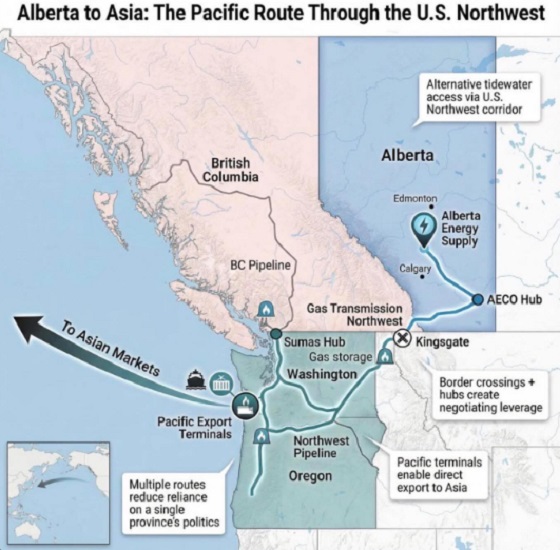
Alberta Premier Danielle Smith is signalling she will look south if Canada cannot move quickly on a new pipeline, saying she is open to shipping oil to the Pacific via the U.S. Pacific Northwest. In a year-end interview, Smith said her “first preference” is still a new West Coast pipeline through northern British Columbia, but she is willing to look across the border if progress stalls.
“Anytime you can get to the West Coast it opens up markets to get to Asia,” she said. Smith also said her focus is building along “existing rights of way,” pointing to the shelved Northern Gateway corridor, and she said she would like a proposal submitted by May 2026.
Deadlines and strings attached
The timing matters because Ottawa and Edmonton have already signed a memorandum of understanding that backs a privately financed bitumen pipeline to a British Columbia port and sends it to the new Major Projects Office. The agreement envisages at least one million barrels a day and sets out a plan for Alberta to file an application by July 1, 2026, while governments aim to finish approvals within two years.
The bargain comes with strings. The MOU links the pipeline to the Pathways carbon capture network, and commits Alberta to strengthen its TIER system so the effective carbon credit price rises to at least 130 dollars a tonne, with details to be settled by April 1, 2026.
Shifting logistics
If Smith is floating an American outlet, it is partly because Pacific Northwest ports are already drawing Canadian exporters. Nutrien’s plan for a $1-billion terminal at Washington State’s Port of Longview highlighted how trade logistics can shift when proponents find receptive permitting lanes.
But the political terrain in Washington and Oregon is unforgiving for fossil fuel projects, even for natural gas. In 2023, federal regulators approved TC Energy’s GTN Xpress expansion over protests from environmental groups and senior officials in West Coast states, with opponents warning about safety and wildfire risk. The project would add about 150 million cubic feet per day of capacity.
A record of resistance
That decision sits inside a longer record of resistance. The anti-development activist website “DeSmog” eagerly estimated that more than 70 percent of proposed coal, oil, and gas projects in the Pacific Northwest since 2012 were defeated, often after sustained local organizing and legal challenges.
Even when a project clears regulators, economics can still kill it. Gas Outlook reported that GTN later said the expansion was “financially not viable” unless it could obtain rolled-in rates to spread costs onto other utilities, a request regulators rejected when they approved construction.
Policy direction is tightening too. Washington’s climate framework targets cutting climate pollution 95 percent by 2050, alongside “clean” transport, buildings, and power measures that push electrification. Recent state actions described by MRSC summaries and NRDC notes reinforce that direction, including moves to help utilities plan a transition away from gas.
Oregon is moving in the same direction. Gov. Tina Kotek issued an executive order directing agencies to move faster on clean energy permitting and grid connections, tied to targets of cutting emissions 50 percent by 2035 and 90 percent by 2050, the Capital Chronicle reported.
For Smith, the U.S. corridor talk may be leverage, but it also underscores a risk, the alternative could be tougher than the Canadian fight she is already waging. The surest way to snuff out speculation is to make it unnecessary by advancing a Canadian project now that the political deal is signed. As Resource Works argued after the MOU, the remaining uncertainty sits with private industry and whether it will finally build, rather than keep testing hypothetical routes.
Resource Works News


Death by a thousand clicks – government censorship of Canada’s internet

Chinese Billionaire Tried To Build US-Born Baby Empire As Overseas Elites Turn To American Surrogates

Viral TikTok video shows 7-year-old cuddling great-grandfather before he’s euthanized

Politicians should be honest about environmental pros and cons of electric vehicles
-
 Agriculture21 hours ago
Why is Canada paying for dairy ‘losses’ during a boom?
-
 Automotive1 day ago
Ford’s EV Fiasco Fallout Hits Hard
-
 Crime2 days ago
The Uncomfortable Demographics of Islamist Bloodshed—and Why “Islamophobia” Deflection Increases the Threat
-
 Alberta22 hours ago
Alberta’s new diagnostic policy appears to meet standard for Canada Health Act compliance
-
 Censorship Industrial Complex23 hours ago
Top constitutional lawyer warns against Liberal bills that could turn Canada into ‘police state’
-
 espionage2 days ago
Carney Floor Crossing Raises Counterintelligence Questions aimed at China, Former Senior Mountie Argues
-
 International2 days ago
Ottawa is still dodging the China interference threat
-
 Health2 days ago
All 12 Vaccinated vs. Unvaccinated Studies Found the Same Thing: Unvaccinated Children Are Far Healthier