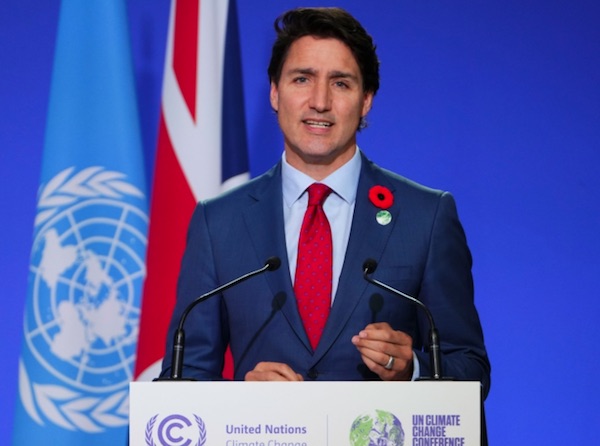
#Just out of his electric Jaguar (because nothing says “I’m staying in touch with the average person” like a Jaguar), Justin Trudeau took the stage at the Conference of the Parties (COP26) meeting in Glasgow yesterday.
Trudeau’s message in Glasgow: his extreme green agenda is about to get, well, more extreme.
Here are the “highlights”:
– a carbon tax set to reach 170 dollars a ton in less than a decade. (Over four times its current price);
– a second carbon tax called the “Clean Fuel Standard”, or CFS, that he sneaked by with little notice as a regulation;
– a tax on methane that is, in effect, a third carbon tax for anyone using natural gas (and this represents more than a third of our energy in Canada);
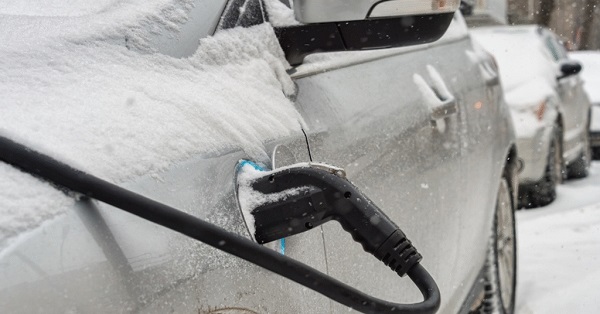
– billions in handouts to cities to buy electric buses that then don’t work well in the Canadian winter (and in some cases need polluting diesel generators to be heated);
– billions to the provinces for electric vehicle charging station subsidies so that people wealthy enough to buy an electric car can find a place to charge it;
– billions in handouts to an international fund to help other countries reduce their emissions with the same;
And that’s not all, even at a time when the country is massively in debt and more so every day, when the cost of living is rising dramatically and banks are now signaling interest rate rises are coming, when Canadians are trying to come out of over a year and a half of unprecedented lockdowns and start society up again……..
Now the Prime Minister says Canada will put an absolute cap on oil and gas emissions, and lower that cap every year.
All these announcements might seem like mere noise to most of us. This is because we don’t appreciate the day-to-day implications – who has the time to figure out what all of this means? And it sounds good, doesn’t it? You know, because “green.” Because it’s 2015, um, no – because it’s 2021.
But Canadians need to know these latest installments of Trudeau’s green agenda have very real implications. And yesterday’s announcement should drive the point home.
If you don’t allow greenhouse gas (GHG) emissions to rise, how do you build infrastructure projects? How do you grow your economy? How do you deliver oil and gas exports to nations that want them and can’t believe we won’t export them? How do you get our oil and gas – some of the most cleanly produced in the world – to places where people still heat with much dirtier, much less efficient, much less healthy wood and dung? The fact is you don’t.
Trudeau’s announcement is his most powerful signal yet that he will kill the Canadian economy to satisfy his ideological green agenda. Our lives are about to become significantly more expensive.
And this doesn’t have to happen.
But Trudeau is making it happen.
Will resource company CEOs finally stand-up?
Will all those executives bending over backwards to show how committed they are to being “green” finally defend the interests of their shareholders – all of us who have their stocks in our RSPs and pension funds – and say “enough is enough”? Will our energy executives start to express even the slightest interest in the hundreds of thousands of Canadians currently in their employ – people who will lose their jobs as a result of Trudeau’s policies?
Life is going to get even less affordable. But wow, that electric Jaguar is a nice-looking car isn’t it?
An 18 year veteran of the House of Commons, Dan is widely known in both official languages for his tireless work on energy pricing and saving Canadians money through accurate price forecasts. His Parliamentary initiatives, aimed at helping Canadians cope with affordable energy costs, led to providing Canadians heating fuel rebates on at least two occasions.
Widely sought for his extensive work and knowledge in energy pricing, Dan continues to provide valuable insights to North American media and policy makers. He brings three decades of experience and proven efforts on behalf of consumers in both the private and public spheres. Dan is committed to improving energy affordability for Canadians and promoting the benefits we all share in having a strong and robust energy sector.
An 18 year veteran of the House of Commons, Dan is widely known in both official languages for his tireless work on energy pricing and saving Canadians money through accurate price forecasts. His Parliamentary initiatives, aimed at helping Canadians cope with affordable energy costs, led to providing Canadians heating fuel rebates on at least two occasions.
Widely sought for his extensive work and knowledge in energy pricing, Dan continues to provide valuable insights to North American media and policy makers. He brings three decades of experience and proven efforts on behalf of consumers in both the private and public spheres. Dan is committed to improving energy affordability for Canadians and promoting the benefits we all share in having a strong and robust energy sector.
Things have only gone from bad to worse for the global Electric Vehicle industry. And that’s a problem for Canada, because successive Liberal governments have done everything in their power to hitch our cart to that horse.
Earlier this month, the Trump Administration rolled back more Biden-era regulations that effectively served as a back-door EV mandate in the United States. These rules mandated that all passenger cars be able to travel at least 65.1 miles (and for light trucks, 45.2 miles) per gallon of gasoline or diesel, by the year 2031. Since no Internal Combustion Engine (ICE) vehicle could realistically conform to those standards, that would have essentially boxed them out of the market.
Trump’s rolling them back was a fulfillment of his campaign promise to end the Biden Administration’s stealth EV mandates. But it was also a simple recognition of the reality that EVs can’t compete on their own merits.
For proof of that, look no further than our second bit of bad news for EVs: Ford Motor Company has just announced a massive $19.5 billion write-down, almost entirely linked to its aggressive push into EVs. They’ve lost $13 billion on EVs in the past two years alone.
The company invested tens of billions on these go-carts, and lost their shirt when it turned out the market for them was miniscule.
Ford’s EV division president Andrew Frick explained, “Ford is following the customer. We are looking at the market as it is today, not just as everyone predicted it to be five years ago.”
Of course, five years ago, the market was assuming that government subsidies-plus-mandates would create a market for EVs at scale, which hasn’t happened.
As to what this portends for the market, the Wall Street Journalargued, “The company’s pivot from all-electric vehicles is a fresh sign that America’s roadways – after a push to remake them – will continue to look in the near future much like they do today, with a large number of gas-powered cars and trucks and growing use of hybrids.”
And that’s not just true in the U.S. Across the Atlantic, reports suggest the European Union is preparing to delay their own EV mandates to 2040. And the U.K.’s Labour government is considering postponing their own 2030 ICE vehicle ban to align with any EU change in policy.
It’s looking like fewer people around the world will be forced by their governments to buy EVs. Which means that fewer people will be buying EVs.
Now, that is a headache for Canada. Our leaders, at both the federal and provincial levels, have bet big on the success of EVs, investing billions in taxpayer dollars in the hopes of making Canada a major player in the global EV supply chain.
To bolster those investments, Ottawa introduced its Electric Vehicle mandate, requiring 100 per cent of new light-duty vehicle sales to be electric by 2035. This, despite the fact that EVs remain significantly more expensive than gas-and-diesel driven vehicles, they’re poorly suited to Canada’s vast distances and cold climate, and our charging infrastructure is wholly inadequate for a total transition to EVs.
But even if these things weren’t true, there still aren’t enough of us to make the government’s investment make sense. Their entire strategy depends on exporting to foreign markets that are rapidly cooling on EVs.
Collapsing demand south of the border – where the vast majority of the autos we build are sent – means that Canadian EVs will be left without buyers. And postponed (perhaps eventually canceled) mandates in Europe mean that we will be left without a fallback market.
Canadian industry voices are growing louder in their concern. Meanwhile, plants are already idling, scaling back production, or even closing, leaving workers out in the cold.
As GM Canada’s president, Kristian Aquilina, said when announcing her company’s cancellation of the BrightDrop Electric delivery van, “Quite simply, we just have not seen demand for these vehicles climb to the levels that we initially anticipated…. It’s simply a demand and a market-driven response.”
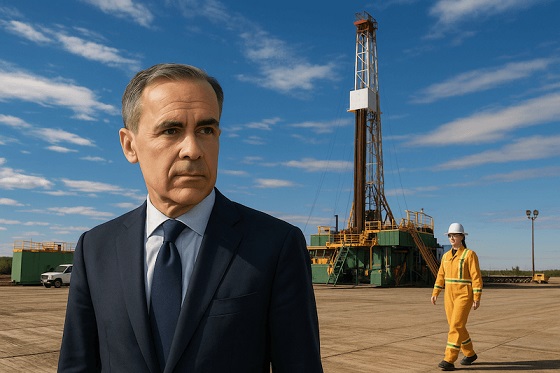
Prime Minister Mark Carney, while sharing much of the same environmental outlook as his predecessor, has already been compelled by economic realities to make a small adjustment – delaying the enforcement of the 2026 EV sales quotas by one year.
But a one-year pause doesn’t solve the problem. It kicks the can down the road.
Mr. Carney must now make a choice. He can double down on this troubled policy, continuing to throw good money after bad, endangering a lot of jobs in our automotive sector, while making transportation more expensive and less reliable for Canadians. Or he can change course: scrap the mandates, end the subsidies, and start putting people and prosperity ahead of ideology.
Here’s hoping he chooses the latter.
The writing is on the wall. Around the world, the forced transition to EVs is crashing into economic reality. If Canada doesn’t wake up soon, we’ll be left holding the bag.