
COVID-19
2017 Influenza VS 2020 COVID19 – A comparison


We’ve all heard the claim “COVID19 is no worse than the flu”.
Is this true? Now that COVID19 has been around for about a year we can look at the numbers and make some definitive observations.
The first case of COVID19 in Canada was reported by Health Canada on Jan. 25, in a Toronto man who had recently travelled from Wuhan. Nine months later, COVID19 has swept the country, devastated economies, and is responsible for the death of over 12,000 Canadians. In some areas measures to control the spread seem to be working, in other areas despite a range of measures, it’s spreading rapidly. There’s still so many unknowns and COVID19 remains nearly as mysterious as when it first appeared. As usual in a situation where knowledge is lacking, fear is not. The Canada Suicide Prevention Service reported to the Canadian Press that in September, 18% of their calls came from people worried about their finances while 26% of their calls were from people very worried that they or someone close to them would contract COVID-19. It’s very likely the claim COVID is no worse than the flu is an understandable response and an attempt to calm this “fear of the unknown”. It is true that so far the survival rate is closer to 100% than it is to 99% for those of us under the age of 60, but can we truly compare COVID and influenza?
The first thing we have to do is dismiss any comparisons with the 1918 Spanish Flu Pandemic
The only other time millions of Canadians tried to protect themselves with masks was during the 1918 Spanish Flu Pandemic. Actually there is no comparison between the severity of these 2 viruses. The 1918 Spanish Flu was FAR more devastating. We can put this comparison to rest immediately. According to government figures the 1918 ” international pandemic killed approximately 55,000 people in Canada, most of whom were young adults between the ages of 20 and 40.” As of early December, COVID19 is responsible for under 12,500 deaths in Canada. There are fewer deaths (so far) and the age group most severely attacked is much, much older. The majority of COVID19 fatalities are at, or above the life expectancy of Canadians (82.37 years of age in 2019).
So what about the regular flu? Is it true that COVID19 is no worse that the (regular) flu?
Well if you’re going to make a claim that the flu is as bad as COVID19 you’d better pick a pretty bad flu season to compare. 2017 was a bad year for the flu in Alberta. About the worst in the past 10 years. According to the 2017 Seasonal Influenza Summary Reports on the Alberta Health Website:
2017 Influenza – 9,069 laboratory-confirmed influenza cases (the largest number of cases in the previous five seasons)
2017 Influenza – 3,053 hospitalizations, 242 ICU admissions and 92 deaths
Compare these numbers to the stats from the Province of Alberta’s COVID19 website.

2020 COVID19 (to Dec 4) – 64,261 positive tests
2020 COVID19 (to Dec 4) – 2,096 hospitalizations, 379 ICU admissions and 590 deaths.
Up to December 4 there were actually more people hospitalized due to the flu in the 2017 / 2018 season, but that number looks like it will tip toward COVID19 in the next week or less. The other numbers swing heavily toward COVID19 being worse than the flu. Furthermore, it’s important to note COVID19 is NOT behind us yet. So while the numbers here are current to the beginning of December, it could be nearly another year (when vaccines have been widely distributed everywhere) before we’re more-less finished with COVID19 in this first series of waves.
Our final answer
Within the next week or so (after 58 more people are hospitalized) COVID19 will conclusively be worse and in the end far worse than the flu in every category our health system measures.
Interesting Final Note
Having said all this, a remarkable thing is happening with the 2020 flu season. So far there isn’t one. According to Health Canada’s weekly FluWatch Report as of the end of November there is no evidence of community circulation of the flu virus in Canada. Officials are not sure why but they suggest the lack of positive flu tests may be related to the existence of COVID19.


From LifeSiteNews
The Justice Department attorney did not mention the Trump FDA’s recent admission linking the COVID shots to at least 10 child deaths so far.
The Trump Department of Justice (DOJ) is attempting to dismiss a whistleblower case against Pfizer over its COVID-19 shots, even as the Trump Food & Drug Administration (FDA) is beginning to admit their culpability in children’ s deaths.
As previously covered by LifeSiteNews, in 2021 the BMJ published a report on insider information from a former regional director of the medical research company Ventavia, which Pfizer hired in 2020 to conduct research for the company’s mRNA-based COVID-19 shot.
The regional director, Brook Jackson, sent BMJ “dozens of internal company documents, photos, audio recordings, and emails,” which “revealed a host of poor clinical trial research practices occurring at Ventavia that could impact data integrity and patient safety […] We also discovered that, despite receiving a direct complaint about these problems over a year ago, the FDA did not inspect Ventavia’s trial sites.”
According to the report, Ventavia “falsified data, unblinded patients, employed inadequately trained vaccinators, and was slow to follow up on adverse events reported in Pfizer’s pivotal phase III trial.” Overwhelmed by numerous problems with the trial data, Jackson filed an official complaint with the FDA.
Jackson was fired the same day, and Ventavia later claimed that Jackson did not work on the Pfizer COVID-19 shot trial; but Jackson produced documents proving she had been invited to the Pfizer trial team and given access codes to software relating to the trial. Jackson filed a lawsuit against Pfizer for violating the federal False Claims Act and other regulations in January 2021, which was sealed until February 2022. That case has been ongoing ever since.
Last August, U.S. District Judge Michael Truncale dismissed most of Jackson’s claims with prejudice, meaning they could not be refiled. Jackson challenged the decision, but the Trump DOJ has argued in court to uphold it, Just the News reports, with DOJ attorney Nicole Smith arguing that the case concerns preserving the government’s unfettered power to dismiss whistleblower cases.
The rationale echoes a recurring trend in DOJ strategy that Politico described in May as “preserving executive power and preventing courts from second-guessing agency decisions,” even in cases that involve “backing policies favored by Democrats.”
Jackson’s attorney Warner Mendenhall responded that the administration “really sort of made our case for us” in effectively admitting that DOJ is taking the Fair Claims Act’s “good cause” standard for state intervention to mean “mere desire to dismiss,” which infringes on his client’s “First Amendment right to access the courts, to vindicate what she learned.”
Mendenhall added that in a refiled case, Jackson “may be able to bring a very different case along the same lines, but with the additional information” to prove fraud, whereas rejection would send the message that “if fraud involves government complicity, don’t bother reporting it.”
That additional information would presumably include the FDA’s recent admission that at least 10 children the agency has reviewed so far “died after and because of receiving COVID-19 vaccination.”
“The truth is we do not know if we saved lives on balance,” admitted FDA Chief Medical Officer Vinay Prasad in a recent leaked email. “It is horrifying to consider that the U.S. vaccine regulation, including our actions, may have harmed more children than we saved. This requires humility and introspection.”
The COVID shots have been highly controversial ever since the first Trump administration’s Operation Warp Speed initiative prepared and released them in a fraction of the time any previous vaccine had ever been developed and tested. As LifeSiteNews has extensively covered, a large body of evidence has steadily accumulated over the past five years indicating that the COVID jabs failed to prevent transmission and, more importantly, carried severe risks of their own.
Ever since, many have intently watched and hotly debated what President Donald Trump would do about the situation upon his return to office. Though he never backed mandates like former President Joe Biden did, for years Trump refused to disavow the shots to the chagrin of his base, seeing Operation Warp Speed as one of his crowning achievements. At the same time, during his latest run he embraced the “Make America Healthy Again” movement and its suspicion of the medical establishment more broadly.
So far, Trump’s second administration has rolled back several recommendations for the shots but not yet pulled them from the market, despite hiring several vocal critics of the COVID establishment and putting the Department of Health & Human Services under the leadership of America’s most prominent anti-vaccine advocate, Robert F. Kennedy Jr. Most recently, the administration has settled on leaving the current jabs optional but not supporting work to develop successors.
In a July interview, FDA Commissioner Marty Makary asked for patience from those unsatisfied by the administration’s handling of the shots, insisting more time was needed for comprehensive trials to get more definitive data.
COVID-19
University of Colorado will pay $10 million to staff, students for trying to force them to take COVID shots

From LifeSiteNews
The University of Colorado Anschutz School of Medicine caused ‘life-altering damage’ to Catholics and other religious groups by denying them exemptions to its COVID shot mandate, and now the school must pay a hefty settlement.
The University of Colorado’s Anschutz School of Medicine must pay more than $10.3 million to 18 plaintiffs it attempted to force into taking COVID-19 shots despite religious objections, in a settlement announced by the religious liberty law firm the Thomas More Society.
As previously covered by LifeSiteNews, in April 2021, the University of Colorado (UC) announced its requirement that all staff and students receive COVID jabs, leaving specific policy details to individual campuses. On September 1, 2021, it enforced an updated policy stating that “religious exemption may be submitted based on a person’s religious belief whose teachings are opposed to all immunizations,” but required not only a written explanation why one’s “sincerely held religious belief, practice of observance prevents them” from taking the jabs, but also whether they “had an influenza or other vaccine in the past.”
On September 24, the policy was revised to stating that “religious accommodation may be granted based on an employee’s religious beliefs,” but “will not be granted if the accommodation would unduly burden the health and safety of other Individuals, patients, or the campus community.”
In practice, the school denied religious exemptions to Catholic, Buddhist, Eastern Orthodox, Evangelical, Protestant, and other applicants, most represented by Thomas More in a lawsuit contending that administrators “rejected any application for a religious exemption unless an applicant could convince the Administration that her religion ‘teaches (them) and all other adherents that immunizations are forbidden under all circumstances.’”
The UC system dropped the mandate in May 2023, but the harm had been done to those denied exemptions while it was in effect, including unpaid leave, eventual firing, being forced into remote work, and pay cuts.
In May 2024, a three-judge panel of the U.S. Tenth Circuit Court of Appeals rebuked the school for denying the accommodations. Writing for the majority, Judge Allison Eid found that a “government employer may not punish some employees, but not others, for the same activity, due only to differences in the employee’s religious beliefs.”
Now, Thomas More announces that year-long settlement negotiations have finally secured the aforementioned hefty settlement for their clients, covering damages, tuition costs, and attorney’s fees. It also ensured the UC will agree to allow and consider religious accommodation requests on an equal basis to medical exemption requests and abstain from probing the validity of applicants’ religious beliefs in the future.
“No amount of compensation or course-correction can make up for the life-altering damage Chancellor Elliman and Anschutz inflicted on the plaintiffs and so many others throughout this case, who felt forced to succumb to a manifestly irrational mandate,” declared senior Thomas More attorney Michael McHale. “At great, and sometimes career-ending, costs, our heroic clients fought for the First Amendment freedoms of all Americans who were put to the unconscionable choice of their livelihoods or their faith during what Justice Gorsuch has rightly declared one of ‘the greatest intrusion[s] on civil liberties in the peacetime history of this country.’ We are confident our clients’ long-overdue victory indeed confirms, despite the tyrannical efforts of many, that our shared constitutional right to religious liberty endures.”
On top of the numerous serious adverse medical events that have been linked to the COVID shots and their demonstrated ineffectiveness at reducing symptoms or transmission of the virus, many religious and pro-life Americans also object to the shots on moral grounds, due to the ethics of how they were developed.
According to a detailed overview by the pro-life Charlotte Lozier Institute, Pfizer, Moderna, and Johnson & Johnson all used fetal cells derived from aborted babies during their COVID shots’ testing phase; and Johnson & Johnson also used the cells during the design and development and production phases. The American Association for the Advancement of Science’s journal Science and even the left-wing “fact-checking” outlet Snopes have also admitted the shots’ abortion connection, which gives many a moral aversion to associating with them.
Catholic World Report notes that similarly large sums have been won in other high-profile lawsuits against COVID shot mandates, including $10.3 million to more than 500 NorthShore University HealthSystem employees in 2022 and $12.7 million to a Catholic Michigander fired by Blue Cross Blue Shield in 2024.


Wayne Gretzky’s Terrible, Awful Week.. And Soccer/ Football.

Western Campuses Help Build China’s Digital Dragnet With U.S. Tax Funds, Study Warns
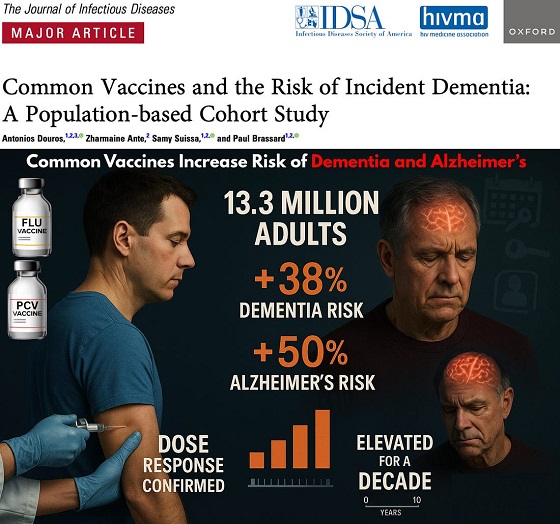
Common Vaccines Linked to 38-50% Increased Risk of Dementia and Alzheimer’s

The day the ‘King of rock ‘n’ roll saved the Arizona memorial
-
espionage2 days ago
Western Campuses Help Build China’s Digital Dragnet With U.S. Tax Funds, Study Warns
-
Focal Points2 days ago
Common Vaccines Linked to 38-50% Increased Risk of Dementia and Alzheimer’s
-
 Automotive1 day ago
The $50 Billion Question: EVs Never Delivered What Ottawa Promised
-
 Business2 days ago
Canada invests $34 million in Chinese drones now considered to be ‘high security risks’
-
 Alberta13 hours ago
Alberta introducing three “all-season resort areas” to provide more summer activities in Alberta’s mountain parks
-
 Health2 days ago
The Data That Doesn’t Exist
-
 Economy2 days ago
Affordable housing out of reach everywhere in Canada
-
 Business22 hours ago
Storm clouds of uncertainty as BC courts deal another blow to industry and investment