
Environment
Why Wind and Solar Make Our Power Grid Less Reliable

From StosselTV
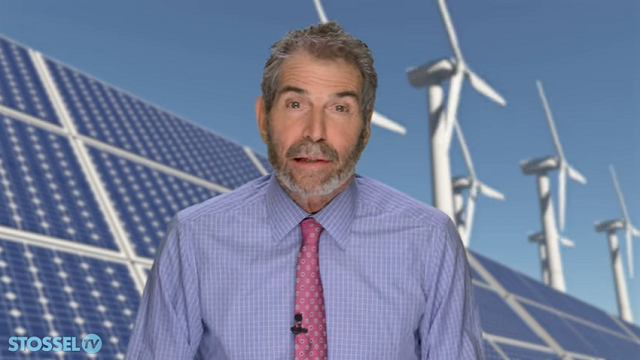
Politicians and activists tell how “renewable” energy will save us from the climate “crisis.” They don’t tell us about the real costs of green power.
——
My new video covers a documentary series called, “Juice: Politics, Power and the Grid.” It reveals how although renewables sound green, they have lots of problems. California promises to get 50% of their electricity from renewable sources. Now they deal with blackouts, rationing, and prices that increased 3x faster than in the rest of the US. You can watch the full documentary at @JuiceTheSeries .
After 40+ years of reporting, I now understand the importance of limited government and personal freedom.
——————————————
Libertarian journalist John Stossel created Stossel TV to explain liberty and free markets to young people. Prior to Stossel TV he hosted a show on Fox Business and co-anchored ABC’s primetime newsmagazine show, 20/20. Stossel’s economic programs have been adapted into teaching kits by a non-profit organization, “Stossel in the Classroom.” High school teachers in American public schools now use the videos to help educate their students on economics and economic freedom. They are seen by more than 12 million students every year.
Stossel has received 19 Emmy Awards and has been honored five times for excellence in consumer reporting by the National Press Club. Other honors include the George Polk Award for Outstanding Local Reporting and the George Foster Peabody Award.
————
To get our new weekly video from Stossel TV, sign up here: https://www.johnstossel.com/#subscribe
————


From LifeSiteNews
90,000 people were without electricity in Berlin on Saturday after radical environmentalists attacked a gas power plant supposedly to ‘protect the earth.’
A left-wing extremist group has claimed responsibility for an attack on the power grid that caused a massive blackout in Berlin.
On Saturday morning, around 45,000 homes and 90,000 people in southwest Berlin were without electricity after perpetrators set a fire on a power line supplying a gas power plant in the Lichterfelde district.
During the cold and snowy weather in Berlin, many households were without power and heating for days. According to BILD, the 97-year-old Ingeborg Esser was among those who had to sleep in a heated gym because her apartment was too cold.
In a letter published online on Sunday, the left-wing extremist “Vulkangruppe” (Volcano group) confessed to carrying out the attack in the name of saving the climate.
The group described the attack as an “action for the common good.” The State Criminal Police Office told the German news outlet Tagesspiegel that it considers the letter to be authentic. The Vulkangruppe, founded in 2011, has also carried out other acts of eco-terrorism in recent years, including two attacks on the Tesla Gigafactory in Grünheide, located to the east of Berlin.
“We successfully sabotaged the gas power plant in Berlin-Lichterfelde last night,” the letter stated. “The attack on the gas power plant is an act of self-defense and international solidarity with all those who protect the earth and life.”
The group, apparently motivated by the belief of impending doom due to the “climate crisis,” said, “There were power outages in the wealthier districts of Wannsee, Zehlendorf, and Nikolassee.“
”Power outages were not the goal of the action, but rather the fossil fuel industry,” the group claimed. “We apologize to the less affluent people in southwest Berlin.”
However, they added, “Our sympathy for the many villa owners in these neighborhoods is limited.”
The Vulkangruppe repeatedly blamed “the rich” for allegedly destroying the planet.
A prolonged power outage affecting private households was “neither intentional nor calculated,” the group wrote.
“We are also trying to put an end to species extinction” and the “exploitation of the earth,” the left-wing extremist group said.
According to Tagesspiegel, the operator Stromnetz Berlin expects that the power supply in the districts of Nikolassee, Zehlendorf, and Wannsee will remain interrupted until Thursday.
Berlin’s mayor Kai Wegner, from the Christian Democrats (CDU), said on Sunday, “This is not just arson or sabotage. This is terrorism.”
“We will place a high priority on prosecuting this crime. We want to catch these perpetrators,” Wegner stated.
“It was a left-wing extremist group that once again attacked our infrastructure and thus also threatened the lives of people, of elderly people who may need ventilators, of families with small children.”
The Vulkangruppe also claimed responsibility for an attack on Berlin’s power grid in September that caused a three-day power outage in Adlershof, in the district of Treptow-Köpenick.

From the Frontier Centre for Public Policy
Livestock contribute far less to emissions than activists claim, and eliminating them would weaken nutrition, resilience and food security
The war on livestock pushed by Net Zero ideologues is not environmental science; it’s a dangerous, misguided campaign that threatens global food security.
The priests of Net Zero 2050 have declared war on the cow, the pig and the chicken. From glass towers in London, Brussels and Ottawa, they argue that cutting animal protein, shrinking herds and pushing people toward lentils and lab-grown alternatives will save the climate from a steer’s burp.
This is not science. It is an urban belief that billions of people can be pushed toward a diet promoted by some policymakers who have never worked a field or heard a rooster at dawn. Eliminating or sharply reducing livestock would destabilize food systems and increase global hunger. In Canada, livestock account for about three per cent of total greenhouse gas emissions, according to Environment and Climate Change Canada.
Activists speak as if livestock suddenly appeared in the last century, belching fossil carbon into the air. In reality, the relationship between humans and the animals we raise is older than agriculture. It is part of how our species developed.
Two million years ago, early humans ate meat and marrow, mastered fire and developed larger brains. The expensive-tissue hypothesis, a theory that explains how early humans traded gut size for brain growth, is not ideology; it is basic anthropology. Animal fat and protein helped build the human brain and the societies that followed.
Domestication deepened that relationship. When humans raised cattle, sheep, pigs and chickens, we created a long partnership that shaped both species. Wolves became dogs. Aurochs, the wild ancestors of modern cattle, became domesticated animals. Junglefowl became chickens that could lay eggs reliably. These animals lived with us because it increased their chances of survival.
In return, they received protection, veterinary care and steady food during drought and winter. More than 70,000 Canadian farms raise cattle, hogs, poultry or sheep, supporting hundreds of thousands of jobs across the supply chain.
Livestock also protected people from climate extremes. When crops failed, grasslands still produced forage, and herds converted that into food. During the Little Ice Age, millions in Europe starved because grain crops collapsed. Pastoral communities, which lived from herding livestock rather than crops, survived because their herds could still graze. Removing livestock would offer little climate benefit, yet it would eliminate one of humanity’s most reliable protections against environmental shocks.
Today, a Maasai child in Kenya or northern Tanzania drinking milk from a cow grazing on dry land has a steadier food source than a vegan in a Berlin apartment relying on global shipping. Modern genetics and nutrition have pushed this relationship further. For the first time, the poorest billion people have access to complete protein and key nutrients such as iron, zinc, B12 and retinol, a form of vitamin A, that plants cannot supply without industrial processing or fortification. Canada also imports significant volumes of soy-based and other plant-protein products, making many urban vegan diets more dependent on long-distance supply chains than people assume. The war on livestock is not a war on carbon; it is a war on the most successful anti-poverty tool ever created.
And what about the animals? Remove humans tomorrow and most commercial chickens would die of exposure, merino sheep would overheat under their own wool and dairy cattle would suffer from untreated mastitis (a bacterial infection of the udder). These species are fully domesticated. Without us, they would disappear.
Net Zero 2050 is a climate target adopted by federal and provincial governments, but debates continue over whether it requires reducing livestock herds or simply improving farm practices. Net Zero advocates look at a pasture and see methane. Farmers see land producing food from nothing more than sunlight, rain and grass.
So the question is not technical. It is about how we see ourselves. Does the Net Zero vision treat humans as part of the natural world, or as a threat that must be contained by forcing diets and erasing long-standing food systems? Eliminating livestock sends the message that human presence itself is an environmental problem, not a participant in a functioning ecosystem.
The cow is not the enemy of the planet. Pasture is not a problem to fix. It is a solution our ancestors discovered long before anyone used the word “sustainable.” We abandon it at our peril and at theirs.
Dr. Joseph Fournier is a senior fellow at the Frontier Centre for Public Policy. An accomplished scientist and former energy executive, he holds graduate training in chemical physics and has written more than 100 articles on energy, environment and climate science.

Rulings could affect energy prices everywhere: Climate activists v. the energy industry in 2026

The Global Push for Government Mandated Digital IDs And Why You Should Worry

Maduro says he’s “ready” to talk

The U.S. Just Removed a Dictator and Canada is Collateral Damage
-
 Frontier Centre for Public Policy1 day ago
Is Canada still worth the sacrifice for immigrants?
-
 Bruce Dowbiggin1 day ago
The Olympic Shutout: No Quebec Players Invited For Canada
-
 Canadian Energy Centre1 day ago
Five reasons why 2026 could mark a turning point for major export expansions
-
 International1 day ago
Network of Nonprofits with Marxist and CCP Ties, and Elected Socialists Race to Counter Washington’s Narrative of the Maduro Raid
-
 Alberta1 day ago
Trump’s Venezuela Geopolitical Earthquake Shakes up Canada’s Plans as a “Net Zero” Energy Superpower
-
 Business1 day ago
Policy uncertainty continues to damage Canada’s mining potential
-
Environment1 day ago
Left-wing terrorists sabotage German power plant, causing massive power outage
-
 Energy1 day ago
Trump’s Venezuela Move: A $17 Trillion Reset of Global Geopolitics and a Pivotal Shift in US Energy Strategy