
Business
‘We Had A Bad Experience’: Chinese Officials Losing Sleep Over Thought Of Dealing With Second Trump Term

From the Daily Caller News Foundation

By Jake Smith
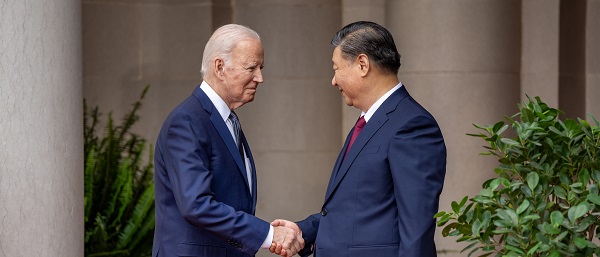
Chinese Communist Party (CCP) officials quietly believe that a second Donald Trump presidency would be more dangerous to them than a Kamala Harris administration, The Wall Street Journal reported on Tuesday.
The Biden-Harris administration’s relationship with Beijing has been marred with tensions in recent years over diplomatic, economic and national security disputes. But Chinese officials would seemingly still rather have Harris win in November over Trump because they worry that the former president will open up another trade war against China, officials told the WSJ.
“Chinese officials and scholars, in private conversations over many months, are largely exceptionally wary of a Trump victory,” Richard McGregor, China expert at the Lowy Institute in Sydney, told the WSJ.
Those worries are largely kept quiet. Publicly, Chinese officials maintain a stance of neutrality toward the U.S. elections. Chinese President Xi Jinping wrote in a letter last week that China had always handled relations with the U.S. with “mutual respect” and said that Beijing “is willing to work with the United States as partners and friends.”
“The presidential elections are the United States’ own affairs,” a spokesman from the Chinese Embassy in the U.S. told the Daily Caller News Foundation. “We hope that whoever gets elected will be committed to growing sound and stable China-U.S. ties.”
Beijing wants whoever the next president is to take a predictable stance toward relations and dial back the U.S.’ tough-on-China stance. Privately, officials felt that standard was better reflected in President Joe Biden over Trump and thought his reelection would be better for China, according to the WSJ.
After Biden dropped out of the race in July, Beijing felt the same about Harris, officials told the WSJ.
“Under Trump, we had a bad experience,” senior CCP diplomat Liu Jianchao bemoaned during a closed-door session with U.S. think tanks earlier in the year.
The concerns of a second Trump term among Chinese officials stem from fears he will launch a second trade war against China, as he did in his first term, according to the WSJ.
Trump issued a sweeping set of tariffs against China during his first term — adding a tax to imports coming in from the country — in a bid to encourage domestic U.S. investment and compel China to buy more American goods.
Xi and those and his orbit became exhausted in trying to maneuver the trade war and Trump’s demands, according to the WSJ. Trump has weighed the idea in his second term to issue a 60% tariff against incoming Chinese goods, which economists at UBS have predicted could mark a 2.5% blow to China’s GDP growth over a year-long period.
Trump has also recently weighed the idea of using the threat of tariffs to deter China from invading Taiwan, even musing that he would completely halt trade relations if the island is taken by force, which has been received extremely poorly in Beijing.
“I would say: If you go into Taiwan, I’m sorry to do this, I’m going to tax you”—meaning impose tariffs—“at 150% to 200%,” Trump told the WSJ in an interview on Thursday.
The Trump and Harris campaigns did not immediately respond to a request for comment.

Alberta
COWBOY UP! Pierre Poilievre Promises to Fight for Oil and Gas, a Stronger Military and the Interests of Western Canada
Fr0m Energy Now
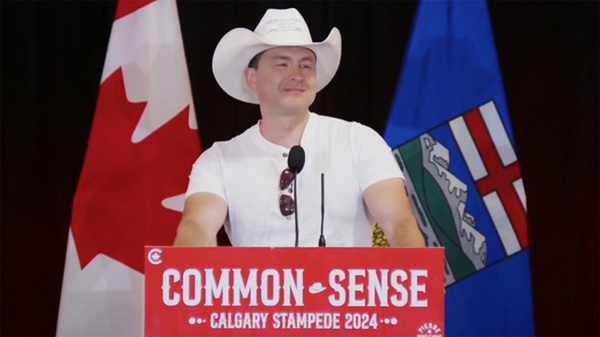
As Calgarians take a break from the incessant news of tariff threat deadlines and global economic challenges to celebrate the annual Stampede, Conservative party leader Pierre Poilievre gave them even more to celebrate.
Poilievre returned to Calgary, his hometown, to outline his plan to amplify the legitimate demands of Western Canada and not only fight for oil and gas, but also fight for the interests of farmers, for low taxes, for decentralization, a stronger military and a smaller federal government.
Speaking at the annual Conservative party BBQ at Heritage Park in Calgary (a place Poilievre often visited on school trips growing up), he was reminded of the challenges his family experienced during the years when Trudeau senior was Prime Minister and the disastrous effect of his economic policies.
“I was born in ’79,” Poilievre said. “and only a few years later, Pierre Elliott Trudeau would attack our province with the National Energy Program. There are still a few that remember it. At the same time, he hammered the entire country with money printing deficits that gave us the worst inflation and interest rates in our history. Our family actually lost our home, and we had to scrimp and save and get help from extended family in order to get our little place in Shaughnessy, which my mother still lives in.”
This very personal story resonated with many in the crowd who are now experiencing an affordability crisis that leaves families struggling and young adults unable to afford their first house or condo. Poilievre said that the experience was a powerful motivator for his entry into politics. He wasted no time in proposing a solution – build alliances with other provinces with mutual interests, and he emphasized the importance of advocating for provincial needs.
“Let’s build an alliance with British Columbians who want to ship liquefied natural gas out of the Pacific Coast to Asia, and with Saskatchewanians, Newfoundlanders and Labradorians who want to develop their oil and gas and aren’t interested in having anyone in Ottawa cap how much they can produce. Let’s build alliances with Manitobans who want to ship oil in the port of Churchill… with Quebec and other provinces that want to decentralize our country and get Ottawa out of our business so that provinces and people can make their own decisions.”
Poilievre heavily criticized the federal government’s spending and policies of the last decade, including the increase in government costs, and he highlighted the negative impact of those policies on economic stability and warned of the dangers of high inflation and debt. He advocated strongly for a free-market economy, advocating for less government intervention, where businesses compete to impress customers rather than impress politicians. He also addressed the decade-long practice of blocking and then subsidizing certain industries. Poilievre referred to a famous quote from Ronald Reagan as the modus operandi of the current federal regime.
“The Government’s view of the economy could be summed up in a few short phrases. If anything moves, tax it. If it keeps moving, regulate it. And if it stops moving, subsidize it.”
The practice of blocking and then subsidizing is merely a ploy to grab power, according to Poilievre, making industry far too reliant on government control.
“By blocking you from doing something and then making you ask the government to help you do it, it makes you reliant. It puts them at the center of all power, and that is their mission…a full government takeover of our economy. There’s a core difference between an economy controlled by the government and one controlled by the free market. Businesses have to clamour to please politicians and bureaucrats. In a free market (which we favour), businesses clamour to impress customers. The idea is to put people in charge of their economic lives by letting them have free exchange of work for wages, product for payment and investment for interest.”
Poilievre also said he plans to oppose any ban on gas-powered vehicles, saying, “You should be in the driver’s seat and have the freedom to decide.” This is in reference to the Trudeau-era plan to ban the sale of gas-powered cars by 2035, which the Carney government has said they have no intention to change, even though automakers are indicating that the targets cannot be met. He also intends to oppose the Industrial Carbon tax, Bill C-69 the Impact Assessment Act, Bill C-48 the Oil tanker ban, the proposed emissions cap which will cap energy production, as well as the single-use plastics ban and Bill C-11, also known as the Online Streaming Act and the proposed “Online Harms Act,” also known as Bill C-63. Poilievre closed with rallying thoughts that had a distinctive Western flavour.
“Fighting for these values is never easy. Change, as we’ve seen, is not easy. Nothing worth doing is easy… Making Alberta was hard. Making Canada, the country we love, was even harder. But we don’t back down, and we don’t run away. When things get hard, we dust ourselves off, we get back in the saddle, and we gallop forward to the fight.”
Cowboy up, Mr. Poilievre.
Maureen McCall is an energy professional who writes on issues affecting the energy industry.

From the Fraser Institute
In his June speech announcing a major buildup of Canada’s military, Prime Minister Mark Carney repeated his belief that this country faces a “hinge moment” of the sort the allied countries confronted after the Second World War.
A better comparison might be with the beginning of the war itself.
Then, the Allies found themselves at war with an autocratic state bent on their defeat and possible destruction. Now, Carney faces an antagonistic American president bent on annexing Canada through economic warfare.
Then, Canada rose to the challenge, creating the world’s third-largest navy and landing an army at Normandy on D-Day. Now, Carney has announced the most aggressive reorienting of Canada’s economic, foreign and defence policies in generations.
Polls show strong support among Canadians for this new agenda. But the old Canada is still there. It will fight back. It may yet win.
The situation certainly would have been more encouraging had Carney not inherited Justin Trudeau’s legacy of severe economic and environmental restrictions—picking economic winners and losers rather than letting the market decide—and chronic deficits. The new prime minister would do well to dismantle as much of that legacy as he can.
Some advocate a return to the more laissez-faire approach of Stephen Harper’s government. But Harper didn’t confront a belligerent president hoping to annex Canada through the “economic force” of tariff walls.
The prime minister succeeded in getting Bill C-5, which is intended to weaken at least some of the restrictions on resource development and infrastructure, passed into law. He and the premiers pledge to finally dismantle generations of internal trade and labour mobility barriers. If we must trade less with the Americans, we can at least learn to trade with ourselves.
And the prime minister deserves high praise for reversing decades of military decline through increased spending and efforts to improve procurement. If Carney accomplishes nothing more than restoring Canada’s defences, especially in the Arctic, he will be well remembered.
That said, major challenges confront the Carney agenda.
There’s much talk about a new national energy corridor. But what does that mean? One KPMG executive defined it as a “dedicated, streamlined pathway for the energy, electricity, decarbonization, transportation and digital infrastructure.”
Yes, but what does that mean?
Whatever it means, some First Nations will oppose it tooth-and-nail. Not all of them, mind you. The First Nations Major Project Coalition is dedicated to assisting First Nations in working with government and the private sector for the benefit of all. But many First Nations people consider resource development further exploitation of their ancestral lands by a colonizing power. At the first major proposal to which they do not buy in, they will take the government to court.
What investor will be willing to commit to a project that could be blocked for years as First Nations and Ottawa fight it out all the way to the Supreme Court?
The prime minister, formerly a fervent advocate of combatting climate change, now talks about developing “conventional energy,” which means oil and gas pipelines. But environmental activists will fiercely oppose those pipelines.
There is so much that could go wrong. Sweep away those internal trade barriers? Some premiers will resist. Accelerate housing development? Some mayors will resist. Expand exports to Europe and Asia? Some businesses and entrepreneurs will say it’s not worth the risk.
As for the massive increase in defence spending, where will the money come from? What will be next year’s deficit? What will be the deficit’s impact on inflation, interest rates and sovereign creditworthiness? The obstacles are high enough to make anyone wonder how much, if any, of the government’s platform will be realized. But other factors are at work as well, factors that were also present in 1939.
To execute his mandate, Carney is surrounding himself with what, back in the Second World War, were called “dollar a year men”—executives who came to Ottawa from the private sector to mobilize the economy for wartime.
In Carney’s case he has brought in Marc-André Blanchard as chief of staff and Michael Sabia as clerk of the privy council. Both are highly experienced in government and the private sector. Both are taking very large pay cuts because, presumably, they understand the gravity of the times and believe in the prime minister’s plans.
Most important, Carney’s agenda has broad support from a public that fears for the country’s future and will have little patience toward any group seeking to block the prime minister’s agenda.
Millions of Canadians want this government’s reform efforts to succeed. Those who would put it at risk of failing will have to contend with public anger. That gives Carney a shot at making real change.

John Ibbitson



RFK Jr. says Hep B vaccine is linked to 1,135% higher autism rate
Alberta Independence Seekers Take First Step: Citizen Initiative Application Approved, Notice of Initiative Petition Issued

National Health Care Fraud Takedown Results in 324 Defendants Charged in Connection with Over $14.6 Billion in Alleged Fraud

RFK Jr. Unloads Disturbing Vaccine Secrets on Tucker—And Surprises Everyone on Trump
-
Business2 days ago
RFK Jr. says Hep B vaccine is linked to 1,135% higher autism rate
-
 Business1 day ago
Why it’s time to repeal the oil tanker ban on B.C.’s north coast
-
 Alberta1 day ago
Alberta Provincial Police – New chief of Independent Agency Police Service
-
 Energy1 day ago
If Canada Wants to be the World’s Energy Partner, We Need to Act Like It
-
 Alberta1 day ago
Pierre Poilievre – Per Capita, Hardisty, Alberta Is the Most Important Little Town In Canada
-
 International1 day ago
CBS settles with Trump over doctored 60 Minutes Harris interview
-
 Aristotle Foundation1 day ago
How Vimy Ridge Shaped Canada
-
 Alberta24 hours ago
Alberta uncorks new rules for liquor and cannabis