
Business
Texas pulls $8.5 billion from BlackRock over DEI rules, left-wing climate agenda


From LifeSiteNews
‘’BlackRock’s destructive approach towards the energy companies that this state and our world depend on is incompatible with our fiduciary duty to Texans,’ said Texas State Board of Education Chairman Aaron Kinsey.
The Texas Permanent School Fund (PSF) is becoming the latest state fund to divest its financial stake in far-left asset management giant BlackRock, Inc., pulling $8.5 billion from the company over its use of corporate influence to push leftist activism.
The Washington Examiner reports that Texas State Board of Education Chairman Aaron Kinsey notified BlackRock and announced the decision the same day, March 19.
“BlackRock’s dominant and persistent leadership in the ESG movement immeasurably damages our state’s oil and gas economy and the very companies that generate revenues for our [Permanent School Fund],” he said. “Texas and the PSF have worked hard to grow this fund to build Texas’s schools. BlackRock’s destructive approach towards the energy companies that this state and our world depend on is incompatible with our fiduciary duty to Texans.”
The withdrawal followed the 2021 passage of a law banning the state from any company that practices so-called “environmental, social, and governance” (ESG) standards, essentially a scoring system that incentivizes investing in companies not on the basis of their performance for customers and shareholders, but rather on their fealty to so-called “social justice” principles such as diversity and environmentalism. ESG is one of the reasons why so many companies in recent years have attempted to influence public policy on issues such as homosexuality, transgenderism, race relations, and abortion.

In 2022, Texas state Comptroller Glenn Hegar released a list of firms that would be barred from “entering into contracts with state and local” governmental agencies over their hostility to traditional energy production in favor of the so-called “green” agenda, including BlackRock.
“Today’s bold step by Aaron Kinsey and the Permanent School Fund of Texas, in accordance with state law, is a massive blow against the scam of ESG,” cheered State Financial Officers Foundation CEO Derek Kreifels, Fox Business reports. “This is what happens when public fiduciaries stand up for those to whom they owe a duty, instead of bowing down to Wall Street’s asset managers who continue to abuse their position in the market to advance radical ideologies.”
“Under Larry Fink’s leadership, BlackRock has been misusing client funds to push a political agenda for years. Nowhere was that more egregious than in Texas, where BlackRock was simultaneously trying to destroy the domestic oil and gas industry while managing funds that depended on royalties derived from that very same industry,” agreed Consumers’ Research executive director Will Hild. “A more flagrant violation of fiduciary duty is difficult to imagine.”
Arizona, Arkansas, Florida, Louisiana, Missouri, South Carolina, Utah, and West Virginia have previously divested themselves of BlackRock. Last year, nineteen states – Alabama, Alaska, Arkansas, Florida, Georgia, Idaho, Iowa, Mississippi, Missouri, Montana, Nebraska, New Hampshire, North Dakota, Oklahoma, South Dakota, Tennessee, Utah, West Virginia, and Wyoming – formed a coalition to collectively agree to resist ESG standards in a variety of ways, such as banning their use in state pension-fund investment decisions, banning the use of “social credit scores” in banking and lending practices, and banning ideological discrimination against customers by financial institutions.


““He knows nothing; and he thinks he knows everything. That points clearly to a political career.” George Bernard Shaw
In the days immediately following Donald Trump’s rude intervention into the 2025 Canadian federal election— suggesting Canada might best choose American statehood— two schools of thought emerged.
The first and most impactful school in the short term was the fainting-goat response of Canadian’s elites. Sensing an opening in which to erode Pierre Poilievre’s massive lead in the 2024 polls over Justin Trudeau, the Laurentian elite concocted Elbows Up, a self-pity response long on hurt feelings and short on addressing the issues Trump had cited in his trashing of the Canadian nation state.
In short order they fired Trudeau into oblivion, imported career banker Mark Carney as their new leader in a sham convention and convinced Canada’s Boomers that Trump had the tanks ready to go into Saskatchewan at a moment’s notice. The Elbows Up meme— citing Gordie Howe— clinched the group pout.

(In fact, Trump has said that America is the world’s greatest market, and if those who’ve used it for free in the past [Canada] want to keep special access they need to pay tariffs to the U.S. or drop protectionist charges on dairy and more against the U.S.)
The ruse worked out better than they could have ever imagined with Trump even saying he preferred to negotiate with Carney over Poilievre. In short order the Tories were shoved aside, the NDP kneecapped and the pet media anointed Carney the genius skewing Canada away from its largest trade partner to the Eurosphere. We remain in that bubble, although the fulsome promises of Carney’s first days are now coming due.
Which brings us to the second reaction. That was Alberta premier Danielle Smith bolting to Mar A Lago in the days following Trump’s comments. Her goal was to put pride aside and accept that a new world order was in play for Canada. She met with U.S. officials and, briefly, with Trump to remind them that Canada’s energy industry was integral to American prosperity and Canadian stability.
Needless to say, the fainting goats pitched a fit that not everyone was clutching pearls and rending garments in the wake of Trump’s dismissive assessment of his northern neighbours. Their solution to Trump was to join China in retaliatory tariffs— the only two nations to do so— and to boycott American products and travel. Like the ascetic monks they cut themselves off from real life. Trump has yet to get back to Carney the Magnificent

And Smith? She was a “traitor” or a “subversive” who should be keel hauled in the North Saskatchewan. For much of the intervening months she has been attacked at home in Alberta by the N-Deeps and in Ottawa by just about everyone on CBC, CTV, Global and the Globe & Mail. “How could she meet with the Cheeto?”
Nonetheless conservatives in the province moved toward a more independence within Canada. Smith articulated her demands for Alberta to prevent a referendum on whether to remain within Confederation. At the top of her list were pipelines and access to tidewater. Ergo, a no-go for BC’s squish premier David Eby who is the process of handing over his province to First Nations.
It became obvious that for all of Carney’s alleged diplomacy in Europe and Asia (is the man ever home?) he had a brewing disaster in the West with Alberta and Saskatchewan growing restless. In a striking move against the status quo, Nutrien announced it would ship its potash to tidewater via the U.S., thereby bypassing Vancouver’s strike-prone, outdated port and denying them billions.

Suddenly, Smith’s business approach began making eminent good sense if the goal is to keep Canada as one. So we saw last week’s “memorandum of understanding” between Alberta and Ottawa trading off carbon capture and carbon taxes for potential pipelines to tidewater on the B.C. coast. A little bit of something for everyone and a surrender on other things.
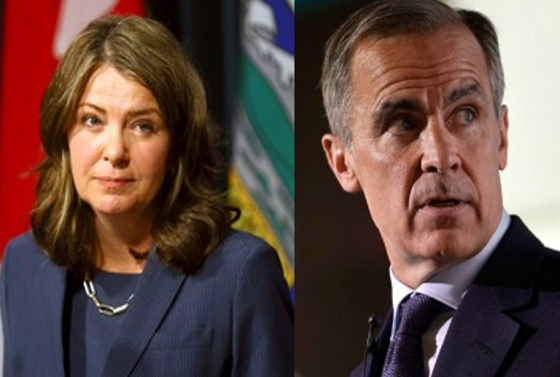
The most amazing feature of the Mark Carney/Danielle Smith MOU is that both politicians probably need the deal to fail. Carney can tell fossil-fuel enemy Quebec that he tried to reason with Smith, and Smith can say she tried to meet the federalists halfway. Failure suits their larger purposes. Which is for Carney to fold Canada into Euro climate insanity and Smith into a strong leverage against the pro-Canada petitioners in her province.
Soon enough, at the AFN Special Chiefs Assembly, FN Chief Cindy Woodhouse Nepinak told Carney that “Turtle Island” (the FN term for North America popularized by white hippy poet Gary Snyder) belongs to the FN people “from coast to coast to coast.” The pusillanimous Eby quickly piped up about tanker bans and the sanctity of B.C. waters etc.
Others pointed out the massive flaw in a plan to attract private interests to build a vital bitumen pipeline if the tankers it fills are not allowed to sail through the Dixon Entrance to get to Asia.
But then Eby got Nutrien’s message that his power-sharing with the indigenous might cause other provinces to bypass B.C. (imagine California telling Texas it can’t ship through its ports over moral objections to a product). He’s now saying he’s open to pipelines but not to lift the tanker ban along the coast. Whatever.
Meanwhile the kookaburras of isolation back east continue with virtue signalling on American booze— N.S. to sell off its remains stocks — while dreaming that Trump’s departure will lead to the good-old days of reliance on America’s generosity.
But Smith looks to be wining the race. B.C.’s population shrank 0.04 percent in the second quarter of 2025, the only jurisdiction in Canada to do so. Meanwhile, Alberta is heading toward five million people, with interprovincial migrants making up 21 percent of its growth.
But what did you expect from the Carney/ Eby Tantrum Tandem? They keep selling fear in place of GDP. As GBS observed, “You have learnt something. That always feels at first as if you have lost something.”
Bruce Dowbiggin @dowbboy is the editor of Not The Public Broadcaster A two-time winner of the Gemini Award as Canada’s top television sports broadcaster, his new book Deal With It: The Trades That Stunned The NHL And Changed hockey is now available on Amazon. Inexact Science: The Six Most Compelling Draft Years In NHL History, his previous book with his son Evan, was voted the seventh-best professional hockey book of all time by bookauthority.org . His 2004 book Money Players was voted sixth best on the same list, and is available via brucedowbigginbooks.ca.

By Jen Hodgson
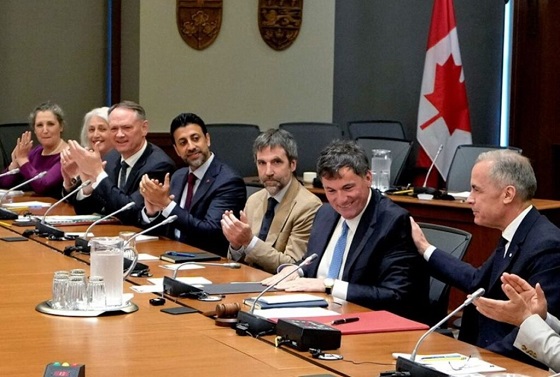
Prime Minister Mark Carney’s two-day cabinet meeting in Toronto cost taxpayers more than $532,000, records reviewed by the Canadian Taxpayers Federation show. Carney’s cabinet meetings cost thousands of dollars more than recent cabinet retreats hosted by former prime minister Justin Trudeau.
“If you’re spending thousands of dollars more than Trudeau on meetings, you’re spending too much money,” said Franco Terrazzano, CTF Federal Director. “It’s going to be hard for politicians to explain to taxpayers why all of the meeting rooms in Ottawa weren’t good enough.”
Carney’s two-day cabinet meeting was held at the Pan Pacific Toronto in September, according to government records submitted in response to an Order Paper Question. Pan Pacific’s website describes itself as a “luxury hotel.”
The Privy Council Office spent $250,400 on the venue and “hospitality,” $78,700 for audiovisual services, $40,000 for security and $8,073 on shipping. The PCO spent another $38,300 on accommodation, meals and transportation.
The total bill to taxpayers may balloon higher. The PCO noted costs only include expenditures processed as of Sept. 23. “Certain associated travel claims and invoices may still be awaiting submission or receipt,” wrote the PCO.
The Royal Canadian Mounted Police spent $29,000 on the cabinet meeting. That only includes expenditures processed as of Sept. 17.
The Translation Bureau charged taxpayers $30,600 for travel expenses, travel time and interpretation services.
Other departments also spent $57,400 for the cabinet meeting. Most of that was for transportation, but some ministers charged taxpayers for meals and accommodation for themselves and their staff.
Carney’s Toronto cabinet meeting cost more than recent cabinet meetings hosted by Trudeau.
Trudeau’s cabinet retreat to Charlottetown, P.E.I., in August 2023, cost taxpayers $485,196. Even after adjusting for inflation, Trudeau’s cabinet retreat cost about $26,000 less than Carney’s.
The Trudeau government also held a cabinet meeting in Vancouver in 2022. It cost taxpayers $471,070. Even after adjusting for inflation, Trudeau’s cabinet retreat cost about $25,000 less than Carney’s.
“Carney told Canadians he was going to cut waste and he should start by not dropping half a million bucks on meetings,” Terrazzano said. “We need a culture change in Ottawa and that needs to start with the prime minister and ministers respecting taxpayers’ hard-earned money.”


Health Canada pauses plan to sell unlabeled cloned meat

Is there a cure for Alzheimer’s Disease?

Google denies scanning users’ email and attachments with its AI software

Learning the Truth about “Children’s Graves” and Residential Schools is More Important than Ever
-
 Alberta2 days ago
This new Canada–Alberta pipeline agreement will cost you more than you think
-
 MAiD1 day ago
From Exception to Routine. Why Canada’s State-Assisted Suicide Regime Demands a Human-Rights Review
-
 Business2 days ago
New Chevy ad celebrates marriage, raising children
-
 Automotive2 days ago
Power Struggle: Governments start quietly backing away from EV mandates
-
 Business1 day ago
Carney government should privatize airports—then open airline industry to competition
-
 Great Reset2 days ago
Canada’s MAiD (State Sanctioned Murder) Report Just Dropped
-
 Energy2 days ago
Unceded is uncertain
-
 Business1 day ago
What’s Going On With Global Affairs Canada and Their $392 Million Spending Trip to Brazil?