
National
Snowbird crash – Video shows pilot ejected.


A Canadian Forces Snowbird jet has crashed.
The #RCAF has been made aware that a Canadian Forces Snowbirds aircraft crashed in the vicinity of Kamloops, BC. Our priority at this time is determining the status of our personnel and supporting emergency personnel. When appropriate, more information will be made available.
— Royal Canadian Air Force (@RCAF_ARC) May 17, 2020
The following video on twitter account of Victor Kaisar appears to show two Snowbirds taking off in Kamloops, with one peeling off and either one or two ejections as the plane plummets.

Local media outlet CFJC Kamloops Today reports the snowbird crashed into a residential area known as Brocklehurst.
Here's a video that was sent to us at @RadioNLNews from earlier this morning. #Kamloops pic.twitter.com/hc61YWscmQ
— Victor Mario Kaisar (@supermario_47) May 17, 2020


From LifeSiteNews
The Employment and Social Development Canada (ESDC) department has officially confirmed it is developing a digital ID for certain licenses and permits.
The Employment and Social Development Canada (ESDC) department has officially confirmed it is developing a digital ID for certain licenses and permits, called “GC Issue and Verify,” which has already been listed on the Google Play store, as a trial-only app for certain users.
The digital ID claims the government can replace and be full “digital versions” of the “physical credentials they already provide today, like work permits and boating licenses.”
“Instead of only having physical credentials in their wallets, people will also be able to securely store their digital credentials on their mobile devices,” says the government.
According to ESDC officials, the digital IDs can be shared online or in-person “when needed, making it easy for departments, organizations, and businesses to validate their information.”
The government argued that since many Canadians already use “digital credentials without realizing it,” such as a digital ticket “stored on our mobile device instead of using a printed ticket,” this would be the same for IDs such as licenses.
ESDC said that “digital options” will be voluntary and that people can still use “traditional physical methods of verification,” instead.
READ: Canada releases new digital ID app for personal documents despite privacy concerns
The reality is that digital IDs and similar systems have long been pushed by globalist groups like the World Economic Forum, an organization with which Canadian Prime Minister Mark Carney has extensive ties, under the guise of ease of access and security.
Also, Canadians do not want digital IDs, as noted by Canada’s Privy Council research from 2023, which said there is strong public resistance to the use of digital IDs to access government services.
GC Issue and Verify is one of two digital ID projects on the go. As reported by LifeSiteNews, the Liberal government under Carney recently quietly released a new type of digital ID app on Google’s Play Store called GC Wallet.
Both GC Wallet and GC Issue and Verify are now being tested with federal partners, those being Transport Canada and Immigration, Refugees and Citizenship Canada.
During COVID, the Canadian federal government released a digital-type app called ArriveCAN app for travel that was a form of digital ID. The app was riddled with technical glitches along with privacy concerns from users.
As reported by LifeSiteNews, the Canadian government hired outside consultants tasked with looking into whether or not officials should proceed with creating a digital ID system for all citizens and residents.
Opp0sition MP Leslyn Lewis, recently warned Canadians to be “on guard” against a push by the ruling Liberal Party to bring forth digital IDs, saying they should be voluntary.
From the Fraser Institute
By Annika Segelhorst and Elmira Aliakbari
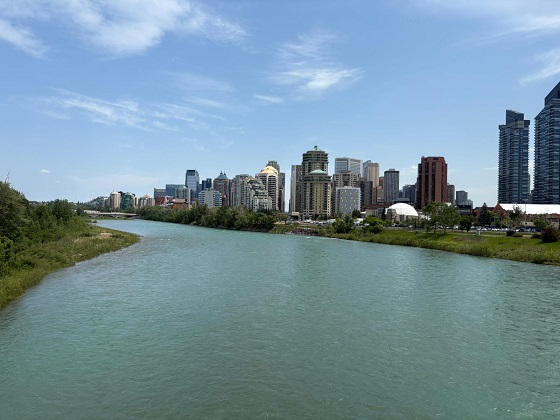
Canada’s rivers are vital to our environment and economy. Clean freshwater is essential to support recreation, agriculture and industry, an to sustain suitable habitat for wildlife. Conversely, degraded freshwater can make it harder to maintain safe drinking water and can harm aquatic life. So, how healthy are Canada’s rivers today?
To answer that question, Environment Canada uses an index of water quality to assess freshwater quality at monitoring stations across the country. In total, scores are available for 165 monitoring stations, jointly maintained by Environment Canada and provincial authorities, from 17 in Newfoundland and Labrador, to 8 in Saskatchewan and 20 in British Columbia.
This index works like a report card for rivers, converting water test results into scores from 0 to 100. Scientists sample river water three or more times per year at fixed locations, testing indicators such as oxygen levels, nutrients and chemical levels. These measurements are then compared against national and provincial guidelines that determine the ability of a waterway to support aquatic life.
Scores are calculated based on three factors: how many guidelines are exceeded, how often they are exceeded, and by how much they are exceeded. A score of 95-100 is “excellent,” 80-94 is “good,” 65-79 is “fair,” 45-64 is “marginal” and a score below 45 is “poor.” The most recent scores are based on data from 2021 to 2023.
Among 165 river monitoring sites across the country, the average score was 76.7. Sites along four major rivers earned a perfect score: the Northeast Magaree River (Nova Scotia), the Restigouche River (New Brunswick), the South Saskatchewan River (Saskatchewan) and the Bow River (Alberta). The Bayonne River, a tributary of the St. Lawrence River near Berthierville, Quebec, scored the lowest (33.0).
Overall, between 2021 and 2023, 83.0 per cent of monitoring sites across the country recorded fair to excellent water quality. This is a strong positive signal that most of Canada’s rivers are in generally healthy environmental condition.
A total of 13.3 per cent of stations were deemed to be marginal, that is, they received a score of 45-64 on the index. Only 3.6 per cent of monitoring sites fell into the poor category, meaning that severe degradation was limited to only a few sites (6 of 165).
Monitoring sites along waterways with relatively less development in the river’s headwaters and those with lower population density tended to earn higher scores than sites with developed land uses. However, among the 11 river monitoring sites that rated “excellent,” 8 were situated in areas facing a combination of pressures from nearby human activities that can influence water quality. This indicates the resilience of Canada’s river ecosystems, even in areas facing a combination of multiple stressors from urban runoff, agriculture, and industrial activities where waterways would otherwise be expected to be the most polluted.
Poor or marginal water quality was relatively more common in monitoring sites located along the St. Lawrence River and its major tributaries and near the Great Lakes compared to other regions. Among all sites in the marginal or poor category, 50 per cent were in this area. The Great Lakes-St. Lawrence region is one of the most population-dense and extensively developed parts of Canada, supporting a mix of urban, agricultural, and industrial land uses. These pressures can introduce harmful chemical contaminants and alter nutrient balances in waterways, impairing ecosystem health.
In general, monitoring sites categorized as marginal or poor tended to be located near intensive agriculture and industrial activities. However, it’s important to reiterate that only 28 stations representing 17.0 per cent of all monitoring stations were deemed to be marginal or poor.
Provincial results vary, as shown in the figure below. Water quality scores in Newfoundland and Labrador, Prince Edward Island, New Brunswick, Saskatchewan and Alberta were, on average, 80 points or higher during the period from 2021 to 2023, indicating that water quality rarely departed from natural or desirable levels.
Rivers sites in Nova Scotia, Ontario, Manitoba and B.C. each had average scores between 74 and 78 points, suggesting occasional departures from natural or desirable levels.
Finally, Quebec’s average river water quality score was 64.5 during the 2021 to 2023 period. This score indicates that water quality departed from ideal conditions more frequently in Quebec than in other provinces, especially compared to provinces like Alberta, Saskatchewan and P.E.I. where no sites rated below “fair.”

Overall, these results highlight Canada’s success in maintaining a generally high quality of water in our rivers. Most waterways are in good shape, though some regions—especially near the Great Lakes and along the St. Lawrence River Valley—continue to face pressures from the combined effects of population growth and intensive land use.


Death by a thousand clicks – government censorship of Canada’s internet

Viral TikTok video shows 7-year-old cuddling great-grandfather before he’s euthanized

Chinese Billionaire Tried To Build US-Born Baby Empire As Overseas Elites Turn To American Surrogates

Politicians should be honest about environmental pros and cons of electric vehicles
-
 Alberta2 days ago
Alberta’s huge oil sands reserves dwarf U.S. shale
-
 Alberta2 days ago
Canada’s New Green Deal
-
 Energy1 day ago
Canada’s sudden rediscovery of energy ambition has been greeted with a familiar charge: hypocrisy
-
 Business2 days ago
COP30 finally admits what resource workers already knew: prosperity and lower emissions must go hand in hand
-
 armed forces2 days ago
Ottawa’s Newly Released Defence Plan Crosses a Dangerous Line
-
 Business1 day ago
Ottawa Pretends To Pivot But Keeps Spending Like Trudeau
-
 Indigenous2 days ago
Residential school burials controversy continues to fuel wave of church arsons, new data suggests
-
 Daily Caller1 day ago
Paris Climate Deal Now Decade-Old Disaster