
Alberta
Red Deer South UCP constituency board member resigns in response to COVID-19 restrictions


A political firestorm is brewing in Alberta. The province’s response to COVID-19 is leading to a growing rift amongst members of Alberta’s UCP. In an effort to slow the spread of COVID the government’s approach has been to protect hospitals by limiting interactions between people. This has lead to thousands of job losses and months of painful uncertainty for small business owners. Increasingly, individual UCP politicians and Constituency Associations are calling on the Premier to take a new direction. They want the province to shift focus to provide comfortable quarantine sites for vulnerable citizens and the people who work with them, while the rest of Alberta returns to normal. In an effort to protect the fragile economy, a number of constituency associations are considering their strongest possible move. They’re deciding whether they should call for a leadership review which would be a direct challenge to Premier Jason Kenney.
In Central Alberta, Calvin Goulet-Jones a member of the Red Deer South UCP Board has resigned. In his resignation letter (below) Goulet-Jones says the UCP has abandoned the core principals which brought conservatives from different parties together. Janis Nett, President of the Red Deer South UCP Board says other members of the board support the decision Goulet-Jones has made, but they also support Red Deer South MLA Jason Stephan and the party. Nett says remaining board members are hoping a change in direction can be accomplished without fracturing conservatives into two more more parties in the next provincial election. The Red Deer South Constituency Association meets later this week and a discussion about how best to convince party leadership to change direction will be on the agenda.
Below is a post from the Facebook page of former Red Deer South Constituency Association board member Calvin Goulet-Jones.
Here is an excerpt of the my resignation letter to the local UCP board. I share this as a reminder of what the UCP was built on. For context, the content within the letter is relevant to the end of January. Please also note that this was not an admonishment of local board members, but a recognition that I can no longer be involved at this time for the reasons I state below.
It is no secret that times have changed and I strongly believe we have lost sight of the principles I feel we all hold dear. I am saddened when I look at the core principles that the UCP was built upon. I am saddened because it is so evident that the UCP has abandoned their foundation. They are no longer the party that Albertans elected.
Let me elaborate on the principles the UCP was built upon and where we find ourselves today.
Principle 1 – A robust civil society made up of free individuals, strong families, and voluntary associations.
We live in an era right now where individuals are not free. In fact, we live in an era where the freedom to earn an income is fined, where putting in an honest day’s work to put food on the table results in intimidation and strong families are being weakened as a result. This may not affect you, but it affects our society. When freedom is taken away from one individual it is taken away from all of us. Our society is neither robust, nor is it civil. In fact, it can be argued it is breaking down at the hands of our government.
Principle 2 – Freedom of speech, worship and assembly.
No one can take away the freedom to worship, including the government, however they certainly can put a major damper on it. Our government has intimidated and bullied churches severely beyond what could ever be deemed reasonable. Not only in Alberta but across this country the freedom to corporately worship has been taken away. The point is that this is a core principle of the UCP and the government seems to have not given it a second thought.
Principle 3 – Affirm the family as the building block of society and the means by which citizens pass on their values and beliefs and ensure that families are protected from intrusion by government.
The family is the building block of society, meanwhile families are suffering and children are bearing the brunt of the governments decisions. While the child help line has received an unprecedented amount of calls for help our government applies bandaids. This government is deconstructing the building block of society, mental health issues are rampant, and they have shifted the burden of covid and placed it upon the most vulnerable: Our children. They are affected by the very specific decisions that the government makes more than they will ever know.
Furthermore, the government’s logic is beyond reason. To say that a loved one may babysit your kids but that same loved one may not stay for dinner is absurd. To impose a fine to an individual who is struggling with loneliness and needs familiar company, yet allow a contractor to enter homes is mean spirited. I can go on, but I cannot imagine anyone can truly say that this government is busy ensuring that individuals are protected by the intrusion of government.
Principle 4 – Economic freedom in a market economy which encourages the creation of wealth through free enterprise, and protection of the right to own, enjoy and exchange property.
This government has shut down businesses and are bankrupting the individuals who own them. What’s more, this government has taken it further and has called those people who are soon to be homeless ‘selfish’. Alluding to the idea that they are greedy for wanting to earn an income. I find it very sad that the UCP has abandoned this principle as it is cornerstone policy that the UCP was built on. Free markets and private sector job creation. Instead, the UCP continues to actively work towards shutting small businesses down.
Principle 5 – Limited government, including low levels of taxation to help generate economic growth while allowing Albertans to enjoy the fruits of their own labour.
This government has given itself an unprecedented amount of power to intervene in any and every situation it deems fit. This is not limited government. The UCP speaks of low taxation while putting in policies that result in businesses and individuals earning a pittance. This government has literally made it a crime for certain people in our society to enjoy the fruits of their own labour by threatening fines and threatening prison.
Principle 6 – Fiscal responsibility, including balanced budgets, debt reduction, and respect for taxpayers’ money
The government has stifled growth and has ballooned debt. There was a reasonable point (back in March/April) where I can understand some of the decisions that were made. No one, including the government knew what was going on. We are well beyond that point though, yet the government continues to double down. Balanced budgets are a thing of fantasy, and we seem to live in a dream world that Trudeau himself would be proud of – that the government has an endless amount of money.
Principle 7 – Protecting public safety as a primary responsibility of government.
“Two Weeks to bend the curve.” “Stay home, stay safe.” “We are all in this together.” Three catch phrases used by our government to convince the public that abandoning your principles is worth it. Instead, this government is creating a never seen before amount of unrest. People are not happy. People are losing their homes and becoming desperate. It would be easy to say that this is because of the virus, but it is not. It is because of the specific decisions that our government is making.

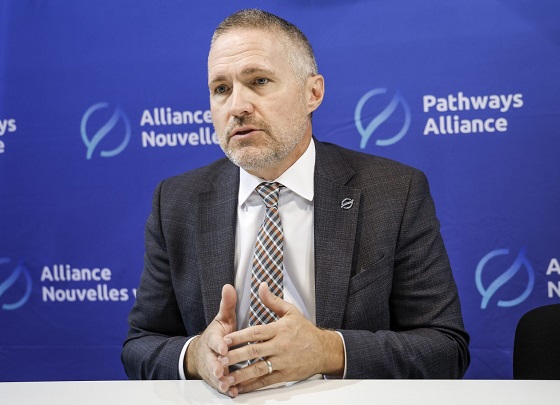
Pathways Alliance CEO Kendall Dilling is interviewed at the World Petroleum Congress in Calgary, Monday, Sept. 18, 2023.THE CANADIAN PRESS/Jeff McIntosh
From Resource Works
Carbon capture gives biggest bang for carbon tax buck CCS much cheaper than fuel switching: report
Canada’s climate change strategy is now joined at the hip to a pipeline. Two pipelines, actually — one for oil, one for carbon dioxide.
The MOU signed between Ottawa and Alberta two weeks ago ties a new oil pipeline to the Pathways Alliance, which includes what has been billed as the largest carbon capture proposal in the world.
One cannot proceed without the other. It’s quite possible neither will proceed.
The timing for multi-billion dollar carbon capture projects in general may be off, given the retreat we are now seeing from industry and government on decarbonization, especially in the U.S., our biggest energy customer and competitor.
But if the public, industry and our governments still think getting Canada’s GHG emissions down is a priority, decarbonizing Alberta oil, gas and heavy industry through CCS promises to be the most cost-effective technology approach.
New modelling by Clean Prosperity, a climate policy organization, finds large-scale carbon capture gets the biggest bang for the carbon tax buck.
Which makes sense. If oil and gas production in Alberta is Canada’s single largest emitter of CO2 and methane, it stands to reason that methane abatement and sequestering CO2 from oil and gas production is where the biggest gains are to be had.
A number of CCS projects are already in operation in Alberta, including Shell’s Quest project, which captures about 1 million tonnes of CO2 annually from the Scotford upgrader.
What is CO2 worth?
Clean Prosperity estimates industrial carbon pricing of $130 to $150 per tonne in Alberta and CCS could result in $90 billion in investment and 70 megatons (MT) annually of GHG abatement or sequestration. The lion’s share of that would come from CCS.
To put that in perspective, 70 MT is 10% of Canada’s total GHG emissions (694 MT).
The report cautions that these estimates are “hypothetical” and gives no timelines.
All of the main policy tools recommended by Clean Prosperity to achieve these GHG reductions are contained in the Ottawa-Alberta MOU.
One important policy in the MOU includes enhanced oil recovery (EOR), in which CO2 is injected into older conventional oil wells to increase output. While this increases oil production, it also sequesters large amounts of CO2.
Under Trudeau era policies, EOR was excluded from federal CCS tax credits. The MOU extends credits and other incentives to EOR, which improves the value proposition for carbon capture.
Under the MOU, Alberta agrees to raise its industrial carbon pricing from the current $95 per tonne to a minimum of $130 per tonne under its TIER system (Technology Innovation and Emission Reduction).
The biggest bang for the buck
Using a price of $130 to $150 per tonne, Clean Prosperity looked at two main pathways to GHG reductions: fuel switching in the power sector and CCS.
Fuel switching would involve replacing natural gas power generation with renewables, nuclear power, renewable natural gas or hydrogen.
“We calculated that fuel switching is more expensive,” Brendan Frank, director of policy and strategy for Clean Prosperity, told me.
Achieving the same GHG reductions through fuel switching would require industrial carbon prices of $300 to $1,000 per tonne, Frank said.
Clean Prosperity looked at five big sectoral emitters: oil and gas extraction, chemical manufacturing, pipeline transportation, petroleum refining, and cement manufacturing.
“We find that CCUS represents the largest opportunity for meaningful, cost-effective emissions reductions across five sectors,” the report states.

Fuel switching requires higher carbon prices than CCUS.
Measures like energy efficiency and methane abatement are included in Clean Prosperity’s calculations, but again CCS takes the biggest bite out of Alberta’s GHGs.
“Efficiency and (methane) abatement are a portion of it, but it’s a fairly small slice,” Frank said. “The overwhelming majority of it is in carbon capture.”

From left, Alberta Minister of Energy Marg McCuaig-Boyd, Shell Canada President Lorraine Mitchelmore, CEO of Royal Dutch Shell Ben van Beurden, Marathon Oil Executive Brian Maynard, Shell ER Manager, Stephen Velthuizen, and British High Commissioner to Canada Howard Drake open the valve to the Quest carbon capture and storage facility in Fort Saskatchewan Alta, on Friday November 6, 2015. Quest is designed to capture and safely store more than one million tonnes of CO2 each year an equivalent to the emissions from about 250,000 cars. THE CANADIAN PRESS/Jason Franson
Credit where credit is due
Setting an industrial carbon price is one thing. Putting it into effect through a workable carbon credit market is another.
“A high headline price is meaningless without higher credit prices,” the report states.
“TIER credit prices have declined steadily since 2023 and traded below $20 per tonne as of November 2025. With credit prices this low, the $95 per tonne headline price has a negligible effect on investment decisions and carbon markets will not drive CCUS deployment or fuel switching.”
Clean Prosperity recommends a kind of government-backstopped insurance mechanism guaranteeing carbon credit prices, which could otherwise be vulnerable to political and market vagaries.
Specifically, it recommends carbon contracts for difference (CCfD).
“A straight-forward way to think about it is insurance,” Frank explains.
Carbon credit prices are vulnerable to risks, including “stroke-of-pen risks,” in which governments change or cancel price schedules. There are also market risks.
CCfDs are contractual agreements between the private sector and government that guarantees a specific credit value over a specified time period.
“The private actor basically has insurance that the credits they’ll generate, as a result of making whatever low-carbon investment they’re after, will get a certain amount of revenue,” Frank said. “That certainty is enough to, in our view, unlock a lot of these projects.”
From the perspective of Canadian CCS equipment manufacturers like Vancouver’s Svante, there is one policy piece still missing from the MOU: eligibility for the Clean Technology Manufacturing (CTM) Investment tax credit.
“Carbon capture was left out of that,” said Svante co-founder Brett Henkel said.
Svante recently built a major manufacturing plant in Burnaby for its carbon capture filters and machines, with many of its prospective customers expected to be in the U.S.
The $20 billion Pathways project could be a huge boon for Canadian companies like Svante and Calgary’s Entropy. But there is fear Canadian CCS equipment manufacturers could be shut out of the project.
“If the oil sands companies put out for a bid all this equipment that’s needed, it is highly likely that a lot of that equipment is sourced outside of Canada, because the support for Canadian manufacturing is not there,” Henkel said.
Henkel hopes to see CCS manufacturing added to the eligibility for the CTM investment tax credit.
“To really build this eco-system in Canada and to support the Pathways Alliance project, we need that amendment to happen.”
Resource Works News

From the Canadian Energy Centre
Canada’s energy landscape changed significantly in 2025, with mounting U.S. economic pressures reinforcing the central role oil and gas can play in safeguarding the country’s independence.
Here are the Canadian Energy Centre’s top five most-viewed stories of the year.
5. Alberta’s massive oil and gas reserves keep growing – here’s why

The Northern Lights, aurora borealis, make an appearance over pumpjacks near Cremona, Alta., Thursday, Oct. 10, 2024. CP Images photo
Analysis commissioned this spring by the Alberta Energy Regulator increased the province’s natural gas reserves by more than 400 per cent, bumping Canada into the global top 10.
Even with record production, Alberta’s oil reserves – already fourth in the world – also increased by seven billion barrels.
According to McDaniel & Associates, which conducted the report, these reserves are likely to become increasingly important as global demand continues to rise and there is limited production growth from other sources, including the United States.
4. Canada’s pipeline builders ready to get to work

Photo courtesy Coastal GasLink
Canada could be on the cusp of a “golden age” for building major energy projects, said Kevin O’Donnell, executive director of the Mississauga, Ont.-based Pipe Line Contractors Association of Canada.
That eagerness is shared by the Edmonton-based Progressive Contractors Association of Canada (PCA), which launched a “Let’s Get Building” advocacy campaign urging all Canadian politicians to focus on getting major projects built.
“The sooner these nation-building projects get underway, the sooner Canadians reap the rewards through new trading partnerships, good jobs and a more stable economy,” said PCA chief executive Paul de Jong.
3. New Canadian oil and gas pipelines a $38 billion missed opportunity, says Montreal Economic Institute

Steel pipe in storage for the Trans Mountain Pipeline expansion in 2022. Photo courtesy Trans Mountain Corporation
In March, a report by the Montreal Economic Institute (MEI) underscored the economic opportunity of Canada building new pipeline export capacity.
MEI found that if the proposed Energy East and Gazoduq/GNL Quebec projects had been built, Canada would have been able to export $38 billion worth of oil and gas to non-U.S. destinations in 2024.
“We would be able to have more prosperity for Canada, more revenue for governments because they collect royalties that go to government programs,” said MEI senior policy analyst Gabriel Giguère.
“I believe everybody’s winning with these kinds of infrastructure projects.”
2. Keyera ‘Canadianizes’ natural gas liquids with $5.15 billion acquisition

Keyera Corp.’s natural gas liquids facilities in Fort Saskatchewan, Alta. Photo courtesy Keyera Corp.
In June, Keyera Corp. announced a $5.15 billion deal to acquire the majority of Plains American Pipelines LLP’s Canadian natural gas liquids (NGL) business, creating a cross-Canada NGL corridor that includes a storage hub in Sarnia, Ontario.
The acquisition will connect NGLs from the growing Montney and Duvernay plays in Alberta and B.C. to markets in central Canada and the eastern U.S. seaboard.
“Having a Canadian source for natural gas would be our preference,” said Sarnia mayor Mike Bradley.
“We see Keyera’s acquisition as strengthening our region as an energy hub.”
1. Explained: Why Canadian oil is so important to the United States

Enbridge’s Cheecham Terminal near Fort McMurray, Alberta is a key oil storage hub that moves light and heavy crude along the Enbridge network. Photo courtesy Enbridge
The United States has become the world’s largest oil producer, but its reliance on oil imports from Canada has never been higher.
Many refineries in the United States are specifically designed to process heavy oil, primarily in the U.S. Midwest and U.S. Gulf Coast.
According to the Alberta Petroleum Marketing Commission, the top five U.S. refineries running the most Alberta crude are:
- Marathon Petroleum, Robinson, Illinois (100% Alberta crude)
- Exxon Mobil, Joliet, Illinois (96% Alberta crude)
- CHS Inc., Laurel, Montana (95% Alberta crude)
- Phillips 66, Billings, Montana (92% Alberta crude)
- Citgo, Lemont, Illinois (78% Alberta crude)

Georgia county admits illegally certifying 315k ballots in 2020 presidential election

ICYMI: Largest fraud in US history? Independent Journalist visits numerous daycare centres with no children, revealing massive scam
Alberta project would be “the biggest carbon capture and storage project in the world”
Canada’s debate on energy levelled up in 2025
-
 Energy1 day ago
Rulings could affect energy prices everywhere: Climate activists v. the energy industry in 2026
-
 Digital ID1 day ago
The Global Push for Government Mandated Digital IDs And Why You Should Worry
-
 Bruce Dowbiggin1 day ago
The Rise Of The System Engineer: Has Canada Got A Prayer in 2026?
-
 International1 day ago
Maduro says he’s “ready” to talk
-
International10 hours ago
“Captured and flown out”: Trump announces dramatic capture of Maduro
-
 International1 day ago
LOCKED AND LOADED: Trump threatens U.S. response if Iran slaughters protesters
-
 Energy4 hours ago
The U.S. Just Removed a Dictator and Canada is Collateral Damage
-
International9 hours ago
Trump Says U.S. Strike Captured Nicolás Maduro and Wife Cilia Flores; Bondi Says Couple Possessed Machine Guns