
Frontier Centre for Public Policy
Peckford: The legality and morality of our country are no longer aligned

From the Frontier Centre for Public Policy
“Our legal system may find me/us guilty, but the legality and morality of our country are no longer aligned.”
This is a part of the statement by Marco Huigenbos of the Coutts three after being found guilty of mischief for behaviour at the Alberta border during the Covid protests.

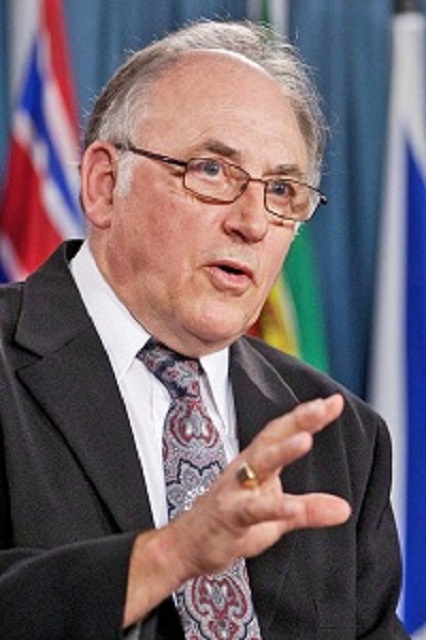
The “Coutts Three,” Marco Van Huigenbos, Alex Van Herk and George Janzen
Mr. Huigenbos hits the nail squarely on the head – – –
This country through its so called legal system has ignored the Charter of Rights and Freedoms opening words —‘Whereas Canada is founded on principles that recognize the Supremacy of God and the Rule of Law ‘ and abused Section 1 of this same Charter by violating ‘ demonstrably justify’ and in ‘a free and democratic society ‘ and hence no longer has the decency or respect towards its people that is characteristic of a democratic nation.
Thousands have been injured and many hundreds dead as a result of Governments’ mandates and lockdowns and blatant coercion and lies to use experimental health damaging vaccines. Peoples’ rights and freedoms have been trampled on and our Constitution destroyed.
These Coutts men are to be lauded for their courage, their faith and their tenacity in the face of the country’s leadership, at all levels, that has lost its way.
This present leadership political, judicial in our country, at federal, provincial and municipal levels have abused the efforts our early 19th century reformers who were fighting for our rights and freedoms and have insulted all those who fought for our country’s freedom in the great wars.
Mr. Huigenbos’s wisdom shines forth today.
The Honourable A. Brian Peckford P.C. is the last living First Minister who helped craft the Canadian Charter of Rights

From the Frontier Centre for Public Policy
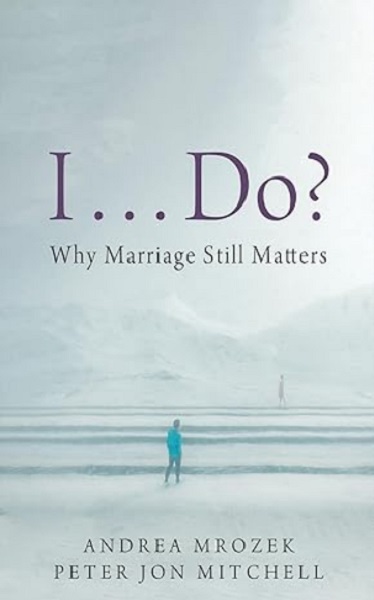
Travis Smith reviews I… Do? by Andrea Mrozek and Peter Jon Mitchell, showing that marriage is a public good, not just private choice, arguing culture, not politics, must lead any revival of this vital institution.
Andrea Mrozek and Peter Jon Mitchell, in I… Do?, write that the fading value of marriage is a threat to social stability
I… Do? by Andrea Mrozek and Peter Jon Mitchell manages to say something both obvious and radical: marriage matters. And not just for sentimental reasons. Marriage is a public good, the authors attest.
The book is a modestly sized but extensively researched work that compiles decades of social science data to make one central point: stable marriages improve individual and societal well-being. Married people are generally healthier, wealthier and more resilient. Children from married-parent homes do better across almost every major indicator: academic success, mental health, future earnings and reduced contact with the justice system.
The authors refer to this consistent pattern as the “marriage advantage.” It’s not simply about income. Even in low-income households, children raised by married parents tend to outperform their peers from single-parent families. Mrozek and Mitchell make the case that marriage functions as a stabilizing institution, producing better outcomes not just for couples and kids but for communities and, by extension, the country.
While the book compiles an impressive array of empirical findings, it is clear the authors know that data alone can’t fix what’s broken. There’s a quiet but important concession in these pages: if statistics alone could persuade people to value marriage, we would already be seeing a turnaround.
Marriage in Canada is in sharp decline. Fewer people are getting married, the average age of first marriage continues to climb, and fertility rates are hitting historic lows. The cultural narrative has shifted. Marriage is seen less as a cornerstone of adult life and more as a personal lifestyle choice, often put off indefinitely while people wait to feel ready, build their careers or find emotional stability.
The real value of I… Do? lies in its recognition that the solutions are not primarily political. Policy changes might help stop making things worse, but politicians are not going to rescue marriage. In fact, asking them to may be counterproductive. Looking to politicians to save marriage would involve misunderstanding both marriage and politics. Mrozek and Mitchell suggest the best the state can do is remove disincentives, such as tax policies and benefit structures that inadvertently penalize marriage, and otherwise get out of the way.
The liberal tradition once understood that family should be considered prior to politics for good reason. Love is higher than justice, and the relationships based in it should be kept safely outside the grasp of bureaucrats, ideologues, and power-seekers. The more marriage has been politicized over recent decades, the more it has been reshaped in ways that promote dependency on the impersonal and depersonalizing benefactions of the state.
The book takes a brief detour into the politics of same-sex marriage. Mrozek laments that the topic has become politically untouchable. I would argue that revisiting that battle is neither advisable nor desirable. By now, most Canadians likely know same-sex couples whose marriages demonstrate the same qualities and advantages the authors otherwise praise.
Where I… Do? really shines is in its final section. After pages of statistics, the authors turn to something far more powerful: culture. They explore how civil society—including faith communities, neighbourhoods, voluntary associations and the arts can help revive a vision of marriage that is compelling, accessible and rooted in human experience. They point to storytelling, mentorship and personal witness as ways to rebuild a marriage culture from the ground up.
It’s here that the book moves from description to inspiration. Mrozek and Mitchell acknowledge the limits of top-down efforts and instead offer the beginnings of a grassroots roadmap. Their suggestions are tentative but important: showcase healthy marriages, celebrate commitment and encourage institutions to support rather than undermine families.
This is not a utopian manifesto. It’s a realistic, often sobering look at how far marriage has fallen off the public radar and what it might take to put it back. In a political climate where even mentioning marriage as a public good can raise eyebrows, I… Do? attempts to reframe the conversation.
To be clear, this is not a book for policy wonks or ideologues. It’s for parents, educators, community leaders and anyone concerned about social cohesion. It’s for Gen Xers wondering if their children will ever give them grandchildren. It’s for Gen Zers wondering if marriage is still worth it. And it’s for those in between, hoping to build something lasting in a culture that too often encourages the opposite.
If your experiences already tell you that strong, healthy marriages are among the greatest of human goods, I… Do? will affirm what you know. If you’re skeptical, it won’t convert you overnight, but it might spark a much-needed conversation.
Travis D. Smith is an associate professor of political science at Concordia University in Montreal. This book review was submitted by the Frontier Centre for Public Policy.

From the Frontier Centre for Public Policy
By Lee Harding
Lee Harding exposes the truth behind Canada’s sky-high carbon tax—one that’s hurting our oil industry and driving businesses away. With foreign oil paying next to nothing, Harding argues this policy is putting Canada at a major economic disadvantage. It’s time to rethink this costly approach.
Our sky-high carbon tax places Canadian businesses at a huge disadvantage and is pushing investment overseas
No carbon tax will ever satisfy global-warming advocates, but by most measures, Canada’s carbon tax is already too high.
This unfortunate reality was brought to light by Resource Works, a B.C.-based non-profit research and advocacy organization. In March, one of their papers outlined the disproportionate and damaging effects of Canada’s carbon taxes.
The study found that the average carbon tax among the top 20 oil-exporting nations, excluding Canada, was $0.70 per tonne of carbon emissions in fiscal 2023. With Canada included, that average jumps to $6.77 per tonne.
At least Canada demands the same standards for foreign producers as it does for domestic ones, right? Wrong.
Most of Canada’s oil imports come from the U.S., Saudi Arabia, and Nigeria, none of which impose a carbon tax. Only 2.8 per cent of Canada’s oil imports come from the modestly carbon-taxing countries of the U.K. and Colombia.
Canada’s federal consumer carbon tax was $80 per tonne, set to reach $170 by 2030, until Prime Minister Mark Carney reduced it to zero on March 14. However, parallel carbon taxes on industry remain in place and continue to rise.
Resource Works estimates Canada’s effective carbon tax at $58.94 per tonne for fiscal 2023, while foreign oil entering Canada had an effective tax of just $0.30 per tonne.
“This results in a 196-fold disparity, effectively functioning as a domestic tariff against Canadian oil production,” the research memo notes. Forget Donald Trump—Ottawa undermines our country more effectively than anyone else.
Canada is responsible for 1.5 per cent of global CO2 emissions, but the study estimates that Canada paid one-third of all carbon taxes in 2023. Mexico, with nearly the same emissions, paid just $3 billion in carbon taxes for 2023-24, far less than Canada’s $44 billion.
Resource Works also calculated that Canada alone raised the global per-tonne carbon tax average from $1.63 to $2.44. To be Canadian is to be heavily taxed.
Historically, the Canadian dollar and oil and gas investment in Canada tracked the global price of oil, but not anymore. A disconnect began in 2016 when the Trudeau government cancelled the Northern Gateway pipeline and banned tanker traffic on B.C.’s north coast.
The carbon tax was introduced in 2019 at $15 per tonne, a rate that increased annually until this year. The study argues this “economic burden,” not shared by the rest of the world, has placed Canada at “a competitive disadvantage by accelerating capital flight and reinforcing economic headwinds.”
This “erosion of energy-sector investment” has broader economic consequences, including trade balance pressures and increased exchange rate volatility.
According to NASA, Canadian forest fires released 640 million metric tonnes of carbon in 2023, four times the amount from fossil fuel emissions. We should focus on fighting fires, not penalizing our fossil fuel industry.
Carney praised Canada’s carbon tax approach in his 2021 book Value(s), raising questions about how long his reprieve will last. He has suggested raising carbon taxes on industry, which would worsen Canada’s competitive disadvantage.
In contrast, Conservative leader Pierre Poilievre argued that extracting and exporting Canadian oil and gas could displace higher-carbon-emitting energy sources elsewhere, helping to reduce global emissions.
This approach makes more sense than imposing disproportionately high tax burdens on Canadians. Taxes won’t save the world.
Lee Harding is a research fellow for the Frontier Centre for Public Policy.


FDA requires new warning on mRNA COVID shots due to heart damage in young men

Before Trudeau average annual immigration was 617,800. Under Trudeau number skyrocketted to 1.4 million annually

Carney’s new agenda faces old Canadian problems

Internal emails show Canadian gov’t doubted ‘mass graves’ narrative but went along with it

-
COVID-1921 hours ago
FDA requires new warning on mRNA COVID shots due to heart damage in young men
-
Business19 hours ago
Carney’s new agenda faces old Canadian problems
-
Indigenous20 hours ago
Internal emails show Canadian gov’t doubted ‘mass graves’ narrative but went along with it
-
 Daily Caller16 hours ago
Blackouts Coming If America Continues With Biden-Era Green Frenzy, Trump Admin Warns
-
 Bruce Dowbiggin22 hours ago
Eau Canada! Join Us In An Inclusive New National Anthem
-
 Business2 days ago
CBC six-figure salaries soar
-
 Addictions2 days ago
Can addiction be predicted—and prevented?
-
 Addictions2 days ago
More young men want to restrict pornography: survey