
Opinion
Partisan politics has become the greatest threat in our lives.

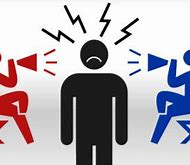

Political parties, have they become unnecessary obstacles? Do we still need them?
I am a tax payer and have been affected by this pandemic, but the politics being played out may be the hardest part.
There are several layers of governments and my taxes pays for all them or part of them. Each level takes my money, gleefully, I might add but each level takes a portion to protect their turf from the other levels. Waste of my money.
Personally I do not care which level of government does what because I usually deal with the bureaucrats that do the services that I need. I have yet to see a politician renew my driver’s license, x-ray a bone or teach math to children.
This COVID-19 comes along and almost daily we hear how bad the Trudeau Federal Liberals are screwing things up. They sent us vaccines too early, and we weren’t ready for them, they are only sending us 407,000 doses by March 31 not 470,000 doses. We can’t plan on who needs vaccinations in Alberta because we don’t know the exact amount.
The federal government needs to close the borders said some of the same politicians who left the country over Christmas break. The federal government made a deal for vaccines that put us at the back of the line, yet we got vaccines before we are ready for them, It’s Trudeau’s fault.

Conservative Premiers want trade sanctions against the US because President Biden cancelled Keystone XL. Conservative Premier Kenney leads the pack, but was silent as a Conservative Cabinet Minister under Conservative Prime Minister Harper when President Obama and then Vice President Biden denied it the first time.
Partisan politics is getting so juvenile that it is becoming a danger to people’s lives.
I have to ask that if Trudeau is responsible for everything then let’s make it official. Let’s us nationalize our health care, our education, our long term care, our services, our highways, our police forces, our parks, our employment standards and the list goes on.
Then we should do away with political parties and perhaps we could co-operate with each other. If Ottawa was in charge of everything all the levels of governments would save the money they spend on lawyers fighting each other. We could take advantage of volume discounts, simplify bureaucracies, reduce red tape and perhaps we could handle this ongoing crisis like adults. Just saying.
This idea may be just a bit less crazy than simply blaming Trudeau for everything. Or is it the sanest option?


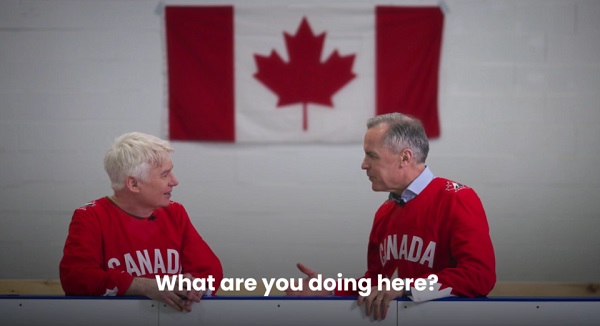
“Of all tyrannies, a tyranny sincerely exercised for the good of its victims may be the most oppressive. It would be better to live under robber barons than under omnipotent moral busybodies.” C.S. Lewis
One of the aims of logical positivism has been Boomers’ quest to kill Western religion and the pursuit of faith in order to make room for the state. Symbols are banned. Churches are burned. Infidels are rewarded. Esoteric faith systems applauded. Yet, as 2026 dawns, it appears that, not only is traditional religion not dead, it might just be making a comeback with younger generations who’ve grown skeptical of their parents’ faux religion of self.
How? In an age of victim status, traditional religion is suddenly a cuddly TikTok puppy. Hard to imagine that the force that spread imperialism and war across the globe for centuries being a victim. But yes. Only Christians and Jews are singled out for censure In Carney’s Canada The zeal to repeal God has backfired. Faith is off the canvas and punching back. (And we are NOT talking about the Woke pope.)
The purveyors of “old-time religion” will still find themselves facing a determined opponent well on the way to moral inversion. And a compliant population. As blogger Melanie in Saskatchewan points out, “Canadians were sold a calm, competent adult in the room. What they got was an unelected system engineer quietly converting moral claims into financial constraints. This is not leadership. It is non-consensual governance.

The freedoms that make dissent possible are being used to hollow out dissent. The protections meant to guard against abuse are being used to avoid scrutiny. And the law—stripped of its moral imagination—is asked to do what it cannot: resolve psychic conflict through paperwork.”
The sophistry of the superior class demands submission. C.S. Lewis warned of this inversion in God In The Dock. “To be “cured” against one’s will and cured of states which we may not regard as disease is to be put on a level of those who have not yet reached the age of reason or those who never will; to be classed with infants, imbeciles, and domestic animals.”
In Canada that compliant class has embraced Mark Carney as the great stabilizer. “Canadians keep asking the wrong question about Mark Carney,” says blogger Melanie in Saskatchewan. “They keep asking whether he is a good politician. That is like asking whether a locksmith is a good interior decorator.
Carney is not here to govern. He is here to re-engineer the operating system of the country while the Liberal Party provides the helpful stage props and applause track. And judging by how little scrutiny this government receives, the audience seems perfectly content to clap at whatever is placed in front of them, provided it comes with soothing words like “stability,” “resilience,” and “the experts agree”.
Adds Dr. Andrea Wagner, Canadians “hide behind procedure. Behind policy. Behind institutions. Behind NDAs. Behind committees, processes, protocols. Behind phrases like “we’re reviewing this internally” and “that’s beyond my authority.” They hide behind the pretense of empathy while quietly perpetuating injustice. They hide behind performative busy-ness: “I wish I had time,” “I’m swamped,” “I’ve been unwell.” There is enormous power in powerlessness—and Canadians wield it masterfully.”
The problem, says Melanie in Saskatchewan, is not that Mark Carney in full power is incompetent. The problem is that he is extremely competent at something Canadians never actually consented to. Technocrats redesign the machinery so that the outcome becomes inevitable. No messy debate. No inconvenient voters. No public reckoning. Just “the framework,” “the model,” “the standard,” and eventually the quiet conclusion that there is “no alternative.”
And this is precisely the world Mark Carney comes from. ”He did not rise through grassroots politics or party service. He rose through central banks, global finance institutions, and elite climate-finance bodies that speak fluent acronym and consider democracy an optional inconvenience. The man does not campaign. He architects.”
While the Conservative Party of Canada still polls evenly with the Liberals they are playing a different game, one they— with their traditional tactics— are not wired to win in a battle of systems with Carney. This cringeworthy “Keep It Up” endorsement of Carney by former CPC leader Erin O’Toole speaks to why they are further from power than ever.
The manufactured crisis over indigenous Rez school graves illustrates the method. “To call out intimidation or dehumanization is to risk being reframed as the aggressor. The person who names harm becomes the disturbance; the one who weaponizes grievance becomes the protected party. Justice no longer asks what happened, only who claims injury first. This is not accidental. It is the logical endpoint of a culture that has confused victimhood with virtue and pain with authority.

Suffering, once something to be alleviated, has become something to be curated. Identity now precedes evidence; accusation outruns inquiry. The system does not ask whether harm is real or proportional—only whether it can be procedurally contained. And containment, I am learning, is often preferred to truth.”
There are still some who believe there remains a way out of this. Here’s Paul Wells on Substack with a valid conclusion— which most sentient people reached by the end of Trudeau’s first term. “Canada has spent too long thinking of itself as a warehouse for the world instead of designing and building for itself. It’s time for a shared mindset of ambition quality and real investment in physical and human capital so Canadians become Canada’s designers and builders of livable cities rather than bystanders to our own future.”
But it’s hard to square that with the gap Carney’s already has. “The tragedy is that the Liberal Party is perfectly happy to hand (Carney) the country and then scold the public for noticing. If Canadians want a future where choices are still made by voters instead of algorithms and advisory panels, they are going to have to stop applauding this performance and start asking the one question that truly terrifies technocrats and their obedient political enablers.”

This system monolith taking over life is why the abrasive, defiant Donald Trump emerged. Vast segments of America employ him to defy the EU scolds with their censorship regimes. His defiance is categorical— which is why it frightens Canadians. The man from Mitch & Murray delivered a few truths to them and they soiled themselves. Paradise will never be the same!. Bad Trump! But an almost-octogenarian has little runway left himself. Who can continue the resistance to the Carney system engineers?
In the past organized religion was a refuge from the maelstrom of the secular storm. There was comfort in the message. Thus, the Liberals’ current need to destroy faith. So the epidemic of churches burned is ignored. The intrusive demonstrations of militant Islam are tolerated. (Carney says Muslim virtues are Canadian virtues.) History is re-written. Heroes debunked.
If Soviet Russia is any indication, the traditional faiths can survive and act as a bulwark against the technocrats— if they find their Pope John Paul II.. The Catholic and Orthodox faiths furnished a way out from behind the Iron Curtain. As organizations not co-opted by the state in the West religions can provide a moral backbone to expose and defeat the secular globalists.
Whether you are a believer or not they provide a pushback to restore the moral clarity C.S. described. It’s not too late as 2026 dawns. But if nothing is done in the West — if Canada accepts EU censorship and global ID— then writing this column in 2027 could well be defined as a criminal act.
“That which you most need will be found where you least want to look.” Carl Jung
Bruce Dowbiggin @dowbboy is the editor of Not The Public Broadcaster A two-time winner of the Gemini Award as Canada’s top television sports broadcaster, his 2025 book Deal With It: The Trades That Stunned The NHL And Changed Hockey is now available on Amazon. Inexact Science: The Six Most Compelling Draft Years In NHL History, his previous book with his son Evan, was voted the seventh-best professional hockey book of all time by bookauthority.org . His new poetry collection In Other Words is available via brucedowbigginbooks.ca and on Kindle books at https://www.amazon.ca/dp/1069802700



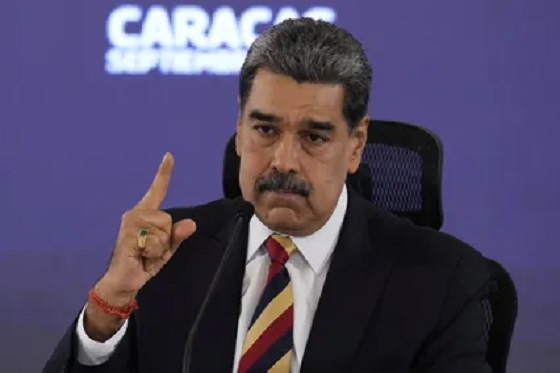
Venezuelan strongman Nicolás Maduro is striking a suddenly conciliatory tone toward Washington after a reported CIA drone strike targeted a cartel-linked docking area inside his country, claiming Caracas is now “ready” to negotiate with the United States on drug trafficking — and even dangling access to Venezuela’s oil sector as leverage.
In a sit-down interview recorded on New Year’s Eve with Spanish journalist Ignacio Ramonet and aired Thursday on state television, Maduro said the U.S. government has long known Venezuela is open to talks, insisting that if Washington wants a note-for-note agreement to combat narcotics flows, “we’re ready.”
He went further, suggesting that American energy firms could return in force, saying Venezuela is open to U.S. oil investment “whenever they want it, wherever they want it and however they want it,” explicitly referencing past dealings with Chevron.
Venezuelan President Maduro:
If the United States wants to seriously talk about an agreement to combat drug trafficking, we are ready. pic.twitter.com/3cWMyDxuC8
— Open Source Intel (@Osint613) January 2, 2026
The remarks come amid an aggressive U.S. pressure campaign that has seen at least 35 American strikes on suspected drug-smuggling vessels across the Caribbean and eastern Pacific since early September, operations U.S. officials say have killed more than 115 suspected traffickers.
Those actions are widely viewed as part of a broader effort to choke off cartel pipelines tied to the Maduro regime and destabilize a government Washington has long accused of functioning as a narco-state.
Last week’s strike — the first publicly acknowledged U.S. operation on Venezuelan soil since the maritime campaign began — was revealed by President Trump himself in a Dec. 26 radio interview, marking a sharp escalation.
Maduro refused to address the strike directly during the interview, saying only that he could “talk about it in a few days,” a silence that stood in contrast to his sudden eagerness to negotiate.
U.S. officials have been far less ambiguous. Secretary of State Marco Rubio said in December that the current relationship with Caracas is “intolerable,” accusing the regime of actively partnering with terrorist organizations and criminal networks that threaten U.S. national interests.
Maduro, who is under U.S. indictment on charges including drug trafficking, money laundering, and corruption, is now signaling flexibility just as American pressure tightens — a familiar pattern for a regime that has often talked cooperation when cornered, only to revert once the heat eases.
Whether Washington sees this latest outreach as a genuine shift or another tactical feint remains an open question, but the timing suggests the message was less about diplomacy than survival.
Georgia county admits illegally certifying 315k ballots in 2020 presidential election

‘The electric story is over’

ICYMI: Largest fraud in US history? Independent Journalist visits numerous daycare centres with no children, revealing massive scam
Alberta project would be “the biggest carbon capture and storage project in the world”
-
 Energy2 days ago
Why Japan wants Western Canadian LNG
-
 Business2 days ago
Land use will be British Columbia’s biggest issue in 2026
-
 Energy3 hours ago
Rulings could affect energy prices everywhere: Climate activists v. the energy industry in 2026
-
 Digital ID4 hours ago
The Global Push for Government Mandated Digital IDs And Why You Should Worry
-
Bruce Dowbiggin2 hours ago
The Rise Of The System Engineer: Has Canada Got A Prayer in 2026?
-
 International1 day ago
Trump confirms first American land strike against Venezuelan narco networks
-
International3 hours ago
Maduro says he’s “ready” to talk
-
 Addictions2 days ago
Coffee, Nicotine, and the Politics of Acceptable Addiction