
Frontier Centre for Public Policy
No, Mr. Mayor outside organizers are not responsible for student radicalism




From the Frontier Centre for Public Policy
While there are malevolent outside actors doing what they can with universities, the influential corruption is internal.
In his May 1 press conference on the university student demonstrations, occupations, and riots, New York Mayor Eric Adams blamed outside professional organizers for radicalizing our young people in universities in New York, on campuses throughout the country, and around the world. Exactly who these sinister outside forces are, the mayor did not specify.
Of course, the mayor is correct that there are outside professional organizers and agitators who have infiltrated campuses and encouraged even more extreme measures by demonstrators. Everyone sees the uniformity across the country of materials provided, such as tents and signs.
Yes, these are malevolent forces bent on transforming or destroying the United States. But funders and organizers are facilitators and enablers, not primary motivators. Mr. Adams is right in saying that professionals are behind these upheavals. But outside agitators and funders are not shaping the hearts and minds of university students. Rather, the professionals responsible for students’ mindsets are not external to universities; they are the employees of universities, who have been working on the students, miseducating them, throughout their entire university careers.
The satirical website Babylon Bee gets it right. With reference to the occupation of the Columbia University administration building, the Bee article headline is “Oh No! Indoctrinated Woke Extremists Destroy Woke Extremist Indoctrination Center.”
Quoting an imaginary university official, the Bee stated: “‘We didn’t see this coming,’ said one official. ‘After spending decades brainwashing young, impressionable people into volatile, savage revolutionaries, we were shocked to see them unleash such volatility and savagery while trying to launch a revolution. We wish there had been warning signs along the way.’”
Would that this were only humorous parody. Alas, it is an accurate representation of our universities in the 21st century. The many professors who have joined the demonstrators-occupiers-rioters, and who knows how many administrators and staff, is proof of the nature of today’s education.
The Bee continued:
“Students who engaged in the violent attack were thankful for the years of intense training they received from the institution they were now actively working to destroy. …
“At publishing time, the school’s leadership was confident that the government would do nothing to impede their ongoing efforts to make the country worse and more dangerous.”
The many pleas from well-meaning observers for the occupiers to desist so that students can return to their classes are beside the point. Their classes are where they were radicalized. The faculty itself is almost entirely radicalized.
Left-wing university monoculture today is nothing like the Enlightenment-based university that I attended in the mid-20th century, where the emphasis was on searching for the objective truth of reality using reason, evidence, and well-founded conclusions. Universities have now rejected the search for truth in favor of activism based on far-left Marxist “truths,” which may not be questioned.
Among these “truths” is the certainty that all people in the world are divided between evil, ruthless oppressors and exploiters and innocent, noble victims. In this class conflict, which is the only important feature of human life, black, indigenous, and people of color (BIPOC), LGBT people, females, the disabled, and Muslims are all innocent victims of whites, Asians, and Jews, heterosexuals, males, the able, and Christians.
“Victims” are represented in universities by grievance subjects, which at first leaked into but then flooded the humanities and social sciences. Feminist, Black, Queer, Islamic, and Disabled Studies do not exist to investigate truth and reality but to advocate for the victims they represent, and to spur change to the advantage of their designated category.
As part of this project, one common belief among grievance subjects, and now the humanities and social sciences, is that Western civilization must be abandoned as oppressive, and Western countries, such as the United States and Canada, must be transformed entirely or destroyed. Anti-colonial studies “prove” that these countries are in any case invalid and that the American and Canadian citizens are “colonial settlers” without legitimate standing.
University administrators are not innocent victims of these trends. On the contrary, they are primary instigators. They impose the “diversity, equity, and inclusion” manifestations of the “social justice” ideology, leading to official implementation of reverse racism, reverse sexism, and segregation. Discrimination against “oppressors” is not only tolerated; it is also systematically imposed and celebrated.
While student bodies have remained consistent in size, and the professoriat has, if anything, shrunk, not to mention the increased reliance on untenured, temporary “sessional” lecturers (a great financial saving), administrations have exploded in size, increasing to double or triple in most universities. One source of this is “DEI officers,” hired at every level and in every unit, at huge cost, to serve as political commissars policing thought and speech, so that no one can deviate from politically “correct” belief and expression.
Any professor, lecturer, or instructor professing opinions not in line with “social justice” and radical change are quickly identified and surrounded by DEI commissars and forced to confess error, go to re-education programs, lose privileges of various kinds—forget promotion and funding—and, if stubborn in deviation, termination outright, and banishment from the university. This puts great power in the hands of students, who only have to say that they are offended by what a professor says, and she (more rarely he today) is on the chopping block.
So while there are malevolent outside actors doing what they can with universities, the influential corruption is internal. If you block the outsiders, nothing will change. The universities are the source of the radicalism.
Philip Carl Salzman is Emeritus Professor of Anthropology at McGill University and Senior Fellow at the Frontier Centre for Public Policy.

From the Frontier Centre for Public Policy
Madrid knew solar and wind power were unreliable but pressed ahead anyway
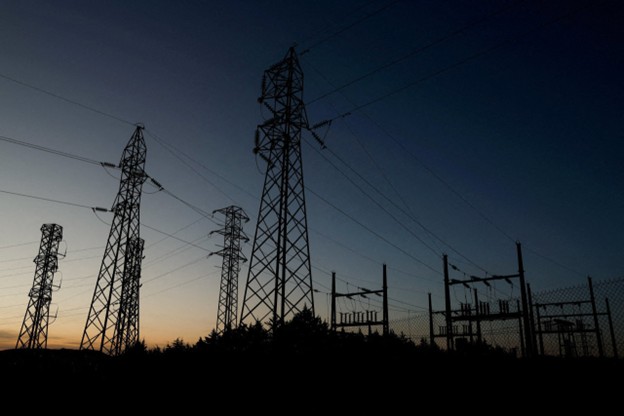
When a grid failure plunged 55 million people in Spain and Portugal into darkness at the end of April, it should have been a wake-up call on green energy. Climate activists promised that solar and wind power were the future of cheap, dependable electricity. The massive half-day blackout shows otherwise. The nature of solar and wind generation makes grids that rely on them more prone to collapse—an issue that’s particularly expensive to ameliorate.
As I wrote in these pages in January, the data have long shown that environmentalists’ vision of cheap, reliable solar and wind energy was a mirage. The International Energy Agency’s latest cost data continue to underscore this: Consumers and businesses in countries with almost no solar and wind on average paid 11 U.S. cents for a kilowatt hour of electricity in 2023, but costs rise by more than 4 cents for every 10% increase in the portion of a nation’s power generation that’s covered by solar and wind. Green countries such as Germany pay 34 cents, more than 2.5 times the average U.S. rate and nearly four times China’s.
Prices are high in no small part because solar and wind require a duplicate backup energy system, often fossil-fuel driven, for when the sun doesn’t shine or the wind doesn’t blow. The Iberian blackout shows that the reliability issues and costs of solar and wind are worse than even this sort of data indicates.
Grids need to stay on a very stable frequency—generally 50 Hertz in Europe—or else you get blackouts. Fossil-fuel, hydro and nuclear generation all solve this problem naturally because they generate energy by powering massive spinning turbines. The inertia of these heavy rotating masses resists changes in speed and hence frequency, so that when sudden demand swings would otherwise drop or hike grid frequency, the turbines work as immense buffers. But wind and solar don’t power such heavy turbines to generate energy. It’s possible to make up for this with cutting-edge technology such as advanced inverters or synthetic inertia. But many solar and wind farms haven’t undergone these expensive upgrades. If a grid dominated by those two power sources gets off frequency, a blackout is more likely than in a system that relies on other energy sources.
Spain has been forcing its grid to rely more on unstable renewables. The country has pursued an aggressive green policy, including a commitment it adopted in 2021 to achieve “net zero” emissions by 2050. The share of solar and wind as a source of Spain’s electricity production went from less than 23% in 2015 to more than 43% last year. The government wants its total share of renewables to hit 81% in the next five years—even as it’s phasing out nuclear generation.
Just a week prior to the blackout, Spain bragged that for the first time, renewables delivered 100% of its electricity, though only for a period of minutes around 11:15 a.m. When it collapsed, the Iberian grid was powered by 74% renewable energy, with 55% coming from solar. It went down under the bright noon sun. When the Iberian grid frequency started faltering on April 28, the grid’s high proportion of solar and wind generation couldn’t stabilize it. This isn’t speculation; it’s physics. As the electricity supply across Spain collapsed, Portugal was pulled along, because the two countries are tightly interconnected through the Iberian electricity network.
Madrid had been warned. The parent company of Spain’s grid operator admitted in February: “The high penetration of renewable generation without the necessary technical capabilities in place to keep them operating properly in the event of a disturbance . . . can cause power generation outages, which could be severe.”
Yet the Spanish government is still in denial. Even while admitting that he didn’t know the April blackout’s cause, Prime Minister Pedro Sánchez insisted that there was “no empirical evidence” that renewables were to blame and that Spain is “not going to deviate a single millimeter” from its green energy ambitions.
Unless the country—and its neighbors—are comfortable with an increased risk of blackouts, this will require expensive upgrades. A new Reuters report written with an eye to the Iberian blackout finds that for Europe as a whole this would cost trillions of dollars in infrastructure updates. It’s possible that European politicians can talk voters into eating that cost. It’ll be impossible for India or nations in Africa to follow suit.
That may be unwelcome news to Mr. Sánchez, but even a prime minister can’t overcome physics. Spain’s commitment to solar and wind is forcing the country onto an unreliable, costly, more black-out-prone system. A common-sense approach would hold off on a sprint for carbon reductions and instead put money toward research into actually reliable, affordable green energy.
Unfortunately for Spain and those countries unlucky enough to be nearby, the Spanish energy system—as one Spanish politician put it—“is being managed with an enormous ideological bias.”
Bjorn Lomborg is president of the Copenhagen Consensus, a visiting fellow at Stanford University’s Hoover Institution and author of “Best Things First.”
From the Frontier Centre for Public Policy
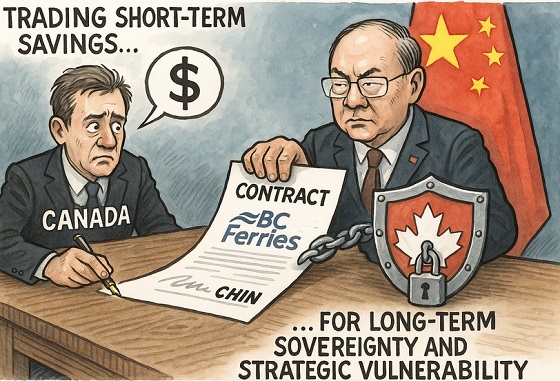
Scott McGregor warns BC Ferries’ contract with a Chinese state-owned shipbuilder reveals Canada’s failure to align procurement with national security. It is trading short-term savings for long-term sovereignty and strategic vulnerability.
BC Ferries’ recent decision to award the construction of four new vessels to China Merchants Industry (Weihai), a state-owned shipyard under the Chinese Communist Party (CCP), is a cautionary tale of strategic policy failure. While framed as a cost-effective solution to replace aging vessels, the agreement reveals a more critical issue: Canada’s persistent failure to align vital infrastructure procurement with national security and economic resilience.
The situation goes beyond transportation. It is a governance failure at the intersection of trade, security, and sovereignty.
Outsourcing Sovereignty
China Merchants Industry is part of a sprawling state-owned conglomerate, closely connected to the CCP. It is not merely a commercial player; it is a geopolitical actor. In China, these organizations thrive on a unique blend of state subsidies, long-term strategic direction, and complex corporate structures that often operate in the shadows. This combination grants them a significant competitive edge, allowing them to navigate the business landscape with an advantage that many try to replicate but few can match.
The same firms supplying ferries to BC are also building warships for the People’s Liberation Army Navy. That alone should give pause.
Yet BC Ferries, under provincial oversight, proceeded without meaningful scrutiny of these risks. No Canadian shipyards submitted bids due to capacity constraints and a lack of strategic investment. But choosing a Chinese state-owned enterprise by default is not a neutral act. It is the consequence of neglecting industrial policy.
Hybrid Risk, Not Just Hybrid Propulsion
China’s dominance in shipbuilding, now over 60% of global orders, has not occurred by chance. It is the result of state-driven market distortion, designed to entrench foreign dependence on Chinese industrial capacity.
Once that dependency forms, Beijing holds leverage. It can slow parts shipments, withhold technical updates, or retaliate economically in response to diplomatic friction. This is not speculative; it has already happened in sectors such as canola, critical minerals, and telecommunications.
Ordering a ferry, on its face, might seem apolitical. But if the shipbuilder is state-owned, its obligations to the CCP outweigh any commercial contract. That is the nature of hybrid threats to security: they appear benign until they are not.
Hybrid warfare combines conventional military force with non-military tactics (such as cyber attacks, disinformation, economic coercion, and the use of state-owned enterprises) to undermine a target country’s stability, influence decisions, or gain strategic control without resorting to open conflict. It exploits legal grey zones and democratic weaknesses, making threats appear benign until they’ve done lasting damage.
A Policy Void, Not Just a Procurement Gap
Ottawa designed its National Shipbuilding Strategy to rebuild Canadian capability, but it has failed to scale quickly enough. The provinces, including British Columbia, have been left to procure vessels without the tools or frameworks to evaluate foreign strategic risk. Provincial procurement rules treat a state-owned bidder the same as a private one. That is no longer defensible.
Canada must close this gap through deliberate, security-informed policy. Three steps are essential for the task:
Ottawa should mandate National Security reviews for critical infrastructure contracts. Any procurement involving foreign state-owned enterprises must trigger a formal security and economic resilience assessment. This should apply at the federal and provincial levels.
Secondly, when necessary, Canada should enhance its domestic industrial capabilities through strategic investments. Canada cannot claim to be powerless when there are no local bids available. Federal and provincial governments could collaborate to invest in scalable civilian shipbuilding, in addition to military contracts. Otherwise, we risk becoming repeatedly dependent on external sources.
Canada should enhance Crown oversight by implementing intelligence-led risk frameworks. This means that agencies, such as BC Ferries, must develop procurement protocols that are informed by threat intelligence rather than just cost analysis. It also involves incorporating security and foreign interference risk indicators into their Requests for Proposals (RFPs).
The Cost of Strategic Amnesia
The central point here is not only about China; it is primarily about Canada. The country needs more strategic foresight. If we cannot align our economic decisions with our fundamental security posture, we will likely continue to cede control of our critical systems, whether in transportation, healthcare, mining, or telecommunications, to adversarial regimes. That is a textbook vulnerability in the era of hybrid warfare.
BC Ferries may have saved money today. But without urgent policy reform, the long-term cost will be paid in diminished sovereignty, reduced resilience, and an emboldened adversary with one more lever inside our critical infrastructure.
Scott McGregor is a senior security advisor to the Council on Countering Hybrid Warfare and Managing Partner at Close Hold Intelligence Consulting Ltd.


Ontario man launches new challenge against province’s latest attempt to ban free expression on roadside billboards
Ottawa Funded the China Ferry Deal—Then Pretended to Oppose It

FDA Exposed: Hundreds of Drugs Approved without Proof They Work

New Peer-Reviewed Study Affirms COVID Vaccines Reduce Fertility
-
 Business2 days ago
Latest shakedown attempt by Canada Post underscores need for privatization
-
 Business1 day ago
Why it’s time to repeal the oil tanker ban on B.C.’s north coast
-
 Aristotle Foundation2 days ago
How Vimy Ridge Shaped Canada
-
 Alberta1 day ago
Pierre Poilievre – Per Capita, Hardisty, Alberta Is the Most Important Little Town In Canada
-
 Alberta1 day ago
Alberta Provincial Police – New chief of Independent Agency Police Service
-
 International2 days ago
CBS settles with Trump over doctored 60 Minutes Harris interview
-
 Energy1 day ago
If Canada Wants to be the World’s Energy Partner, We Need to Act Like It
-
 MxM News1 day ago
UPenn strips Lia Thomas of women’s swimming titles after Title IX investigation