
Business
Mark Carney’s carbon tax plan hurts farmers



From the Canadian Taxpayers Federation
Liberal leadership front-runner Mark Carney recently announced his carbon tax plan and here are some key points.
It’s expensive for Canadians.
It’s even more expensive for farmers.
Carney announced he would immediately remove the consumer carbon tax if he became prime minister.
That sounds like good news, but it’s important to read the fine print.
Carney went on and announced that he would be “integrating a new consumer carbon credit market into the industrial pricing system.” Carney also said he would “improve and tighten” the industrial carbon tax and impose carbon tax tariffs on imports into Canada.
If that sounds like Carney isn’t getting rid of the carbon tax, that’s because he isn’t. He’s trying to hide the costs from Canadians by imposing higher carbon taxes on businesses.
What that means is that Carney’s plan would tax businesses and then businesses will pass those costs onto consumers.
That also means farmers.
Under the current carbon tax, farmers have an exemption from the carbon tax on the gas and diesel they use on their farm. The hidden industrial carbon tax is applied directly to industry. Businesses are forced to pay the carbon tax if they emit above the government’s prescribed limit.
But businesses don’t just swallow those costs. They pass them on. The trucking industry is a great example.
“Due to razor thin margins in the trucking industry, these added costs cannot be absorbed and must be passed on to customers,” said the Canadian Trucking Alliance when analyzing the current Trudeau carbon tax.

The same concept applies to the Carney scheme.
If Carney removes the consumer carbon tax and replaces it with a higher tax on businesses under the hidden industrial carbon tax, that means more costs for farmers.
There isn’t any exemption for farmers under the industrial carbon tax. Oil and gas refineries will be paying a higher carbon tax and they will be forced to pass that cost onto their consumers. Farmers use a lot of fuel.
The pain doesn’t stop there. Farmers also use a lot of fertilizer and Carney’s carbon tax means higher costs for fertilizer plants. Then farmers will be stuck paying more for fertilizer.
Some businesses, like those fertilizer plants, could pack up and move production south. But farmers are still going to need fertilizer. Carney’s plan compounds the pain with carbon tax tariffs.
Fertilizer is only one example. If Canadian farmers need to buy a part to fix equipment that can only come from the U.S., it could be more expensive because of Carney’s carbon tax tariffs.
This will hurt Canadian farmers when they’re buying supplies. But it’ll also hurt when farmers when they go to market. Canadian farmers compete with farmers around the world and majority of them aren’t paying carbon taxes.
Farmers wouldn’t be at a disadvantage because American farmers are smarter or farm better, but because, under Carney’s carbon tax, they would be stuck paying costs competitors don’t have to pay. And farmers know this all too well.
“My competitors to the south of me in the United States do not pay that [carbon] tax, so now my cost goes up and I have no alternative,” said Jeff Barlow, a corn, wheat and soybean farmer in Ontario. “By penalizing me there’s nothing else that I can do but just be penalized.”
And if farmers won’t be the only ones hurt.
Families across Canada are struggling with grocery prices and increasing the cost of production for farmers certainly won’t lower those prices.
Carney says that he wants to cancel the consumer tax because it’s too “divisive.” That statement misses the nail completely and hammers the thumb. Canadians don’t want to get rid of the carbon tax because of perception, they want to get rid of it because it makes life more expensive.
Carney needs to commit to getting rid of carbon taxes, not rebranding the failed policy into something that could end up costing Canadians and farmers even more.


From the Daily Caller News Foundation
During the latest marathon cabinet meeting on Dec. 2, Energy Secretary Chris Wright made news when he told President Donald Trump that “The biggest determinant of the price of energy is politicians, political leaders, and polices — that’s what drives energy prices.”
He’s right about that, and it is why the back-and-forth struggle over federal energy and climate policy plays such a key role in America’s economy and society. Just 10 months into this second Trump presidency, the administration’s policies are already having a profound impact, both at home and abroad.
While the rapid expansion of AI datacenters over the past year is currently being blamed by many for driving up electric costs, power bills were skyrocketing long before that big tech boom began, driven in large part by the policies of the Obama and Biden administration designed to regulate and subsidize an energy transition into reality. As I’ve pointed out here in the past, driving up the costs of all forms of energy to encourage conservation is a central objective of the climate alarm-driven transition, and that part of the green agenda has been highly effective.
Dear Readers:
As a nonprofit, we are dependent on the generosity of our readers.
Please consider making a small donation of any amount here.
Thank you!
President Trump, Wright, and other key appointees like Interior Secretary Doug Burgum and EPA Administrator Lee Zeldin have moved aggressively throughout 2025 to repeal much of that onerous regulatory agenda. The GOP congressional majorities succeeded in phasing out Biden’s costly green energy subsidies as part of the One Big Beautiful Bill Act, which Trump signed into law on July 4. As the federal regulatory structure eases and subsidy costs diminish, it is reasonable to expect a gradual easing of electricity and other energy prices.
This year’s fading out of public fear over climate change and its attendant fright narrative spells bad news for the climate alarm movement. The resulting cracks in the green facade have manifested rapidly in recent weeks.
Climate-focused conflict groups that rely on public fears to drive donations have fallen on hard times. According to a report in the New York Times, the Sierra Club has lost 60 percent of the membership it reported in 2019 and the group’s management team has fallen into infighting over elements of the group’s agenda. Greenpeace is struggling just to stay afloat after losing a huge court judgment for defaming pipeline company Energy Transfer during its efforts to stop the building of the Dakota Access Pipeline.
350.org, an advocacy group founded by Bill McKibben, shut down its U.S. operations in November amid funding woes that had forced planned 25 percent budget cuts for 2025 and 2026. Employees at EDF voted to form their own union after the group went through several rounds of budget cuts and layoffs in recent months.
The fading of climate fears in turn caused the ESG management and investing fad to also fall out of favor, leading to a flood of companies backtracking on green investments and climate commitments. The Net Zero Banking Alliance disbanded after most of America’s big banks – Goldman Sachs, J.P. Morgan Chase, Citigroup, Wells Fargo and others – chose to drop out of its membership.
The EV industry is also struggling. As the Trump White House moves to repeal Biden-era auto mileage requirements, Ford Motor Company is preparing to shut down production of its vaunted F-150 Lightning electric pickup, and Stellantis cancelled plans to roll out a full-size EV truck of its own. Overall EV sales in the U.S. collapsed in October and November following the repeal of the $7,500 per car IRA subsidy effective Sept 30.
The administration’s policy actions have already ended any new leasing for costly and unneeded offshore wind projects in federal waters and have forced the suspension or abandonment of several projects that were already moving ahead. Capital has continued to flow into the solar industry, but even that industry’s ability to expand seems likely to fade once the federal subsidies are fully repealed at the end of 2027.
Truly, public policy matters where energy is concerned. It drives corporate strategies, capital investments, resource development and movement, and ultimately influences the cost of energy in all its forms and products. The speed at which Trump and his key appointees have driven this principle home since Jan. 20 has been truly stunning.
David Blackmon is an energy writer and consultant based in Texas. He spent 40 years in the oil and gas business, where he specialized in public policy and communications.
From the Canadian Energy Centre
Bigger project maintains decades-long marine safety record
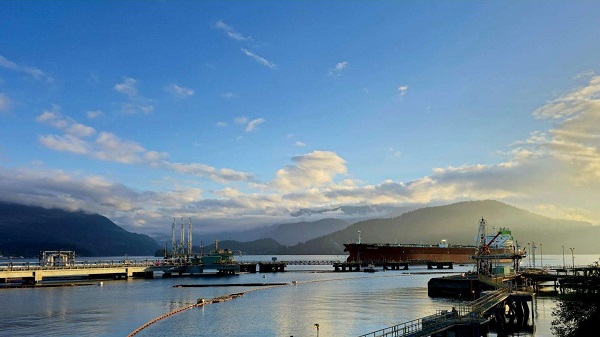
The Trans Mountain system continues its decades-long record of zero marine spills, even as oil tanker traffic has surged more than 800 per cent since the pipeline’s expansion in May 2024.
The number of tankers calling at Trans Mountain’s Westridge Marine Terminal in the Port of Vancouver in one month now rivals the number that used to go through in one year.
A global trend toward safer tanker operations
Trans Mountain’s safe operations are part of a worldwide trend. Global oil tanker traffic is up, yet spills are down, according to the International Tanker Owners Pollution Federation, a London, UK-based nonprofit that provides data and response support.

Graph courtesy International Tanker Owners Pollution Federation
Transport Canada reports a 95 per cent drop in ship-source oil spills and spill volumes since the 1970s, driven by stronger ship design, improved response and better regulations.
“Tankers are now designed much more safely. They are double-hulled and compartmentalized to mitigate spills,” said Mike Lowry, spokesperson for the Western Canada Marine Response Corporation (WCMRC).
WCMRC: Ready to protect the West Coast

One of WCMRC’s new response vessels arrives in Barkley Sound. Photo courtesy Western Canada Marine Response Corporation
From eight marine bases including Vancouver and Prince Rupert, WCMRC stands at the ready to protect all 27,000 kilometres of Canada’s western coastline.
Lowry sees the corporation as similar to firefighters — training to respond to an event they hope they never have to see.
In September, it conducted a large-scale training exercise for a worst-case spill scenario. This included the KJ Gardner — Canada’s largest spill response vessel and a part of WCMRC’s fleet since 2024.
“It’s part of the work we do to make sure everybody is trained and prepared to use our assets just in case,” Lowry said.
Expanding capacity for Trans Mountain

The K.J. Gardner is the largest-ever spill response vessel in Canada. Photo courtesy Western Canada Marine Response Corporation
WCMRC’s fleet and capabilities were doubled with a $170-million expansion to support the Trans Mountain project.
Between 2012 and 2024, the company grew from 13 people and $12 million in assets to more than 200 people and $213 million in assets.
“About 80 per cent of our employees are mariners who work as deckhands, captains and marine engineers on our vessels,” Lowry said.
“Most of the incidents we respond to are small marine diesel spills — the last one was a fuel leak from a forest logging vessel near Nanaimo — so we have deployed our fleet in other ways.”
Tanker safety starts with strong rules and local expertise

Tanker loading at the Westridge Marine Terminal in the Port of Vancouver. Photo courtesy Trans Mountain Corporation
Speaking on the ARC Energy Ideas podcast, Trans Mountain CEO Mark Maki said tanker safety starts with strong regulations, including the use of local pilots to guide vessels into the harbour.
“On the Mississippi River, you have Mississippi River pilots because they know how the river behaves. Same thing would apply here in Vancouver Harbour. Tides are strong, so people who are familiar with the harbor and have years and decades of experience are making sure the ships go in and out safely,” Maki said.
“A high standard is applied to any ship that calls, and our facility has to meet very strict requirements. And we have rejected ships, just said, ‘Nope, that one doesn’t fit the bill.’ A ship calling on our facilities is very, very carefully looked at.”

Working with communities to protect sensitive areas
Beyond escorting ships and preparing for spills, WCMRC partners with coastal communities to map sensitive areas that need rapid protection including salmon streams, clam beds and culturally important sites like burial grounds.
“We want to empower communities and nations to be more prepared and involved,” Lowry said.
“They can help us identify and protect the areas that they value or view as sensitive by working with our mapping people to identify those areas in advance. If we know where those are ahead of time, we can develop a protection strategy for them.”


Is there a cure for Alzheimer’s Disease?

Learning the Truth about “Children’s Graves” and Residential Schools is More Important than Ever

Media bound to pay the price for selling their freedom to (selectively) offend

The Unmasking of Vaccine Science
-
National12 hours ago
Media bound to pay the price for selling their freedom to (selectively) offend
-
 Bruce Dowbiggin11 hours ago
Sometimes An Ingrate Nation Pt. 2: The Great One Makes His Choice
-
 COVID-192 days ago
University of Colorado will pay $10 million to staff, students for trying to force them to take COVID shots
-
Business2 days ago
Oil tanker traffic surges but spills stay at zero after Trans Mountain Expansion
-
 Censorship Industrial Complex2 days ago
Justice Centre campaigning Canadian provinces to follow Alberta’s lead protecting professionals
-
 National2 days ago
Alberta will use provincial laws to stop Canadian gov’t from trying to confiscate legal firearms
-
 Energy1 day ago
ELZABETH MAY HAS IT WRONG: An Alberta to Prince Rupert Oil Pipeline Will Contribute to Greater Global Oil Tanker Safety
-
 COVID-192 days ago
Canadian legislator introduces bill to establish ‘Freedom Convoy Recognition Day’ as a holiday