
Connect with us

Censorship Industrial Complex

Jordan Peterson says he rejected regulator’s offer to pay legal fees in exchange for resignation

Published

7 minute read

From LifeSiteNews

By Anthony Murdoch

The free speech advocate said the College of Psychologists of Ontario mistakenly thought he could ‘be bought’ after losing his court appeal challenging that he submit to social media training to keep his license.

Best-selling Canadian author and clinical psychologist Dr. Jordan Peterson says his regulatory college offered him a deal to “be bought” in which the legal fees owed to them after losing his court challenge could be waived but only if he agreed to quit his job as a psychologist.

Peterson, who gained fame for his vigorous defense of free speech, announced the offer, as he put it, “to be bought” from the College of Psychologists of Ontario (CPO) in an opinion piece posted by the National Post on October 11. He said that lawyers from the CPO told him that “a settlement offer might be possible” if he resigned, but doing so would bar him from being able to practice in the province.

He noted the CPO’s “first offer was (get this — and I still can’t believe it): ‘If Dr. Peterson agrees to resign, we would be willing to forgo the legal costs the court ruled he owes us!’”

Peterson observed that the CPO’s “opening gambit was based on the assumptions (1) that I could be bought and (2) that I could be bought cheaply.”

“The first was truly insulting, as well as preposterous: If cost alone was going to stop me, it would have happened long ago,” he wrote.

“The second was ironically laughable, and an indication of their ignorance regarding what is at stake here: If I was for sale — and I am not — it would be for a hell of a lot more than the court costs that the Supreme Court deemed me liable for when my appeal was rejected.”

Peterson said that he is already in “over my head for a lot more than that on the expenditure side alone.”

“In addition, I have enough stable sources of income now arrayed around me such that the amount in question is not a relevant determinant of my behaviour, as the college tyrannocrats should have realized, had they done an iota of necessary homework.”

Peterson observed that one of the reasons the CPO has begun to negotiate with him over the fees owed is because it is now “backed in a corner.”

Last month, as reported by LifeSiteNews, Peterson agreed to accept the CPO’s social media “training,” saying he was doing so to defend free speech for all Canadians.

This came after a ruling in August by the Supreme Court of Canada, which refused to hear Peterson’s appeal to the CPO regarding the threat of losing his license unless he submit to the social media “training.”

‘God only knows how it will all end’

Peterson is a professor emeritus of psychology at the University of Toronto and has gotten into trouble from regulatory bodies for repeatedly calling out the “trans-butchery of minor children” as a “crime against humanity.”

He has also been a vocal critic of Canadian health and government officials for promoting COVID mandates and jabs as “safe.”

Regarding the CPO’s offer, Peterson said that after he was ordered by the court to undergo social media “training,” he had asked for the names of those who would be ready to re-educate” him. However, the names of the so-called “social media experts” tasked with the re-“education” were redacted when he received them.

“One problem remained, and a serious one, indeed, practically speaking: the very lines in the document that contained the identifying information of the experts (names, email addresses, professional standing, and telephone numbers) had been redacted,” he wrote.

“Note also that since it is now early October, the college only has about seven weeks to straighten out the mess they created around themselves, without violating their own rules, and to repair me one way or another, in the hopefully permanent manner they are devoutly hoping to manage.”

The CPO’s mandate that Peterson undergo social media “training” must be done by November.

In concluding the opinion piece, Peterson noted, “God only knows how it will all end.”

“But it certainly appears, as of the current moment, that the much-vaunted and much-moralized-publicly-about re-education efforts of the Ontario College of Psychologists and Behaviour Analysts have been brought to a shuddering and shameful halt, not least because of the utter indefensibility of their own position,” he wrote.

Peterson has warned Canadian professionals to “wake up” to the rise of cancel culture.

“Wake up, citizens: professionals are now required to hold their tongue if they believe anything politically verboten. For all you leaning to the left – sometimes validly: these precedents will eventually be weaponized by those who stand opposed to you,” he posted.

Todayville is a digital media and technology company. We profile unique stories and events in our community. Register and promote your community event for free.

Follow Author

Business

The EU Insists Its X Fine Isn’t About Censorship. Here’s Why It Is.

Published on

logo

By

Europe calls it transparency, but it looks a lot like teaching the internet who’s allowed to speak.

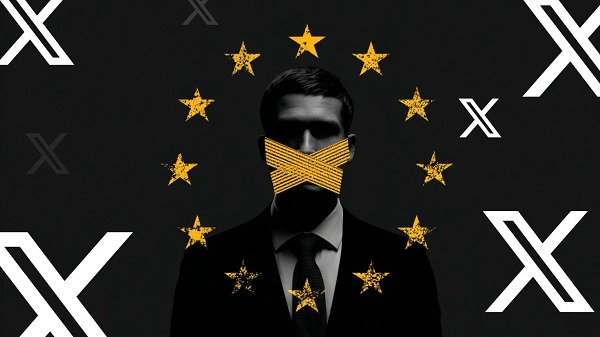
When the European Commission fined X €120 million on December 5, officials could not have been clearer. This, they said, was not about censorship. It was just about “transparency.”
They repeat it so often you start to wonder why.
The fine marks the first major enforcement of the Digital Services Act, Europe’s new censorship-driven internet rulebook.
It was sold as a consumer protection measure, designed to make online platforms safer and more accountable, and included a whole list of censorship requirements, fining platforms that don’t comply.
The Commission charged X with three violations: the paid blue checkmark system, the lack of advertising data, and restricted data access for researchers.
None of these touches direct content censorship. But all of them shape visibility, credibility, and surveillance, just in more polite language.
Musk’s decision to turn blue checks into a subscription feature ended the old system where establishment figures, journalists, politicians, and legacy celebrities got verification.
The EU called Musk’s decision “deceptive design.” The old version, apparently, was honesty itself. Before, a blue badge meant you were important. After, it meant you paid. Brussels prefers the former, where approved institutions get algorithmic priority, and the rest of the population stays in the queue.
The new system threatened that hierarchy. Now, anyone could buy verification, diluting the aura of authority once reserved for anointed voices.
Reclaim The Net is sustained by its readers.
Your support fuels the fight for privacy, free speech and digital civil liberties while giving you access to exclusive content, practical how to guides, premium features and deeper dives into freedom-focused tech.
Become a supporter here.
However, that’s not the full story. Under the old Twitter system, verification was sold as a public service, but in reality it worked more like a back-room favor and a status purchase.
The main application process was shut down in 2010, so unless you were already famous, the only way to get a blue check was to spend enough money on advertising or to be important enough to trigger impersonation problems.
Ad Age reported that advertisers who spent at least fifteen thousand dollars over three months could get verified, and Twitter sales reps told clients the same thing. That meant verification was effectively a perk reserved for major media brands, public figures, and anyone willing to pay. It was a symbol of influence rationed through informal criteria and private deals, creating a hierarchy shaped by cronyism rather than transparency.
Under the new X rules, everyone is on a level playing field.
Government officials and agencies now sport gray badges, symbols of credibility that can’t be purchased. These are the state’s chosen voices, publicly marked as incorruptible. To the EU, that should be a safeguard.
The second and third violations show how “transparency” doubles as a surveillance mechanism. X was fined for limiting access to advertising data and for restricting researchers from scraping platform content. Regulators called that obstruction. Musk called it refusing to feed the censorship machine.
The EU’s preferred researchers aren’t neutral archivists. Many have been documented coordinating with governments, NGOs, and “fact-checking” networks that flagged political content for takedown during previous election cycles.
They call it “fighting disinformation.” Critics call it outsourcing censorship pressure to academics.
Under the DSA, these same groups now have the legal right to demand data from platforms like X to study “systemic risks,” a phrase broad enough to include whatever speech bureaucrats find undesirable this month.
The result is a permanent state of observation where every algorithmic change, viral post, or trending topic becomes a potential regulatory case.
The advertising issue completes the loop. Brussels says it wants ad libraries to be fully searchable so users can see who’s paying for what. It gives regulators and activists a live feed of messaging, ready for pressure campaigns.
The DSA doesn’t delete ads; it just makes it easier for someone else to demand they be deleted.
That’s how this form of censorship works: not through bans, but through endless exposure to scrutiny until platforms remove the risk voluntarily.
The Commission insists, again and again, that the fine has “nothing to do with content.”
That may be true on a direct level, but the rules shape content all the same. When governments decide who counts as authentic, who qualifies as a researcher, and how visibility gets distributed, speech control doesn’t need to be explicit. It’s baked into the system.
Brussels calls it user protection. Musk calls it punishment for disobedience. This particular DSA fine isn’t about what you can say, it’s about who’s allowed to be heard saying it.
TikTok escaped similar scrutiny by promising to comply. X didn’t, and that’s the difference. The EU prefers companies that surrender before the hearing. When they don’t, “transparency” becomes the pretext for a financial hammer.
The €120 million fine is small by tech standards, but symbolically it’s huge.
It tells every platform that “noncompliance” means questioning the structure of speech the EU has already defined as safe.
In the official language of Brussels, this is a regulation. But it’s managed discourse, control through design, moderation through paperwork, censorship through transparency.
And the louder they insist it isn’t, the clearer it becomes that it is.
Reclaim The Net Needs Your Help
With your help, we can do more than hold the line. We can push back. We can expose censorship, highlight surveillance overreach, and amplify the voices of those being silenced.
If you have found value in our work, please consider becoming a supporter.
Your support does more than keep us independent. It also gives you access to exclusive content, deep dive exploration of freedom focused technology, member-only features, and practical how-to posts that help you protect your rights in the real world.
You help us expand our reach, educate more people, and continue this fight.
Please become a supporter today.
Thank you for your support.
Continue Reading

Censorship Industrial Complex

US Condemns EU Censorship Pressure, Defends X

Published on

US Vice President JD Vance criticized the European Union this week after rumors reportedly surfaced that Brussels may seek to punish X for refusing to remove certain online speech.

In a post on X, Vance wrote, “Rumors swirling that the EU commission will fine X hundreds of millions of dollars for not engaging in censorship. The EU should be supporting free speech not attacking American companies over garbage.”

His remarks reflect growing tension between the United States and the EU over the future of online speech and the expanding role of governments in dictating what can be said on global digital platforms.

Screenshot of a verified social-media post with a profile photo, reading: "Rumors swirling that the EU commission will fine X hundreds of millions of dollars for not engaging in censorship. The EU should be supporting free speech not attacking American companies over garbage." Timestamp Dec 4, 2025, 5:03 PM and "1.1M Views" shown.

Vance was likely referring to rumors that Brussels intends to impose massive penalties under the bloc’s Digital Services Act (DSA), a censorship framework that requires major platforms to delete what regulators define as “illegal” or “harmful” speech, with violations punishable by fines up to six percent of global annual revenue.

For Vance, this development fits a pattern he’s been warning about since the spring.

In a May 2025 interview, he cautioned that “The kind of social media censorship that we’ve seen in Western Europe, it will and in some ways, it already has, made its way to the United States. That was the story of the Biden administration silencing people on social media.”

He added, “We’re going to be very protective of American interests when it comes to things like social media regulation. We want to promote free speech. We don’t want our European friends telling social media companies that they have to silence Christians or silence conservatives.”

Yet while the Vice President points to Europe as the source of the problem, a similar agenda is also advancing in Washington under the banner of “protecting children online.”

This week’s congressional hearing on that subject opened in the usual way: familiar talking points, bipartisan outrage, and the recurring claim that online censorship is necessary for safety.

The House Subcommittee on Commerce, Manufacturing, and Trade convened to promote a bundle of bills collectively branded as the “Kids Online Safety Package.”

The session, titled “Legislative Solutions to Protect Children and Teens Online,” quickly turned into a competition over who could endorse broader surveillance and moderation powers with the most moral conviction.

Rep. Gus Bilirakis (R-FL) opened the hearing by pledging that the bills were “mindful of the Constitution’s protections for free speech,” before conceding that “laws with good intentions have been struck down for violating the First Amendment.”

Despite that admission, lawmakers from both parties pressed ahead with proposals requiring digital ID age verification systems, platform-level content filters, and expanded government authority to police online spaces; all similar to the EU’s DSA censorship law.

Vance has cautioned that these measures, however well-intentioned, mark a deeper ideological divide. “It’s not that we are not friends,” he said earlier this year, “but there’re gonna have some disagreements you didn’t see 10 years ago.”

That divide is now visible on both sides of the Atlantic: a shared willingness among policymakers to restrict speech for perceived social benefit, and a shrinking space for those who argue that freedom itself is the safeguard worth protecting.

If you’re tired of censorship and surveillance, join Reclaim The Net.

Fight censorship and surveillance. Reclaim your digital freedom.

Get news updates, features, and alternative tech explorations to defend your digital rights.

Continue Reading

Trending

X