
International
Immigration ‘powder keg’, violence, and the suppression of free expression: Just what is going on in the UK?

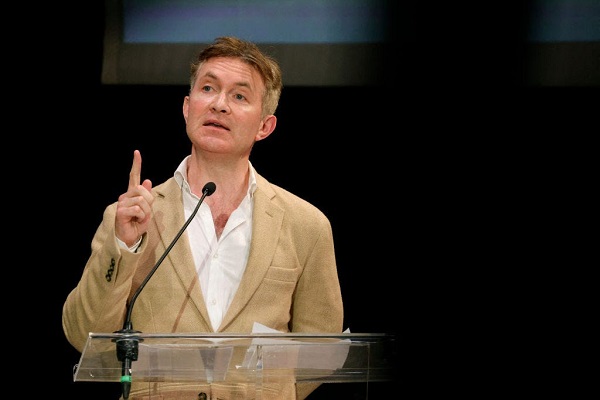


Douglas Murray at the Theatre Antoine in Paris on June 3, 2024. (Geoffroy Van Dew Hasselt via Getty Images)
News release from The Free Press
Our Friend Douglas Murray
We know that nothing will stop our columnist from truth-telling. The more they try to intimidate him, the more they prove him right.
Douglas Murray is not just a Free Press columnist with a love of poetry and rhetoric. He has also emerged over the past decade as one of the most important and articulate defenders of the West—and, especially since the massacres of October 7, one of the most fearless.
If you haven’t read his best-selling books—including The Strange Death of Europe: Immigration, Identity, Islam—now would be a good time to purchase hard copies. Because if certain authorities in Britain have their way, we suspect they’ll be titles that might be harder to find.
To understand why this is the case, we need to go back two weeks. The story begins in Southport, a small town in the northwest of the country, when, on July 29, a 17-year-old named Axel Rudakubana allegedly murdered three girls—ages 6, 7, and 9—in a Taylor Swift–themed dance class. Many others were critically injured.
The alleged perpetrator was neither Muslim nor an immigrant; his parents immigrated from Rwanda. But none of that mattered to the thugs who attacked the local mosque based on the rumor that he was both. In Belfast and Bristol and in towns across the UK, mobs gathered to variously harass migrant centers, attack mosques, and burn police vehicles.
These working-class rioters catalyzed others. The counter mobs were composed of Muslim men, some wielding hammers and knives, who were spoiling for a fight.
It’s very clear who started this: the brutes who went hunting for migrants and Muslims. But the violent breakdown is not a two-week-old story, but a tragedy years in the making and one with many authors. Namely, it is the story of a governing class that offered few answers as immigration took off and ignored a population that, at every turn, voted against it.
Almost everyone ignored that powder keg primed to explode because the price of noticing it was to be called a racist and a xenophobe.
Don’t take our word for it. Listen to what Nadhim Zahawi—who fled Saddam’s death squads as a boy only to become Britain’s Chancellor of the Exchequer—wrote last week in our pages.
The warning signs have been present for years, but for every person who tried to tip-toe through the minefield of topics pertinent to this disorder—society, culture, religion, disenfranchisement, racism, the speed of change, feelings of powerlessness—there were ten more who wanted to bury their heads in the sand. Even I, a brown man born in a Muslim country, feel the need to caveat what I say, and hide behind facets of my identity such as the color of my skin (facets that I largely consider unimportant) just to pass comment on things of importance to my country.
Almost everyone buried their heads in the sand. Almost everyone, that is, except Douglas Murray.
For years now, Murray has been one of the voices warning of what might happen in Britain with poorly controlled, exploding immigration; an obvious lack of assimilation; and a police force that appears more worried about violating multicultural pieties than enforcing the law. He has also warned about the cost of suppressing, rather than debating, difficult subjects.
You would think that now would be a good time to heed his advice. To look carefully at how this happened. To impose law and order. To assure those citizens who are convinced that their country has adopted a two-tiered justice system that justice remains blind—meted out equally, irrespective of the religion or ethnicity of the perpetrator. That is how things are meant to go in liberal democracies.
But the United Kingdom, which lacks a First Amendment equivalent, has opted for a different strategy: a campaign of suppression that includes criminal charges for speech.
On Thursday, a 55-year-old woman named Bernadette Spofforth was arrested “on suspicion of publishing written material to stir up racial hatred” and “false communications” after she spread the false rumor that the man who killed three girls in Southport was an asylum seeker.
Spofforth is just one example of how the United Kingdom is prioritizing jailing its people for social media posts rather than addressing the causes of the violence. The director of public prosecutions of England and Wales, Stephen Parkinson, said this week that even retweeting a post “which is insulting or abusive, which is intended to or likely to start racial hatred” makes one liable for arrest.
Worse yet, in the same interview, Parkinson spoke about “dedicated police officers who are scouring social media. Their job is to look for this material and then follow up with identification, arrests, and so forth.”
Police officers are authorized to show up at your door for comments on a Facebook page based on a law prohibiting “incitement of racial hatred.” The chief of London’s Metropolitan Police has even suggested that the UK might try to extradite American citizens suspected of violating UK’s hate speech legislation. This is the same police, mind you, that prevented a Jewish Londoner from crossing the street during a Gaza protest, and threatened him with arrest, because his “openly Jewish” appearance was deemed a provocation to the violent mob. The police, in other words, incapable of keeping the peace during an anti-Israel protest, turned looking Jewish into “incitement.”
Last week, the British government issued a warning on X: “Think before you post.” The embedded post reminds Britons that “content that incites violence or hatred isn’t just harmful—it can be illegal.”
Which brings us back to Douglas Murray. It’s not just that his past warnings have gone unheeded. It’s that they are being viewed as incitement to violence rather than as prophecy.
On Friday, Alastair Campbell, Tony Blair’s former spokesman and former director of communications for the Labour Party, posted a clip of Murray with the following caption:
“Think @metpoliceuk might want to take a look at this book plug.”
Read that twice.
That is a powerful journalist and former spin doctor with more than a million followers on X calling for Murray to be investigated by the police for discussing the ways in which his 2017 book foretold the current violence in the UK. Campbell, the flack that he is, knew just what he was doing, and has succeeded in stirring up others.
You need not agree with Murray on this subject or any other to be alarmed by this turn. But that point seems to be lost on Britain’s commentariat, who are all too relaxed about their country’s speech crackdown. One senior Guardian journalist egged the authorities on, arguing that Elon Musk should face criminal prosecution for tweeting about the disorder in the UK.
 |
As for us? We’re honored to publish Murray’s fabulously popular “Things Worth Remembering” column, which celebrates freedom as well as the beauty of the English literary tradition. Nobody we know embodies the credo articulated almost 400 years ago by John Milton: “Give me the liberty to know, to utter, and to argue freely according to conscience, above all liberties.”
Our columnist—who has reported from Ukraine and Gaza and Israel in the past year—understands that the fight over free speech is, as much as any literal battlefield, at the core not only of Britain’s future but that of the West.
We know that nothing will stop Douglas Murray from truth-telling. The more they try to silence and intimidate him, the more they prove him right.
 |
To read all of Douglas’s columns click here.
And to support our mission of independent journalism, become a Free Press subscriber today:

From The Center Square
By
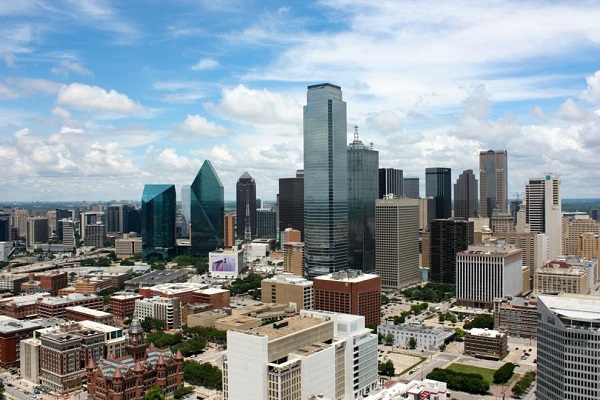
After the self-described socialist Zohran Mamdani won the Democratic primary for mayor in New York, Dallas Mayor Eric Johnson invited New Yorkers and others to move to Dallas.
Mamdani has vowed to implement a wide range of tax increases on corporations and property and to “shift the tax burden” to “richer and whiter neighborhoods.”
New York businesses and individuals have already been relocating to states like Texas, which has no corporate or personal income taxes.
Johnson, a Black mayor and former Democrat, switched parties to become a Republican in 2023 after opposing a city council tax hike, The Center Square reported.
“Dear Concerned New York City Resident or Business Owner: Don’t panic,” Johnson said. “Just move to Dallas, where we strongly support our police, value our partners in the business community, embrace free markets, shun excessive regulation, and protect the American Dream!”
Fortune 500 companies and others in recent years continue to relocate their headquarters to Dallas; it’s also home to the new Texas Stock Exchange (TXSE). The TXSE will provide an alternative to the New York Stock Exchange and Nasdaq and there are already more finance professionals in Texas than in New York, TXSE Group Inc. founder and CEO James Lee argues.
From 2020-2023, the Dallas-Fort Worth-Arlington MSA reported the greatest percentage of growth in the country of 34%, The Center Square reported.
Johnson on Thursday continued his invitation to New Yorkers and others living in “socialist” sanctuary cities, saying on social media, “If your city is (or is about to be) a sanctuary for criminals, mayhem, job-killing regulations, and failed socialist experiments, I have a modest invitation for you: MOVE TO DALLAS. You can call us the nation’s first official ‘Sanctuary City from Socialism.’”
“We value free enterprise, law and order, and our first responders. Common sense and the American Dream still reside here. We have all your big-city comforts and conveniences without the suffocating vice grip of government bureaucrats.”
As many Democratic-led cities joined a movement to defund their police departments, Johnson prioritized police funding and supporting law and order.
“Back in the 1800s, people moving to Texas for greater opportunities would etch ‘GTT’ for ‘Gone to Texas’ on their doors moving to the Mexican colony of Tejas,” Johnson continued, referring to Americans who moved to the Mexican colony of Tejas to acquire land grants from the Mexican government.
“If you’re a New Yorker heading to Dallas, maybe try ‘GTD’ to let fellow lovers of law and order know where you’ve gone,” Johnson said.
Modern-day GTT movers, including a large number of New Yorkers, cite high personal income taxes, high property taxes, high costs of living, high crime, and other factors as their reasons for leaving their states and moving to Texas, according to multiple reports over the last few years.
In response to Johnson’s invitation, Gov. Greg Abbott said, “Dallas is the first self-declared “Sanctuary City from Socialism. The State of Texas will provide whatever support is needed to fulfill that mission.”
The governor has already been doing this by signing pro-business bills into law and awarding Texas Enterprise Grants to businesses that relocate or expand operations in Texas, many of which are doing so in the Dallas area.
“Texas truly is the Best State for Business and stands as a model for the nation,” Abbott said. “Freedom is a magnet, and Texas offers entrepreneurs and hardworking Texans the freedom to succeed. When choosing where to relocate or expand their businesses, more innovative industry leaders recognize the competitive advantages found only in Texas. The nation’s leading CEOs continually cite our pro-growth economic policies – with no corporate income tax and no personal income tax – along with our young, skilled, diverse, and growing workforce, easy access to global markets, robust infrastructure, and predictable business-friendly regulations.”
Crime
National Health Care Fraud Takedown Results in 324 Defendants Charged in Connection with Over $14.6 Billion in Alleged Fraud
 By
By A 50-district dragnet uncovers transnational fraud, AI-driven deception, and systemic theft from Medicare, Medicaid, and U.S. taxpayers totaling over $14.6 billion
The Department of Justice announced Monday the outcome of the 2025 National Health Care Fraud Takedown, the largest coordinated enforcement action against health care fraud in U.S. history. Federal prosecutors have filed criminal charges against 324 individuals across 50 federal judicial districts and 12 State Attorneys General’s Offices, including 96 licensed medical professionals—among them doctors, nurse practitioners, and pharmacists. The defendants stand accused of orchestrating fraudulent schemes amounting to more than $14.6 billion in intended losses to Medicare, Medicaid, and other federally funded programs.

This historic enforcement action more than doubles the previous national record of $6 billion. As part of this effort, federal and state authorities have seized over $245 million in cash, luxury vehicles, cryptocurrency, and other high-value assets. The Centers for Medicare & Medicaid Services (CMS) separately reported that it successfully prevented more than $4 billion in fraudulent payments in the months leading up to the Takedown. CMS also confirmed that it suspended or revoked the billing privileges of 205 providers linked to fraudulent activity. In the civil domain, federal agencies filed actions against 20 defendants tied to $14.2 million in alleged fraud and finalized civil settlements with an additional 106 defendants, totaling $34.3 million in recovered funds.
The Takedown was led by the Health Care Fraud Unit of the DOJ Criminal Division’s Fraud Section and carried out in close coordination with U.S. Attorneys’ Offices nationwide, the Department of Health and Human Services Office of Inspector General (HHS-OIG), the Federal Bureau of Investigation (FBI), the Drug Enforcement Administration (DEA), and multiple state law enforcement agencies. Medicaid Fraud Control Units in 18 states also played a central role in investigating and prosecuting the cases.
In remarks accompanying the announcement, Secretary of Health and Human Services Robert F. Kennedy Jr. emphasized that the agency would aggressively work with law enforcement to eliminate the “pervasive health care fraud that drove up costs and harmed patients under the former administration.” Attorney General Pamela Bondi echoed the urgency, calling the action “justice delivered to those who steal from taxpayers and endanger lives.” Matthew R. Galeotti, head of the Justice Department’s Criminal Division, underscored the gravity of the crimes targeted, noting that fraudulent schemes often lead not only to financial losses but also to direct patient harm, including medically unnecessary procedures and worsened addiction outcomes.
FBI Director Kash Patel emphasized that this Takedown represents the largest in the bureau’s history, highlighting the theft of more than $13 billion from federal health programs. Acting Inspector General Juliet T. Hodgkins of HHS-OIG described the scale of harm as unprecedented and reaffirmed the agency’s commitment to safeguarding the public.
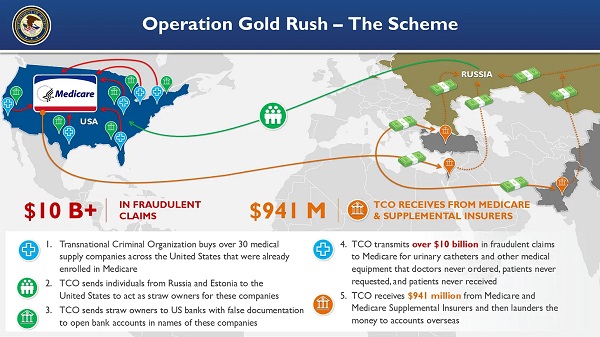
Among the most significant components of this national operation was Operation Gold Rush, which uncovered a sophisticated transnational conspiracy responsible for over $10 billion in fraudulent Medicare claims. The scheme was orchestrated by foreign nationals who, acting as a coordinated criminal enterprise, acquired more than 30 medical supply companies across the United States. These companies had already been enrolled in Medicare, and were then used to funnel false claims for urinary catheters and other durable medical equipment. Stolen identities of over one million Americans were used to submit these claims, which had not been requested by patients, nor ordered by physicians.
The conspiracy relied on straw owners sent from Russia and Estonia to the U.S., who were directed by co-conspirators communicating through encrypted channels. Using fraudulent documentation, these straw owners opened U.S. bank accounts for laundering proceeds. Though the organization submitted over $10.6 billion in claims, CMS successfully blocked most of the payments. Only approximately $41 million reached the conspirators via Medicare, but approximately $900 million was disbursed by Medicare supplemental insurers before the fraud was detected.
Four individuals were arrested in Estonia and eight others were apprehended at major U.S. airports and border crossings as they attempted to flee. Law enforcement seized approximately $27.7 million in fraud proceeds from this operation.

Federal prosecutors filed related charges in five districts: the Central District of California, the Middle District of Florida, the Northern District of Illinois, the District of New Jersey, and the Eastern District of New York.
In a separate scheme centered in Illinois, the Department brought charges against five individuals, including two executives from Pakistani marketing firms, who used artificial intelligence to generate fake audio recordings of Medicare beneficiaries purporting to consent to receive medical equipment. This fraudulent data was sold to laboratories and equipment suppliers, which used it to file $703 million in false claims. Approximately $418 million was ultimately paid out on these claims, and the government has so far seized $44.7 million in related assets. The fraud involved not only AI-based deception but also the illegal sale and laundering of stolen personal health information.
Another case exposed a billing company executive based in Pakistan and the United Arab Emirates who conspired with addiction treatment centers to submit approximately $650 million in fraudulent claims to Arizona Medicaid. Some services billed were never rendered, and others were so deficient as to provide no therapeutic value. The operation targeted vulnerable individuals, including members of Native American tribes and the homeless. Kickbacks were paid for patient referrals, and the executive used at least $25 million in illicit funds to purchase a $2.9 million home in Dubai.

The Department also charged 49 defendants in connection with over $1.17 billion in fraudulent claims tied to telemedicine and genetic testing. In one Florida case, an owner of both telemedicine and durable medical equipment companies orchestrated a $46 million scheme involving deceptive telemarketing campaigns that generated unauthorized genetic testing and equipment claims. The Department continues to prioritize cases involving telehealth-based fraud, which often exploits unwitting patients through misrepresented or manufactured consent.
Prescription opioid diversion was another central focus of the Takedown. A total of 74 defendants, including 44 licensed medical professionals, were charged across 58 criminal cases for illegally distributing more than 15 million opioid pills. One Texas pharmacy alone was responsible for over 3 million of these pills, which included highly addictive substances such as oxycodone, hydrocodone, and carisoprodol. The DEA concurrently announced 93 administrative actions to revoke licenses and registrations of pharmacies and providers implicated in the unlawful handling of controlled substances.
Other cases include a $28.7 million scheme in Tennessee involving medications falsely billed to the Federal Employees’ Compensation Fund, where prescriptions were neither authorized by physicians nor dispensed as claimed. In separate indictments filed in Washington and California, medical providers were charged with stealing fentanyl and hydrocodone intended for pediatric patients under anesthesia.
The geographic scope of the Takedown was vast. In total, 189 federal cases were filed across all 50 federal judicial districts, and 91 state-level cases were brought in 12 states by participating Attorneys General. This unprecedented coordination underscores the national impact and bipartisan support for rooting out fraud in American health care systems.
To enhance ongoing efforts, the Department also announced the establishment of a new Health Care Fraud Data Fusion Center.

This joint initiative brings together specialists from the DOJ’s Health Care Fraud Unit, HHS-OIG, FBI, and CMS to leverage cloud computing, artificial intelligence, and large-scale data analytics to detect emergent fraud patterns. The Fusion Center aligns with Executive Order 14243, “Stopping Waste, Fraud, and Abuse by Eliminating Information Silos,” which mandates interagency cooperation and data-sharing to reduce redundancy and increase efficiency in enforcement.
Principal Assistant Deputy Chief Jacob Foster, Assistant Deputy Chief Rebecca Yuan, Trial Attorney Miriam L. Glaser Dauermann, and Data Analyst Elizabeth Nolte coordinated this year’s Takedown from within the DOJ’s Health Care Fraud Unit. Prosecutors from the National Rapid Response team and regional Strike Forces in 27 districts led casework alongside U.S. Attorneys’ Offices and 18 state Medicaid Fraud Control Units. Additional support came from the Department of Labor, VA-OIG, IRS Criminal Investigation, Homeland Security Investigations, the Defense Criminal Investigative Service, the Office of Personnel Management, the United States Postal Service OIG, and numerous other federal and local agencies.
Image sources: US DOJ


New Peer-Reviewed Study Affirms COVID Vaccines Reduce Fertility
Ottawa Funded the China Ferry Deal—Then Pretended to Oppose It

The permanent CO2 storage site at the end of the Alberta Carbon Trunk Line is just getting started

Canada’s euthanasia regime is not health care, but a death machine for the unwanted
-
 Alberta6 hours ago
Alberta Independence Seekers Take First Step: Citizen Initiative Application Approved, Notice of Initiative Petition Issued
-
Crime5 hours ago
National Health Care Fraud Takedown Results in 324 Defendants Charged in Connection with Over $14.6 Billion in Alleged Fraud
-
 Health4 hours ago
RFK Jr. Unloads Disturbing Vaccine Secrets on Tucker—And Surprises Everyone on Trump
-
 Bruce Dowbiggin7 hours ago
The Game That Let Canadians Forgive The Liberals — Again
-
 Agriculture2 days ago
Canada’s supply management system is failing consumers
-
 Alberta1 day ago
COVID mandates protester in Canada released on bail after over 2 years in jail
-
 armed forces1 day ago
Canada’s Military Can’t Be Fixed With Cash Alone
-
 Crime2 days ago
Project Sleeping Giant: Inside the Chinese Mercantile Machine Linking Beijing’s Underground Banks and the Sinaloa Cartel