
Business
Federal government keeps violating self-imposed fiscal rules



From the Fraser Institute
By Jake Fuss and Grady Munro
By continually violating its own fiscal anchor, the Trudeau government has rendered the rule meaningless and abandoned the discipline it’s meant to impose.
Last week, after tabling the Trudeau government’s fall fiscal update, which includes evermore spending and borrowing, Finance Minister Chrystia Freeland called it a “responsible fiscal plan.” Upon closer scrutiny, however, the finance minister has once again abandoned her self-imposed fiscal rules and continues to spend, borrow and tax at unsustainable levels.
Fiscal rules, also known as “fiscal anchors,” help guide policy on government spending, taxes and borrowing. They’re supposed to prevent a deterioration in government finances, with an eye on ensuring debt is sustainable for future generations.
After taking office in 2015, the Trudeau government announced its fiscal anchor—balance the budget by fiscal year 2019-20. When the government quickly realized it would not achieve this goal, it dropped a new fiscal anchor—reduce Canada’s debt-to-GDP ratio, a common measure of a country’s ability to pay back its debt. However, the 2019 fall fiscal update revealed the government had violated its new fiscal anchor before the pandemic, as debt-to-GDP ticked up slightly from 30.8 to 31.0 per cent. In other words, federal debt grew slightly faster than the Canadian economy.
Then the government spent and borrowed hundreds of billions during COVID, driving debt-to-GDP up to 47.2 per cent in 2020-21. Afterwards, as the economy rebounded, the ratio levelled off and stabilized around 42 per cent in 2022-23.
Last week, Minister Freeland indicated the government will violate its own fiscal anchor at least two more times—debt-to-GDP will increase to 42.4 per cent in 2023-24 then climb higher in 2024-25. Again, federal debt is growing faster than the Canadian economy.

By continually violating its own fiscal anchor, the Trudeau government has rendered the rule meaningless and abandoned the discipline it’s meant to impose. There’s little direction for federal finances and almost nothing to ensure the government is disciplined with spending and debt growth. In such a scenario, politics—not responsible fiscal principles—governs decisions over the public purse.
So, what are the consequences to this wholly undisciplined approach to fiscal policy?
All else equal, a rising debt-to-GDP ratio means that debt interest costs will rise relative to the size of the economy. Spending on rising debt interest costs will divert money away from government programs and/or crowd out any fiscal room for tax relief for Canadian families.
And debt interest costs are rising rapidly. In 2020/21, when interest rates were at historic lows, the federal government spent $20.4 billion on debt interest. This year, interest costs will reach a projected $46.5 billion, more than double what they were three years ago. And will hit a projected $60.7 billion by 2028/29—double what the government plans to spend on employment insurance benefits that year.
Finally, according to last week’s fiscal update, debt-to-GDP will begin to decline after 2024/25, but this should be taken with a huge grain of salt since this government has consistently increased spending and debt beyond its original projections. And there’s nothing preventing the government from scrapping these commitments like they have with all their other fiscal anchors. Given the government’s clear preference for spending financed by borrowing, our debt-to-GDP ratio will likely continue to grow.
Unfortunately, there are few signs the Trudeau government will transform into a responsible steward of public finances and take meaningful steps to control debt and debt interest costs. And of course, Canadian taxpayers will pay the price.
Authors:


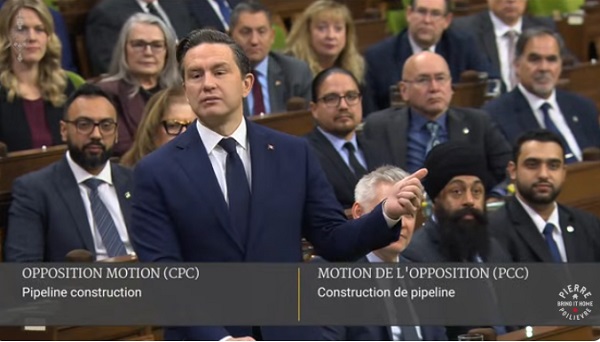
From Pierre Poilievre
From the Frontier Centre for Public Policy
By Ian Madsen
Canada’s growing LNG exports are opening global markets and reducing dependence on U.S. prices, if Ottawa allows the pipelines and export facilities needed to reach those markets
Canada’s LNG advantage is clear, but federal bottlenecks still risk turning a rare opening into another missed opportunity
Canada is finally in a position to profit from global LNG demand. But that opportunity will slip away unless Ottawa supports the pipelines and export capacity needed to reach those markets.
Most major LNG and pipeline projects still need federal impact assessments and approvals, which means Ottawa can delay or block them even when provincial and Indigenous governments are onside. Several major projects are already moving ahead, which makes Ottawa’s role even more important.
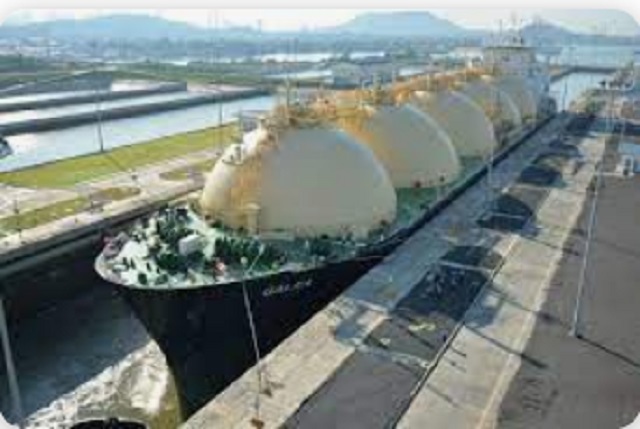
The Ksi Lisims floating liquefaction and export facility near Prince Rupert, British Columbia, along with the LNG Canada terminal at Kitimat, B.C., Cedar LNG and a likely expansion of LNG Canada, are all increasing Canada’s export capacity. For the first time, Canada will be able to sell natural gas to overseas buyers instead of relying solely on the U.S. market and its lower prices.
These projects give the northeast B.C. and northwest Alberta Montney region a long-needed outlet for its natural gas. Horizontal drilling and hydraulic fracturing made it possible to tap these reserves at scale. Until 2025, producers had no choice but to sell into the saturated U.S. market at whatever price American buyers offered. Gaining access to world markets marks one of the most significant changes for an industry long tied to U.S. pricing.
According to an International Gas Union report, “Global liquefied natural gas (LNG) trade grew by 2.4 per cent in 2024 to 411.24 million tonnes, connecting 22 exporting markets with 48 importing markets.” LNG still represents a small share of global natural gas production, but it opens the door to buyers willing to pay more than U.S. markets.
LNG Canada is expected to export a meaningful share of Canada’s natural gas when fully operational. Statistics Canada reports that Canada already contributes to global LNG exports, and that contribution is poised to rise as new facilities come online.
Higher returns have encouraged more development in the Montney region, which produces more than half of Canada’s natural gas. A growing share now goes directly to LNG Canada.
Canadian LNG projects have lower estimated break-even costs than several U.S. or Mexican facilities. That gives Canada a cost advantage in Asia, where LNG demand continues to grow.
Asian LNG prices are higher because major buyers such as Japan and South Korea lack domestic natural gas and rely heavily on imports tied to global price benchmarks. In June 2025, LNG in East Asia sold well above Canadian break-even levels. This price difference, combined with Canada’s competitive costs, gives exporters strong margins compared with sales into North American markets.
The International Energy Agency expects global LNG exports to rise significantly by 2030 as Europe replaces Russian pipeline gas and Asian economies increase their LNG use. Canada is entering the global market at the right time, which strengthens the case for expanding LNG capacity.
As Canadian and U.S. LNG exports grow, North American supply will tighten and local prices will rise. Higher domestic prices will raise revenues and shrink the discount that drains billions from Canada’s economy.
Canada loses more than $20 billion a year because of an estimated $20-per-barrel discount on oil and about $2 per gigajoule on natural gas, according to the Frontier Centre for Public Policy’s energy discount tracker. Those losses appear directly in public budgets. Higher natural gas revenues help fund provincial services, health care, infrastructure and Indigenous revenue-sharing agreements that rely on resource income.
Canada is already seeing early gains from selling more natural gas into global markets. Government support for more pipelines and LNG export capacity would build on those gains and lift GDP and incomes. Ottawa’s job is straightforward. Let the industry reach the markets willing to pay.
Ian Madsen is a senior policy analyst at the Frontier Centre for Public Policy.


Media bound to pay the price for selling their freedom to (selectively) offend

Sometimes An Ingrate Nation Pt. 2: The Great One Makes His Choice

Recent price declines don’t solve Toronto’s housing affordability crisis

From Exception to Routine. Why Canada’s State-Assisted Suicide Regime Demands a Human-Rights Review
-
 Bruce Dowbiggin1 day ago
Integration Or Indignation: Whose Strategy Worked Best Against Trump?
-
 COVID-191 day ago
University of Colorado will pay $10 million to staff, students for trying to force them to take COVID shots
-
 Banks2 days ago
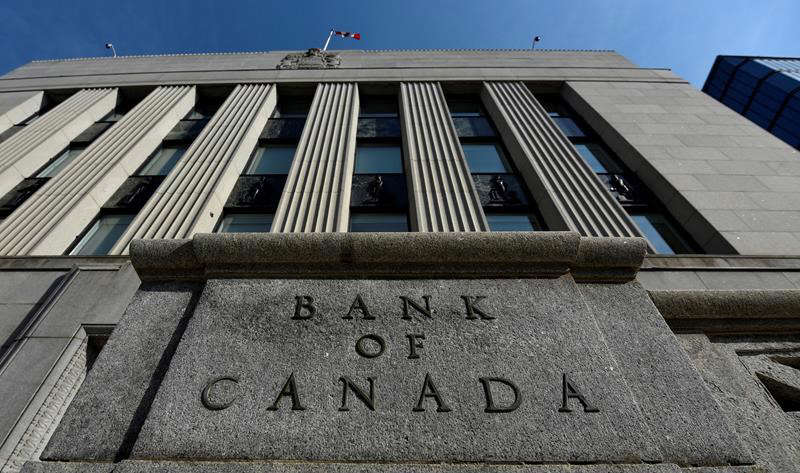
To increase competition in Canadian banking, mandate and mindset of bank regulators must change
-
 Focal Points2 days ago
Common Vaccines Linked to 38-50% Increased Risk of Dementia and Alzheimer’s
-
 Business2 days ago
Loblaws Owes Canadians Up to $500 Million in “Secret” Bread Cash
-
 espionage1 day ago
Western Campuses Help Build China’s Digital Dragnet With U.S. Tax Funds, Study Warns
-
 Bruce Dowbiggin1 day ago
Wayne Gretzky’s Terrible, Awful Week.. And Soccer/ Football.
-
 Agriculture1 day ago
Canada’s air quality among the best in the world