
Energy
Most Canadians support Saskatchewan’s refusal to collect Trudeau’s carbon tax: poll

From LifeSiteNews
Since January 1, the Canadian province has not been collecting the carbon tax on home heating despite threats from the Trudeau government.
A majority of Canadian believe that Saskatchewan is correct in not collecting Prime Minister Justin Trudeau’s carbon tax on home heating.
According to a March 25 poll by Angus Reid, most Canadians support Saskatchewan’s refusal to collect the carbon tax on home heating, ranging from 41% supporting the move in Quebec to 71% in Alberta.
“A majority of Canadians (not just SK residents) say our government is doing the right thing by not collecting and remitting the Trudeau-NDP carbon tax on home heating,” Saskatchewan Premier Scott Moe celebrated on X, formerly known as Twitter.
A majority of Canadians (not just SK residents) say our government is doing the right thing by not collecting and remitting the Trudeau-NDP carbon tax on home heating. pic.twitter.com/2CdLWRxmmP
— Scott Moe (@PremierScottMoe) March 25, 2024
Saskatchewan stopped collecting the carbon tax on home heating in January after the Trudeau government gave a carbon tax exemption on home heating oil, a break that almost exclusively benefits the Liberal voting Atlantic provinces.
According to the poll, 56% of Canadians held that cost of living concerns should trump “climate change” concerns when making economic policies. Sixty-eight percent also believe that the tax is ineffective at reducing Canada’s greenhouse gas emissions.
Forty percent of Canadians revealed that the carbon tax has made their life “a lot” more expensive, and 26% said it has only increased their cost of living by “a little.”
While Canadians revealed that they had received carbon tax rebates, 45% declared that they believe they pay more in taxes than receive in rebates.
Indeed, for most Canadians, this is true, as the Parliamentary Budget Officer revealed that the government rebates are insufficient to cover the rising costs of fuel under Trudeau’s carbon tax, leaving Canadians to pay the balance.
While Moe has received threats from the Liberal government for his refusal to collect the tax, the move has already been shown to have lowered the province’s inflation rate.
Despite the popularity and seeming fairness of Moe’s decision, Trudeau’s Liberal government has refused to rule out jail time for Moe if he refuses to collect the carbon tax on home heating.
Meanwhile, Trudeau has refused to pause the carbon tax hike scheduled for April 1, despite seven out of 10 provincial premiers and 70% of Canadians pleading with him to halt his plan.
Trudeau’s carbon tax, framed as a way to reduce carbon emissions, has cost Canadian households hundreds of dollars annually despite rebates.
The increased costs are only expected to rise, as a recent report revealed that a carbon tax of more than $350 per tonne is needed to reach Trudeau’s net-zero goals by 2050.
Currently, Canadians living in provinces under the federal carbon pricing scheme pay $65 per tonne, but the Trudeau government has a goal of $170 per tonne by 2030.
However, despite appeals from politicians and Canadians alike, Trudeau remains determined to increase the carbon tax regardless of its effects on Canadians’ lives.
The Trudeau government’s current environmental goals – which are in lockstep with the United Nations’ 2030 Agenda for Sustainable Development – include phasing out coal-fired power plants, reducing fertilizer usage, and curbing natural gas use over the coming decades.
The reduction and eventual elimination of so-called “fossil fuels” and a transition to unreliable “green” energy has also been pushed by the World Economic Forum, the globalist group behind the socialist “Great Reset” agenda in which Trudeau and some of his cabinet are involved.

From the C2C Journal
By Gwyn Morgan
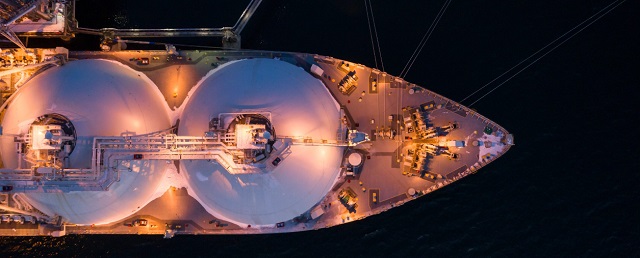
It is Prime Minister Justin Trudeau’s contention there’s no “business case” for exporting Canada’s abundant, inexpensively produced natural gas as LNG. But Canadians might do well to politely decline management consulting advice from a former substitute drama teacher who was born into wealth and has never had to meet a payroll, balance a budget or make a sale. Bluntly stated, someone who has shown no evidence of being able to run the proverbial lemonade stand. And one whose real agenda, the evidence shows, is to strangle the nation’s most productive and wealth-generating industry. With the first LNG ship finally expected to dock at Kitimat, B.C. over the next year and load Canada’s first-ever LNG export cargo, Gwyn Morgan lays out the business and environmental cases for ramping up our LNG exports – and having them count towards Canada’s greenhouse gas reduction targets.
Pierre Poilievre’s Axe the (carbon) Tax campaign is a spectacular success. But the Conservative Party of Canada needs its own plan to reduce greenhouse gas emissions from fossil fuels. Paradoxically, it’s a fossil fuel that provides much of the answer.
Canada’s rich endowment of natural gas resources offers an immense opportunity to reduce global carbon dioxide (CO2) emissions while also helping to rescue the Liberal-government-ravaged Canadian economy by exporting liquefied natural gas (LNG) to China, Japan, South Korea and the other coal-dependent Asia-Pacific countries. Switching from coal to natural gas for producing electricity and generating heat for buildings and industrial processes can typically reduce CO2 emissions by 50 percent for the same unit of output, while all-but eliminating the toxic compounds and lung-clogging particulates emitted from burning coal that shorten the lives of millions living in smog-stricken Asian cities.
More natural gas is urgently needed, since countries throughout Asia – especially China and India – are currently adding even more coal-burning power plants to meet rapidly growing electricity demand. The benefits of fuel-switching are not speculation, but a proven result: the United States’ pronounced switch starting in the mid-2000s from coal to natural gas for electricity materially reduced that country’s CO2 emissions (see accompanying graph), nearly equalling the entire European Union’s emissions cuts, as I wrote about in this previous column.

A study by respected consulting firm Wood Mackenzie, released in late 2022, determined the following:
But through a decade of trying to navigate Canada’s increasingly obstructive and Byzantine regulatory process, project proponents dropped out one by one. Today LNG Canada is the only one of those major projects left standing. (Two much smaller LNG projects, Woodfibre LNG in Howe Sound at Squamish, and Cedar LNG just a few kilometres from the LNG Canada project, are also proceeding, and one other large project proposed by the Nisga’a First Nation is making regulatory progress.) LNG Canada succeeded only because South African project leader Andy Calitz, backed by the enthusiasm of the Haisla Nation which saw the immense potential to create a self-sustaining, wealth-generating economy for its people, refused to give up.
After five years of construction, the LNG Canada liquefaction facility and loading terminal are nearing completion, with the first LNG ship scheduled to sail to China in 2025 (possibly even this year). The Kitimat plant itself is just one component of Canada’s first LNG export project. TC Energy Corp.’s (formerly TransCanada Pipelines) $15 billion, recently completed Coastal GasLink pipeline will carry the required natural gas from the northeastern B.C. gas fields to the Kitimat terminal. And additional billions of dollars have been invested in drilling natural gas wells, proving up the immense reserves needed to feed the LNG facility for decades to come, and constructing field production systems.

The economic benefits are myriad. Aside from the jobs created and the wealth generated for the participating companies, B.C.’s annual natural gas royalties are forecast to double from $700 million in 2024 to $1.4 billion in 2027. Benefits for First Nations include significant employment and business opportunities, such as HaiSea Marine’s 50 percent interest in a $500 million contract.
And that’s just LNG Canada’s Phase 1, which will produce 14 million tonnes per annum (mtpa) of LNG, or approximately 1.8 billion cubic feet (bcf) per day. With that one project coming on-stream, about 10 percent of Canada’s total natural gas production will be exported to international markets, earning premium prices. Construction of Phase 2 is scheduled to begin in 2026 and will double the facility’s output, with first delivery scheduled for 2032. A report from Canada Action estimates that completion of both phases will reduce CO2 emissions in Asian countries as much as would removing 18 million cars from Canadian roads. That is a far more efficient and realistic way of reducing emissions than the Trudeau government’s current scheme to force everyone into electric vehicles within a decade.

A major barrier for LNG project sponsors has been Canadian regulators’ fixation on a project’s domestic emissions – which come mainly from producing the energy needed to operate the liquefaction and storage process and loading facility. These emissions are miniscule compared to the enormous emissions reductions when natural gas is used instead of coal in consuming countries. But in their zeal to force Canada to “net zero” emissions, government authorities initially tried to veto LNG Canada generating its electricity and compression power using some of the natural gas that will be already piped to the site, insisting instead upon hydroelectric power. This seriously delayed the project due to the need for B.C. Hydro to first build a new dam to supply the required power, along with a new, $3 billion transmission line that has not even begun its environmental review process.
Regulators finally waived their objection so the project could be finished, and it will initially use natural gas for power. But the same objection is now being raised with respect to another major LNG venture proposed in the same region. The Ksi Lisims LNG project would utilize a floating liquefaction and loading facility docked at lands owned by the Nisga’a First Nation north of Prince Rupert. Its natural gas would be supplied through an already-approved but never-built pipeline planned for one of the cancelled LNG projects. The $10 billion venture would have approximately two-thirds the capacity of LNG Canada Phase 1. The facility would be powered by hydroelectricity.

Ksi Lisims sounds like a great addition to Canada’s modest LNG lineup, one that British Columbians should applaud. Instead, the proponents have been assailed by objections over the greenhouse gas emissions from the facility and the natural gas production process, and concurrently the B.C. Wilderness Committee is calling on the province’s NDP government to veto any further LNG development. None of these zealots acknowledge the vastly greater reduction of greenhouse gas emissions that will be achieved as consuming countries switch to natural gas.
Prior to the December 2018 UN Climate Change Conference in Katowice, Poland, Canada’s Conservative Party urged leaders of their nation’s delegation to propose that the use of imported natural gas to displace coal and thereby reduce emissions in one country should count towards the exporting country’s emissions reduction targets. But this made far too much sense for our Prime Minister and his team of anti-fossil-fuel eco-zealots. A new federal government that encourages LNG projects might well see a return of those other big sponsors that were driven off.
And that brings us back to Pierre Poilievre and the need for a Conservative alternative to Trudeau’s carbon tax. LNG export would be not only vastly superior in reducing emissions, it would also create tens of billions of dollars in economic benefits for a beleaguered Canadian private sector. It is beyond high time. A Macdonald-Laurier Institute report, Estimating the True Size of Government in Canada, concludes that Canada’s private sector has shrunk to just 36 percent of the nation’s GDP. That’s right – Canada’s public sector now represents nearly two-thirds of the Canadian economy, if one includes in that measure the vast amounts governments spend on tax credits and other tax-related expenditures, plus the economic impacts of regulating the pricing or outputs of private industries. This is appalling.

Even more incomprehensible is a research report from the Harvard Kennedy School noting that “Communist” China’s private sector generates “approximately 60% of China’s GDP, 70% of its innovative capacity, 80% of urban employment and 90% of new jobs.” By those measures, the private sector in ostensibly free and democratic Canada, with its allegedly market-based economy, has been reduced to barely half the relative size of the private sector in authoritarian China.
It is clear that for Canada, getting out of the way of privately-driven growth in LNG exports would be a vastly superior environmental alternative to Trudeau’s economically destructive and politically divisive carbon tax, while also helping to reverse the decline of what was once a proud, thriving nation into an indebted, unproductive, government-dominated basket case.
Gwyn Morgan is a retired business leader who was a director of five global corporations.
|
|

Today is Earth Day, a day on which we are taught to feel guilty about our allegedly destructive impact on Earth—above all from our mass-use of fossil fuels.
But note that Earth, before we started impacting it on a large scale through the use of fossil fuels, was long a terrible place for the typical human being to live—and once we started using fossil fuels, rapidly became a far, far better place for the typical human being to live.
As I explain in Chapter 4 of Fossil Future,
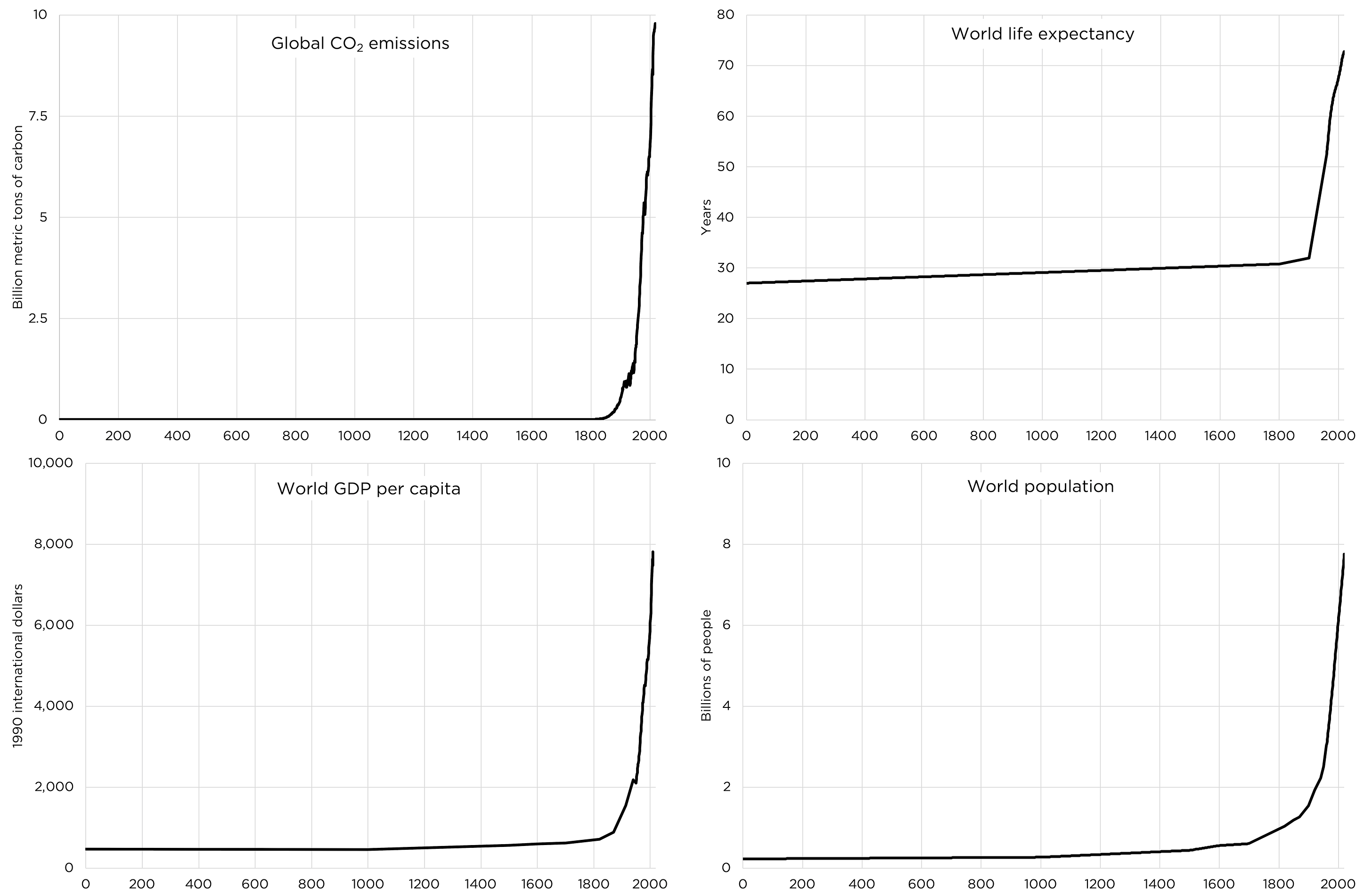
While there are no perfect metrics of the world’s livability from a human flourishing perspective, three excellent ones are average life expectancy, average income, and total population…
If today’s narrative about fossil fuels destroying our delicate, nurturing planet were true, then a chart of fossil fuel use, life expectancy, income, and population would be a sad story. As fossil fuel use went up, life expectancy would go down as fossil fuels depleted the Earth of nourishment and created myriad new dangers. Income would also go down as resources became scarce—and the scarcity would become worse and worse if population went up.
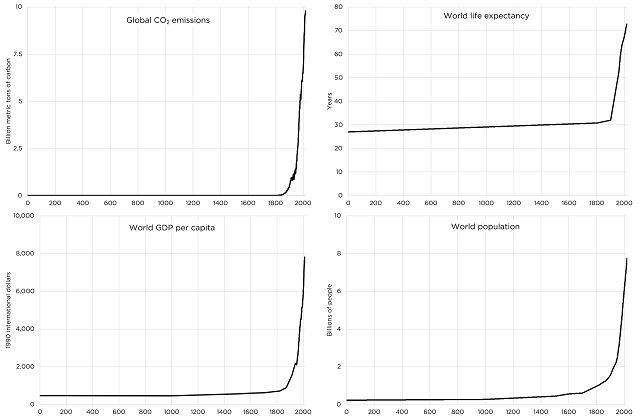
But when we look at an actual chart of these metrics of a livable world, we see that these metrics are going up in an unbelievable “hockey stick” that exactly correlates with fossil fuel use, including the CO2 emissions that are supposedly destroying our world…
One of the key phenomena this chart shows is that each of the metrics of livability—life expectancy, income, population—stagnated at a very low level for thousands of years, meaning Earth was a barely livable place from a human flourishing perspective. While these charts go back only two thousand years, we know from historical records that they were preceded by tens of thousands of years of even less flourishing and progress. Then, some two hundred years ago, everything started improving dramatically. Earth went from what we would consider an unlivable place for the average human being to an increasingly livable place, continuing through to today—with the world being what our ancestors would consider to be an unimaginably livable place.
The incredible improvement in Earth’s livability should be the number one story we talk about when we talk about our relationship to our environment. It should be the subject of fascination, enthusiasm, and aspiration—the aspiration to continue our overall positive direction.
Instead, the incredible improvement in Earth’s livability is the subject of disinterest and evasion by our knowledge system, to the point that most people think that Earth today is a less livable place than it used to be…
we must eagerly seek to understand the causes of today’s unprecedented livability, especially its most fundamental causes.
While an incredibly strong direct correlation between CO2 emissions and the world’s livability doesn’t prove causation, such correlations are often reflections of causation. And in this case, the relationship is causal to a degree that almost no one appreciates: the ultra-cost-effective fossil fuel energy emitting the CO2 is literally driving the world’s unprecedented, increasing livability.
I want to distinguish my view from the position that fossil fuel energy is incidental to or even merely important to the unprecedented and growing livability of our world. When the improvement of our world is, all too rarely and incompletely, acknowledged, it is invariably ascribed to crucial factors that are treated as unrelated or barely-related to fossil fuel use, such as scientific discoveries, technological innovation, improved medical care, and improved sanitation. While scientific discoveries, technological innovations, improved medical care, and improved sanitation are indeed crucial contributors to the world’s livability, they are not unrelated or barely-related to fossil fuel use. In fact they have overwhelmingly depended on and will continue to depend on ultra-cost-effective energy production from fossil fuels or their equal.
I love today’s fossil-fuel-dominated Earth, because with the aid of billions of fossil-fueled machines today’s humans are able to create a world of unnatural abundance, safety, and opportunity.
While I am not participating in any Earth Day events this year, I want to share with you for the first time an Earth Day conversation I had last year with former Texas Governor and US Secretary of Energy Rick Perry at last year’s EarthX (the largest Earth Day event in the world). I hope you enjoy it.
What follows is the video and complete transcript of the event, edited only for clarity (including avoided repetition).
If you’re hungry for more Earth Day content, check out the other event I did with Rick Perry last year: a debate he moderated between me and climate scientist John Nielsen-Gammon.
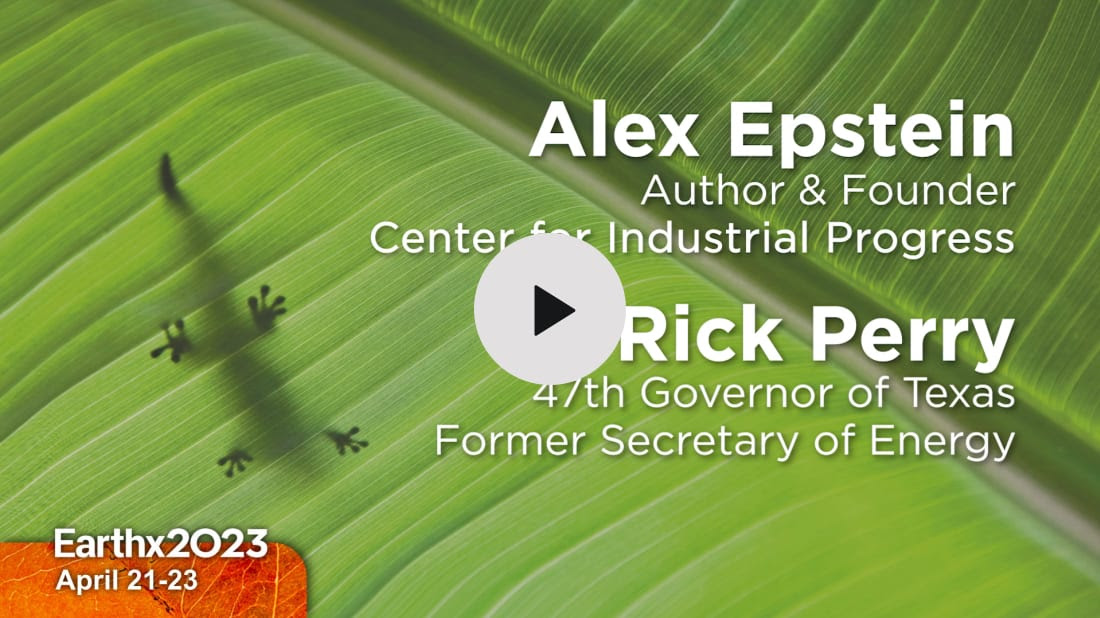
Rick Perry:
Hi, Rick Perry, former Governor of the State of Texas at the Fair Park in Dallas, Texas, the side of the State Fair of Texas. Actually, on the 21st day of April of 2023, which is a big day for Texas. It’s the day we started our independence in the State of Texas, not our actual Independence Day, but the Battle of San Jacinto when Texas won its independence. And so, freedom’s really important to people in the State of Texas.
We’ve fought for it, we’ve been fighting for it ever since. Which brings me to the opportunity to have Alex Epstein with us today, the author of Fossil Future, one of the great books about fossil fuels and the great raging debate about whether or not fossil fuels are good, whether we ought to be using them or not. And anyway, I want to say thank you for being here and joining us at EarthX, the largest Earth Day event in the world. You think about it, it’s pretty exciting. So I’m glad you’re here.
Alex Epstein:
I thought it was very exciting that they invited somebody who’s wearing an I Love Fossil Fuels pin and is known for writing Fossil Future.
Rick Perry:
Yeah. Well, you’re really a great example of what I admire. You and I met… Gosh, I think it was six years ago in Cape Town at an energy conference.
Alex Epstein:
Exactly right.
Rick Perry:
In a place where, if they know what lack of energy, lack of access to fossil fuel can do to you, they know about it in South Africa, in the whole continent of Africa.
Alex Epstein:
Yeah, for sure.
Rick Perry:
So what I’d like for you to do here, Alex, is just talk a little bit about not only your book, about what the passion is. As a matter of fact, just a little bit of the background. There was a time when you might’ve been on the other side of this raging debate about the climate until you educated yourself and became very knowledgeable about truth. And that’s what we’re after today in the pursuit of freedom and truth.
Alex Epstein:
I had an interesting journey because in a sense, I’m the last person you would expect to be the world’s biggest champion of fossil fuels. I grew up in Chevy Chase, Maryland, which is a liberal place right outside Washington DC. I went to one of the top math, science high schools in the country, and I went to Duke University. I learned zero positive about fossil fuels. The only thing I quote learned is that “fossil fuels are causing climate catastrophe.” And I think this is typical of the education—or miseducation—people get, which is that fossil fuels essentially have no benefits, and they only have side effects. And those side effects are catastrophic to the point where we should be in real fear of looming apocalypse.
And what really changed is I just randomly ended up studying the early history of the oil industry. And I learned that in 1859, right, when the oil industry was beginning—I’ve never told you this story actually—in Titusville, Pennsylvania, the countryside in that area was dark. Even though there were many technologies for illuminating your home, there were like half a dozen alternatives to oil, and yet nothing illuminated the countryside because nothing was cost-effective. Within five years of the beginning of the oil industry, the countryside was bright.
And it just occurred to me, “Wait, I could have been one of those people.” Imagine what it would be like to go from darkness to light. And it’s not just about having the technology that works, it’s about having the technology that’s cost-effective. And it occurred to me, “Well, maybe the reason we’re still using fossil fuels for 80% of our energy, maybe the reason it’s still growing is because they’re still the most cost-effective alternative for billions of people.”
And then I learned that there are 6 billion people who are kind of like those people in the countryside where they have very little energy by our standards. 6 billion people use an amount of energy we would consider unacceptable. A third of the world is using wood and animal dung for their heating and cooking. 3 billion people are using less electricity than a typical American refrigerator.
So I just saw the world, it’s totally underpowered. And what are we doing? We’re focused on getting rid of our number one source of energy, instead of—how do we expand the availability of energy? And that’s part of the passion is: I understand what energy has done for me and I would like that opportunity for the rest of the world, and I would not like it to be taken away from me.
Rick Perry:
Yeah. So it’s really interesting that you bring us to this point. And you talk about the benefits of fossil fuels. Seems like every time we turn on the TV or we see a newspaper article, or we see some rally somewhere, all they want to talk about is the evils of fossil fuel. Here’s the negative side of fossil fuels. And they never talk about the positive side of fossil fuel and how it’s allowed the people of the planet to flourish when they’ve had access to it.
Alex Epstein:
And it’s really a crazy thing because I’ve said this a million times. Do you agree that whenever you’re evaluating a product or technology, you should carefully weigh the benefits and side effects? Do you agree with that? Of course you do.
Rick Perry:
Of course.
Alex Epstein:
Nobody has ever disagreed, ever. I’ve asked this question countless times, nobody has ever disagreed. So you think, “Okay, I’m taking a prescription drug. I carefully weigh the benefits and side effects.” And yet almost nobody does it with fossil fuels at the highest level.
I mentioned in my book that Michael Mann, one of the world’s leading climate activists, he’s a climate scientist. He has a whole book on fossil fuels and climate, and he only talks about, for example, agricultural negatives—which, that’s fine to look into that, but he never once mentions diesel fuel for agriculture or natural gas for fertilizer, even though those make it possible to feed 8 billion people.
If we’re totally ignoring the benefits of something, we’re going to make terrible decisions. But it’s even worse than that because the main concern about fossil fuels has to deal with climate and making climate more dangerous. But one of the key benefits of fossil fuels is it allows us to neutralize climate danger. This is why climate disaster deaths are at all-time lows. We can irrigate to alleviate drought. We can heat when it’s cold. We can cool when it’s hot.
So fossil fuels, unlike a prescription drug, they can cure their own side effects. So imagine you’ve got a life-saving prescription drug. It can cure its own side effects with its benefits—but you ignore its benefits. That’s how we can be trying to get rid of the thing that’s saving the world and that billions more people need. I’m very emphatic about it cause it’s so clear and it’s so important.
Rick Perry:
Yeah, that’s it. Matter of fact, I got a copy of Fossil Future right here that you wrote, and that’s the most important—from my perspective—the most important message that comes out of this book is not only to help people understand the positive aspects of fossil fuels historically and going forward in the future, but it talks about the flourishing of mankind, if you care about humankind.
Alex Epstein:
And I think it might seem like, “Why are you bringing that up? Doesn’t everyone care about the flourishing of humankind?” And I think most people when pressed, if you say yes or no, they’ll say, “Yeah.” They’re not going to say, “I don’t care about it at all.” But here’s what happens: when they’re thinking about the Earth, when they’re thinking about the planet, for example, on Earth Day, they’re not actually focused on the flourishing of mankind because we’ve been taught that our number one goal with respect to the Earth should be to not impact it, to minimize or eliminate our impact.
And yet—this is what I learned when I was 18, this changed my life. I didn’t know anything about energy, I only learned that later, but this changed my life—I realized, “Wait a second. The modern environmental movement, its core goal is to eliminate human impact on Earth and humans survive and flourish by impacting Earth.”
So our goal with respect to Earth is an anti-human goal. And that’s why the key message you mentioned, the number one aspect of my book is that it looks at the Earth from a human flourishing perspective, and it says it’s good for us to build buildings. It’s good for us to build roads. It’s also good to enjoy beautiful nature. But guess what? You need a lot of energy and a lot of roads to do that. It’s good to have clean air and clean water, but it’s because it’s good for humans.
And so I look at the Earth and everything in it from a human flourishing perspective, and that really is radical, unfortunately.
Rick Perry:
I look at it from a—I’m a Christian—a biblical standpoint, and in Genesis, it clearly says that man is supposed to subdue the environment, but do it in a righteous way. And so clearly in our biblical teachings, it says that we’re supposed to use this environment for the flourishing of mankind, if you will. Be wise about it, do it in a righteous way, which pretty much is what you’re saying.
Alex Epstein:
Yeah. But I’m not coming from that background at all.
Rick Perry:
I understand that. I know that.
Alex Epstein:
But it is notable, I think, because it’s true I think in this case that the kind of Judeo-Christian religion with respect to this thing is unfortunately much more rational than the so-called scientific view because unfortunately, the quote, “scientific view” is actually an anti-human primitive religion cause it’s really a belief that the Earth without us is this, I sometimes call it, the “perfect planet premise.”
So, the unimpacted planet is this perfect thing. So it’s stable. It doesn’t change too much. It’s sufficient. It gives us enough—unless we’re too greedy—and it’s safe. And this is not at all true. We live on a very imperfect planet if you’re judging it from a human perspective; that’s why life was terrible for most people. So rationally, if you are just a human being who wants to live and you want your fellow human beings to live, you should be for looking at Earth from a human flourishing perspective, and you should embrace intelligently impacting Earth, and I argue fossil fuels is a big part of that.
Rick Perry:
Yeah. So you bring up a really interesting point about, what would the world be like today if you didn’t have human innovation, if you didn’t have human impact? And so, talk a little bit about the data that’s out there on climate-related deaths, climate-related injuries that occur historically. And my instinct is, the world’s a lot safer place today because of the fossil fuel engines that we have.
Alex Epstein:
Yeah I mean, it’s true of every metric of human life. So one of my favorite statistics that I use in Fossil Future is what I call the human-flourishing hockey sticks. Cause you see, life was just bad for thousands of years. So you have, for example, life expectancy is around 30, and then suddenly 200 years ago, for some reason, it starts going up like a hockey stick. And then you have income, which is how much resource an average person has access to. And it’s like this. And then population is like this cause everyone was dying so much before.
And a big part of it, not all of it, but a big part of it was climate. Climate is naturally deficient, as in it doesn’t always give us what we need, say in terms of rainfall. This is why drought was historically such a killer and people prayed to weather gods. It’s not actually a perfect planet at all.
And the climate is incredibly dangerous. It’s just constantly ravaging us and terrorizing us. So when people say, “Oh, the climate, save the climate.” You don’t want to save the climate. You want to master the climate, and fossil fuels have been essential to mastering the climate. Your instinct is right.
Just think about drought: so drought used to be a killer. You can look back in the ‘20s and ‘30s and see headlines of “2 million Chinese die from famine after drought.”
Rick Perry:
Well, think about the Dust Bowl and right here in the central part of the United States back in the ‘30s.
Alex Epstein:
Yeah, just think about what it means. 2 million in the past is, that’s like 8 million today adjusted for population. Drought related deaths are down 99% plus.
Rick Perry:
Wow.
Alex Epstein:
So that means you have a one in 100 chance of dying from drought. Why is that? Well, think about: we have modern irrigation. So, even when you have a drought, you can irrigate. So it’s as if you didn’t have a drought. We essentially have zero drought related deaths in the United States now.
You think about crop transport. So this happens a lot, particularly in Africa where they still, they’re not fully industrialized unfortunately. But now if they have a really bad harvest, including due to drought, we can use machines powered by oil to transport them crops. And of course, we grew the crops using oil and then natural gas for fertilizer.
So the climate and the Earth is so much more livable from a human flourishing perspective. That’s why I say the whole thing is looking at the world from a human flourishing perspective. You just feel like, “Oh my God,” to use maybe a biblical expression, like, “The scales come off.” You can see what’s true.
Rick Perry:
Yeah. So one of the things that I’d like to transition to here is to talk about: why is this such a conflictual issue? Why has there become people choosing sides over here—if you’re a climate denier, you’re a Holocaust denier, you’re put in the same camp. And why has this become such an issue that has caused such great division and angst? Can’t we be more in pursuit of the truth?
I use the IPCC, for instance, and I think their data and what their data says… And we look back on it historically, and they’ve missed the mark on this pretty substantially from time to time. But you’re read on: why do we find ourselves at this rather conflicting moment in history dealing with the climate and why this disdain for fossil fuels?
Alex Epstein:
I think part of it is, there’s a legitimacy in that it’s a high stakes issue. Now, I think the main way it’s viewed as a high stakes issue is not the way in which it’s actually high stakes. The way in which it’s actually high stakes is, “Does the world have cost-effective energy and thus do humans have the opportunity to flourish?” That, for me, is the high stakes issue because that’s life or death. That’s having an opportunity-filled life versus no opportunity.
You mentioned when we met in Africa, you just see that all over the place, making the right or wrong decisions is going to affect the fate of hundreds of millions of people for sure. Do they have the ability to have anything resembling a life like ours or not?
So now the other way thinks of it as high stakes in terms of they think we’re destroying the planet. You remember when AOC said that thing about “Scientists are telling us we have 12 years left, and you’re talking about the cost.” So for me, the cost of energy is actually, that’s the thing that matters. For her though, they have this view of the perfect planet, and I think this is, our educational system has taught people that we live on a perfect planet and then we’re parasite polluters who just ruin the planet.
And so they’re always expecting a new apocalypse. That’s why we’re supposed to run out of resources—we have more resources than ever. We were supposed to pollute the planet into oblivion—most of the planet is cleaner than ever. We were supposed to have catastrophic global cooling, catastrophic global warming—fewer climate-related disaster deaths than ever.
But they have this false view of the planet and of human beings and so they always expect apocalypse and then they feel like, “Hey, Rick Perry, Alex Epstein, you are leading to the apocalypse because you’re allowing us to use evil fossil fuels when the planet is going to be destroyed.”
It has a very religious narrative. It’s actually a Hell kind of narrative. And what I’m trying to get people to do is to think of it in a scientific way where you weigh pros and cons instead of treating it as though it’s an infinite con and the Climate God is going to punish us. That’s how we view it now.
Whenever you view there’s an infinite risk, it creates infinite fear and then infinite hostility toward anyone who seems to get in the way of your agenda.
Rick Perry:
Yeah. So again, I want to remind people, Alex’s book here, Fossil Future. It is truly, I think, full of truth.
Alex Epstein:
Thank you.
Rick Perry:
And as I said earlier, as we started this in the great State of Texas, which is where we are at Earth Day, as we’ve always been in the pursuit of freedom and truth. And, Alex, I think your book does that.
Alex Epstein:
Thank you.
Rick Perry:
So thank you for participating and being here with us today. God bless You.
Alex Epstein:
Thank you. I came here because of you for sure. You asked me to do something, I’ll do it, because you have helped me spread the word about this book better than anyone, and you certainly didn’t get paid to do it and I really appreciate that.
Rick Perry:
It’s all about the truth.
Alex Epstein:
Thank you. For me too.
Rick Perry:
Alex Epstein. And so anyway, here we are finishing up at Earth Day, a great beautiful day in downtown Dallas, Texas at the State Fair facilities here at Fair Park in Texas. And God bless you. And may God continue to bless the great State of Texas.


Fentanyl Fiasco: The Tragic Missteps of BC’s Drug Policy
Maxime Bernier says it’s ‘astounding’ Alberta is ‘pushing’ COVID boosters, tells Danielle Smith to stop it

Powerful players count on corruption of ideal carbon tax

German parliament passes law allowing minors to change their legal gender once a year
Canada’s advantage as the world’s demand for plastic continues to grow

Canada’s economy has stagnated despite Ottawa’s spin

Canadian receives one-year jail sentence, lifetime firearms ban for setting church on fire

-
 Alberta23 hours ago
Red Deer Doctor critical of Alberta’s COVID response to submit report to Danielle Smith this May
-
 conflict1 day ago
Col. Douglas Macgregor torches Trump over support for bill funding wars in Ukraine and Israel
-
 Censorship Industrial Complex1 day ago
Now We Are Supposed to Cheer Government Surveillance?
-
 Censorship Industrial Complex2 days ago
Desperate Liberals move to stop MPs from calling Trudeau ‘corrupt’
-
 Business6 hours ago
Don’t be fooled by high-speed rail
-
 Alberta6 hours ago
Activity-Based Hospital Funding in Alberta: Insights from Quebec and Australia
-
 Business2 days ago
Federal government’s ‘fudget budget’ relies on fanciful assumptions of productivity growth
-
 Health1 day ago
Transgender activists are threatening the author of scathing UK report on child ‘sex changes’