
Brownstone Institute
Another Tacit Admission That COVID Mandates Were a Disastrous Mistake

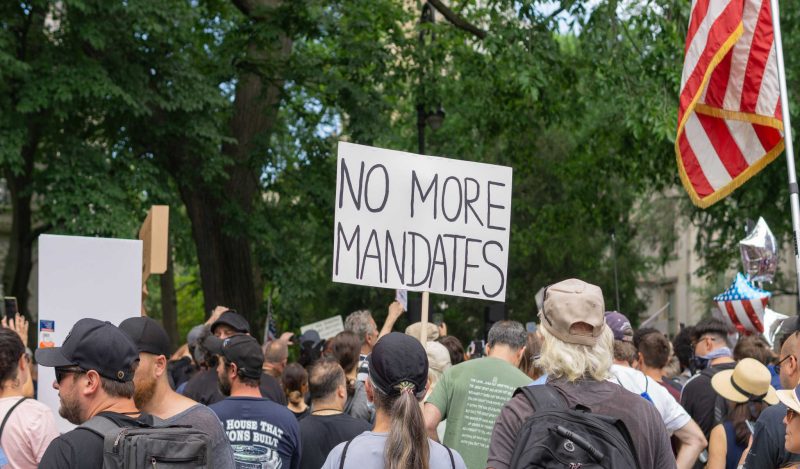
From the Brownstone Institute

Pandemic restrictions were an unmitigated failure, and the evidence base against the politicians and “experts” who imposed them and demanded compliance continues to grow.
And it raises some substantial questions about holding those responsible accountable for their actions. Especially as mask mandates return in certain parts of the country, with hints of more on the way.
Recently a new government report from the United Kingdom was released to little fanfare, which not-so-surprisingly mirrors the fanfare resulting from the release of new data from the CDC itself, showing how vaccine efficacy has fallen to zero.
Finally, Rochelle Walensky did acknowledge publicly that the vaccines couldn’t stop transmission. However it was already far too late to matter.
But all along the agency has strongly stated that the mRNA shots were effective at preventing hospitalizations. Or at least that the latest booster was effective, tacitly acknowledging that the original 2=dose series has lost whatever impact it once had.
What The Evidence Says About NPI’s
The UK’s Health Security Agency (HSA) recently posted a lengthy examination on the effectiveness of non-pharmaceutical interventions at preventing or slowing the spread of COVID-19 in the country.
And at the risk of revealing a spoiler alert, it’s not good news for the COVID extremists determined to bring mask mandates back.
The goal of the examination was laid out succinctly; the UK’s HSA intended to use primary studies on NPIs within the community to see how successful or unsuccessful they were at reducing COVID infections.
The purpose of this rapid mapping review was to identify and categorise primary studies that reported on the effectiveness of non-pharmaceutical interventions (NPIs) implemented in community settings to reduce the transmission of coronavirus (COVID-19) in the UK.
Streamlined systematic methods were used, including literature searches (using sources such as Medline, Embase, and medRxiv) and use of systematic reviews as sources to identify relevant primary studies.
Unsurprisingly, they found that the evidence base on COVID interventions was exceptionally weak.
In fact, roughly 67 percent of the identified evidence was essentially useless.. In fact two-thirds of the evidence identified was modeling.
Two-thirds of the evidence identified was based on modeling studies (100 out of 151 studies).
There was a lack of experimental studies (2 out of 151 studies) and individual-level observational studies (22 out of 151 studies). Apart from test and release strategies for which 2 randomised controlled trials (RCTs) were identified, the body of evidence available on effectiveness of NPIs in the UK provides weak evidence in terms of study design, as it is mainly based on modelling studies, ecological studies, mixed-methods studies and qualitative studies.
This is a key learning point for future pandemic preparedness: there is a need to strengthen evaluation of interventions and build this into the design and implementation of public health interventions and government policies from the start of any future pandemic or other public health emergency.
Modeling, as we know, is functionally useless, given that it’s hopelessly prone to bias, incorrect assumptions and the ideological needs of its creators.
The two paragraphs which followed are equally as important.
Low quality evidence is not something that should be relied upon for decision making purposes, yet that’s exactly what the UK, US and many other countries did. Fauci, the CDC, and others embraced modeling as fact at the beginning of the pandemic. They then repeatedly referenced shoddy, poor quality work because it confirmed their biases throughout its duration, with unsurprising results.
And this government report concurs; stating simply and devastatingly, “there is a lack of strong evidence on the effectiveness of NPIs to reduce COVID-19 transmission, and for many NPIs the scientific consensus shifted over the course of the pandemic.”
Of course the scientific consensus shifted over the course of the pandemic because, as we learned, it became politically expedient for it to shift.
As their paragraphs on the available evidence show, there was little solid, high-quality data showing that NPI’s were having a significant impact on the spread of the virus, a reality that had been predicted by decades of pandemic planning.
But the consensus shifted towards NPIs and away from something approaching Sweden’s strategy or the Great Barrington Declaration, simply because Fauci, the CDC, and other “experts” demanded it shift to suit their ideological aims.
The few high-quality studies on say, masking, that were conducted during the pandemic showed that there was no benefit from mask wearing at an individual or population level. And that is why the Cochrane review came to its now infamous conclusion.
Instead of acknowledging that they were relying on poor quality evidence, the “experts” operated with an unjustified certainty that their interventions were based on following “The Science™.” At every turn, when criticized or questioned, they would default back to an appeal to authority; that the consensus in the scientific community unequivocally believed that the evidence showed that lockdowns, mandates, travel restrictions, and other NPIs were based on the best available information.
After initially determining that the UK should follow Sweden’s example and incorporate a more hands-off approach that relied on protecting the elderly while allowing immunity to build up amongst the younger, healthy populations, Boris Johnson panicked, at the behest of Neil Ferguson, and terrified expert groups. Tossing out decades of planning out of fear, while claiming publicly to be following science.
Instead, a systemic, detailed review of the evidence base relied on by those same experts has now concluded that there never was any high-quality information suggesting that pandemic policies were justifiable. Only wishful thinking from an incompetent, arrogant, malicious “expert” community, and unthinking, unblinking compliance from terrified politicians using restrictions and mandates without care or concern for adverse effects.
While this new report wasn’t specifically designed to determine how effective NPIs were in reducing transmission, it’s clear and obvious conclusions give away that answer too.
If it were easy to prove that COVID policies and mandates had a positive impact on the spread of the virus, there would be dozens of high-quality studies showing a benefit. And those high-quality studies would be covered in this report, with a strong recommendation to reinstate such mandates in future pandemics.
Instead, there’s nothing.
Just exhortations to do better next time, to follow the actual high-quality evidence and not guesswork.
Based on how little accountability there’s been for the “experts” and politicians who lied about “The Science™,” there’s little doubt that when presented with the next opportunity they’ll be sure to handle it in exactly the same way.
Abandoning evidence in favor of politics.
Reprinted from the author’s Substack
Author


From the Brownstone Institute

For me, it’s not difficult to see what the world’s real rulers are trying to achieve. They’re trying to obtain more power and control for themselves. In fact, they’ve largely already achieved this goal. The terrifying thought is they are far from done.
We know they are not finished because their most conspicuous initiative at the moment is their quest to slay the petulances of “misinformation” and “disinformation.”
The correct definition of misinformation/disinformation is any speech that challenges what authority figures say is the truth.
The world’s real rulers don’t want their pronouncements challenged, as this would pose a grave risk to their continued rule and their ability to implement myriad programs that will effectively defeat, once and for all, human freedom.
As long as persuasive dissent doesn’t go viral, the Powers that Be know they will achieve their objectives, which are authoritarian world government much closer to the communist utopia envisioned by thinkers and tyrants like Marx, Mao, and Lenin.
But real communism is not the real goal either, as communism was supposed to make every person equal. The modern form of communism, not unlike all previous forms of communism, ensures the world’s elite organizations will remain ultra-powerful while the proletariat will beg for crumbs.
Who are the World’s Elite Organizations?
They are every important organization – those with great influence (and police-state powers) – including all governmental agencies and departments as well as international government organizations like the UN, WHO, and European Union.
They are also all the major “crony” corporations that benefit from close ties to government and non-governmental organizations.
Plus, foundations like the Bill & Melinda Gates Foundation, the Wellcome Trust, and the Rockefeller Foundation, which have more money than many nations and certainly more ideological commitment to deploy their resources to implement their agendas.
A simple method to define the establishment organizations would be to simply identify the world’s key authorized narratives and then ask yourself what organizations zealously support these initiatives (aka “The Current Thing”).
In the last four years, any organization that vociferously supported all the Covid protocols would be examples of “captured” organizations that enthusiastically supported the Current Thing.
But these same organizations also support all the other ascendant political movements, such as the fight against (allegedly) man-made Climate Change, numerous wars or “interventions” to advance “democracy,” central bank digital currency, and ever more mRNA “vaccines.”
Furthermore, it’s obvious these same organizations support initiatives designed to discredit long-accepted cultural norms in favor of more “progressive” thinking that normalizes gender reversal, race grievances, LGBT+ initiatives, or any reform that advances “diversity, inclusion, or equity.”
The promotion of policies that make mass illegal immigration much easier to achieve has also become a crucial program of our planet’s establishment rulers.
I believe the above summary provides an accurate assessment of the state of the world today.
I also note that it’s an undeniable truth that every program of these establishment organizations has made the world a darker place, with future developments planned by our leaders guaranteed to decrease the qualify of life for children or young adults who may live another 50 to 80 years.
For example, at the moment, unelected delegates who serve on the World Health Organization continue to deliberate in secret as they finalize a new health treaty and make changes to “international regulations” that will affect virtually every citizen on the planet in decades to come.
The salient point about the WHO is that this agency was provably and disastrously wrong on every policy and piece of guidance it issued involving the response to Covid-19.
Another way to identify the members of the Establishment ruling class is to simply identify those who were spectacularly wrong on every key issue of our times. These are the people and organizations who are seeking even more power and control.
Who Will Prevail in the End?
The good news is our side – those who still believe in human liberty – vastly outnumbers the group that is clearly aligned against us.
Above I listed many of the world’s captured organizations. These organizations are staffed by probably a couple hundred thousand key leaders who are committed to supporting the nefarious and freedom -eradicating components of “The Current Thing.”
As I’ll show below, the numbers who identify with “our side” surely exceed tens of millions of citizens.
The bad news is the the enemies of freedom – the worshippers of Big Brother – control all of the institutions and organizations in the world that actually matter.
Whoever sought to capture all of these organizations – from the CDC, the military, the Federal Reserve, the WEF, and the mainstream press – didn’t embark on these projects just to entertain themselves. They did this for a reason. This reason? They wanted to use these organizations to advance/achieve their goals.
To be more specific, they must have known that if they captured all of these organizations it would be almost impossible for any private citizens to stop their plans.
Our Side Actually has a Major Numeric Advantage
Still, the committed generals and staff officers who are seeking even more global control of the masses are…greatly outnumbered by people who are repulsed by their programs.
I’m currently working on a business idea that might supplement the dissident class of independent writers or “citizen journalists” found in the alternative media and on Substack.
In working on this project, I’m very interested in gauging the size of the market for content that resonates with the world’s population that still values freedom. This would be the group of citizens who is skeptical of the authorized narratives and values (genuine) “watchdog” journalism.
My estimate is there must be tens of millions of people who think like I do, people who would like to stop all the goals of the WEF, Davos, and WHO crowd.
The Tucker Carlson Metric
Perhaps the simplest way to estimate the size of this market is to examine the audience of one of the world’s best-known “contrarian journalists,” Tucker Carlson.
Before Carlson was fired by Fox News, his nightly news show routinely drew four million viewers per night, which made it the top-rated news program in North America. Over the course of a month, the show might have attracted 10 million viewers.
As we all know, Carlson was fired for producing content that was extremely popular with millions of adults. But Carlson didn’t disappear or stop producing “taboo” commentary and news segments, he simply moved to Twitter (now X) and kept doing the exact same thing.
Carlson’s interview with Vladimir Putin garnered more than 150 million views and his various streaming podcasts routinely double or triple the number of people he was reaching on Fox News.
Since Tucker covers many of the same “taboo” subjects I do, one can conservatively estimate that at least 10 million of Carlson’s regular viewers strongly oppose everything the world’s so-called leaders want to make a reality. And that’s just Carlson’s audience.
Substack has more than 35 million subscribers, probably 20 percent of whom are searching for content they know they won’t find in, say, the New York Times or CBS News. That would be a “market” of 7 million freedom-supporting citizens.
Tucker was recently the guest on Joe Rogan’s podcast show. Rogan probably has an audience just as large and loyal as Carlson. Indeed, in their wide-ranging and fascinating conversation, Rogan made the point that shows like his and Tucker’s should now be considered “mainstream”…because they reach far more viewers than, say, the newscasts of the big TV networks (which actually aren’t so big anymore).
As far as I can tell, all the “alternative media” outlets are growing rapidly while all the traditional news outlets are Dead Men Walking.
Again, this is an extremely encouraging sign for anyone who believes that skeptical and independent speech is important to help ensure a world where real freedom might continue to exist.
But I Haven’t Mentioned the Biggest Group of Citizens
While “our side” greatly outnumbers the figure of key employees occupying all the captured organizations, the real population group that matters is the immense group that is sitting out this existential battle for freedom.
The citizens who will probably determine the outcome of this battle are the people who have not discovered the Substack contrarians or who never watch Joe Rogan…or who think Tucker Carlson is a dangerous extremist who should have been fired by Fox (and should now be fired by Elon Musk and X). This group numbers in the billions.
(This would be the group that doesn’t want to think anymore about the Covid response or think about the possibility that scary-looking, worm-like clots might be in their veins and arteries right now.)
This group just wants to get through each day with adequate supplies of bread…and if they’re given a few mildly entertaining circuses to distract them from the challenges of their daily lives, that’s enough.
For this segment of the population, any big debate on “freedom” is either boring, not germane to their lives, or they love and appreciate Big Brother and are convinced he is protecting them.
What this means to you and me is that the denouement of this historic battle will be determined by a relatively small percentage of the world’s population.
On one side, we have the 200,000 or so leaders of thousands of important captured organizations. On the other side, we have 10 to 20 million citizens who’ve found each other in the alternative media. In the middle, we have a couple billion people who are oblivious to what’s really at stake.
Whatever way this massive middle group swings in the future, so goes the world.
One suspects the world’s real rulers know that their track record and planned agendas won’t stand up to close scrutiny. They know that their arguments are not as persuasive and could easily be debunked if our side’s arguments were to “go viral.”
To help keep this middle group indifferent or on their side, the Deep State concocted the concepts of disinformation and misinformation to smear or throttle the influence of those on our side.
The ever-growing Censorship Industrial Complex has performed its most important job with (disgusting) distinction. For now at least, the depressing truth is the masses don’t seem to care much about the issues that some of us think are tectonic.
This means recruiting the legions of people we need to recruit will be a strangely tough sale.
Our charge of persuading more of our neighbors to join our side has been made far more difficult by the false narrative that all of the important disinformation is coming from citizens like us, when, in fact, we don’t control any of the important information.
If and when the masses realize who’s been producing the real disinformation, freedom might pull an upset victory.
Republished from the author’s Substack
Author


From the Brownstone Institute

I’ve seen some crazy things over the last few years but this is off-the-charts insane.
Last week, Michael E. Mann spoke at the EcoHeath Alliance: Green Planet One Health Benefit 2024. Just to recap who each of these players are:
- Michael E. Mann is the creator of the “hockey stick graph” that has driven the global warming debate for the last 25 years.
- EcoHealth Alliance is the CIA cutout led by Peter Daszak that launders money from the NIH to the Wuhan Institute of Virology to create gain-of-function viruses (including SARS-CoV-2 which killed over 7 million people).
- “One Health” is the pretext the World Health Organization (WHO) is using to drive the Pandemic Treaty that will vastly expand the powers of the WHO and create economic incentives for every nation on earth to develop new gain-of-function viruses.
So a leader in the global warming movement spoke at an event to raise money for the organization that just murdered 7 million people and the campaign that intends to launch new pandemics in perpetuity to enrich the biowarfare industrial complex.

And then just for good measure, Peter Hotez reposted all of this information on Twitter, I imagine in solidarity with all of the exciting genociding going on.

Mann’s appearance at this event is emblematic of a disturbing shift that has been years in the making. Serious and thoughtful people in the environmental movement tried to address industrial and military pollution for decades. Now their cause has been co-opted by Big Tech and other corporate actors with malevolent intentions — and the rest of the environmental movement has gone along with this, apparently without objection. So we are witnessing a convergence between the global warming movement, the biowarfare industrial complex, and the WHO pandemic treaty grifters.
I wish it wasn’t true but here we are.
Before I go any further I need to make one thing clear: the notion that pandemics are driven by global warming is complete and total bullsh*t. The evidence is overwhelming that pandemics are created by the biowarfare industrial complex including the 13,000 psychopaths who work at over 400 US bioweapons labs (as described in great detail in The Wuhan Cover-Up).
Unfortunately “global warming” has become a cover for the proliferation of the biowarfare industrial economy.
Mann’s appearance at an event to raise money for people who are clearly guilty of genocide (and planning more carnage) made me realize that this really is World War III. They are straight-up telling us who they are and what they intend to do.
The different sides in this war are not nation-states. Instead, Team Tyranny is a bunch of different business interests pushing what has become a giant multi-trillion dollar grift. And Team Freedom is ordinary people throughout the world just trying to return to the classical economic and political liberalism that drove human progress from 1776 until 2020.
Here’s how I see the battle lines being drawn:
TEAM TYRANNY
Their base: Elites, billionaires, the ruling class, the biowarfare industrial complex, intelligence agencies, and bougie technocrats.
Institutions they control: WEF, WHO, UN, BMGF, World Bank, IMF, most universities, the mainstream media, and liberal governments throughout the developed world.
Economic philosophy: The billionaires should control all wealth on earth. The peasants should only be allowed to exist to serve the billionaires, grow food, and fix the machines when necessary. Robots and Artificial Intelligence will soon be able to replace most of the peasants.
Political philosophy: Centralized control of everything. Elites know best. The 90% should shut up, pay their taxes, take their vaccines, develop chronic disease, and die. High tech global totalitarianism is the best form of government. Billionaires are God.
Philosophy of medicine: Allopathic. Cut, poison, burn, kill. Corporations create all knowledge. Bodies are machines. Transhumanism is ideal. The billionaires will soon live forever in the digital cloud.
Their currency: For now, inflationary Federal Reserve policies. Soon, Central Bank Digital Currency (CBDC) that will put the peasants in their place once and for all.
Policy vehicles to advance their agenda: One Health; WHO Pandemic Treaty; social credit scores; climate scores; vaccine mandates/passports; lockdowns and quarantine camps; elimination of small farms and livestock; corporate control of all food, land, water, transportation, and the weather; corporate control of social movements; and 15-minute cities for the peasants.
Military strategy: Gain-of-function viruses, propaganda, and vaccines.
TEAM FREEDOM
Our base: The medical freedom movement, Constitutionalists, small “l” libertarians, independent farmers, natural meat and milk producers, pirate parties, natural healers, homeopaths, chiropractors, integrative and functional medicine doctors, and osteopaths.
Aligned institutions: CHD, ICAN, Brownstone Institute, NVIC, SFHF, the RFK, Jr. campaign, the Republican party at the county level…
Economic philosophy: Small “c” capitalism. Competition. Entrepreneurship.
Political philosophy: Classical liberalism. The people, using their own ingenuity, will generally figure out the best way to do things. Decentralize everything including the internet. If the elites would just leave us alone the world would be a much more peaceful, creative, and prosperous place. Human freedom leads to human flourishing.
Philosophy of medicine: Nature is infinite in its wisdom. Listen to the body. Systems have the ability to heal and regenerate.
Our currency: Cash, gold, crypto, and barter. (I don’t love crypto but lots of smart people in our movement do.)
Policy ideas: Exit the WHO. Boycott WEF companies. Repeal the Bayh-Dole Act, NCVIA Act, Patriot Act, and PREP Act. Add medical freedom to the Constitution. Prosecute the Faucistas at Nuremberg 2.0. Overhaul the NIH, FDA, CDC, EPA, USDA, FCC, DoD, and intelligence agencies. Make all publicly-funded scientific data available to the public. Ban insider trading by Congress. Support and protect organic food, farms, and farmers’ markets. Break up monopolies. Cut the size of the federal government in half (or more).
Our preferred tools to create change: Ideas, love for humanity, logic and reason, common sense, art and music, and popular uprising.
What would you add, subtract, or change in each of these lists?
Republished from the author’s Substack
Author



Japanese study finds ‘significant increases’ in cancer deaths after third mRNA COVID doses

Maxime Bernier warns Canadians of Trudeau’s plan to implement WEF global tax regime
A Coup Without Firing a Shot
WHO Official Admits the Truth About Passports
-
COVID-192 days ago
Japanese study finds ‘significant increases’ in cancer deaths after third mRNA COVID doses
-
Business2 days ago
Maxime Bernier warns Canadians of Trudeau’s plan to implement WEF global tax regime
-
Brownstone Institute2 days ago
A Coup Without Firing a Shot
-
COVID-191 day ago
WHO Official Admits the Truth About Passports
-
 Bruce Dowbiggin2 days ago
Coyotes Ugly: The Sad Obsession Of Gary Bettman
-
 Energy1 day ago
Anti-LNG activists have decided that they now actually care for LNG investors after years of calling to divest
-
 Freedom Convoy2 days ago
Ottawa spent “excessive” $2.2 million fighting Emergencies Act challenge
-
 Brownstone Institute1 day ago
Is the Overton Window Real, Imagined, or Constructed?