
National
NDP leader Jagmeet Singh pulls support from Trudeau’s Liberals

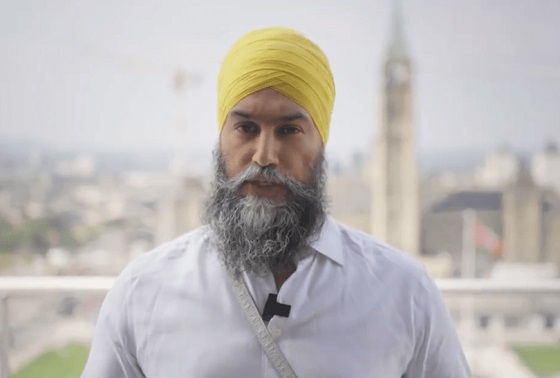

From LifeSiteNews
“The Liberals are too weak, too selfish and too beholden to corporate interests to stop the Conservatives and their plans to cut. But the NDP can.”
New Democratic Party leader Jagmeet Singh announced today that his deal to keep Trudeau and his Liberal Party in power is ‘done,’ leading to speculation as to whether an election may be called before it is mandated in October 2025.
The head of the New Democratic Party (NDP), Jagmeet Singh, today announced he is pulling his official support for Prime Minister Justin Trudeau’s Liberals, meaning there is now a possibility a fall election could be held should a non-confidence vote pass in the House of Commons.
“The deal is done. The Liberals are too weak, too selfish and too beholden to corporate interests to stop the Conservatives and their plans to cut. But the NDP can,” wrote Singh on X this afternoon.
The deal is done.
The Liberals are too weak, too selfish and too beholden to corporate interests to stop the Conservatives and their plans to cut. But the NDP can.
Big corporations and CEOs have had their governments. It's the people's time. pic.twitter.com/BsE9zT0CwF
— Jagmeet Singh (@theJagmeetSingh) September 4, 2024
“Big corporations and CEOs have had their governments. It’s the people’s time.”
Singh also posted a video to go along with his X statement, saying, “Justin Trudeau has proven again and again he will always cave to corporate greed. The Liberals have let people down. They don’t deserve another chance from Canadians.”

He then took a shot at Canada’s Conservative Party leader Pierre Poilievre, calling him an even bigger “threat” than Trudeau.
Before today, Singh had in place an informal coalition with the Trudeau government that began last year. This agreement has until now kept the Liberals in power until the next election, which is scheduled for the fall of 2025.
It is expected that later today Singh will lay out in detail what his pulling out of the deal with Trudeau will fully entail. Some pundits have speculated that he may still support the Liberals on most bills, which would keep the Liberals in power.
Late last month, leader of Canada’s Conservative Party Pierre Poilievre called on Singh to pull his support for Trudeau’s Liberals, so that an election could be held.
Recent polls show that the Conservatives under Poilievre would win a majority government in a landslide were an election held today. Singh’s NDP and Trudeau’s Liberals would lose a massive number of seats.
As reported by LifeSiteNews, the Trudeau Liberals were hoping to delay the 2025 federal election by a few extra days in what many see as a stunt to try and secure pensions for MPs who are projected to lose their seats. Approximately 80 MPs would qualify for their pensions should they sit as MPs until at least October 27, 2025, which is the newly proposed election date. The election date as it stands now is set to happen on October 20, 2025.
LifeSiteNews, in a recent opinion piece by this writer, observed that most of the recent polling shows that if a federal election were held today, “Pierre Poilievre’s Conservative Party would not only mop the floor of the House of Commons of most Liberal MPs but wash the windows of the house on Parliament Hill as well with a tint of conservative blue.”


From the Fraser Institute
By Tegan Hill and Jason Clemens
Recent court decision adds to growing uncertainty in B.C.
A recent decision by the B.C. Court of Appeal further clouds private property rights and undermines investment in the province. Specifically, the court determined British Columbia’s mineral claims system did not follow the province’s Declaration on the Rights of Indigenous Peoples Act (DRIPA), which incorporated the United Nations Declaration on the Rights of Indigenous Peoples (UNDRIP) into law.
DRIPA (2019) requires the B.C. provincial government to “take all measures necessary to ensure the laws of British Columbia are consistent with the Declaration,” meaning that all legislation in B.C. must conform to the principles outlined in the UNDRIP, which states that “Indigenous peoples have the right to the lands, territories and resources which they have traditionally owned, occupied or otherwise used or acquired.” The court’s ruling that the provincial government is not abiding by its own legislation (DRIPA) is the latest hit for the province in terms of ongoing uncertainty regarding property rights across the province, which will impose massive economic costs on all British Columbians until it’s resolved.
Consider the Cowichan First Nations legal case. The B.C. Supreme Court recently granted Aboriginal title to over 800 acres of land in Richmond valued at $2.5 billion, and where such aboriginal title is determined to exist, the court ruled that it is “prior and senior right” to other property interests. Put simply, the case puts private property at risk in BC.
The Eby government is appealing the case, yet it’s simultaneously negotiating bilateral agreements that similarly give First Nations priority rights over land swaths in B.C.
Consider Haida Gwaii, an archipelago on Canada’s west coast where around 5,000 people live—half of which are non-Haida. In April 2024, the Eby government granted Haida Aboriginal title over the land as part of a bilateral agreement. And while the agreement says private property must be honoured, private property rights are incompatible with communal Aboriginal title and it’s unclear how this conflict will be resolved.
Moreover, the Eby government attempted to pass legislation that effectively gives First Nations veto power over public land use in B.C. in 2024. While the legislation was rescinded after significant public backlash, the Eby’s government’s continued bilateral negotiations and proposed changes to other laws indicate it’s supportive of the general move towards Aboriginal title over significant parts of the province.
UNDRIP was adopted by the United Nations in 2007 and the B.C. Legislature adopted DRIPA in 2019. DRIPA requires that the government must secure “free, prior and informed consent” before approving projects on claimed land. Premier Eby is directly tied to DRIPA since he was the attorney general and actually drafted the interpretation memo.
The recent case centres around mineral exploration. Two First Nations groups—the Gitxaala Nation and the Ehattesaht First Nation—claimed the duty to consult was not adequately met and that granting mineral claims in their land “harms their cultural, spiritual, economic, and governance rights over their traditional territories,” which is inconsistent with DRIPA.
According to a 2024 survey of mining executives, more uncertainty is the last thing B.C. needs. Indeed, 76 per cent of respondents for B.C. said uncertainty around protected land and disputed land claims deters investment compared to only 29 per cent and 44 per cent (respectively) for Saskatchewan.
This series of developments have and will continue to fuel uncertainty in B.C. Who would move to or invest in B.C. when their private property, business, and investment is potentially at risk?
It’s no wonder British Columbians are leaving the province in droves. According to the B.C. Business Council, nearly 70,000 residents left B.C. for other parts of Canada last year. Similarly, business investment (inflation-adjusted) fell by nearly 5 per cent last year, exports and housing starts were down, and living standards in the province (as measured by per-person GDP) contracted in both 2023 and 2024.
B.C.’s recent developments will only worsen uncertainty in the province, deterring investment and leading to stagnant or even declining living standards for British Columbians. The Eby government should do its part to reaffirm private property rights, rather than continue fuelling uncertainty.

Tegan Hill
Director, Alberta Policy, Fraser Institute

Jason Clemens
Executive Vice President, Fraser Institute
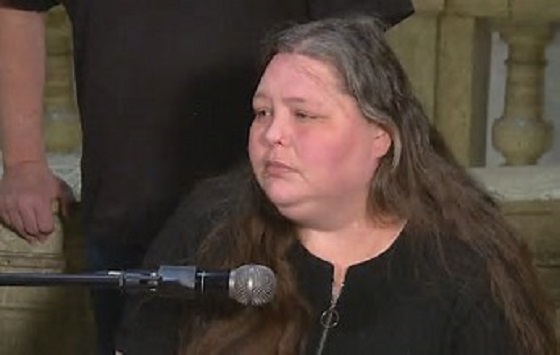
From LifeSiteNews
Jolene Van Alstine was approved for euthanasia after tiring of waiting years for surgery in Canada
A Canadian woman is looking to die by state-sanctioned euthanasia because she has had to endure long wait times to get what she considers to be proper care for a rare parathyroid disease.
The woman is Jolene Van Alstine, whose condition, normocalcemic primary hyperparathyroidism (nPHPT), causes her to experience vomiting, nausea, and bone pain.
As noted in a recent CBC report, Van Alstine claims she is not able to get proper surgery to remove her parathyroid in her home province of Saskatchewan, as there are no surgeons in that province who can perform that type of surgery.
She has said her “friends have stopped visiting me” and she is “isolated” and living “alone lying on the couch for eight years, sick and curled up in a ball, pushing for the day to end.”
“I go to bed at six at night because I can’t stand to be awake anymore,” she said.
As a result of her frustrations with the healthcare system, Van Alstine applied for Canada’s Medical Assistance in Dying (MAiD). She was approved for the procedure on January 7, 2026.
Saskatchewan Health Minister Jeremy Cockrill met with Van Alstine last month to try to see if he could help her, but what they talked about remains confidential.
“The Government of Saskatchewan expresses its sincere sympathy for all patients who are suffering with a difficult health diagnosis,” the government said.
As reported by LifeSiteNews, over 23,000 Canadians have died while on wait lists for medical care as Prime Minister Mark Carney’s Liberal government is focused on euthanasia expansions.
A new Euthanasia Prevention Coalition report revealed that Canada has euthanized 90,000 people since 2016, the year it was legalized.
Americans offering Jolene surgery help now say they have made contact with her
Van Alstine’s story has gone viral on the social media platform X, catching the attention of well-known American personalities, some who have claimed they can help her.
“If there is any surgeon in America who can do this, I’ll pay for this patient to come down here for treatment,” Glenn Beck wrote Tuesday on X.
“THIS is the reality of ‘compassionate’ progressive healthcare. Canada must END this insanity and Americans can NEVER let it spread here.”
According to Beck in a subsequent X post, he has had “surgeons who emailed us standing by to help her.”
“We are in contact with Jolene and her husband! Please continue to pray for her health,” he wrote on X.
“Will update more soon.”
As reported by LifeSiteNews recently, a Conservative MP’s private member’s bill that, if passed, would ban euthanasia for people with mental illness received the full support of the Euthanasia Prevention Coalition.
Lobby groups have pushed for MAiD to be expanded to minors.
Desiring to expand the procedure to even more Canadians, former Prime Minister Justin Trudeau’s government sought to expand from just the chronically and terminally ill to those suffering solely from mental illness. The current Liberal government appears to want to continue with the MAiD regime.
However, in February, after pushback from pro-life, medical, and mental health groups as well as most of Canada’s provinces, the federal government delayed the mental illness expansion until 2027.


Media bound to pay the price for selling their freedom to (selectively) offend

Sometimes An Ingrate Nation Pt. 2: The Great One Makes His Choice

Recent price declines don’t solve Toronto’s housing affordability crisis

From Exception to Routine. Why Canada’s State-Assisted Suicide Regime Demands a Human-Rights Review
-
 COVID-192 days ago
University of Colorado will pay $10 million to staff, students for trying to force them to take COVID shots
-
 Bruce Dowbiggin2 days ago
Integration Or Indignation: Whose Strategy Worked Best Against Trump?
-
 espionage2 days ago
Western Campuses Help Build China’s Digital Dragnet With U.S. Tax Funds, Study Warns
-
 Bruce Dowbiggin2 days ago
Wayne Gretzky’s Terrible, Awful Week.. And Soccer/ Football.
-
 Agriculture2 days ago
Canada’s air quality among the best in the world
-
 Business1 day ago
Canada invests $34 million in Chinese drones now considered to be ‘high security risks’
-
Great Reset1 day ago
Surgery Denied. Death Approved.
-
 Health1 day ago
The Data That Doesn’t Exist