Connect with us

Economy

3 billion a week! Bank of Canada buying bonds at same rate as federal government overspending

Published

1 minute read

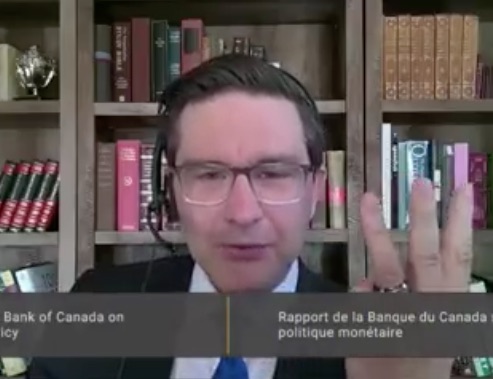
At a committee hearing today, Opposition MP Pierre Poilievre showed how The Bank of Canada is helping the Federal Government drive up inflation. Poilievre pointed out the Federal Government is borrowing 3 billion dollars a week while the Central Bank is buying 3 billion dollars a week worth of government bonds.
Critics of this approach say the Bank of Canada is in effect helping the federal government to pay for overspending, punishing lower income Canadians.  Funding the government with printed money drives up the prices of  everything, boosting the cost of housing, food, and general necessities throughout the country.
In this exchange Poilievre asked Tiff Macklem, Governor of the Bank of Canada why the Bank of Canada is widening the gap between rich and poor.

After 15 years as a TV reporter with Global and CBC and as news director of RDTV in Red Deer, Duane set out on his own 2008 as a visual storyteller. During this period, he became fascinated with a burgeoning online world and how it could better serve local communities. This fascination led to Todayville, launched in 2016.

Follow Author

Business

Taxing food is like slapping a surcharge on hunger. It needs to end

Published on

This article supplied by Troy Media.

Troy Media By Sylvain Charlebois

Cutting the food tax is one clear way to ease the cost-of-living crisis for Canadians

About a year ago, Canada experimented with something rare in federal policymaking: a temporary GST holiday on prepared foods.

It was short-lived and poorly communicated, yet Canadians noticed it immediately. One of the most unavoidable expenses in daily life—food—became marginally less costly.

Families felt a modest but genuine reprieve. Restaurants saw a bump in customer traffic. For a brief moment, Canadians experienced what it feels like when government steps back from taxing something as basic as eating.

Then the tax returned with opportunistic pricing, restoring a policy that quietly but reliably makes the cost of living more expensive for everyone.

In many ways, the temporary GST cut was worse than doing nothing. It opened the door for industry to adjust prices upward while consumers were distracted by the tax relief. That dynamic helped push our food inflation rate from minus 0.6 per cent in January to almost four per cent later in the year. By tinkering with taxes rather than addressing the structural flaws in the system, policymakers unintentionally fuelled volatility. Instead of experimenting with temporary fixes, it is time to confront the obvious: Canada should stop taxing food altogether.

Start with grocery stores. Many Canadians believe food is not taxed at retail, but that assumption is wrong. While “basic groceries” are zero-rated, a vast range of everyday food products are taxed, and Canadians now pay over a billion dollars a year in GST/HST on food purchased in grocery stores.

That amount is rising steadily, not because Canadians are buying more treats, but because shrinkflation is quietly pulling more products into taxable categories. A box of granola bars with six bars is tax-exempt, but when manufacturers quietly reduce the box to five bars, it becomes taxable. The product hasn’t changed. The nutritional profile hasn’t changed. Only the packaging has changed, yet the tax flips on.

This pattern now permeates the grocery aisle. A 650-gram bag of chips shrinks to 580 grams and becomes taxable. Muffins once sold in six-packs are reformatted into three-packs or individually wrapped portions, instantly becoming taxable single-serve items. Yogurt, traditionally sold in large tax-exempt tubs, increasingly appears in smaller 100-gram units that meet the definition of taxable snacks. Crackers, cookies, trail mixes and cereals have all seen slight weight reductions that push them past GST thresholds created decades ago. Inflation raises food prices; Canada’s outdated tax code amplifies those increases.

At the same time, grocery inflation remains elevated. Prices are rising at 3.4 per cent, nearly double the overall inflation rate. At a moment when food costs are climbing faster than almost everything else, continuing to tax food—whether on the shelf or in restaurants—makes even less economic sense.

The inconsistencies extend further. A steak purchased at the grocery store carries no tax, yet a breakfast wrap made from virtually the same inputs is taxed at five per cent GST plus applicable HST. The nutritional function is not different. The economic function is not different. But the tax treatment is entirely arbitrary, rooted in outdated distinctions that no longer reflect how Canadians live or work.

Lower-income households disproportionately bear the cost. They spend 6.2 per cent of their income eating outside the home, compared with 3.4 per cent for the highest-income households. When government taxes prepared food, it effectively imposes a higher burden on those often juggling two or three jobs with limited time to cook.

But this is not only about the poorest households. Every Canadian pays more because the tax embeds itself in the price of convenience, time and the realities of modern living.

And there is an overlooked economic dimension: restaurants are one of the most effective tools we have for stimulating community-level economic activity. When people dine out, they don’t just buy food. They participate in the economy. They support jobs for young and lower-income workers. They activate foot traffic in commercial areas. They drive spending in adjacent sectors such as transportation, retail, entertainment and tourism.

A healthy restaurant sector is a signal of economic confidence; it is often the first place consumers re-engage when they feel financially secure. Taxing prepared food, therefore, is not simply a tax on convenience—it is a tax on economic participation.

Restaurants Canada has been calling for the permanent removal of GST/HST on all food, and they are right. Eliminating the tax would generate $5.4 billion in consumer savings annually, create more than 64,000 foodservice jobs, add over 15,000 jobs in related sectors and support the opening of more than 2,600 new restaurants across the country. No other affordability measure available to the federal government delivers this combination of economic stimulus and direct relief.

And Canadians overwhelmingly agree. Eighty-four per cent believe food should not be taxed, regardless of where it is purchased. In a polarized political climate, a consensus of that magnitude is rare.

Ending the GST/HST on all food will not solve every affordability issue but it is one of the simplest, fairest and most effective measures the federal government can take immediately.

Food is food. The tax system should finally accept that.

Dr. Sylvain Charlebois is a Canadian professor and researcher in food distribution and policy. He is senior director of the Agri-Food Analytics Lab at Dalhousie University and co-host of The Food Professor Podcast. He is frequently cited in the media for his insights on food prices, agricultural trends, and the global food supply chain. 

Troy Media empowers Canadian community news outlets by providing independent, insightful analysis and commentary. Our mission is to support local media in helping Canadians stay informed and engaged by delivering reliable content that strengthens community connections and deepens understanding across the country.

Continue Reading

Business

Ottawa Pretends To Pivot But Keeps Spending Like Trudeau

Published on

From the Frontier Centre for Public Policy

By Marco Navarro-Genie

New script, same budget playbook. Nothing in the Carney budget breaks from the Trudeau years

Prime Minister Mark Carney’s first budget talks reform but delivers the same failed spending habits that defined the Trudeau years.

While speaking in the language of productivity, infrastructure and capital formation, the diction of grown-up economics, it still follows the same spending path that has driven federal budgets for years. The message sounds new, but the behaviour is unchanged.

Time will tell, to be fair, but it feels like more rhetoric, and we have seen this rhetoric lead to nothing before.

The government insists it has found a new path, one where public investment leads private growth. That sounds bold. However, it is more a rebranding than a reform. It is a shift in vocabulary, not in discipline. The government’s assumptions demand trust, not proof, and the budget offers little of the latter.

Former prime ministers Jean Chrétien and Paul Martin did not flirt with restraint; they executed it. Their budget cuts were deep, restored credibility, and revived Canada’s fiscal health when it was most needed. Ottawa shrank so the country could grow. Budget 2025 tries to invoke their spirit but not their actions. The contrast shows how far this budget falls short of real reform.

Former prime minister Stephen Harper, by contrast, treated balanced budgets as policy and principle. Even during the global financial crisis, his government used stimulus as a bridge, not a way of life. It cut taxes widely and consistently, limited public service growth and placed the long-term burden on restraint rather than rhetoric. Carney’s budget nods toward Harper’s focus on productivity and capital assets, yet it rejects the tax relief and spending controls that made his budgets coherent.

Then there is Justin Trudeau, the high tide of redistribution, vacuous identity politics and deficit-as-virtue posturing. Ottawa expanded into an ideological planner for everything, including housing, climate, childcare, inclusion portfolios and every new identity category.

The federal government’s latest budget is the first hint of retreat from that style. The identity program fireworks are dimmer, though they have not disappeared. The social policy boosterism is quieter. Perhaps fiscal gravity has begun to whisper in the prime minister’s ear.

However, one cannot confuse tone for transformation.

Spending still rises at a pace the government cannot justify. Deficits have grown. The new fiscal anchor, which measures only day-to-day spending and omits capital projects and interest costs, allows Ottawa to present a balanced budget while still adding to the deficit. The budget relies on the hopeful assumption that Ottawa’s capital spending will attract private investment on a scale economists politely describe as ambitious.

The housing file illustrates the contradiction. New funding for the construction of purpose-built rentals and a larger federal role in modular and subsidized housing builds announced in the budget is presented as a productivity measure, yet continues the Trudeau-era instinct to centralize housing policy rather than fix the levers that matter. Permitting delays, zoning rigidity, municipal approvals and labour shortages continue to slow actual construction. These barriers fall under provincial and municipal control, meaning federal spending cannot accelerate construction unless those governments change their rules. The example shows how federal spending avoids the real obstacles to growth.

Defence spending tells the same story. Budget 2025 offers incremental funding and some procurement gestures, but it avoids the core problem: Canada’s procurement system is broken. Delays stretch across decades. Projects become obsolete before contracts are signed. The system cannot buy a ship, an aircraft or an armoured vehicle without cost overruns and missed timelines. The money flows, but the forces do not get the equipment they need.

Most importantly, the structural problems remain untouched: no regulatory reform for major projects, no tax-competitiveness agenda and no strategy for shrinking a federal bureaucracy that has grown faster than the economy it governs. Ottawa presides over a low-productivity country but insists that a new accounting framework will solve what decades of overregulation and policy clutter have created. The budget avoids the hard decisions that make countries more productive.

From an Alberta vantage, the pivot is welcome but inadequate. The economy that pays for Confederation receives more rhetorical respect, yet the same regulatory thicket that blocks pipelines and mines remains intact. The government praises capital formation but still undermines the key sectors that generate it.

Budget 2025 tries to walk like Chrétien and talk like Harper while spending like Trudeau. That is not a transformation. It is a costume change. The country needed a budget that prioritized growth rooted in tangible assets and real productivity. What it got instead is a rhetorical turn without the courage to cut, streamline or reform.

Canada does not require a new budgeting vocabulary. It requires a government willing to govern in the country’s best interests.

Marco Navarro-Genie is vice-president of research at the Frontier Centre for Public Policy and co-author with Barry Cooper of Canada’s COVID: The Story of a Pandemic Moral Panic (2023).

Continue Reading

Trending

X