“Today, I addressed the Legislative Assembly and spoke to the actions that the Government of Alberta has taken and will continue to take to advocate for Alberta and Canada’s interests in the U.S. as we continue to face the threat and imposition of tariffs.”
Mr. Speaker,
When U.S. President Donald Trump first announced his threatened tariffs against Canada, and began musing about our country becoming the 51st state, many Canadians – and Albertans – feared for their futures.
Why? Because, regardless of our political stripe, we all knew the imposition of 25% tariffs on all Canadian goods to the U.S. would cost the jobs of hundreds of thousands of Canadians, would depress our economy, devastate our budget and damage the sovereignty of our country.
And in the roughly 4 months until just before last weekend’s federal election call, Premiers, party leaders and Canadians were united (other than perhaps the Alberta NDP) in working as hard as we could to convince the U.S. President and Congress to reconsider these unjustified actions against our country.
In fact, Premiers were all encouraged by each other as well as the former Prime Minister and his ministers, to visit the U.S., get on U.S. media, speak with every U.S. official and influencer we could find to convince the U.S. President to refrain from imposing these tariffs.
It was all about working as ‘Team Canada’ for the greater good.
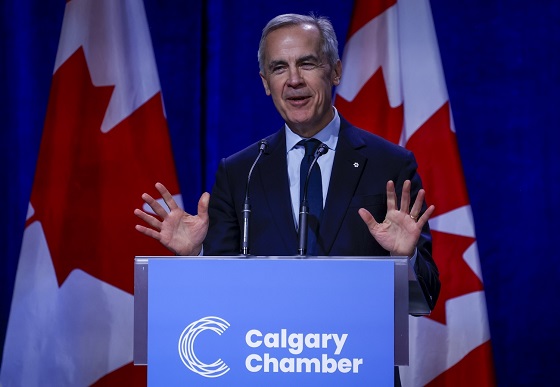
Enter Liberal Prime Minister Mark Carney.
Now, all of a sudden, it is treason to talk to American media personalities that we disagree with. It is disloyal to try and persuade high-profile Republicans holding influence with the President to abandon his tariff policies on Canada. Indeed, it is a high crime to try and convince U.S. officials to refrain from imposing tariffs until after our country has an elected leader with a strong mandate.
Shame on all who dare to speak with the enemy, they say!
These are the Team Carney and Nenshi NDP talking points.
Their endgame is quite obvious. Frighten and divide Canadians. Try and make Canadians forget the utter incompetence of Liberal and NDP policies inflicted upon this country over the last 10 years. Associate conservatives with President Trump. And if they play their cards just right – and sprinkle in just enough anti-Alberta rhetoric – presto – Canada can elect another Liberal majority government.
Well – the Carney Liberals and Nenshi NDP are right about one thing…our country is indeed vulnerable right now.
And the reason why is as clear as a sunny Alberta day.
It is because for the last 10 years, Liberal and NDP leaders across this country – both federal and provincial – have repeatedly sold out Canada and Alberta with policies that have landlocked our immense natural resources, made nation building projects impossible to finance and build, and have made securing access to our ports an exercise in frustration and futility.
These Liberal and NDP leaders – from Trudeau to Singh and now to Prime Minister Mark Carney – have done everything in their power to sow investment uncertainty, add impossibly high costs on the development of our resources, and have disastrously weakened our security and military – and all in the name of their green extremist religion and its cult leaders named Guilbeault, Suzuki, Gore and Thunberg.
And the results are obvious – Canadians are poorer than Americans – overly-dependent on the Americans – and vulnerable to many nations including the Americans.
Canada has indeed been sold out – big time – and it’s been sold out by the utter incompetent, self-righteous and extreme policies of Liberal and NDP leadership across this country – including the Nenshi NDP here in Alberta. From C-69, to oil and gas production caps to tanker bans to a dozen other examples – the Liberals and their allies have attacked the Alberta and Saskatchewan economies mercilessly.
But despite all that – despite the 10 year attack on Alberta by our own federal government – when tariffs were threatened on our fellow Canadians and the federal Liberals realized they had no contacts or allies anywhere in the new U.S. administration…what did the Alberta Government do?
Did we cower in the corner madly texting our tweets about hating Donald Trump on X?
Did we turn into part time TikTok rage farmers to stir up as much fear and loathing of Americans as humanly possible?
Did we give up, throw our hands in the air, express righteous indignation – but do nothing to fight against the threat posed against our province and country?
No – that’s what the Nenshi NDP did of course – but we, Alberta’s UCP government, did not.
Instead, our government did exactly what Albertans expected us to do – we decided to fight tooth and nail for Albertan and Canadian jobs and sovereignty.
My ministers, officials and I have spent hundreds of hours over the last several months talking with, lobbying, educating, and persuading every U.S. lawmaker and media influencer that was willing to listen, about how damaging and wrongheaded imposing tariffs on Canada would be for Americans, and the millions of American jobs that would be lost because of them.
I’ve made this case repeatedly to the American people and their leaders – especially Republican leaders – from the President of the United States personally, to members of his Cabinet to Senators to governors to members of congress to podcasters to media personalities.
I’ve lost track of how many nights I have spent in uncomfortable hotel beds and in airports – doing everything humanly possible to stand up for Canadian and Alberta workers and families.
Convincing U.S. Officials to refrain from putting tariffs on any Canadian goods. Asking that they respect the current free trade agreement and not begin renegotiations until Canadians elect a new Prime Minister with a strong mandate.
Doing all we could in Alberta to secure the U.S. border and urging the Liberals to do the same across the country so we could further delay the implementation of tariffs.
And it hasn’t just been Alberta – several other Premiers – particularly conservative Premiers – from Premier Scott Moe to Premier Tim Houston to Premier Doug Ford – have been doing the same thing.
And the results – it has been almost 4 months since the President first threatened tariffs on Canada, and although steel and aluminum are being wrongfully tariffed at this time – the tariffs on remaining Canadian goods sit at zero today – rather than the threatened 25%.
And what has the Nenshi NDP done to contribute to this effort? Not a single thing other than raging against this government for every effort made to protect Albertans.
Needless to say, there is not a doubt in my mind that had the Nenshi NDP been in charge during this period, we would likely have long ago been hit with across the board 25% tariffs and lost thousands of Alberta jobs already.
Because the NDP have no idea what diplomacy is as they don’t know how to talk constructively and effectively with anyone they disagree with.
Glad we never need to find out.
Our government’s advocacy has made a massive difference for Albertans and Canadians.
That’s a fact.
But now, we have another tariff deadline looming on April 2nd – and I am off to the U.S. yet again to try and speak to Americans this time through the 2nd largest podcaster in the world whose audience is made up of exactly the people we need to persuade to convince their president to change course on tariffs against Canada.
And what does Team Carney want me to do?
They want me to abandon my post, remain in Alberta and do absolutely nothing to defend our province.
They want me to cower in the face of eastern media pundits and politicians who favour political grandstanding to effective diplomacy.
I’m fiercely criticized for going into the lion’s den to change the hearts and minds of the very Americans we need on Canada’s side to avoid a trade war with the most powerful economy on Earth.
They want this lady and Alberta to just sit down and shut up.
Well…here is my response to that.
I will not be silent. Alberta will not be silent.
We will not be pushed around and called traitors for merely having the courage to actually do something about our nation’s and province’s predicament other than merely indulging in self-righteous tantrums.
And I for one will never be silenced by the party in Ottawa that has sold out our beloved province for the last 10 years with the help of their NDP collaborators.
I have and will always put Albertans first.
And until this danger to Alberta and our economy is past, they’re going to have to roll me off in a stretcher before I stop fighting for this province and our people.
So call me and my caucus whatever name in the dictionary you want.
As long as Albertans know we’re fighting for them and their families – we could care less what the members opposite or Liberal politicians in Ottawa have to say about us.
Because Albertans expect their Premier and government to always put Albertans first and to lead them through this storm with fearless determination.
As Winston Churchill once said: “Fear is a reaction. Courage is a decision.”
We on this side of the house have made the decision to act with courage…So that Alberta may remain forever strong and free.
Thank-you, Mr. Speaker.