
Business
What’s Going On With Global Affairs Canada and Their $392 Million Spending Trip to Brazil?




As I’m sure your eyes have been glued to every scrap of news about the recent COP30 climate conference, I need hardly tell you about Canada’s related $392 million commitment. This, of course, will be part of (or perhaps in addition to) our overall $200 billion investment in the fight against global warming since 2015.
$200 billion, by the way, comes to nearly $5,000 for each man, woman, and child in the country. The yearly interest on the loans that were required to spend that money will cost considerably more. And, as far as we can tell, all that money has so far failed to even slow the rise in global temperatures.
Ok. But who’s getting this particular tranche of $392 million? Well, $263 million of it will go to the International Fund for Agricultural Development (IFAD).
IFAD is a fund, so it doesn’t do anything itself. But in this case, it’s expected to distribute money for projects in the Brazilian Amazon and work with local partners on forest and rural development issues. It’s the local partners who will do the work.
No matter who’s holding the shovels, any rural, agricultural, or environmental operations taking place in, for example, the State of Amazonas will require approval or licensing from the government agency, Instituto de Proteção Ambiental do Amazonas (IPAAM).
And that could be interesting. Because that very same IPAAM, as it happens, has been under Brazilian Federal Police investigation for the past year. In other words, the agency in control of issuing licenses and authorizing the work IFAD wants done, is (allegedly) as crooked as a corkscrew.
Well that certainly gets us off to a great start.

The next $106 million from Canada’s commitment has been directed to Deetken Asset Management’s new Inclusive Climate Action Fund (ICAF). As the name suggests, ICAF is a climate-focused investment fund whose broader strategy includes a “gender lens”. Which is another way of saying that financial success is not the fund’s overriding priority.
Under the best of circumstances, deploying climate-focused financial instruments through small and medium-sized enterprises – especially in emerging markets – is notoriously challenging. Besides all the regular headwinds facing any business startup, initiatives in those parts of the world will routinely face risks related to corruption, criminal gangs, and plenty of currency volatility. Being forced to operate while business solvency is your second or third-tier priority is like swimming across a fast-moving river with your legs tied to a tree.
What’s curious is that the government is doubling down on ESG investments at just the moment in history when ESG failures are hitting their stride. U.S.-based ESG funds faced net outflows of $8.6B in Q1 2025, while fund closures outpaced launches in 2024. Major managers like Vanguard approved no ESG proposals at all in 2024.
Closer to home, Canada Pension Plan Investments scrapped its net-zero emissions commitment “after several Canadian banks left the Net-Zero Banking Alliance earlier this year”. It seems that they felt rigid climate targets could conflict with the Plan’s fiduciary duties to maximize financial returns.
I for one would be curious to know who in Global Affairs Canada was ultimately responsible for those spending choices and whether they’ll be held responsible in the event of program failures. Although, all things considered, I’d be surprised if we ever hear anything at all about where all that money really ended up.

From Resource Works
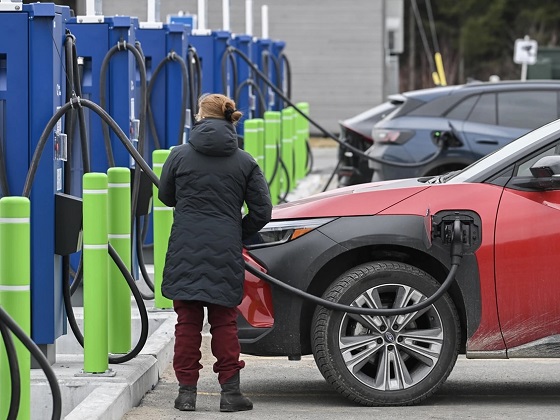
Barry Penner doesn’t posture – he brings evidence. And lately, the evidence has been catching up fast to what he’s been saying for months.
Penner, chair of the Energy Futures Institute and a former B.C. environment minister and attorney-general, walked me through polling that showed a decisive pattern: declining support for electric-vehicle mandates, rising opposition, and growing intensity among those pushing back.
That was before the political landscape started shifting beneath our feet.
In the weeks since our conversation, the B.C. government has begun retreating from its hardline EV stance, softening requirements and signalling more flexibility. At the same time, Ottawa has opened the door to revising its own rules, acknowledging what the market and motorists have been signalling for some time.
Penner didn’t need insider whispers to see this coming. He had the data.

Barry Penner, Chair of the Energy Futures Institute
B.C.’s mandate remains the most aggressive in North America: 26 per cent ZEV sales by 2026, 90 per cent by 2030, and 100 per cent by 2035. Yet recent sales paint a different picture. Only 13 per cent of new vehicles sold in June were electric. “Which means 87 per cent weren’t,” Penner notes. “People had the option. And 87 per cent chose a non-electric.”
Meanwhile, Quebec has already adjusted its mandate to give partial credit for hybrids. Polling shows 76 per cent of British Columbians want the same. The trouble? “There’s a long waiting list to get one,” Penner says.
Cost, charging access and range remain the top barriers for consumers. And with rebates shrinking or disappearing altogether, the gap between policy ambition and practical reality is now impossible for governments to ignore.
Penner’s advice is simple, and increasingly unavoidable: “Recognition of reality is in order.”
- Now watch Barry Penner’s full video interview with Stewart Muir on Power Struggle here:

From LifeSiteNews
By Matt Lamb
Chevrolet’s new Christmas ad portrays the ups and downs of family life and the fun of parenting.
Car company Chevrolet launched its Christmas ad campaign with a beautiful commercial that highlights the messiness of raising kids while championing the value of having a family.
The ad, titled “Memory Lane,” shows a middle-aged married couple loading up their decades-old Chevy Suburban with food to head off to a family dinner. At this point, the ad switches between the couple in the present day and grainy, recorder-quality video of family memories.
It begins with a young family, including a baby, loading up into the same car. As the couple begins to drive, the wife and mom is reminiscing. The husband asks her not to “keep all the good stuff” to herself.
From there, the ad reflects on the ups and downs of the family’s life, including memories of mistakenly tying a Christmas tree to the car door and comforting their college-aged daughter about a break-up. As the couple pulls up to a house at the end of their trip, the wife turns to her husband and says: “They never made it easy, did they?”
“Did you want it to be easy?” he replies.
“No, I wanted it to be just like it was,” she says, before they exit the car to meet family, including a grandchild and a new dog that looks like their old dog.
“The greatest journey is the one we take together,” the ad ends.
Commercial accurately portrays that family life isn’t easy, but it is fun
Anyone who has kids knows that it is not always easy raising them, but it is enjoyable. They scream, they cause messes, they wake you up in the middle of the night. And that’s just before they turn five years old. It only gets more enjoyable, and more difficult, as they age (from what I can tell).
Even if you do not have kids, you can probably remember your own life and think about the ways you caused your parents headaches (getting a bad grade in a class or breaking the curfew), but also the ways you brought them joy (graduating from college, joining the military, or getting married).
The truth is that families are messy, and no one is guaranteed an easy life. But the important thing is to persevere by sticking together.
Another thing that stuck out is that both parents remained married throughout their life and are celebrating Christmas with both of their children.
One of the kids did not avoid Christmas because dad voted for Trump or because mom has strongly held religious beliefs – something that does happen to the glee (and detriment) of leftist writers. The entire family, not just those who perfectly agree with each other, were together for the holidays. In fact, this is one way we honor our father and mother, by getting together over the holidays and at other family gatherings.
As a parent myself, I sometimes wish it would be “easy,” but the truth is the ups and downs are what make it enjoyable.
Thank you to Chevy for reminding me, and other parents, of this lesson.



From Underdog to Top Broodmare

Landmark 2025 Study Says Near-Death Experiences Can’t Be Explained Away

STUDY: TikTok, Instagram, and YouTube Shorts Induce Measurable “Brain Rot”
Blacked-Out Democracy: The Stellantis Deal Ottawa Won’t Show Its Own MPs
-
 National2 days ago
Media bound to pay the price for selling their freedom to (selectively) offend
-
 C2C Journal2 days ago
Learning the Truth about “Children’s Graves” and Residential Schools is More Important than Ever
-
 Business2 days ago
Is there a cure for Alzheimer’s Disease?
-
 Bruce Dowbiggin2 days ago
Sometimes An Ingrate Nation Pt. 2: The Great One Makes His Choice
-
 Alberta2 days ago
New era of police accountability
-
 Brownstone Institute2 days ago
The Unmasking of Vaccine Science
-
 Alberta2 days ago
Emissions Reduction Alberta offering financial boost for the next transformative drilling idea
-
 Business1 day ago
Recent price declines don’t solve Toronto’s housing affordability crisis