
Connect with us

Energy

Unleashing American Energy: America’s Silver Bullet

Published

9 minute read

It’s said that in politics there’s no silver bullet that’ll make everything better.

But we do have 1 silver bullet in the chamber: the opportunity to unleash American energy, which Donald Trump has rightly vowed to do.

  • The single most important thing government can do to make our lives better—something that will lead to a better economy, a lower cost of living, more job opportunities, a lower deficit, greater security, and a better environment—is unleash abundant, affordable, American energy.
  • If we unleash abundant, affordable, American oil, natural gas, and coal production from the anti-energy policies holding it back, we can go from crippling inflation—substantially driven by energy costs—to affordable food, housing, transportation, and heating bills.
  • Unleashing American energy will take us from nationwide electricity shortages to affordable, reliable power for all—and from losing good job opportunities to China, which we’ve allowed to outcompete us on energy costs, to creating millions of new well-paying jobs here at home.
  • Unleashing American energy will take us from begging OPEC+ for oil, depending on Russia for uranium, and being at China’s mercy for critical minerals, to producing an abundant and secure supply of these crucial commodities at home.
  • Many Americans are hesitant to embrace policies that unleash abundant, affordable energy because they think it will harm environmental progress—progress in air and water quality, safety from climate, and enjoyment of nature. Nothing could be further from the truth.
  • Environmental progress isn’t in conflict with abundant, affordable energy; it requires abundant, affordable energy—to afford pollution controls, to clean up natural environmental hazards, and to protect ourselves from the always-dynamic and dangerous climate.
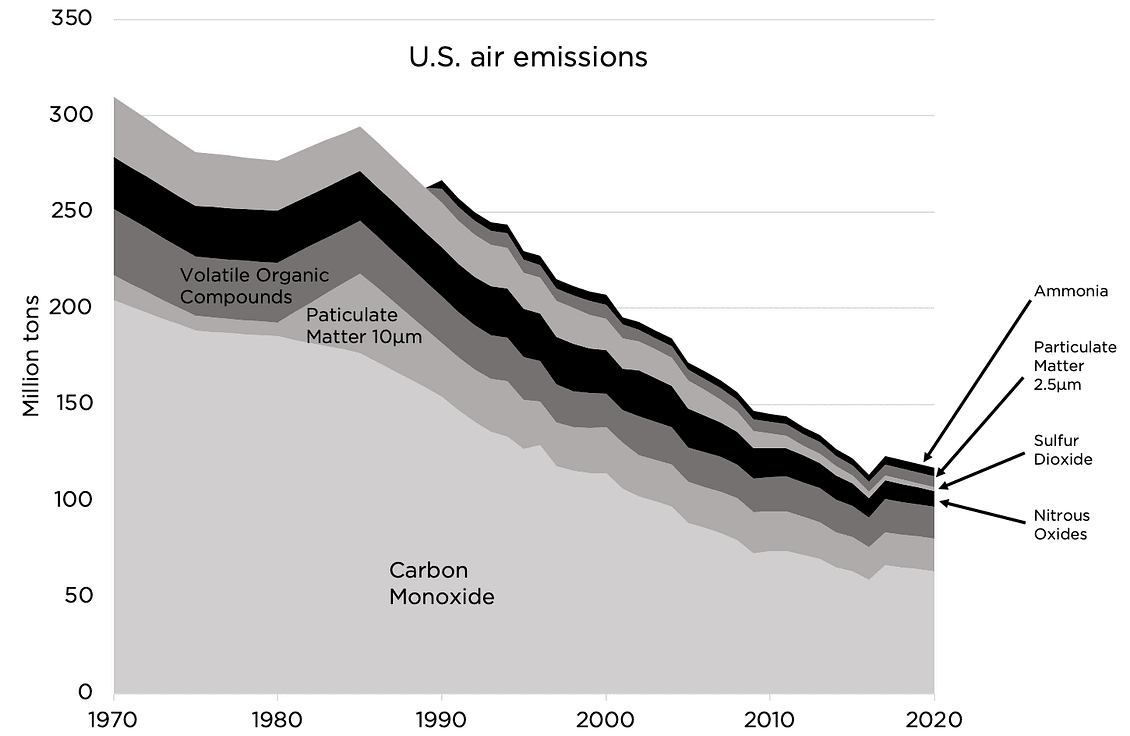
  • Thanks to abundant, affordable energy, America has been wealthy enough to innovate and adopt pollution controls that make our air far cleaner—which is why America was able to increase its fossil fuel use 25% since 1970 while reducing air pollution 78%.¹
  • Thanks to abundant, affordable energy, America has been able to clean up natural environmental hazards such as undrinkable water, which requires affordable, reliable energy to purify, or mosquito-infested swamps, which require abundant, affordable energy to drain.
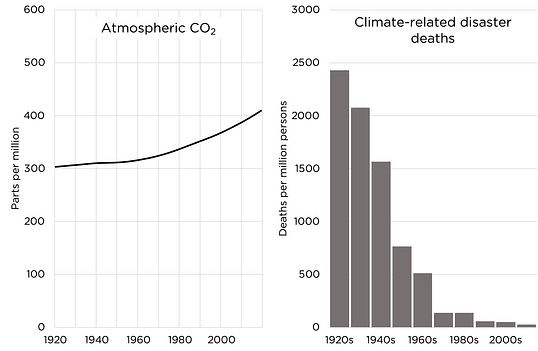
  • Thanks to abundant, affordable energy, we can protect ourselves from the always-dangerous climate by powering heating and A/C systems, storm warning and evacuation systems, and irrigation systems; witness the 98% drop in climate-related disaster deaths over the last century.²
  • Thanks to abundant, affordable energy we have the wealth we need to enjoy and preserve the most valuable and beautiful parts of nature—which is why America is able to be both the world’s economic superpower and a place of unsurpassed access to the great outdoors.
  • The key to supporting America’s energy abundance and environmental progress is maintaining steadfast support of individual and economic freedom, including the protection of property rights.
  • Property rights allow our energy companies to produce and innovate as they judge best. The shale revolution happened here because we alone protect underground property rights. Producers used this freedom to figure out how to extract abundant oil and gas from once-useless rocks.
  • Property rights allow us to care for our environment on our own property—and people tend to care best for what they own. And property rights are the basis for laws protecting our air and water from dangerous levels of pollution.
  • America has shown time and again that pro-freedom energy and environmental policies drive energy and environmental progress. And we can do it again, if we reverse the anti-freedom policies of the past several decades and embrace the following “energy freedom” policies.
  • To aid America in unleashing American energy, I’ve created the Energy Freedom Plan—a comprehensive plan that includes hundreds of high-leverage policy changes for every aspect of energy, from drilling to pipelines to electricity to nuclear to rare earth elements.
  • The Energy Freedom Plan is based on 5 game-changing goals:
    1. Unleash responsible development
    2. End preferences for unreliable electricity
    3. Set environmental standards using cost-benefit analysis
    4. Address climate danger through resilience and innovation
    5. Unleash nuclear energy
  • Unleash responsible development

    Anti-development policies prevent the drilling, mining, transporting, and building all energy needs to reach its potential—from natural gas to nuclear to solar.

    Liberating responsible development will create unprecedented US energy abundance.

  • End preferences for unreliable electricity

    Our grid is being ruined by systemic preferences for unreliable electricity, which cause prices to rise and reliability to decline.

    Ending these preferences and prioritizing reliability is needed to make power cheap and reliable again.

  • Set environmental standards using cost-benefit analysis

    The EPA harms prosperity and health via emissions standards that impose huge costs for little or no benefit.

    Real cost-benefit analysis, including objective health science will promote prosperity and environmental quality.

  • Address climate danger through resilience and innovation, not punishing America

    “Climate policy”” that singles out US emissions makes us poorer and less resilient while global emissions go up.

    Becoming more resilient and unleashing innovation are the keys to climate safety.

  • Unleash nuclear energy from pseudo-scientific restrictions

    The strangulation of nuclear has made it 10 times more expensive than it needs to be.

    Unleashing nuclear, including getting rid of pseudoscientific policies like LNT and ALARA, will make possible a nuclear renaissance.

  • This week I will be releasing the FULL Energy Freedom Plan, including over 100 SPECIFIC game-changing policies that can unleash American energy like never before.

    To make sure you see the whole plan, follow me @AlexEpstein and especially subscribe to alexepstein.substack.com.

Share

Questions about this article? Ask AlexAI, my chatbot for energy and climate answers:

Try AlexAI for free


Popular links


“Energy Talking Points by Alex Epstein” is my free Substack newsletter designed to give as many people as possible access to concise, powerful, well-referenced talking points on the latest energy, environmental, and climate issues from a pro-human, pro-energy perspective.

Share Energy Talking Points by Alex Epstein

UC San Diego – The Keeling Curve

For every million people on earth, annual deaths from climate-related causes (extreme temperature, drought, flood, storms, wildfires) declined 98%–from an average of 247 per year during the 1920s to 2.5 per year during the 2010s.

Data on disaster deaths come from EM-DAT, CRED / UCLouvain, Brussels, Belgium – www.emdat.be (D. Guha-Sapir).

Population estimates for the 1920s from the Maddison Database 2010, the Groningen Growth and Development Centre, Faculty of Economics and Business at University of Groningen. For years not shown, population is assumed to have grown at a steady rate.

Population estimates for the 2010s come from World Bank Data.

Todayville is a digital media and technology company. We profile unique stories and events in our community. Register and promote your community event for free.

Follow Author

Business

Canada’s future prosperity runs through the northwest coast

Published on

Prince Rupert Port Authority CEO Shaun Stevenson. Photo courtesy Prince Rupert Port Authority

From the Canadian Energy Centre

By Deborah Jaremko

A strategic gateway to the world

Tucked into the north coast of B.C. is the deepest natural harbour in North America and the port with the shortest travel times to Asia.

With growing capacity for exports including agricultural products, lumber, plastic pellets, propane and butane, it’s no wonder the Port of Prince Rupert often comes up as a potential new global gateway for oil from Alberta, said CEO Shaun Stevenson.

Thanks to its location and natural advantages, the port can efficiently move a wide range of commodities, he said.

That could include oil, if not for the federal tanker ban in northern B.C.’s coastal waters.

The Port of Prince Rupert on the north coast of British Columbia. Photo courtesy Prince Rupert Port Authority

“Notwithstanding the moratorium that was put in place, when you look at the attributes of the Port of Prince Rupert, there’s arguably no safer place in Canada to do it,” Stevenson said.

“I think that speaks to the need to build trust and confidence that it can be done safely, with protection of environmental risks. You can’t talk about the economic opportunity before you address safety and environmental protection.”

Safe Transit at Prince Rupert

About a 16-hour drive from Vancouver, the Port of Prince Rupert’s terminals are one to two sailing days closer to Asia than other West Coast ports.

The entrance to the inner harbour is wider than the length of three Canadian football fields.

The water is 35 metres deep — about the height of a 10-storey building — compared to 22 metres at Los Angeles and 16 metres at Seattle.

Shipmasters spend two hours navigating into the port with local pilot guides, compared to four hours at Vancouver and eight at Seattle.

“We’ve got wide open, very simple shipping lanes. It’s not moving through complex navigational channels into the site,” Stevenson said.

A Port on the Rise

The Prince Rupert Port Authority says it has entered a new era of expansion, strengthening Canada’s economic security.

The port estimates it anchors about $60 billion of Canada’s annual global trade today. Even without adding oil exports, Stevenson said that figure could grow to $100 billion.

“We need better access to the huge and growing Asian market,” said Heather Exner-Pirot, director of energy, natural resources and environment at the Macdonald-Laurier Institute.

“Prince Rupert seems purpose-built for that.”

Roughly $3 billion in new infrastructure is already taking shape, including the $750 million rail-to-container CANXPORT transloading complex for bulk commodities like specialty agricultural products, lumber and plastic pellets.

The Ridley Island Propane Export Terminal, Canada’s first marine propane export terminal, started shipping in May 2019. Photo courtesy AltaGas Ltd.

Canadian Propane Goes Global

A centrepiece of new development is the $1.35-billion Ridley Energy Export Facility — the port’s third propane terminal since 2019.

“Prince Rupert is already emerging as a globally significant gateway for propane exports to Asia,” Exner-Pirot said.

Thanks to shipments from Prince Rupert, Canadian propane – primarily from Alberta – has gone global, no longer confined to U.S. markets.

More than 45 per cent of Canada’s propane exports now reach destinations outside the United States, according to the Canada Energy Regulator.

“Twenty-five per cent of Japan’s propane imports come through Prince Rupert, and just shy of 15 per cent of Korea’s imports. It’s created a lift on every barrel produced in Western Canada,” Stevenson said.

“When we look at natural gas liquids, propane and butane, we think there’s an opportunity for Canada via Prince Rupert becoming the trading benchmark for the Asia-Pacific region.”

That would give Canadian production an enduring competitive advantage when serving key markets in Asia, he said.

Deep Connection to Alberta

The Port of Prince Rupert has been a key export hub for Alberta commodities for more than four decades.

Through the Alberta Heritage Savings Trust Fund, the province invested $134 million — roughly half the total cost — to build the Prince Rupert Grain Terminal, which opened in 1985.

The largest grain terminal on the West Coast, it primarily handles wheat, barley, and canola from the prairies.

The Prince Rupert Grain Terminal. Photo courtesy Prince Rupert Port Authority

Today, the connection to Alberta remains strong.

In 2022, $3.8 billion worth of Alberta exports — mainly propane, agricultural products and wood pulp — were shipped through the Port of Prince Rupert, according to the province’s Ministry of Transportation and Economic Corridors.

In 2024, Alberta awarded a $250,000 grant to the Prince Rupert Port Authority to lead discussions on expanding transportation links with the province’s Industrial Heartland region near Edmonton.

Handling Some of the World’s Biggest Vessels

The Port of Prince Rupert could safely handle oil tankers, including Very Large Crude Carriers (VLCCs), Stevenson said.

“We would have the capacity both in water depth and access and egress to the port that could handle Aframax, Suezmax and even VLCCs,” he said.

“We don’t have terminal capacity to handle oil at this point, but there’s certainly terminal capacities within the port complex that could be either expanded or diversified in their capability.”

Market Access Lessons From TMX

Like propane, Canada’s oil exports have gained traction in Asia, thanks to the expanded Trans Mountain pipeline and the Westridge Marine Terminal near Vancouver — about 1,600 kilometres south of Prince Rupert, where there is no oil tanker ban.

The Trans Mountain expansion project included the largest expansion of ocean oil spill response in Canadian history, doubling capacity of the West Coast Marine Response Corporation.

The K.J. Gardner is the largest-ever spill response vessel in Canada. Photo courtesy Western Canada Marine Response Corporation

The Canada Energy Regulator (CER) reports that Canadian oil exports to Asia more than tripled after the expanded pipeline and terminal went into service in May 2024.

As a result, the price for Canadian oil has gone up.

The gap between Western Canadian Select (WCS) and West Texas Intermediate (WTI) has narrowed to about $12 per barrel this year, compared to $19 per barrel in 2023, according to GLJ Petroleum Consultants.

Each additional dollar earned per barrel adds about $280 million in annual government royalties and tax revenues, according to economist Peter Tertzakian.

The Road Ahead

There are likely several potential sites for a new West Coast oil terminal, Stevenson said.

“A pipeline is going to find its way to tidewater based upon the safest and most efficient route,” he said.

“The terminal part is relatively straightforward, whether it’s in Prince Rupert or somewhere else.”

Under Canada’s Marine Act, the Port of Prince Rupert’s mandate is to enable trade, Stevenson said.

“If Canada’s trade objectives include moving oil off the West Coast, we’re here to enable it, presuming that the project has a mandate,” he said.

“If we see the basis of a project like this, we would ensure that it’s done to the best possible standard.”

Continue Reading

Alberta

Emissions Reduction Alberta offering financial boost for the next transformative drilling idea

Published on

From the Canadian Energy Centre

$35-million Alberta challenge targets next-gen drilling opportunities

‘All transformative ideas are really eligible’

Forget the old image of a straight vertical oil and gas well.

In Western Canada, engineers now steer wells for kilometres underground with remarkable precision, tapping vast energy resources from a single spot on the surface.

The sector is continually evolving as operators pursue next-generation drilling technologies that lower costs while opening new opportunities and reducing environmental impacts.

But many promising innovations never reach the market because of high development costs and limited opportunities for real-world testing, according to Emissions Reduction Alberta (ERA).

That’s why ERA is launching the Drilling Technology Challenge, which will invest up to $35 million to advance new drilling and subsurface technologies.

“The focus isn’t just on drilling, it’s about building our future economy, helping reduce emissions, creating new industries and making sure we remain a responsible leader in energy development for decades to come,” said ERA CEO Justin Riemer.

And it’s not just about oil and gas. ERA says emerging technologies can unlock new resource opportunities such as geothermal energy, deep geological CO₂ storage and critical minerals extraction.

“Alberta’s wealth comes from our natural resources, most of which are extracted through drilling and other subsurface technologies,” said Gurpreet Lail, CEO of Enserva, which represents energy service companies.

ERA funding for the challenge will range from $250,000 to $8 million per project.

Eligible technologies include advanced drilling systems, downhole tools and sensors; AI-enabled automation and optimization; low-impact rigs and fluids; geothermal and critical mineral drilling applications; and supporting infrastructure like mobile labs and simulation platforms.

“All transformative ideas are really eligible for this call,” Riemer said, noting that AI-based technologies are likely to play a growing role.

“I think what we’re seeing is that the wells of the future are going to be guided by smart sensors and real-time data. You’re going to have a lot of AI-driven controls that help operators make instant decisions and avoid problems.”

Applications for the Drilling Technology Challenge close January 29, 2026.

Continue Reading

Trending

X