
International
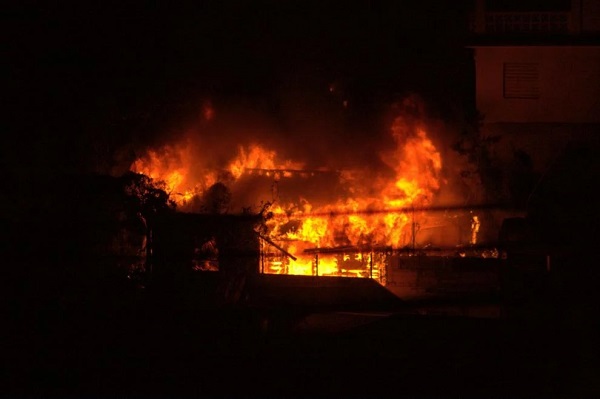
Two major fires continue to burn in SoCal

From The Center Square
Santa Ana winds to pick up Tuesday morning
As two major fires continue to burn in and near Los Angeles, fire officials warn that major Santa Ana winds are expected to return early Tuesday morning, extending red flag warnings.
As of midday Monday, 26 individuals have died from the fires. Many died because they refused to evacuate their homes, according to fire officials. Gov. Gavin Newsom has deployed a second round of national guard members to assist law enforcement in evacuations and prevent looting of evacuated areas.
“The men and women of the California National Guard have been on the ground since day one – not only fighting fires, but also assisting with public safety efforts in communities devastated by these fires,” a statement from Newsom reads.
As of Monday morning, the fire that began in the Pacific Palisades last week has grown to 23,713 acres with 14% containment and 5,123 firefighters working to contain the fire. Additionally, there are 44 helicopters, 540 engines, 66 dozers, 60 water tenders and 115 crews.
Evacuation zones reach east toward Sherman Oaks and south toward Santa Monica. There remains a mandated curfew in these areas from 6 p.m. to 6 a.m. and a “Do Not Drink” notice to Pacific Palisades zip codes and surrounding areas due to the potential of pollutant contamination of the water because of the fire.
The Palisades fire is the most destructive wildfire Los Angeles has ever seen with thousands of structures burning to the ground and tens of thousands of people forced to evacuate.
The other major fire is the Eaton Fire, which also began last week in Eaton Canyon right outside of Pasadena. The fire has grown to 14,117 acres at 33% containment and is spreading into the Los Angeles National Forest, which remains closed. There are hundreds of structures destroyed and thousands of people who have been forced to evacuate. Areas in Altadena and Pasadena near the fire and evacuation zones are under a “Do Not Drink” order and all schools in the Pasadena Unified School District remain closed.
There are currently 3,408 personnel fighting the fire with both air and ground support.
Officials have also issued an air quality warning for the City of Los Angeles and those living in surrounding areas. The pollutants in the air are specifically dangerous, according to officials, because of the structures being burned, including old ones that contain harmful materials such as asbestos.

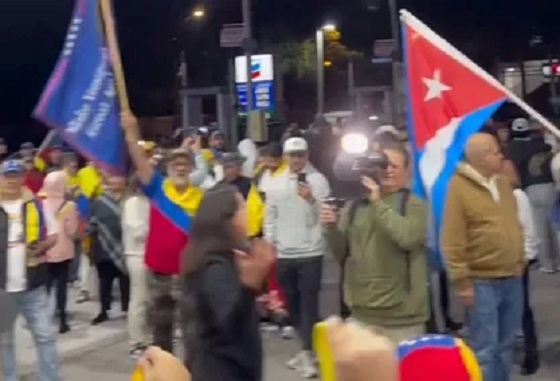

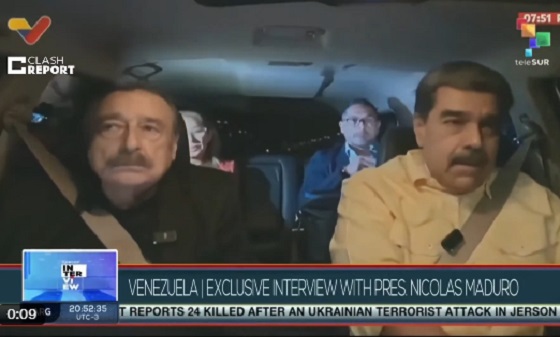
Celebrations broke out across South Florida Saturday as news spread that Venezuela’s longtime socialist strongman Nicolás Maduro had been captured and removed from power, a moment many Venezuelan exiles said they had waited their entire lives to see. In Doral, hundreds gathered outside the El Arepazo restaurant before sunrise, waving flags, embracing strangers, and reacting emotionally to what they described as a turning point for their homeland. Local television footage captured chants, tears, and spontaneous celebrations as word filtered through the community that Maduro and his wife had been “captured and flown out of the country” following U.S. military action announced by Donald Trump earlier that morning.
Venezuelans gathered early this morning in Doral to celebrate after news broke that the U.S. had captured Nicolás Maduro🇻🇪| #ONLYinDADE pic.twitter.com/mSNaF3IhR3
— ONLY in DADE (@ONLYinDADE) January 3, 2026
One young man, Edgar, spoke directly to reporters as the crowd surged behind him, calling the moment “history in the making.” He said his family had spent decades telling him stories about a Venezuela that once had real elections and basic freedoms. “My chest feels like it’s going to explode with joy,” he said, explaining that the struggle against the regime began long before he was born. Edgar thanked President Trump for allowing Venezuelans to work and rebuild their lives in the United States, adding that now, for the first time, he believed they could take those skills back home.
Similar scenes played out beyond Florida. Video circulating online showed Venezuelans celebrating in Chile and other parts of Latin America, reflecting the regional impact of Maduro’s fall. The dictator had clung to power through what U.S. officials and international observers have long described as sham elections, while presiding over economic collapse, mass emigration, and deepening ties to transnational criminal networks. U.S. authorities have pursued him for years, placing a $50 million bounty on information leading to his arrest or conviction. Federal prosecutors accused Maduro in 2020 of being a central figure in the so-called Cartel of the Suns, an international cocaine trafficking operation allegedly run by senior members of the Venezuelan regime and aimed, in prosecutors’ words, at flooding the United States with drugs.
After the overnight strikes, Venezuela’s remaining regime figures declared a state of emergency, even as images of celebration dominated social media abroad. In Washington, reaction from Florida lawmakers was swift. Rep. Carlos Gimenez, who represents a district with large Venezuelan, Cuban, and Nicaraguan exile communities, compared Maduro’s capture to one of the defining moments of the 20th century. “President Trump has changed the course of history in our hemisphere,” Gimenez wrote, calling the operation “this hemisphere’s equivalent to the Fall of the Berlin Wall.” He added that South Florida’s exile communities were “overwhelmed with emotion and hope,” and thanked U.S. service members for what he described as a decisive and successful mission.
For many gathered in Doral, the reaction was deeply personal. A CBS Miami reporter relayed comments from attendees who said they now felt safer about the possibility of returning to Venezuela to see family members they had not hugged in years. One man described it as the end of “26 years of waiting” for a free country, saying the moment felt less like politics and more like the closing of a long, painful chapter.
U.S. Attorney General Pam Bondi confirmed Saturday that Maduro and his wife have been formally indicted in the Southern District of New York. Bondi said the charges include narco-terrorism conspiracy, cocaine importation conspiracy, and weapons offenses involving machine guns and destructive devices. For Venezuelan Americans packed into South Florida streets, those legal details mattered less than the symbolism. After years of watching their country unravel from afar, many said they finally felt something unfamiliar when they looked south — relief, and the cautious hope that Venezuela’s future might no longer be written by a dictator.
Daily Caller
Scathing Indictment Claims Nicolás Maduro Orchestrated Drug-Fueled ‘Culture Of Corruption’ Which Plagued Entire Region

From the Daily Caller News Foundation
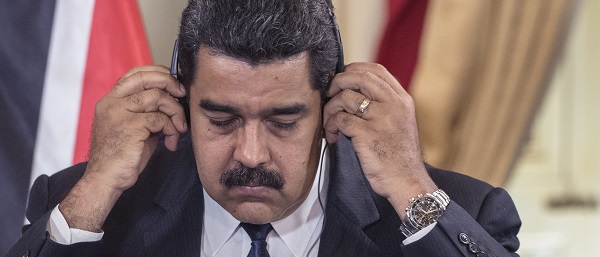
Ousted socialist Venezuelan dictator Nicolás Maduro was the mastermind of a pervasive drug-fueled “culture of corruption” which extended all the way to the U.S.’s backyard, according to the scathing indictment against him, his wife, his son, and others, released Saturday.
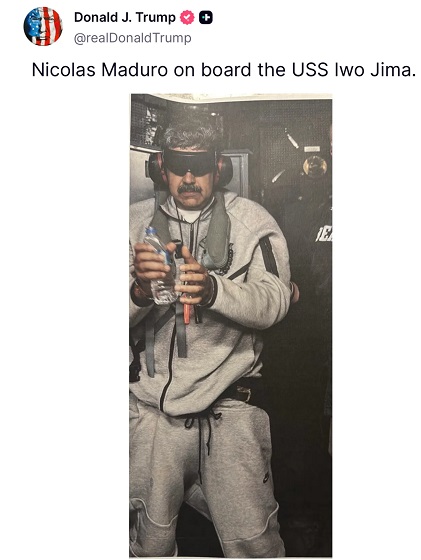
Hours after President Donald Trump announced Maduro’s capture and removal from power, Attorney General Pam Bondi confirmed the deposed despot and his wife, Cilia Flores, were indicted in the Southern District of New York on four charges, including narco-terrorism conspiracy, and “will soon face the full wrath of American justice” on U.S. soil. A grand jury found Maduro “and corrupt members of his regime enabled corruption fueled by drug trafficking throughout” the Latin American region, including in Mexico and Central America, and empowered notorious crime syndicates such as Tren de Aragua (TdA), according to the unsealed indictment.
Signed by Trump-appointed U.S. Attorney Jay Clayton, the 25-page indictment names six defendants, including the deposed Maduro, Flores, and Maduro’s 35-year-old son from his first marriage, Nicolás “Nicolasito” Maduro Guerra. It also names as defendants TdA leader Niño Guerrero and two high-profile members of Maduro’s United Socialist Party, Diosdado Cabello Rondón and Ramón Rodríguez Chacín.
Dear Readers:
As a nonprofit, we are dependent on the generosity of our readers.
Please consider making a small donation of any amount here.
Thank you!
Maduro, “like former President [Hugo] Chávez before him[,] participates in, perpetuates, and protects a culture of corruption in which powerful Venezuelan elites enrich themselves through drug trafficking and the protection of their partner drug traffickers,” the indictment alleges. “The profits of that illegal activity flow to corrupt rank-and-file civilian, military, and intelligence officials, who operate in a patronage system run by those at the top-referred to as the Cartel de Los Soles or Cartel of the Suns, a reference to the sun insignia affixed to the uniforms of high-ranking Venezuelan military officials.”
The Trump administration’s State Department announced it was designating the Cartel de Los Soles as a Foreign Terrorist Organization (FTO) in November 2025. Secretary of State Marco Rubio wrote in a statement at the time the cartel “is headed by Nicolás Maduro and other high-ranking individuals of the illegitimate Maduro regime who have corrupted Venezuela’s military, intelligence, legislature, and judiciary.”
The indictment also notes the South American nation “sits in a geographically valuable location for drug traffickers” and that, around the time Chávez came to power in 1999, “Venezuela became a safe haven” for them.
“In that environment, cocaine trafficking flourished,” the indictment continues, citing State Department estimates from arund 2020, with between 200 and 250 tons of the drug being trafficked through the country each year.
The charging document goes on to allege Maduro, his wife, son, and political allies had “partnered with narcotics traffickers and narco-terrorist groups, who dispatched processed cocaine from Venezuela to the United States via transshipment points in the Caribbean and Central America, such as Honduras, Guatemala, and Mexico.”
“Through this drug trafficking, [Maduro] and corrupt members of his regime enabled corruption fueled by drug trafficking throughout the region,” the indictment continues. “The transshipment points in Honduras, Guatemala, and Mexico similarly relied on a culture of corruption, in which cocaine traffickers operating in those countries paid a portion of their own profits to politicians who protected and aided them. In turn, these politicians used the cocaine-fueled payments to maintain and augment their political power.”
Maduro and his regime also “facilitated the empowerment and growth of violent narco-terrorist groups fueling their organizations with cocaine profits,” according to the indictment.
The charging document notably identifies organizations which collaborated with the Maduro regime: Colombian communist militant groups Revolutionary Armed Forces of Colombia (FARC) and National Liberation Army (ELN); Mexican syndicates the Sinaloa Cartel and Los Zetas; and Guerrero’s TdA.
The indictment also alleges Maduro Guerra, the captured dictator’s son, personally “worked to ship hundreds of kilograms of cocaine from Venezuela to Miami, Florida” around the year 2017. Maduro Guerra is a member of his father’s political party and served as a Deputy to the Venezuelan National Assembly since 2021.
“During this time, MADURO GUERRA spoke with his drug trafficking partners about, among other things, shipping low-quality cocaine to New York because it could not be sold in Miami, arranging a 500-kilogram shipment of cocaine to be unloaded from a cargo container near Miami, and using scrap metal containers to smuggle cocaine into the ports of New York,” the document reads.
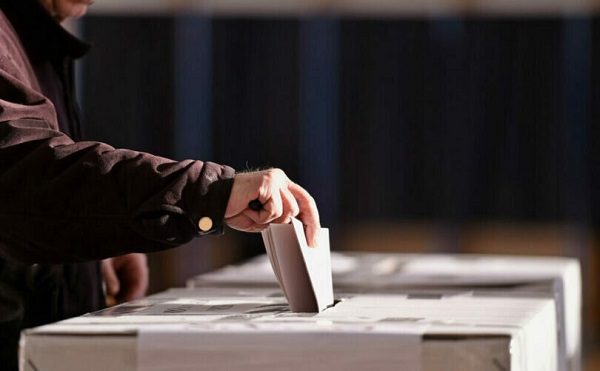
Georgia county admits illegally certifying 315k ballots in 2020 presidential election
Alberta project would be “the biggest carbon capture and storage project in the world”
Canada’s debate on energy levelled up in 2025

Why Japan wants Western Canadian LNG
-
 International1 day ago
“Captured and flown out”: Trump announces dramatic capture of Maduro
-
 International1 day ago
Trump Says U.S. Strike Captured Nicolás Maduro and Wife Cilia Flores; Bondi Says Couple Possessed Machine Guns
-
Energy1 day ago
The U.S. Just Removed a Dictator and Canada is Collateral Damage
-
 International1 day ago
US Justice Department Accusing Maduro’s Inner Circle of a Narco-State Conspiracy
-
 Haultain Research1 day ago
Trying to Defend Maduro’s Legitimacy
-
 Business1 day ago
Vacant Somali Daycares In Viral Videos Are Also Linked To $300 Million ‘Feeding Our Future’ Fraud
-
 Daily Caller17 hours ago
Trump Says US Going To Run Venezuela After Nabbing Maduro
-
International1 day ago
U.S. Claims Western Hemispheric Domination, Denies Russia Security Interests On Its Own Border