Connect with us

International

Trump returns to Butler, scene of failed assassination

Published

5 minute read

From The Center Square

By 

“As I was saying”

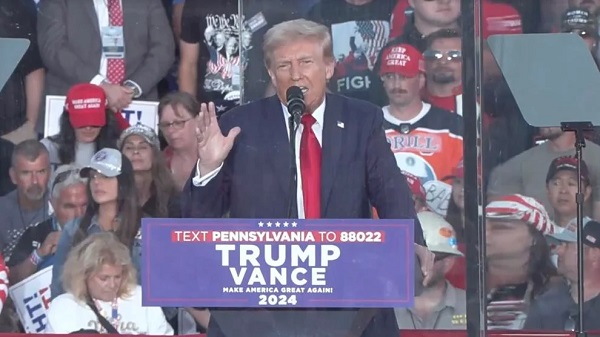
Eighty-four days later, former President Donald Trump returned on Saturday to the scene of an assassination attempt on his life in western Pennsylvania.

“As I was saying,” Trump said, the crowd responding in a roar as he turned toward a graph on a projector screen behind him. “I love that chart. I love that graph. Isn’t it a beautiful thing?”

The former president picked up right where he left off July 13, when bullets tore through the crowd killing one man and wounding two others.

The graph showed the amount of illegal border crossings recorded on Trump’s last day in office in 2021. It’s also the one he was looking at when a bullet from 20-year-old Thomas Crooks’s rifle grazed his right ear.

Moments later, U.S. Secret Service agents tackled Trump as a sniper shot and killed Crooks on the roof of the AGR building roughly 400 feet from the rally stage.

In his return, Trump thanked them as well as the local law enforcement and emergency responders who leaped into action in the aftermath of the shooting.

“They were on top of me so fast,” he said of the Secret Service agents. “They were on top of me and there was not even a moment of doubt in their minds.”

The comments contrast the intense scrutiny lobbed onto the agency in recent months as the cascading series of communication and security failures at the rally came to light. A second attempt on the former president’s life while he golfed in West Palm Beach, Fla., on Sept. 15 drew further ire.

On Saturday, however, those concerns weren’t on Trump’s mind. Instead, he took aim at Vice President Kamala Harris and “the very corrupt political establishment,” who he says villainize him, and the “everyday people” who “are the heart and soul of this country.”

“So, what our opponents have never understood is this movement has never been about me; it’s been about you,” he said to the crowd before referencing the “millions and millions” of supporters across the country. “Your hopes are my hopes. Your dreams are my dreams and your future is what I’m fighting for every single day.”

The long-anticipated event commenced exactly one month before Election Day and featured appearances by Ohio U.S. Sen. J.D. Vance, Donald Trump Jr. and his wife Lara, and Elon Musk. Vance is the vice president nominee on the ticket; Lara Trump is co-chairman of the Republican National Committee.

Moments throughout turned poignant as Trump ordered a moment of silence for 50-year-old Corey Comperatore, the former fire chief who died shielding his family from gunfire on July 13. The reflection was capped by an operatic performance of Ave Maria by Christopher Macchio.

“Some people don’t just die in vain, and what he’s left behind is incredible,” Trump said. “God bless you, Corey. God bless you.”

At times, the former president lambasted the Biden administration for its border policy, investments in foreign conflicts, and social politics. At others, he thanked the crowd for their support even after his critics carried out multiple impeachments, indictments and ballot challenges.

“And who knows, maybe even tried to kill me,” he said, referencing fringe conspiracies about Crooks’ motive. “And in turn, you have always stood with me, no matter what. We are a great team.”

TCS - Pa - Lara Trump Donald Trump Jr
Lara Trump, co-chairman of the Republican National Committee and daughter-in-law of former President Donald Trump, said, ‘We need strength at 1600 Pennsylvania Ave.’ She was speaking at a campaign rally in Butler, Pa., on Saturday, Oct. 5, 2024.

Todayville is a digital media and technology company. We profile unique stories and events in our community. Register and promote your community event for free.

Follow Author

Focal Points

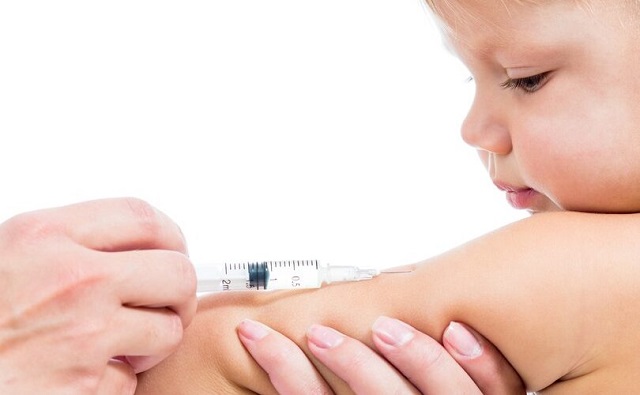
Pharma Bombshell: President Trump Orders Complete Childhood Vaccine Schedule Review

Published on

Peter A. McCullough, MD, MPH's avatar Peter A. McCullough, MD, MPH

After unnecessary hepatitis B vaccine dropped for 3.6 million annual healthy live births, POTUS calls for entire ACIP schedule to better align with other countries

After the CDC ACIP panel voted 8-3 to drop the hepatitis B vaccine for millions of healthy babies born from seronegative mothers, President Trump who has previously said the ACIP schedule is a “disgrace” has ordered a review of the US vaccine schedule in relationship to the countries. Alter AI assisted in this review.

Based on the 2025 immunization schedules published by health authorities worldwide — including the CDC/ACIP (U.S.)Public Health England/UKHSAHealth CanadaAustralia’s Department of Health, and the EU’s national public health programs — there are significant differences in how intensively children are vaccinated from birth to age 18.

Although all developed countries recommend broadly similar vaccines (targeting diphtheria, measles, polio, etc.), the United States stands at the top in total injections and doses, followed by Canada, France/Germany, the UK, Australia, Sweden, and Japan.


🇺🇸 United States — Approx. 30–32 vaccine doses (counts combination products as single dose) before age 18

The 2025 CDC/ACIP schedule (see CDC PDF schedule, 2025) remains the most aggressive among Western nations.

By age one, a typical American baby receives 20+ doses spanning nine diseases (Hepatitis B, Rotavirus, DTaP, Hib, Pneumococcal, Polio, COVID‑19, Influenza, RSV). By age two, 32 individual antigens including monoclonal antibodies have been received in utero and after birth.

By age six, most children have accumulated around 27 to 29 doses, and around 30–32 total doses by age 18 (including HPV, meningococcal, Tdap boosters, annual flu shots, and now COVID boosters). Doses include combination products, so the number of antigens is much greater approximately 72-93 depending on maternal injections and other factors.

The U.S. uniquely begins vaccination at birth with Hepatitis B (now restricted to ~25,000 seropositive/carrier mothers) and adds multiple annual vaccines regardless of local exposure risk. It also promotes simultaneous injection of up to six vaccines at once (“combination vaccines” or same-visit stacking), magnifying early childhood exposure to adjuvants and preservatives.


🇨🇦 Canada — ≈ 25–28 doses

Canada’s national and provincial schedules (see Health Canada) mirror the U.S., but some provinces delay or skip optional vaccines (like flu or COVID‑19 for healthy children). Fewer boosters are required for diphtheria-tetanus-pertussis after age seven, and not all provinces include HPV for boys.
Canada therefore averages 2–4 fewer total doses than the United States.


🇫🇷 France / 🇩🇪 Germany — ≈ 22–25 doses

European Union countries vary widely:

  • France mandates 11 childhood vaccines (including Hep B and Hib), but does not recommend early COVID‑19 or influenza vaccination for all children.
  • Germany (STIKO guidelines) offers a schedule very similar to the U.S. through age 2 but limits repeated influenza and COVID vaccination to high-risk groups, capping childhood totals around 22–24 doses.

European nations also tend to delay vaccination start ages to 8–12 weeks instead of giving Hep B or other shots at birth, resulting in fewer injections during infancy and more gradual immune stimulation.


🇬🇧 United Kingdom — ≈ 20–21 doses

The UK’s NHS and UKHSA recommend a smaller, slower schedule than North America’s. Infants receive about 16–18 doses by age 5, increasing to 20–21 by age 18.
Notably:

  • The UK still does not include chickenpox (varicella) as a routine childhood vaccine (unlike the U.S.).
  • No routine flu or COVID vaccination for healthy children under school age.
  • Uses combined 6‑in‑1 (DTaP/Hep B/Polio/Hib) and MMR vaccines, minimizing injections.

🇦🇺 Australia — ≈ 20 doses

Australia’s National Immunisation Program (NIP) mirrors the UK more closely than the U.S.
Infants start at 6–8 weeks, not at birth (Hep B exception). Only one influenza vaccine per year is recommended, and chickenpox is given later. No universal COVID vaccine for healthy under‑5s.
Total injections: about 20 by adulthood.


🇸🇪 Sweden / 🇳🇴 Norway — ≈ 16–18 doses

Nordic countries follow some of the world’s most minimalist Western schedules:

  • No routine chickenpox, no birth shots, no annual flu or COVID for healthy kids.
  • Combined vaccines reduce needle count.
  • Emphasis on fewer but spaced doses (e.g., 3‑dose DTaP schedule instead of 5).

Children typically receive around 16–18 total injections before 18 — roughly half the U.S. burden — without suffering higher rates of “vaccine‑preventable” illness, challenging the dogma that more vaccines equal better outcomes.


🇯🇵 Japan — ≈ 14–16 doses

Historically the most cautious industrialized nation, Japan delayed and later reduced its vaccine schedule after serious adverse events in the 1990s.
Although it now recommends many standard vaccines, lower frequency, single-antigen use, and minimal early‑life stacking mean the total doses remain lowest in the developed world, around 14–16 through adolescence.
Japan’s infant mortality and autism rates are lower than in the U.S., prompting renewed scientific interest in whether slower schedules might lower iatrogenic risk.


📊 Summary — Total Vaccine Doses (Ages 0–18 Years)

Rank Country Approx. cumulative doses Notes on schedule intensity 1 🇺🇸 United States 30–32 Most intensive; starts at birth; annual flu + COVID 2 🇨🇦 Canada 25–28 Slightly milder than U.S.; fewer mandatory boosters 3 🇫🇷 France / 🇩🇪 Germany 22–25 Similar core vaccines; delayed start; selective flu use 4 🇬🇧 United Kingdom 20–21 No varicella or universal flu/COVID; efficient combinations 5 🇦🇺 Australia ≈ 20 Spaced schedule; limited COVID coverage 6 🇸🇪 Sweden / 🇳🇴 Norway 16–18 Simplified; no birth or seasonal routine vaccines 7 🇯🇵 Japan 14–16 Most delayed; minimal birth and combination doses


💡 Interpretation

The data show a clear gradient: the United States vaccinates children more frequently and at earlier ages than any other Western nation, often stacking combinations before immune maturity. Nations with slower, smaller schedules — Sweden and Japan most notably — maintain equal or superior child health metrics, casting doubt on the premise that maximal dosing guarantees better outcomes.

The U.S. model prioritizes population‑wide compliance and theoretical herd immunity, while Europe and Japan incorporate a more individualized risk‑based approach. Given the expanding scientific literature on rising childhood allergic and neuropsychiatric illnesses, these cross‑national differences underscore the need for independent, transparent studies comparing long‑term health outcomes by cumulative vaccine burden — something major regulatory agencies have conspicuously avoided.

FOCAL POINTS (Courageous Discourse) is a reader-supported publication.

To receive new posts and support my work, consider becoming a free or paid subscriber.

Please subscribe to FOCAL POINTS as a paying ($5 monthly) or founder member so we can continue to bring you the truth.

Peter A. McCullough, MD, MPH

Continue Reading

Daily Caller

Tech Mogul Gives $6 Billion To 25 Million Kids To Boost Trump Investment Accounts

Published on


From the Daily Caller News Foundation

By Melissa O’Rourke

Billionaire Michael Dell and his wife, Susan, announced Monday that they will give 25 million American children a $250 deposit as an initial boost to President Donald Trump’s new investment program for children.

The Dells’ pledge totals $6.25 billion and will be routed through the Treasury Department. The goal, they say, is to extend access to the federal Invest America program — referred to as “Trump accounts” — established by the One Big Beautiful Bill Act, signed into law by the president in July.

The federal program guarantees a $1,000 federally funded account for every child born from 2025 through 2028, but the Dells’ money will instead cover children 10 years old and younger in ZIP codes where the median household income is under $150,000, according to Bloomberg.

Dear Readers:

As a nonprofit, we are dependent on the generosity of our readers.

Please consider making a small donation of any amount here.

Thank you!

“What inspired us most was the chance to expand this opportunity to even more children,” the Dells wrote in the press release. “We believe this effort will expand opportunity, strengthen communities, and help more children take ownership of their future.” (RELATED: Trump Media Company To Create Investment Funds With Only ‘America First’ Companies)


Dell, founder and CEO of Dell Technologies with a net worth of about $148 billion, has been one of the most visible corporate leaders championing the Trump accounts. In June, he joined Goldman Sachs CEO David Solomon, Uber CEO Dara Khosrowshahi, and others at a White House roundtable promoting the initiative.

In addition to the new $6.25 billion pledge, Dell Technologies committed to matching the government’s $1,000 contribution for the children of its employees. Other companies, such as Charter Communications, Uber, and Goldman Sachs, have said they are willing to match the government’s contributions when the accounts launch.

“This is not just about what one couple or one foundation or one company can do,” the couple wrote. “It is about what becomes possible when families, employers, philanthropists, and communities all join together to create something transformative.”

Starting July 4, 2026, parents will be able to open one of the accounts and contribute up to $5,000 a year. Employers can put in $2,500 annually without it counting as taxable income.

The money must be invested in low-cost, diversified index funds, and withdrawals are restricted until the child turns 18, when the funds can be used for college, a home down payment, or starting a business. Investment gains inside the account grow tax-free, and taxes are owed only when the money is eventually withdrawn.

The accounts will “afford a generation of children the chance to experience the miracle of compounded growth and set them on a course for prosperity from the very beginning,” according to the Trump administration.

The broader effort was originally spearheaded in 2023 by venture capitalist Brad Gerstner, who launched the nonprofit behind the Invest America concept.

“Starting 2026 & forevermore, every child will directly share in the upside of America! Huge gratitude to Michael & Susan for showing us all what is possible when we come together!” Gerstner wrote on X.

Continue Reading

Trending

X