
Connect with us

International

Trump in Pennsylvania for first time since assassination attempt

Published

3 minute read

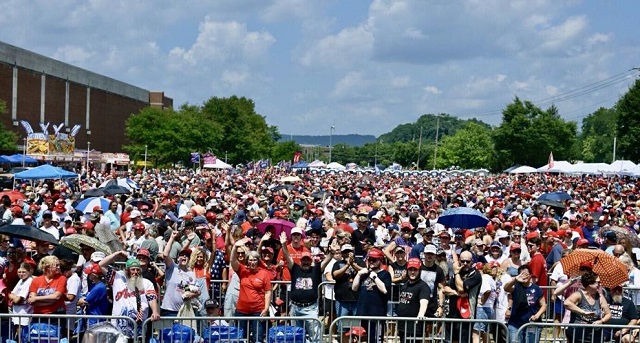
A crowd gathers outside of the Farm Show building in Harrisburg, Pa., ahead of a campaign rally for former President Donald Trump on Wednesday, July 31, 2024.

From The Center Square

By 

Former President Donald Trump on Wednesday appeared in Pennsylvania for the first time since an attempted assassination in Butler on July 13.

He took the stage in a packed auditorium in Harrisburg, where he chided Vice President Kamala Harris, the presumptive Democratic nominee, for shifting her public image and relying on celebrities to draw crowds to her rallies.

“We didn’t need a star,” he said. “We didn’t need some entertainer to fill it up.”

Trump’s comments come 10 days after Harris ascended to the top of the ticket vacated by President Joe Biden via a statement shared on social media.

Since then, delegates across the nation and top Pennsylvania Democrats – including Gov. Josh Shapiro – have thrown support behind the vice president.

The governor himself is on a short list to join Harris as a running mate, along with Arizona Sen. Mark Kelly and Kentucky Gov. Andy Beshear.

One of the nation’s top election forecasters, Nate Silver, said Wednesday – 97 days from Election Day – that Harris’ chances of winning the November election have risen to 43%, “close enough that you could almost get away with calling the race a toss-up, something the Biden-Trump matchup never was.”

A poll conducted from July 20 through July 23 shows Trump holds a 2-percentage point lead over Harris. The vice president, however, is significantly more popular than Biden in the state.

Trump said Wednesday her “personality makeover” shouldn’t distract from her progressive stances on natural gas drilling, immigration, criminal justice and gender politics.

“Don’t forget four weeks ago she was like considered the worst,” he said. “Not smart, terrible, the worst vice president we’ve had in history … and all of sudden she’s the new Margaret Thatcher.

“You’re going to learn. Little things like ‘defund the police,’ that doesn’t work does it? Everything about Kamala Harris rollout, it’s phony and fake,” he added.

During a campaign rally in Montgomery County on Monday, Shapiro and Michigan Gov. Gretchen Whitmer attacked Trump as “dangerous” and “destructive.”

Shapiro also tied the Republican nominee to Project 2025, a conservative policy agenda developed by The Heritage Foundation.

Trump has said his platform doesn’t include Project 2025. Democrats, however, argue that the plan centers on him – whether he wants it to or not – and promotes far-right policies on abortion, public education and illegal border crossings.

Todayville is a digital media and technology company. We profile unique stories and events in our community. Register and promote your community event for free.

Follow Author

Focal Points

Common Vaccines Linked to 38-50% Increased Risk of Dementia and Alzheimer’s

Published on

By Nicolas Hulscher, MPH

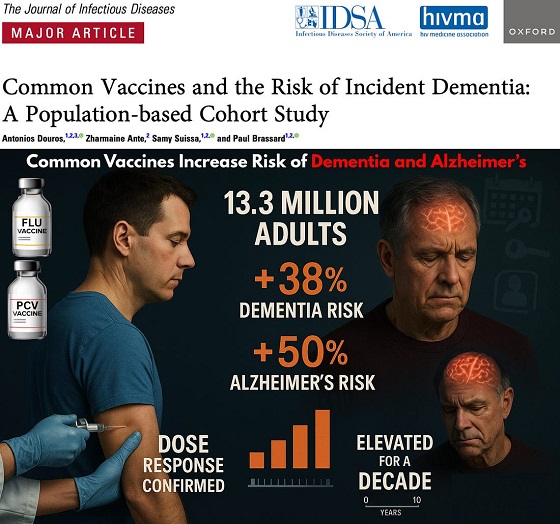
The single largest vaccine–dementia study ever conducted (n=13.3 million) finds risk intensifies with more doses, remains elevated for a full decade, and is strongest after flu and pneumococcal shots.

The single largest and most rigorous study ever conducted on vaccines and dementia — spanning 13.3 million UK adults — has uncovered a deeply troubling pattern: those who received common adult vaccines faced a significantly higher risk of both dementia and Alzheimer’s disease.

The risk intensifies with more dosesremains elevated for a full decade, and is strongest after influenza and pneumococcal vaccination. With each layer of statistical adjustment, the signal doesn’t fade — it becomes sharper, more consistent, and increasingly difficult to explain away.

And critically, these associations persisted even after adjusting for an unusually wide range of potential confounders, including age, sex, socioeconomic status, BMI, smoking, alcohol-related disorders, hypertension, atrial fibrillation, heart failure, coronary artery disease, stroke/TIA, peripheral vascular disease, diabetes, chronic kidney and liver disease, depression, epilepsy, Parkinson’s disease, cancer, traumatic brain injury, hypothyroidism, osteoporosis, and dozens of medications ranging from NSAIDs and opioids to statins, antiplatelets, immunosuppressants, and antidepressants.

Even after controlling for this extensive list, the elevated risks remained strong and remarkably stable.


Vaccinated Adults Had a 38% Higher Risk of Dementia

The primary adjusted model showed that adults receiving common adult vaccines (influenza, pneumococcal, shingles, tetanus, diphtheria, pertussis) had a:

38% increased risk of developing dementia (OR 1.38)

This alone dismantles the narrative of “vaccines protect the brain,” but the deeper findings are far worse.


Alzheimer’s Disease Risk Is Even Higher — 50% Increased Risk

Buried in the supplemental tables is a more shocking result: when the authors restricted analyses to Alzheimer’s disease specifically, the association grew even stronger.

50% increased risk of Alzheimer’s (Adjusted OR 1.50)

This indicates the effect is not random. The association intensifies for the most devastating subtype of dementia.


Clear Dose–Response Pattern: More Vaccines = Higher Risk

The authors ran multiple dose–response models, and every one of them shows the same pattern:

Dementia (all types)

From eTable 2:

  • 1 vaccine dose → Adjusted OR 1.26 (26% higher risk)
  • 2–3 doses → Adjusted OR 1.32 (32% higher risk)
  • 4–7 doses → Adjusted OR 1.42 (42% higher risk)
  • 8–12 doses → Adjusted OR 1.50 (50% higher risk)
  • ≥13 doses → Adjusted OR 1.55 (55% higher risk)

Alzheimer’s Disease (AD) Shows the Same—and Even Stronger—Trend

From eTable 7:

  • 1 dose → Adjusted OR 1.32 (32% higher risk)
  • 2–3 doses → Adjusted OR 1.41 (41% higher risk)
  • ≥4 doses → Adjusted OR 1.61 (61% higher risk)

This is one of the most powerful and unmistakable signals in epidemiology.


Time–Response Curve: Risk Peaks Soon After Vaccination and Remains Elevated for Years

Another signal strongly inconsistent with mere bias: a time-response relationship.

The highest dementia risk occurs 2–4.9 years after vaccination (Adjusted OR 1.56). The risk then slowly attenuates but never returns to baseline, remaining elevated across all time windows.

After 12.5 years, the risk is still meaningfully elevated (Adjusted OR 1.28) — a persistence incompatible with short-term “detection bias” and suggestive of a long-lasting biological impact.

This pattern is what you expect from a biological trigger with long-latency neuroinflammatory or neurodegenerative consequences.


Even After a 10-Year Lag, the Increased Risk Does Not Disappear

When the authors apply a long 10-year lag — meant to eliminate early detection bias — the elevated risk persists:

  • Dementia: OR 1.20
  • Alzheimer’s: OR 1.26

If this were simply “people who see doctors more often get diagnosed earlier,” the association should disappear under long lag correction.


Influenza and Pneumococcal Vaccines Drive the Signal

Two vaccines show particularly strong associations:

Influenza vaccine

  • Dementia: OR 1.39 → 39% higher risk
  • Alzheimer’s: OR 1.49 → 49% higher risk

Pneumococcal vaccine

  • Dementia: OR 1.12 → 12% higher risk
  • Alzheimer’s: OR 1.15 → 15% higher risk

And again, both exhibit dose–response escalation — the hallmark pattern of a genuine exposure–outcome relationship.


Taken together, the findings across primary, supplemental, dose–response, time–response, stratified, and sensitivity analyses paint the same picture:

• A consistent association between cumulative vaccination and increased dementia risk

• A stronger association for Alzheimer’s than for general dementia

• A dose–response effect — more vaccines, higher risk

• A time–response effect — risk peaks after exposure and persists long-term

• Influenza and pneumococcal vaccines strongly drive the signal

• The association remains after 10-year lag correction and active comparator controls

This is what a robust epidemiologic signal looks like.


In the largest single study ever conducted on vaccines and dementia, common adult vaccinations were associated with a 38% higher risk of dementia and a 50% higher risk of Alzheimer’s disease. The risk increases with more doses, persists for a decade, and is strongest for influenza and pneumococcal vaccines.


Nicolas Hulscher, MPH

Epidemiologist and Foundation Administrator, McCullough Foundation

Support our mission: mcculloughfnd.org

Please consider following both the McCullough Foundation and my personal account on X (formerly Twitter) for further content.

FOCAL POINTS (Courageous Discourse) is a reader-supported publication.

To receive new posts and support my work, consider becoming a free or paid subscriber.

Continue Reading

Censorship Industrial Complex

US Condemns EU Censorship Pressure, Defends X

Published on

US Vice President JD Vance criticized the European Union this week after rumors reportedly surfaced that Brussels may seek to punish X for refusing to remove certain online speech.

In a post on X, Vance wrote, “Rumors swirling that the EU commission will fine X hundreds of millions of dollars for not engaging in censorship. The EU should be supporting free speech not attacking American companies over garbage.”

His remarks reflect growing tension between the United States and the EU over the future of online speech and the expanding role of governments in dictating what can be said on global digital platforms.

Screenshot of a verified social-media post with a profile photo, reading: "Rumors swirling that the EU commission will fine X hundreds of millions of dollars for not engaging in censorship. The EU should be supporting free speech not attacking American companies over garbage." Timestamp Dec 4, 2025, 5:03 PM and "1.1M Views" shown.

Vance was likely referring to rumors that Brussels intends to impose massive penalties under the bloc’s Digital Services Act (DSA), a censorship framework that requires major platforms to delete what regulators define as “illegal” or “harmful” speech, with violations punishable by fines up to six percent of global annual revenue.

For Vance, this development fits a pattern he’s been warning about since the spring.

In a May 2025 interview, he cautioned that “The kind of social media censorship that we’ve seen in Western Europe, it will and in some ways, it already has, made its way to the United States. That was the story of the Biden administration silencing people on social media.”

He added, “We’re going to be very protective of American interests when it comes to things like social media regulation. We want to promote free speech. We don’t want our European friends telling social media companies that they have to silence Christians or silence conservatives.”

Yet while the Vice President points to Europe as the source of the problem, a similar agenda is also advancing in Washington under the banner of “protecting children online.”

This week’s congressional hearing on that subject opened in the usual way: familiar talking points, bipartisan outrage, and the recurring claim that online censorship is necessary for safety.

The House Subcommittee on Commerce, Manufacturing, and Trade convened to promote a bundle of bills collectively branded as the “Kids Online Safety Package.”

The session, titled “Legislative Solutions to Protect Children and Teens Online,” quickly turned into a competition over who could endorse broader surveillance and moderation powers with the most moral conviction.

Rep. Gus Bilirakis (R-FL) opened the hearing by pledging that the bills were “mindful of the Constitution’s protections for free speech,” before conceding that “laws with good intentions have been struck down for violating the First Amendment.”

Despite that admission, lawmakers from both parties pressed ahead with proposals requiring digital ID age verification systems, platform-level content filters, and expanded government authority to police online spaces; all similar to the EU’s DSA censorship law.

Vance has cautioned that these measures, however well-intentioned, mark a deeper ideological divide. “It’s not that we are not friends,” he said earlier this year, “but there’re gonna have some disagreements you didn’t see 10 years ago.”

That divide is now visible on both sides of the Atlantic: a shared willingness among policymakers to restrict speech for perceived social benefit, and a shrinking space for those who argue that freedom itself is the safeguard worth protecting.

If you’re tired of censorship and surveillance, join Reclaim The Net.

Fight censorship and surveillance. Reclaim your digital freedom.

Get news updates, features, and alternative tech explorations to defend your digital rights.

Continue Reading

Trending

X