
National
Trudeau says he considers ‘quitting every day’ but vows to stay on as prime minister

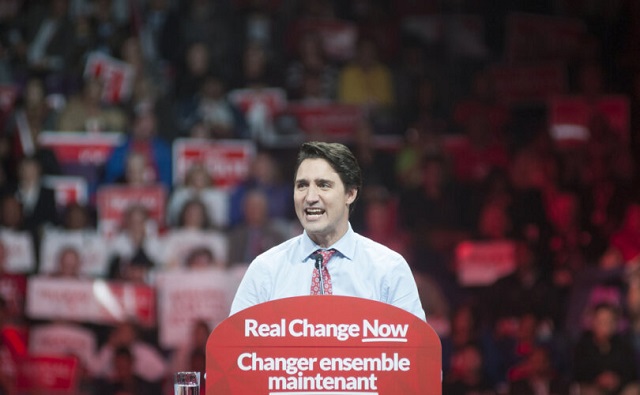

From LifeSiteNews
Conservative Party leader Pierre Poilievre said that while Trudeau thinks about quitting, Canadians think about firing him.
Prime Minister Justin Trudeau has told Canadians that he considers quitting “every day,” but that he is determined to stay on anyway.
During a March 15 interview with Radio-Canada, the French arm of the government-funded Canadian Broadcasting Corporation (CBC), Trudeau revealed that he routinely thinks about abandoning his role as prime minister and views his job as “super platte,” a French phrase that directly translates to “super flat.”
“I think about quitting every day. It’s a crazy job I’m doing, making the personal sacrifices,” he said. “Of course, it’s super tough. It’s very challenging at times.”
However, Trudeau noted that he “could not be the man I am and abandon the fight at this point.”
Trudeau’s interview sparked controversy online as the British Broadcasting Corporation’s (BBC) originally reported that Trudeau said he found his job “super boring” when he used the French phrase “super platte.”
Shortly after, the Crown outlet changed Trudeau’s statement to “very challenging” following backlash from a Canadian columnist. The outlet failed to explain why they made the change or if Trudeau’s office had anything to do with it.
“Super platte,” which can be translated as “super boring,” could also mean “super unfortunate” or a number other of similar statements.
The interview garnished ridicule from Conservative Party leader Pierre Poilievre, who blasted Trudeau for his statement suggesting that serving Canadians is “boring.”

“Canadians are not the only ones suffering,” Poilievre Poilievre said at an “Axe the Tax” rally in Fredericton, New Brunswick this weekend.
“Justin Trudeau has it very tough,” he continued sarcastically. “You hear about this? He’s a little bit bored… incredible this quote, I gotta read these quotes here today. He said this in French in an interview with Rad Can, he said, ‘I think about quitting every day.’ Isn’t that funny? We think about firing him every day.”
“‘It’s a crazy job making the personal sacrifices,’” he added, referring to the interview.
“Yeah right, like flying off to Billionaire Island. Burning thousands and thousands of liters of jet fuel at our expense into the atmosphere. And in these 80, 90 $100,000 vacations you take – sounds like a terrible personal sacrifice,” Poilievre challenged.
“I’m quoting you: ‘Of course, it’s super tough. It’s super boring at times,’” he quoted.
“Wow. Thinks the job is boring .. [but] serving the people is not boring. serving the people is what we do,” he declared.
In the original BBC story, Justin Trudeau said he was "super bored" with being PM. That line disappeared from the story over claims of mistranslation. Really?? @PierrePoilievre says if Trudeau feels like quitting every day, Canadians feel like firing him just as frequently. pic.twitter.com/Bjixo8ZcZ6
— David Krayden (@DavidKrayden) March 17, 2024
The interview comes as a recent poll found that 70 percent of Canadians believe country is “broken” as Trudeau focuses on less important issues. Similarly, in January, most Canadians reported that they’re worse off financially since Trudeau took office.
Additionally, a January poll showed that 46 percent of Canadians expressed a desire for the federal election to take place sooner rather than the latest mandated date in the fall of 2025.
Recent polls show that the scandal-plagued government has sent the Liberals into a nosedive with no end in sight. Per a recent LifeSiteNews report, according to polls, were a Canadian federal election held today, Conservatives under Poilievre would win a majority in the House of Commons over Trudeau’s Liberals.


What Prime Minister Mark Carney gives with his left hand, he takes away with his right hand.
Canadians are already overtaxed and need serious tax cuts to make life more affordable and make our economy more competitive. But at best, the New Year will bring a mixed bag for Canadian taxpayers.
The federal government is cutting income taxes, but it’s hiking payroll taxes. The government cancelled the consumer carbon tax, but it’s hammering Canadian businesses with a higher industrial carbon tax.
The federal government cut the lowest income tax bracket from 15 to 14 per cent. That will save the average taxpayer $190 in 2026, according to the Parliamentary Budget Officer.
But the government is taking more money from Canadians’ paycheques with higher payroll taxes.
Workers earning $85,000 or more will pay $5,770 in federal payroll taxes in 2026. That’s a $262 payroll tax hike. Their employers will also be forced to pay $6,219.
So Canadians will save a couple hundred bucks from the income tax cut in the new year, but many Canadians will pay a couple hundred bucks more in payroll taxes.
It’s the same story with carbon taxes.
After massive backlash from ordinary Canadians, the federal government dropped its consumer carbon tax that cost average families hundreds of dollars every year and increased the price of gas by about 18 cents per litre.
But Carney’s first budget shows he wants higher carbon taxes on Canadian businesses. Carney still hasn’t provided Canadians a clear answer on how much his business carbon tax will cost. He did, however, provide a hint during a press conference he held after signing a memorandum of understanding with the Alberta government.
“It means more than a six times increase in the industrial price on carbon,” Carney said.
Carney previously said that by “changing the carbon tax … We are making the large companies pay for everybody.”
Carney’s problem is that Canadians aren’t buying what he’s selling on carbon taxes.
Just 12 per cent of Canadians believe Carney that businesses will pay most of the cost of his carbon tax, according to a Leger poll. Nearly 70 per cent of Canadians say businesses will pass most or some of the cost to consumers.
Canadians understand that it doesn’t matter what type of lipstick politicians put on their carbon tax pig, all carbon taxes make life more expensive.
Carney is also continuing his predecessor’s tradition of automatically increasing booze taxes.
Ottawa will once again hike taxes on beer, wine and spirits in 2026 through its undemocratic alcohol tax escalator.
First passed in the 2017 federal budget, the alcohol escalator tax automatically increases federal taxes on beer, wine and spirits every year without a vote in Parliament.
Federal alcohol taxes are expected to increase by two per cent on April 1, and cost taxpayers $41 million in 2026. Since being imposed, the alcohol escalator tax has cost taxpayers about $1.6 billion, according to industry estimates.
Canadians are overtaxed and need the federal government to seriously lighten the load.
The biggest expense for the average Canadian family isn’t the home they live in, the food they eat or the clothes they buy. It’s the taxes they pay to all levels of government. More than 40 per cent of the average family’s budget goes to paying taxes, according to the Fraser Institute.
Politicians are taking too much money from Canadians. And their high taxes are driving away investment and jobs.
Canada ranks a dismal 27th out of 38 industrialized countries on individual tax competitiveness, according to the Tax Foundation. Canada ranks 22nd on business tax competitiveness. Canada is behind the United States on both measures.
A little bit of tax relief here and there isn’t going to cut it. Carney’s New Year’s resolution needs to be to embark on a massive tax cutting campaign.

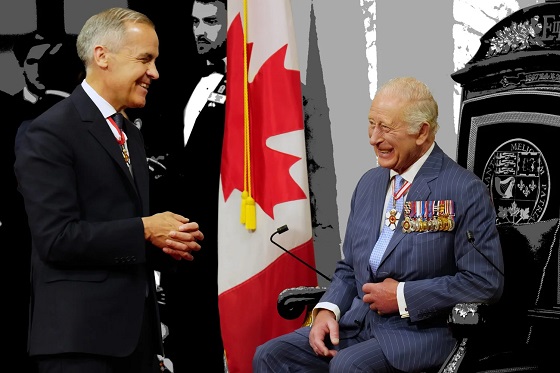
“The unifying theme that enables the Liberal party to maintain its hold over Canada is persistent anti-Americanism…I hope Canadians finally mature, acknowledge that we are neither superior nor inferior to the United States, and abandon our collective national inferiority complex.” Conrad Black quotes a friend.
Canadian media have almost always been reflexively anti-American. Fair enough. Abandoned by Britain they needed to push back. But the real fear of being consumed by the rebel colonies to the south has morphed into a fear of Donald Trump reminding Canada that it has been riding first class while paying economy.
Bashing noisy, bumptious America has always been good business if you owned a Canadian newspaper or television/radio network. The performative worship of Canadian leaders who cocked a snook at the Yankees led, in recent times, to the open-mouthed support for the fatuous Trudeaupian line of monarchs. As Ray Davies sang, “each one a dedicated follower of fashion.”
Since Pierre “The Bold” Trudeau succeeded Lester Pearson and ascended to the throne of the Family Compact in 1968, Canadian policy from Viet Nam to Trump has become “What are the Americans doing? Then let’s do the opposite”. Sample of spite: CBS TV pulled a controversial 60 Minutes news story —but it aired in Canada after being leaked by pissed-off CBS employees.
Yes, there was the brief Harper interregnum when Canada actually fought a military campaign alongside the U.S. in Afghanistan. But mostly it was Jean “Golf Balls” Chretien sitting out the Iraq War.
Alas, all good things must end. Or at least pause. People were starting to notice that Justy was a Chinese trusty, his Montreal riding campaign funded by hundreds of Chinese “businessman” from far away. The tragi-comic Trudeuapian succession hit a speed bump with Mark Carney being brought in to domesticate Canada in manner satisfactory to Brookfield and the EU.

But no one is betting the Libs won’t turn to a third generation of Quebec fashionistas— in the form of another Trudeau progeny— when all else fails.
As usual caustic Conrad Black sums up Canada best. With Quebec and Alberta talking separation he quotes a friend on the state of the nation. “What exists instead is a Liberal Party that manages — often quite poorly — the finances of a collection of provinces and territories, while relying on its media apparatus to shape and safeguard its narrative. It resembles a hedge fund supported by an image consulting firm.” (Insert your convict felon/ anglo wannabe reference here.)
There is no doubt that, as 2025 skulks out, the “image-consulting firm” painting rosy pictures of the Laurentian Elite is in for a a challenge. Justin thought using Trump as his pretext could achieve peace by buying up the lads and lasses of the fourth estate. It worked with Covid and the Truckers Convoy as the column writers/ panel hosts dutifully wrote it like he called it (even as the international press chided Trudeau.).
But even those good times didn’t last, forcing the Libs to do a presto-chango before Justin could lead them to a catastrophic defeat in the spring election. Once more, faced with Trump’s aggressive posture toward trade with Canada, the press closed ranks over Elbows Up, portraying CPC leader Pierre Poilievre as Dick Dastardly.
But new polling shows that the burst of enthusiasm for more Liberal pantomime is wearing thin. The new “new” trade deal promised with Trump has dissipated. The threat to private home ownership in B.C. by government’s indigenous land concessions has sent a chill through the middle class. The NDP fainting goats who bought Elbows Up are headed back to Crazytown, likely under Avi Lewis.
Now, at last, the reckoning promised by the Conservatives’ 20-point lead in polling this time last year may be at hand. While the diehards will go their graves mumbling land acknowledgements and 32 pronouns, there is hope that the under 60s— who emphatically support the Tories— will force change.
What change? Tristan Hopper in the National Post suggests that one place to start reforming the jalopy of Canadian government is in the oceans of money lavished on cause-related political leeches. Seeing the Bondi Beach slaughter by ISIS radicals many now question how long before Toronto or Montreal experiences a similar tragedy at the hands of jihadis who are lavishly supported by tax money.
Yes, not all Muslims in the West are terrorists. But almost all terrorists in the West are Muslim. Hate-spewing Hamas groupies from college faculty are regularly allowed major intersections with police protection as they promise to wipe out infidels. Till now it’s been poor form to even mention, let alone criticize, this pantomime.
Withdrawing financial aid to these groups and their academic fellow travellers would immediately rob these brigands of their impact. The cries of despair from cutting the cord would also expose those in the Commons who have coddled these vipers with grants and ministries.
Similar hacking at the slush money aimed at every other form of leftist posing— from trans to indigenous to illegal immigrants— would also mark the end of free money. Of course there will be caterwauling from the Elizabeth May Free Lunch crew. But with the threat of Canada coming apart with Quebec and Alberta/ Saskatchewan headed for the door those usual dissenting voices will be muted.
Only one thing stands in the way of this culling. That is PM Mark Carney coercing one more MP to cross the floor to his party, cementing its majority status for up to four more years. While the At Issue panels slap their flippers in glee at Poilievre’s demise, the rest of the nation will be less enthralled with the new realities of censorship, trade and housing.

As Stephen Punwasi states. “People in Canada can’t afford homes & prices can’t fall because debt was securitized with widespread fraud—so taxpayers will subsidize foreign speculation. It’s like they hired the mayor of Vancouver to run housing. Oh—they did, eh? Kids, run.”
Bruce Dowbiggin @dowbboy is the editor of Not The Public Broadcaster A two-time winner of the Gemini Award as Canada’s top television sports broadcaster, his 2025 book Deal With It: The Trades That Stunned The NHL And Changed Hockey is now available on Amazon. Inexact Science: The Six Most Compelling Draft Years In NHL History, his previous book with his son Evan, was voted the seventh-best professional hockey book of all time by bookauthority.org . His new poetry collection In Other Words is available via brucedowbigginbooks.ca and on Kindle books at https://www.amazon.ca/dp/1069802700

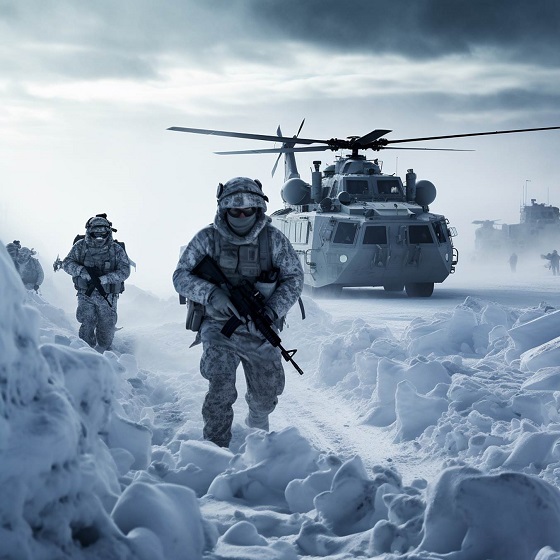
Ottawa’s Newly Released Defence Plan Crosses a Dangerous Line

All 12 Vaccinated vs. Unvaccinated Studies Found the Same Thing: Unvaccinated Children Are Far Healthier

Carney Floor Crossing Raises Counterintelligence Questions aimed at China, Former Senior Mountie Argues

Canadian government launches trial version of digital ID for certain licenses, permits
-
Digital ID2 days ago
Canadian government launches trial version of digital ID for certain licenses, permits
-
 Alberta2 days ago
Alberta Next Panel calls to reform how Canada works
-
 International2 days ago
Georgia county admits illegally certifying 315k ballots in 2020 presidential election
-
 Agriculture2 days ago
End Supply Management—For the Sake of Canadian Consumers
-
 Business2 days ago
The “Disruptor-in-Chief” places Canada in the crosshairs
-
 Artificial Intelligence2 days ago
UK Police Pilot AI System to Track “Suspicious” Driver Journeys
-
 Energy2 days ago
‘The electric story is over’
-
 International2 days ago
World-leading biochemist debunks evolutionary theory