
COVID-19
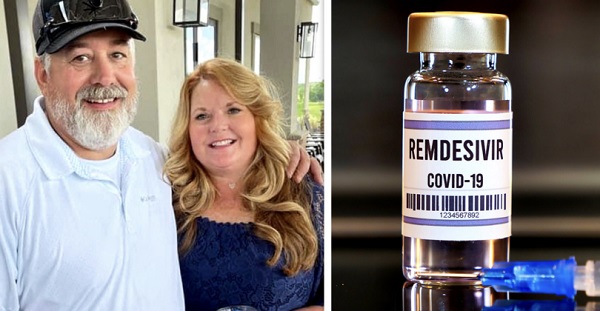
‘They lied to us’: Wife of 53-year-old who died hours after receiving Remdesivir speaks out


From LifeSiteNews
By Michael Nevradakis Ph. D., The Defender
Shannon is trying to raise public awareness of the COVID-19 hospital protocols that she believes led to her husband’s death.
In August 2021, 53-year-old Michael E. Pilgrim and his wife Shannon had just celebrated their 29th wedding anniversary and were looking forward to their daughter’s marriage in October.
A former military service member and father of two, Michael was a “good husband and great dad” and enjoyed golf in his spare time.
However, Michael’s fortunes dramatically changed that month when he experienced difficulty breathing and a low oxygen level. On Aug. 17, 2021, he was admitted to Dallas Regional Medical Center, near his hometown of Forney, Texas, with a COVID-19 diagnosis.
Two days later, on Aug. 19, he was dead.
In an interview with The Defender, Shannon Pilgrim said that from the time Michael was admitted to the hospital, she and other members of her family were barred from visiting him and kept in the dark about the treatment he was receiving.
READ: 26% of those prescribed Remdesivir for COVID died, according to Medicare database
According to Shannon, Michael’s medical records showed that doctors barely offered Michael any treatment and emphasized his unvaccinated status. Treatments Michael received included the controversial drug remdesivir — administered hours before his death.
Today, Shannon is trying to raise public awareness of the COVID-19 hospital protocols that she believes led to her husband’s death. She shared extensive medical documentation with The Defender corroborating her story.
‘Contradictory’ medical records contained ‘many gaps’
Shannon recounted that she and Michael became sick at the same time, but she recovered. Meanwhile, Michael remained bedridden. Shannon said Michael was previously healthy and was not taking any medications, but his breathing difficulties “scared” her and led her to call 911 — a decision she now regrets.
“The worst thing that’s ever happened to me is calling 911,” Shannon said. “I thought that I was doing the best thing for Michael. I came to find out that was the worst thing.”
Michael was taken to Dallas Regional Medical Center, a hospital that “has a horrible reputation” according to Shannon. She accused the hospital of refusing her request for Michael to be transferred and did not let her see him after he was admitted.
Shannon said communication with the hospital was limited. “I would call and the nurses would tell me they were on shift change or were busy and couldn’t talk to me.”
Doctors’ interactions with Michael were also limited, Shannon said. “They were just leaving him in a room and they had an iPad popped in to ask him about medical stuff.”
According to Shannon, most of what she’s learned about Michael’s treatment came from the medical records she obtained after his death — even though the records “are completely just contradictory” and contain “many gaps.”
Shannon referred to an instance when a Dallas Regional doctor told her that Michael was doing well — while the records indicate that the doctor called her to say Michael was in critical condition.
Shannon said the records revealed that the hospital “did nothing” for Michael. She said:

On the first day, they basically didn’t do anything except give him oxygen. The next day, he had a chest X-ray and then doctors gave him vitamins … there’s contradictory stuff in here about whether he even had an IV. I can’t even get — from looking at his medical records — if they gave him fluid.
They started giving him Lovenox shots for blood clots. Why? He didn’t have blood clots … Then they started giving him insulin. Why were they giving him insulin? He wasn’t a diabetic.
But according to the medical records, they really didn’t do anything, and that’s what just completely floored me — except they gave him remdesivir.
Remdesivir, which has been linked to deaths and injuries in COVID-19 patients, was commonly administered to patients under the COVID-19 hospital protocols.
According to Shannon, the records indicate that Michael was administered remdesivir on the day of his death. But as she recalls, when she spoke to her husband on the phone that day at noon he showed no signs of being in danger.
“He called me, and I actually got to talk to him. I didn’t talk to him very long, but he wasn’t on a ventilator. He was better,” Shannon said. “I called my kids and I was like, ‘He sounded so good.’ I said, ‘He’s going to be coming home.’ I was so excited.”
Yet, that afternoon, Michael was given remdesivir. According to Shannon, the hospital called her a few hours later to say that Michael was found unresponsive.
“I got hysterical,” Shannon said. “I was asking again and again, ‘Is he OK? Where is he? How do I get in touch?’ … She wouldn’t give me her name. She just said, ‘I’m so sorry.’ She said he coded and they took him to ICU and ‘someone will call you tomorrow’ … And she hung up the phone on me.”
Shannon’s son called Dallas Regional and was told Michael had died. But the family’s difficulties did not end there, as the hospital did not allow them to see Michael’s body.
“We didn’t get to see him until he was embalmed, because they told us that he had COVID,” Shannon said.
Shannon said she believes her husband’s unvaccinated status played a role in the treatment he received. She said Michael had been “cautious” about the COVID-19 vaccine and reluctant to receive it — and that the hospital was aware of this.
“You see all through his medical records, ‘unvaccinated,’ ‘unvaccinated,’ ‘unvaccinated,’” Shannon said. “It’s even written in there, ‘doesn’t trust the vaccine.’”
‘They completely lied’
Shannon said the hospital stonewalled her and her family after Michael’s death.
“They wouldn’t talk to me, they wouldn’t take my calls,” Shannon said. “I kept calling up there and begging to have somebody tell me what happened and nobody would tell me.” The hospital then started pursuing her for unpaid medical bills, she said.
When she did speak to hospital personnel, they misled her. In one instance, she said a doctor told her that while she had the right to have an autopsy performed on Michael’s body, local authorities were “six to eight months behind” and that she’d have to wait that long for the body to be released.
“They completely lied, because later I found out that by law they have to do an autopsy within two weeks, and then it can be six to eight months before you actually get the report. But they have to do it and they have to release the body. But they lied to us and we trusted them,” Shannon said.
Instead, Shannon said the government-funded COVID-19 Bereavement Assistance Fund offered a $10,000 payout for Michael’s death. “They were giving up to $10,000 if the death certificate had COVID on it. And I said, ‘no way in hell will I take that payout.”
Instead, Shannon became an advocate for families that endured similar experiences, by joining the FormerFedsGroup Freedom Foundation. Through her involvement with this advocacy group, Shannon has met with legislators, attorneys and family members of other COVID-19 hospital protocol victims.
“It’s hard, but I don’t want other loved ones to go through what we went through,” Shannon said. “I realized that I want to keep fighting. And so, as hard as it is to keep reliving this timeframe, I will keep doing it … I don’t want people to think he died from COVID, because he didn’t. He died at the hospital because of them. They killed him.”
This article was originally published by The Defender — Children’s Health Defense’s News & Views Website under Creative Commons license CC BY-NC-ND 4.0. Please consider subscribing to The Defender or donating to Children’s Health Defense.


From LifeSiteNews
The commissioned study will assess the impact on kids’ mental well-being of COVID lockdowns and ‘remote’ school classes that banned outdoor play and in-person learning.
Canada’s Department of Health has commissioned research to study the impact of outdoor play on kids’ mental well-being in light of COVID lockdowns and “remote” school classes that, for a time, banned outdoor play and in-person learning throughout most of the nation.
In a notice to consultants titled “Systematic Literature Reviews And Meta Analyses Supporting Two Projects On Children’s Health And Covid-19,” the Department of Health admitted that “Exposure to green space has been consistently associated with protective effects on children’s physical and mental health.”
A final report, which is due in 2026, will provide “Health Canada with a comprehensive assessment of current evidence, identify key knowledge gaps and inform surveillance and policy planning for future pandemics and other public health emergencies.”
Bruce Squires, president of McMaster Children’s Hospital of Hamilton, Ontario, noted in 2022 that “Canada’s children and youth have borne the brunt” of COVID lockdowns.
From about March 2020 to mid-2022, most of Canada was under various COVID-19 mandates and lockdowns, including mask mandates, at the local, provincial, and federal levels. Schools were shut down, parks were closed, and most kids’ sports were cancelled.
Mandatory facemask polices were common in Canada and all over the world for years during the COVID crisis despite over 170 studies showing they were not effective in stopping the spread of COVID and were, in fact, harmful, especially to children.
In October 2021, then-Prime Minister Justin Trudeau announced unprecedented COVID-19 jab mandates for all federal workers and those in the transportation sector, saying the un-jabbed would no longer be able to travel by air, boat, or train, both domestically and internationally.
As reported by LifeSiteNews, a new report released by the Justice Centre for Constitutional Freedoms (JCCF) raised alarm bells over the “harms caused” by COVID-19 lockdowns and injections imposed by various levels of government as well as a rise in unexplained deaths and bloated COVID-19 death statistics.
Indeed, a recent study showed that COVID masking policies left children less able to differentiate people’s emotions behind facial expressions.
COVID vaccine mandates and lockdowns, which came from provincial governments with the support of the federal government, split Canadian society.
COVID-19
Ontario student appeals ruling that dismissed religious objection to abortion-tainted COVID shot

From LifeSiteNews
An Ontario Tech University student is seeking judicial review after the Human Rights Tribunal of Ontario ruled his beliefs did not qualify as protected ‘creed.’
An Ontario university student who was punished for refusing the COVID shot is contesting a tribunal ruling that rejected his religious objection to the vaccine.
In a November 28 press release, the Justice Centre for Constitutional Freedoms (JCCF) announced that a judicial review has been filed on behalf of former Ontario Tech University student Philip Anisimov after his religious objection to the COVID vaccine was dismissed by an Ontario court.
“Mr. Anisimov’s objection to the Covid vaccine was deeply rooted in his religious commitment to live according to biblical precepts,” Constitutional lawyer Hatim Kheir declared. “He hopes the Divisional Court will clarify that his religious objection was protected by the Human Rights Code and entitled to protection.”
In 2021, Ontario mandated that all students in the province show proof of vaccination unless they had an exemption or agreed to attend a COVID jab education session boasting about the shots. The third option was not available at Ontario Tech University, as schools could choose whether or not they would offer such a program to students.
Anisimov had requested an exemption from the experimental, abortion-tainted COVID shots on religious grounds but was denied and deregistered from his courses.
He was then forced to spend an entire extra year to complete his studies. According to his lawyers, Ontario Tech University’s decision to not approve his COVID jab exemption request “not only disrupted his career plans but also violated his right to be free from discrimination on the basis of religion, as protected by the Ontario Human Rights Code.”
The university’s refusal to honor his exemption prompted Anisimov to take legal action in April with help of the JCCF. However, the Human Rights Tribunal of Ontario rejected his religious objection, arguing that it was not protected as a “creed” under the Ontario Human Rights Code.
Now, Anisimov is appealing the ruling, hoping that his case will serve as a precedent for justice for students who were discriminated against for refusing the abortion-tainted vaccine.
“My hope is that this case helps set an important precedent and encourages Canadians to reflect on the direction our society is taking,” he explained. “My trust is that God does all things for the good of those who love Him, who are called by His purposes.”
COVID vaccine mandates, as well as lockdowns that came from provincial governments with the support of the federal government, split Canadian society. The mRNA shots have been linked to a multitude of negative and often severe side effects in children.
Beyond health concerns, many Canadians, especially Catholics, opposed the vaccines on moral grounds because of their link to fetal cell lines derived from the tissue of aborted babies.


Is there a cure for Alzheimer’s Disease?
Learning the Truth about “Children’s Graves” and Residential Schools is More Important than Ever
Media bound to pay the price for selling their freedom to (selectively) offend
The Unmasking of Vaccine Science
-
National12 hours ago
Media bound to pay the price for selling their freedom to (selectively) offend
-
 Bruce Dowbiggin11 hours ago
Sometimes An Ingrate Nation Pt. 2: The Great One Makes His Choice
-
 COVID-192 days ago
University of Colorado will pay $10 million to staff, students for trying to force them to take COVID shots
-
 Business2 days ago
Oil tanker traffic surges but spills stay at zero after Trans Mountain Expansion
-
 Energy2 days ago
ELZABETH MAY HAS IT WRONG: An Alberta to Prince Rupert Oil Pipeline Will Contribute to Greater Global Oil Tanker Safety
-
 Censorship Industrial Complex2 days ago
Justice Centre campaigning Canadian provinces to follow Alberta’s lead protecting professionals
-
 National2 days ago
Alberta will use provincial laws to stop Canadian gov’t from trying to confiscate legal firearms
-
 COVID-192 days ago
Canadian legislator introduces bill to establish ‘Freedom Convoy Recognition Day’ as a holiday