
International
Secret Service slammed for failing to prevent assassination attempt against Trump

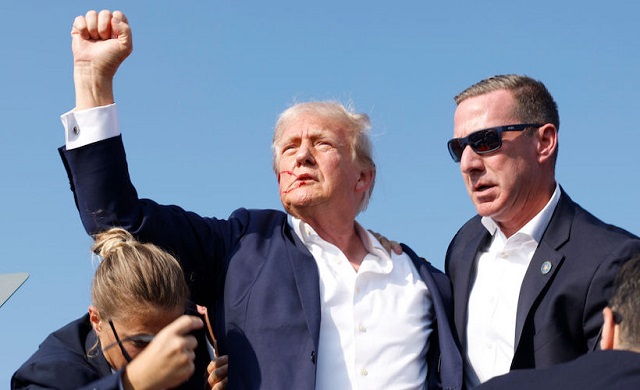

BUTLER, PENNSYLVANIA – JULY 13: Republican presidential candidate former President Donald Trump is rushed offstage during a rally on July 13, 2024 in Butler, Pennsylvania.
From LifeSiteNews
By Matt Lamb
“I don’t like making any assumptions, but it does look like some mistakes were made, that this was preventable”
Secret Service is blaming local law enforcement for not securing the rooftop where a 20-year-old tried to assassinate former President Donald Trump over the weekend.
But local law enforcement, and several experts who spoke to NBC News, said all responsibility for protecting the president ultimately lies with the Secret Service.
The agency is under widespread criticism for allowing a shooter, identified as Thomas Matthew Crooks, to have clear access to President Trump during his rally on Saturday in Pennsylvania. Crooks hit Trump’s right ear, but the president is reportedly in good condition.

It has been reported that Crooks was at one point a registered Republican but that he also made a $15 donation to Progressive Turnout Project, a left-wing Democratic Party-linked activist group, in 2021.
The rooftop “was identified by the Secret Service as a potential vulnerability in the days before the event, two sources familiar with the agency’s operations told NBC News,” the outlet reported last night.
“The Secret Service had designated that rooftop as being under the jurisdiction of local law enforcement, a common practice in securing outdoor rallies,” Secret Service spokesman Anthony Guglielmi said, according to NBC News’ paraphrase.
The outlet reported:
The Secret Service worked with local law enforcement to maintain event security, including sniper teams poised on rooftops to identify and eliminate threats, Secret Service spokesman Anthony Guglielmi said. But no officers were posted on the building used by the would-be assassin, outside the event’s security perimeter but only about 148 yards from the stage — within range of a semiautomatic rifle like the one the gunman was carrying.

From LifeSiteNews
Approximately 150 ‘tabulator tapes’ tracking the votes of more than 300,000 early voters were not signed.
Fulton County, Georgia, has admitted to including 315,000 early votes in the disputed 2020 presidential election despite the fact that they were not properly certified according to state law.
State law demands that voting “tabulator tapes” that publish the recorded results of polling stations must be verified and signed by poll workers, but approximately 150 tapes tracking the votes of more than 300,000 early voters were not signed.
In a hearing before the State Election Board (SEB), an attorney for Fulton County said the county does “not dispute that the tapes were not signed.”
“It was a violation of the rule,” she said. “They shouldn’t have done it.”
“At best, this is sloppy and lazy. At worst, it could be egregious,” fired back Georgia SEB Member Janelle King. “It could have affected an election.”
The December 9 hearing was the result of election integrity activist David Cross, who filed a challenge with the board in 2022, alleging that Fulton County’s handling of early voting violated the state’s election rules.
“These are not clerical errors. They are catastrophic breaks in chain of custody and certification,” Cross said during the hearing.
“Because no tape was ever legally certified, Fulton County had no lawful authority to certify its advanced voting results to the secretary of state. Yet it did,” said Cross. “And Secretary [Brad] Raffensperger accepted and folded those uncertified numbers into Georgia’s official total without questioning them.”
“This is not partisan. This is statutory. This is the law. When the law demands three signatures on tabulator tapes and the county fails to follow the rules, those 315,000 votes are, by definition, uncertified,” said Cross.
Raffensperger, Georgia’s secretary of state, took to social media to discount the allegations.
“Georgia has the most secure elections in the country and all voters were verified with photo ID and lawfully cast their ballots. A clerical error at the end of the day does not erase valid, legal votes,” averred Raffensberger.
– Secretary Raffensperger on alleged procedural errors in Fulton County’s administration of the 2020 election.
— GA Secretary of State Brad Raffensperger (@GaSecofState) December 20, 2025
Meanwhile, Republicans took issue with Raffensperger’s denial of the seriousness of Fulton County’s procedural lapse.
Republican Lieutenant Governor Burt Jones ridiculed Raffensberger’s post.
“If only Georgia had an official responsible for preventing clerical errors that undermine election integrity,” said Jones, a candidate for Georgia governor.
“Is there anyone in Georgia who has that job, Brad?” asked Jones, his opponent in the state’s gubernatorial race.
If only Georgia had an official responsible for preventing clerical errors that undermine election integrity.
Is there anyone in Georgia who has that job, Brad? https://t.co/5v89jcPZwL
— Burt Jones (@burtjonesforga) December 22, 2025
“We just started peeling the layers back on this onion and it already stinks,” said U.S. House Rep. Mike Collins (GA-10). “Years later, when the truth finally comes out, Trump was right.”
“President Trump is owed a massive apology,” asserted Collins. “Turns out over 300,000 early votes in the 2020 election were illegally certified but still included in the final results.”
Collins said he is “tired of empty words from weak leaders. The people of Georgia demand action.”
President Trump is owed a massive apology.
Turns out over 300,000 early votes in the 2020 election were illegally certified but still included in the final results.
I’m tired of empty words from weak leaders. The people of Georgia deserve action. pic.twitter.com/pcCrdGFXVS
— Mike Collins (@MikeCollinsGA) December 20, 2025
In the 2020 election, Joe Biden narrowly beat out incumbent President Donald Trump by less than 12,000 votes in the Peach Tree State.
Business
Federal funds FROZEN after massive fraud uncovered: Trump cuts off Minnesota child care money


The Trump administration has cut off all federal child care payments to Minnesota, ordering a sweeping audit of the state’s day care system as investigators dig into what officials describe as one of the largest fraud schemes ever tied to social service programs.
“We have frozen all child care payments to the state of Minnesota,” Deputy Health and Human Services Secretary Jim O’Neill wrote Tuesday afternoon, saying the move comes after mounting evidence that taxpayer dollars were being siphoned to sham or non-operational day care centers. The freeze follows a viral investigative video that put a national spotlight on facilities across Minneapolis that were receiving large sums of public money despite appearing closed or barely functioning.
According to Alex Adams, assistant secretary at HHS’s Administration for Children and Families, Minnesota has already received roughly $185 million in federal child care funding this year alone. Those funds, the administration says, will remain locked down until the state can demonstrate that payments are being used lawfully. “Funds will be released only when states prove they are being spent legitimately,” Adams said.
We have frozen all child care payments to the state of Minnesota.
You have probably read the serious allegations that the state of Minnesota has funneled millions of taxpayer dollars to fraudulent daycares across Minnesota over the past decade.
Today we have taken three actions… pic.twitter.com/VYbyf3WGop
— Deputy Secretary Jim O'Neill (@HHS_Jim) December 30, 2025
O’Neill accused Minnesota officials of allowing abuse to fester for years, alleging the state has “funneled millions of taxpayer dollars to fraudulent daycares across Minnesota over the past decade.” To halt further losses, HHS outlined a series of immediate enforcement steps. Going forward, states seeking reimbursement through the Administration for Children and Families will be required to provide receipts or photographic proof documenting how funds are spent.
The department has also formally demanded that Gov. Tim Walz order a “comprehensive audit” of the day care centers flagged by investigators. O’Neill said the review must include attendance records, licensing documents, complaints, investigative files, and inspection reports. He pointed directly to a video published Friday by YouTuber Nick Shirley, who visited multiple Minneapolis-area centers listed as receiving millions in public funds but found locations that appeared closed or inactive.
In addition, HHS has launched a dedicated fraud hotline and email address at childcare.gov to encourage tips from parents, providers, and the public. “We have turned off the money spigot and we are finding the fraud,” O’Neill said, urging anyone with information to come forward.
Federal prosecutors say the scope of the alleged abuse is staggering. Authorities have already confirmed at least $1 billion in fraud tied to Minnesota child care programs, with 92 people charged so far. The U.S. Attorney’s Office has warned the total could ultimately reach as high as $9 billion as investigators continue combing through records.
The funding freeze marks one of the most aggressive crackdowns yet by the Trump administration on state-run social programs accused of lax oversight, sending a clear message that federal dollars will not flow until Minnesota can account for where the money went — and who was cashing in.
Georgia county admits illegally certifying 315k ballots in 2020 presidential election
Alberta Next Panel calls to reform how Canada works

Canadian government launches trial version of digital ID for certain licenses, permits

End Supply Management—For the Sake of Canadian Consumers
-
International10 hours ago
Georgia county admits illegally certifying 315k ballots in 2020 presidential election
-
 Business1 day ago
ICYMI: Largest fraud in US history? Independent Journalist visits numerous daycare centres with no children, revealing massive scam
-
 Alberta1 day ago
Alberta project would be “the biggest carbon capture and storage project in the world”
-
 Energy24 hours ago
Canada’s debate on energy levelled up in 2025
-
 Business11 hours ago
What Do Loyalty Rewards Programs Cost Us?
-
 Haultain Research12 hours ago
Sweden Fixed What Canada Won’t Even Name
-
 Business1 day ago
Socialism vs. Capitalism
-
 Energy1 day ago
New Poll Shows Ontarians See Oil & Gas as Key to Jobs, Economy, and Trade