
Censorship Industrial Complex
Rise in arson coincides with residential school murders claim

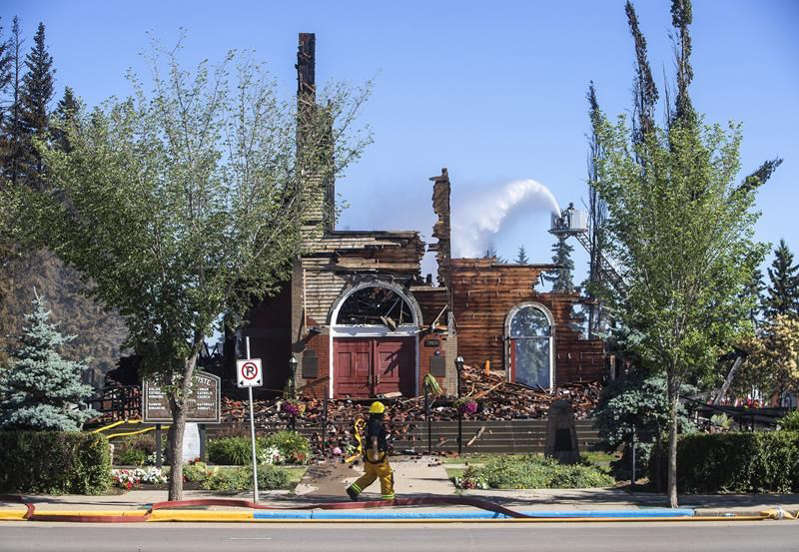

Morinville, Alberta’s 114 year old Jean Baptiste Catholic Church was destroyed by arson in June 2021
From the Frontier Centre for Public Policy

Staggering Number of Churches Burned, More Than Thought
Blacklocks reports that since 2010, when the Truth and Reconciliation (TRC) commissioners began making the claim in interviews and in interim reports that thousands of indigenous children had died at residential schools under suspicious circumstances, more than 400 Christian churches have burned in Canada.
Those allegations were false, and based on a conspiracy theory.
But, the church burnings increased significantly after the May 27, 2021 Kamloops announcement ramped up that claim to an actual accusation by the Tk’emlups Indian band that 215 children had died under sinister circumstances, and were buried by priests in secrecy on the school grounds — “with the forced help of children, as young as six”.
Where did that Tk’emlups story come from? Most importantly, why would anyone believe such obvious nonsense?
The conspiracy theory that launched the entire missing children claim was largely created out of whole cloth by a defrocked United Church minister, named Kevin Annett.
For reasons that defy rational explanation this unusual man made it his life’s work to take the alcoholic ramblings of a few Vancouver east side street residents, polish them up, and present them as fact to the world.
For example, he repeated the story that Queen Elizabeth had kidnapped ten children from the Kamloops school, and those children were never seen again. He also repeated stories about priests clubbing students to death and throwing them into graves dug by other students, dead boys hanging on meathooks in barns, and babies thrown into furnaces by priests and nuns. Respected investigative reporter Terry Glavin, exposed Annett as a crank, and debunked Annett’s wild stories in detail in a 2008 Tyee article. Annett’s stories are so obviously fake that it seems incredible that anyone believed them.
But they did. In fact some of the people who fell for these stories occupied important positions. One was Gary Merasty, a Member of Parliament. Merasty became so convinced that these claims, as presented in Kevin Annett’s most famous documentary, “Unrepentant” were true, that he was able to convince the Assembly of First Nations (AFN) and other important politicians that the newly appointed TRC commissioners must look into Annett’s claims.
The newly appointed TRC commissioners unwisely accepted this new area of study, despite that fact that they had no mandate to do so. When the federal government refused their request for a mandate and funds to search for these phantom “missing children” they ignored the rebuff, and pursued the subject anyway.
It appears from their statements on the subject that they completely bought into the Annett conspiracy theory. Commissioner Murray Sinclair gave many interviews about these supposedly “missing children” and hinted frequently that dark forces were at play.
He even alleged — on absolutely no evidence — that so many deaths occurred at residential schools that the federal government conspired to keep the information from the Canadian public after 1920. Then he upped his death number — again with no evidence to support his claim — to over 6,000. All of this alarming rhetoric was heard across Canada, but particularly within increasingly outraged indigenous communities.
Following the Kamloops announcement he took this rhetoric up to alarming new heights — suggesting that “15-25,000, maybe more” deaths, some deliberate — took place at the schools.
For her part, Commissioner Marie Wilson actively promoted the myth that thousands of children came to the schools, and were never seen again. According to Wilson these children simply disappeared. (She did not explain why there was not even one complaint from a parent that their child had gone missing or discuss cause of death.)
The mainstream media, meanwhile, did not question any of these always improbable claims. Quite the contrary, they not only played along with these baseless claims, but actively encouraged them. It did not seem to occur to them that they were actively supporting a conspiracy theory.
So, it should really come as no surprise that on May 27, 2021 when Chief Casimir made her false claim — that the “remains of 215 former students of KIRS” had been found — there was absolutely no pushback or questioning of what should have seemed to Canadians like a bizarre claim. Instead, the media – including the once prestigious New York Times — actively amped up the rhetoric, and added their own claims about “mass graves found.”
Trudeau and his ministers — especially Marc Miller — made matters immeasurably worse by immediately ordering all federal flags to be flown at half mast, and promising enormous amounts of money to any other indigenous community that wanted to make a similar claim.
The truth is that the TRC’s missing children wild goose chase had thoroughly captivated journalists, and entire indigenous communities, to the extent that the baseless Tk’emlups claim seemed to make sense to them. Justin Trudeau and his ministers were in that gaggle of gullibles. Canada became the laughing stock of the world for dumbly accepting these wild claims.
All along, there have been a few brave souls who have tried to question a residential school narrative that was increasingly getting out of control.
Remember Senator Lynn Beyak? She was forced out of the senate essentially for telling the truth — namely that many children benefitted from their residential school educations, and that the TRC should have said so. She acknowledged that many children were hurt by their experiences there, but insisted that both the good and the bad should have been told. For that bit of common sense she was relentlessly attacked by a partisan media, expelled from the Conservative caucus, and forced into retirement.
Most recently, a retired professor emeritus, Rod Clifton, who spoke about his positive experiences working at a northern residential school, and explained why the claims that residential school students were murdered and secretly buried could not possibly be true, had his True North interview removed by a social media company on the grounds that it was “hate speech”.
Never mind that he was recounting his personal experience at the school. Never mind that his wife and son are indigenous. The professor dared to speak against an orthodoxy that tolerates no dissent.
Meanwhile, the mainstream media reporting about residential schools has become increasingly extreme. Fabulists, like Kevin Annett and other opportunists, have built careers for themselves writing exaggerated, or even completely made up stories about residential school “horrors” and “atrocities.” Instead of being accurately portrayed as the flawed attempts at indigenous education that they were, they are now presented as virtual charnel houses, where children were tortured and murdered.
As stated, all of this heated rhetoric went into overdrive on May 27, 2021, when Chief Rosanne Casimir falsely claimed that “the remains of 215 children” had been found on the grounds of the former Kamloops Indian Residential School (KIRS). In fact, no such remains had been found. The only “evidence” for her claim were stories the people in the community had told themselves, and radar blips (soil anomalies) that an inexperienced radar operator had misinterpreted as possible graves.
There was absolutely no reason why Casimir’s claim should have been taken seriously in 2021. Historical records clearly show that the children who died of disease or accident while attending residential school were all given Christian burials, with their deaths properly recorded. Most were buried by their families in their home communities. In short, there is no historical evidence that even one residential school student died under sinister circumstances, or was buried in secrecy.
But instead of refuting Casimir’s claim, or asking even the most basic questions, the Trudeau government and its CBC ally simply accepted the claim as true.
And since that time, both the Trudeau government and CBC have doubled down on their refusal to correct the misinformation that they have promoted.
In fact, the Senate is now considering ways to make people like Senator Lynn Beyak and Professor Clifton criminals. They want to criminalize any “residential school denier” who dares to doubt the truth of anything that a residential school “survivor” has alleged.
This would include, for example, anyone who dared to disagree with the two Tk’emlups people who claim that they were the “children as young as six” who in the 1960s were forced to dig graves for priests who had somehow killed their comrades, and were now burying them in secrecy.
Those two people are still alive. Have they been interviewed by the RCMP? We do not know.
Why are their identities not being revealed by Casimir and her associates? Again, we do not know. Why has CBC, or others not interviewed these two people about their sensational claim? Again, we are offered no explanation by CBC.
This would also mean that anyone disagreeing with any of the claims of “survivors” such as Billie Coombes, or any of Kevin Annett’s wild stories could face criminal prosecution.
And why did Chief Casimir claim that the “remains of 215 children” had been found, when that was clearly a false claim. Only soil anomalies, which are almost certainly from a 1924 sewage trench were found. Why did it take three years for the T’Kumlups band to confess that no human remains were found?.
Instead, we are left in limbo on the most sensational crime story in Canadian history. 215 — then thousands — of indigenous children were somehow killed and secretly buried at residential schools all across the country? (Former National Chief RoseAnne Archibald says “tens of thousands”, former TRC Commissioner Murray Sinclair says “15-25,000, maybe more.”) Rather than trying to investigate this story by vigorously questioning people making these sensational claims the RCMP sit on their hands in their offices, CBC steadfastly refuses to ask any questions. And our own government threatens to make criminals of any retired professors or others who dare to ask questions about it.
Meanwhile, the Tk’emlups band received (and apparently spent) $8,000,000 from the federal government for making a false claim.
The TRC accused Canadian priests, nuns, teachers and staff at residential schools of somehow being responsible for the disappearance of thousands of indigenous children who attended the schools. That is a shocking accusation. But it is even more shocking that the accusation was made with no real evidence to support it. Chief Rosannne Casimir went even further. She accused those people —who are no longer here to defend themselves — of murder and secret burial. Now, the federal government wants to stop Canadians from even talking about these sensational and baseless claims.
The next logical step for them is to stop Canadians from even knowing about it. That’s exactly what they are doing in every school in the country — misinforming every Canadian school child by telling them that the Kamloops claim is true.
And that is probably what Ottawa has in mind, with the new “digital safety officer” contemplated in Trudeau’s truly frightening Online Harms Act. Truth-telling senators and professors will be silenced. Then the truth will be what lies in unmarked graves.
The church burnings are only the outward manifestation of this larger evil. Canadians are being deliberately deceived by their own government, the indigenous leadership, and our own media. The Trudeau Liberals have actively pursued a policy that has both encouraged, and then kept alive a conspiracy theory — namely, that residential school priests, nuns and teachers were responsible for the deaths and secret burials of the children placed in their care. The indigenous leadership has exploited an obviously false claim — pocketing a mountain of tax dollars, while our moribund mainstream media sits in silence.
Lewis Carroll wrote about an upside down world in Alice in Wonderland. He would immediately understand what is happening in Canada today.
We have a sitting government actively promoting a conspiracy theory, while threatening to criminalize anyone who tries to expose it. We have an RCMP that refuses to do its job, and conduct an investigation that would quickly tell Canadians that there are no secretly buried children at Kamloops. We have CBC and most of the mainstream media asking no questions about the biggest news story in Canadian history. And we have countless grifter writers and academics who are building their careers repeating ghost stories, and pretending that they are telling the truth.
And the Tk’emlups band gets $8,000,000 for lying, while a professor and senator get cancelled for telling the truth.
As Jon Kay notes in his recent Quillette essay, an officially sanctioned lie — and that is exactly what the Kamloops claim has become — cannot endure forever.
At some point Canada must come to its senses.
First published in the Western Standard here.
Brian Giesbrecht, retired judge, is a Senior Fellow at the Frontier Centre for Public Policy.

Censorship Industrial Complex
Death by a thousand clicks – government censorship of Canada’s internet


The Justice Centre for Constitutional Freedoms announces its latest publication, Death by a thousand clicks: The rise of internet censorship and control in Canada, authored by veteran journalist and researcher Nigel Hannaford. The report outlines how recommendations from the Broadcasting and Telecommunications Legislative Review Panel in 2020 set the stage for a series of federal bills that have collectively transformed Canada’s once open internet into a state-managed digital environment that restricts what Canadians may access, share, and say online.
The report highlights the following federal legislation:
Online Streaming Act (C-11): Passed in 2023, this Bill gives the CRTC power to regulate online videos and other content, including material created by everyday Canadians. It also lets the government influence online “discoverability,” meaning it can push certain content to the top of your feeds while making other content harder to find.
Online News Act (C-18): Also passed in 2023, this Bill forces platforms to pay approved news outlets, a measure that led to increased dependence of media organizations on the government and widespread blocking of Canadian news as a result of Meta’s news ban on Facebook and Instagram.
Online Harms Act (C-63): Although this Bill was halted by the 2025 election, it would have empowered a new “Digital Safety Commission” to order content removals, demand platform data, levy severe financial penalties on service providers for non-compliance with regulations created by the federal cabinet, and impose house arrest on Canadians who had not been charged with or convicted of any crime. It also would have allowed the Canadian Human Rights Commission to pursue Canadians over non-criminal “discriminatory” speech, together creating a sweeping censorship regime under the guise of addressing so-called “harms” that were already illegal.
Strong Borders Act (C-2): Introduced in June 2025 and currently at second reading, this Bill authorizes law enforcement to obtain subscriber information and metadata without a warrant, chilling anonymous online expression and eroding digital privacy.
An Act respecting cyber security, amending the Telecommunications Act and making consequential amendments to other Acts (C-8): Introduced in April 2025 and now before committee, this Bill expands government access to private networks and enables federal officials to direct telecommunications providers to kick individual Canadians off the internet without due process or appeal.
Combatting Hate Act (C-9): Introduced in September 2025 and currently before Parliament, this Bill broadens “hate-propaganda” offences, removes Attorney General oversight for prosecutions, encourages widespread self-censorship, and makes Canada more like the United Kingdom, where thousands of citizens are arrested over their social media commentary.
Report author Nigel Hannaford said, “It is important for Canadians to know that these bills are not isolated technical updates. Together they form a coordinated shift toward state-managed digital speech.”
“If we value open debate, privacy, and democratic accountability, we need to repeal the laws already passed and stop the ones now before Parliament,” he added.
Benjamin Klassen, Research and Education Coordinator for the Justice Centre, said, “It is important Canadians stay informed about these important issues. An informed public is essential to a free society.”
“Through research reports like this one, our Education team works to explain complex legislation in a way that empowers Canadians to participate in the national debate around important policies and defend their rights and freedoms,” he added.
To protect free expression online, Canadians should demand the repeal of Bills C-11 and C-18, insist that MPs vote against Bills C-2, C-8, and C-9, and elect representatives committed to restoring a free and open internet.

From the Frontier Centre for Public Policy
By Lee Harding
Ottawa says Bill C-9 fights hate. Critics say it turns ordinary disagreement into a potential crime.
Discriminatory hate is not a good thing. Neither, however, is the latest bill by the federal Liberal government meant to fight it. Civil liberties organizations and conservative commentators warn that Bill C-9 could do more to chill legitimate speech than curb actual hate.
Bill C-9 creates a new offence allowing up to life imprisonment for acts motivated by hatred against identifiable groups. It also creates new crimes for intimidation or obstruction near places of worship or community buildings used by identifiable groups. The bill adds a new hate propaganda offence for displaying terrorism or hate symbols.
The Canadian Civil Liberties Association (CCLA) warns the legislation “risks criminalizing some forms of protected speech and peaceful protest—two cornerstones of a free and democratic society—around tens of thousands of community gathering spaces in Canada.” The CCLA sees no need to add to existing hate laws.
Bill C-9 also removes the requirement that the Attorney General consent to lay charges for existing hate propaganda offences. The Canadian Constitution Foundation (CCF) calls this a major flaw, noting it removes “an important safeguard for freedom of expression that has been part of Canada’s law for decades.” Without that safeguard, decisions to prosecute may depend more on local political pressures and less on consistent national standards.
Strange as it sounds, hatred just will not be what it used to be if this legislation passes. The core problem begins with how the bill redefines the term itself.
Previously, the Supreme Court of Canada said hatred requires “extreme manifestations” of detestation or vilification that involve destruction, abhorrence or portraying groups as subhuman or innately evil. Instead, Bill C-9 defines hatred as “detestation or vilification,” stronger than “disdain or dislike.” That is a notably lower threshold. This shift means that ordinary political disagreement or sharp criticism could now be treated as criminal hatred, putting a wide range of protected expression at real risk.
The bill also punishes a hateful motivation more than the underlying crime. For example, if a criminal conviction prompted a sentence of two years to less than five years, a hateful motivation would add as much as an additional five years of jail time.
On paper, most Canadians may assume they will never be affected by these offences. In practice, the definition of “hate” is already stretched far beyond genuine threats or violence.
Two years ago, the 1 Million March for Children took place across Canada to protest the teaching of transgender concepts to schoolchildren, especially the very young. Although such opposition is a valid position, unions, LGBT advocates and even Newfoundland and Labrador Conservatives adopted the “No Space For Hate” slogan in response to the march. That label now gets applied far beyond real extremism.
Public pressure also shapes how police respond to protests. If citizens with traditional values protest a drag queen story hour near a public library, attendees may demand that police lay charges and accuse officers of implicit hatred if they refuse. The practical result is clear: officers may feel institutional pressure to lay charges to avoid being accused of bias, regardless of whether any genuine threat or harm occurred.
Police, some of whom take part in Pride week or work in stations decorated with rainbow colours in June, may be wary of appearing insensitive or intolerant. There have also been cases where residents involved in home invasion incidents were charged, and courts later determined whether excessive force was used. In a similar way, officers may lay charges first and allow the courts to sort out whether a protest crossed a line. Identity-related considerations are included in many workplace “sensitivity training” programs, and these broader cultural trends may influence how such situations are viewed. In practice, this could mean that protests viewed as ideologically unfashionable face a higher risk of criminal sanction than those aligned with current political priorities.
If a demonstrator is charged and convicted for hate, the Liberal government could present the prosecution as a matter for the justice system rather than political discretion. It may say, “It was never our choice to charge or convict these people. The system is doing its job. We must fight hate everywhere.”
Provincial governments that support prosecution will be shielded by the inability to show discretion, while those that would prefer to let matters drop will be unable to intervene. Either way, the bill could increase tensions between Ottawa and the provinces. This could effectively centralize political authority over hate-related prosecutions in Ottawa, regardless of regional differences in values or enforcement priorities.
The bill also raises concerns about how symbols are interpreted. While most Canadians would associate the term “hate symbol” with a swastika, some have linked Canada’s former flag to extremism. The Canadian Anti-Hate Network did so in 2022 in an educational resource entitled “Confronting and preventing hate in Canadian schools.”
The flag, last used nationally in 1965, was listed under “hate-promoting symbols” for its alleged use by the “alt-right/Canada First movement” to recall when Canada was predominantly white. “Its usage in modern times is an indicator of hate-promoting beliefs,” the resource insisted. If a historic Canadian symbol can be reclassified this easily, it shows how subjective and unstable the definition of a “hate symbol” could become under this bill.
These trends suggest the legislation jeopardizes not only symbols associated with Canada’s past, but also the values that supported open debate and free expression. Taken together, these changes do not merely target hateful behaviour. They create a legal framework that can be stretched to police dissent and suppress unpopular viewpoints. Rest in peace, free speech.
Lee Harding is a research fellow for the Frontier Centre for Public Policy.


Wayne Gretzky’s Terrible, Awful Week.. And Soccer/ Football.

Western Campuses Help Build China’s Digital Dragnet With U.S. Tax Funds, Study Warns

Common Vaccines Linked to 38-50% Increased Risk of Dementia and Alzheimer’s

Trump DOJ seeks to quash Pfizer whistleblower’s lawsuit over COVID shots
-
COVID-191 day ago
Trump DOJ seeks to quash Pfizer whistleblower’s lawsuit over COVID shots
-
 Alberta2 days ago
Alberta introducing three “all-season resort areas” to provide more summer activities in Alberta’s mountain parks
-
 Agriculture1 day ago
Growing Alberta’s fresh food future
-
 International1 day ago
Trump admin wants to help Canadian woman rethink euthanasia, Glenn Beck says
-
 Alberta1 day ago
The case for expanding Canada’s energy exports
-
 Business2 days ago
Storm clouds of uncertainty as BC courts deal another blow to industry and investment
-
Censorship Industrial Complex1 day ago
Ottawa’s New Hate Law Goes Too Far
-
 Business1 day ago
Fuelled by federalism—America’s economically freest states come out on top