
Crime
Project Sleeping Giant: Inside the Chinese Mercantile Machine Linking Beijing’s Underground Banks and the Sinaloa Cartel



U.S. surveillance image shows one of Sai Zhang’s top lieutenants crossing into Mexico with a money courier for the Sinaloa cartel. The photo revealed critical ties between Zhang’s transnational money laundering and drug trafficking operation and one of North America’s dominant fentanyl distributors.

 Sam Cooper
Former senior DEA official describes covert global financial ecosystem tying Chinese students, Sinaloa fentanyl sales, cartel cash collection, and PRC state-linked infrastructure deals.
In January 2021, a grainy black-and-white surveillance photo quietly accelerated one of the most consequential geopolitical investigations in recent times — a case with influence over border security, trade policy, and tariff disputes shaping our era.
Captured at the U.S.-Mexico border, the image showed a thick-set Chinese man wearing a COVID-era face mask driving alongside a Mexican man — a key money launderer for the Sinaloa cartel. The Chinese man turned out to be a senior operative working for Sai Zhang, a younger Chinese international student living in the United States on a student visa.
To a small group of U.S. federal agents, the photo revealed a thread they had been painstakingly unraveling since 2018, part of an ongoing investigation known as Project Sleeping Giant.
The overarching task force, launched by senior DEA agent Don Im — whose career was built on decoding China’s paramount role in global money laundering and supply of chemicals used to produce methamphetamine and fentanyl — aimed to bring cases against Latin cartels working with Chinese money launderers.
This photo was the first concrete step toward proving a direct, operational bridge between Chinese underground banking networks and the blood-soaked heart of Mexico’s most notorious cartel.
While evidence of Sai Zhang’s commanding role in orchestrating Sinaloa fentanyl cash flows was stunning, the involvement of Chinese student networks followed its own curious logic, Im explained in an interview.
“Chinese banking networks were operating in the U.S. long before Zhang linked up with the Sinaloa cartel,” Im said, describing the system in which Chinese buyers bid on pools of drug cash collected in cities worldwide, paying a premium to receive laundered dollars in American locations and investments of their choosing. “The buyers were mostly wealthy Chinese seeking dollars for real estate or tuition in America. Payments were made in yuan through Chinese accounts. In return, Mexican cartels received goods or cash.”
In exclusive interviews, Im revealed in unprecedented details the breathtaking complexity of China’s global drug money laundering networks — a system of Byzantine paths that Sleeping Giant helped map and penetrate. The troubling implications help explain why Washington is now imposing trade sanctions targeting China and countries deeply entwined with its export-driven economy.
At the heart of it, Beijing’s centralized economic apparatus and the Chinese Communist Party’s regional governors knowingly align with global drug barons — channeling fentanyl cash, reintegrating it into China’s factory output, and exporting drug-funded “legitimate” goods worldwide. Meanwhile, Chinese immigrants and travelers access the other side of this narco-banking system, using it to bankroll overseas investments and strengthen the reach of the Chinese diaspora.
It is a system that works for China’s government and citizens alike — on the micro level, it pays for tuition and housing for Chinese students in America; on the macro level, it helps fund Xi Jinping’s Belt and Road infrastructure projects abroad, designed to bind other states more closely to China through trade, debt, and ultimately elite corruption. According to Im, the chemical precursors fueling the production of fentanyl, methamphetamine, and ecstasy in parts of Europe — as well as in countries like Canada and Mexico — are woven into this Belt and Road system.
“Their Belt and Road Initiative is now in over a hundred-and-some-odd countries — with ports, airports, shipping lanes, roads, highways, trains. And all of China’s precursor chemicals are being offloaded,” Im said. “Right now, China’s economy is in dire straits, and they’re looking for capital to pay off debt, fund projects, make investments, or transfer wealth out of China. And that’s huge business. It involves provincial authorities engaged in various organized crime activities, including bribery, intimidation, kickbacks, and providing tariff breaks to known illicit drug and chemical suppliers.”
Don Im has testified on these findings before Congress, and related U.S. government investigations have shown that Beijing provides tax incentives to fentanyl factories.
As Sleeping Giant revealed, a critical cog in Beijing’s Trojan horse system is the Chinese student visitor — exemplified by figures like Sai Zhang.
The Bureau is a reader-supported publication.
To receive new posts and support my work, consider becoming a free or paid subscriber.
The Student Banker
Sai Zhang arrived in the United States on a student visa. By the late 2010s, he had quietly transformed himself into a key broker in a vast underground banking network centered in Southern California. His customers were wealthy Chinese nationals circumventing Beijing’s strict $50,000 annual foreign exchange cap.
Zhang’s operation was deceptively elegant. He tapped into the surplus of U.S. dollars held by Mexican drug cartels from opioid-ravaged eastern states such as North Carolina to cartel-influenced streets in Los Angeles. The Sinaloa drug barons, flush with cash from fentanyl, meth, and cocaine sales, needed a discreet and cost-effective way to convert their U.S. dollar profits back into pesos in Mexico.
Zhang’s network — as is true for all Chinese money brokers — clipped both sides of the ticket, offering direct or indirect services to Mexican cartels, Chinese factory producers, Chinese diaspora retailers across Europe and the western hemisphere who sell Chinese goods, and Chinese citizens seeking to import their yuan-denominated wealth, receiving non-traditional banking payouts in American cities.
So Zhang bought the Sinaloa cartel’s fentanyl cash dollars at a discount, resold them at a premium to Chinese buyers, and closed a loop that turned violent, street-level drug cash into fuel for China’s GDP.
But for U.S. prosecutors working alongside DEA street teams, what had long been known by detectives since the landmark case of Mexican-Chinese methamphetamine baron Zhenli Ye Gon—that is, the deep integration between Chinese and Mexican narco networks—still had to be painstakingly proven in court.
For Sai Zhang, this meant cutting through a labyrinth of protective layers carefully constructed to shield elite money brokers from exposure.
As described in voluminous U.S. court records—and corroborated in detail by Don Im—Zhang relied on a sophisticated chain of cash couriers, brokers, and money mules to keep himself insulated from street-level narcotics transactions. DEA surveillance teams tracked network operators to numerous cash stash houses and clandestine parking lot exchanges, often coming tantalizingly close yet narrowly missing opportunities to link Zhang’s cash directly to drug shipments.
One example is detailed in the affidavit of lead investigator Steven Gonzales. Surveillance teams tracked Xuanyi Mu and Hang Su from the “Naomi Avenue” stash house in Arcadia to a parking lot, where they met Elizabeth Sevilla-Mendoza, a known narcotics courier. Su collected an orange tote bag from her before returning to her black Mercedes-Benz. Officers then directed a traffic stop and deployed a K-9 unit, which alerted to the scent of narcotics on the bag. Inside, agents discovered $34,000 in foil-wrapped cash, neatly stacked and bound with rubber bands.
But within 48 hours of seizing this cash, Zhang’s team shut down the Arcadia stash house, leaving DEA investigators without the drug seizure they needed and cutting off a valuable surveillance node.
The first major break came on October 18, 2022. Acting on a tip from DEA agents in Charlotte, North Carolina, investigators in California zeroed in on a supermarket parking lot in San Gabriel. A wiretap on a Chinese suspected narco in North Carolina named “Mimi” indicated that Sai Zhang had arranged to pick up a $300,000 drug cash payment outside the San Gabriel grocery. Hours later officers watched as a woman in a sleek blue Maserati leaned out and took a black bag — containing about $300,000 in cash — from the driver of a white Ram truck, a Hispanic man.
Gonzalez was well prepared, having spent months quietly briefing local police departments across Los Angeles County on the finely honed clockwork of the Chinese student’s network.
When the DEA called for backup, San Gabriel police launched. They tailed the big Ram truck for hours, weaving through LA’s dense murk until the truck finally stopped in a Compton parking lot. There, the driver transferred two boxes from a silver sedan into his truck. Moments later, officers swooped in, seizing 50 kilos of cocaine — concrete proof that the Chinese money trail led directly to narcotics.
Meanwhile, Steven Gonzalez, DEA’s lead detective, shadowed the blue Maserati east, far from Compton’s industrial edges, finally arriving in Temple City — a quiet suburban enclave in the western San Gabriel Valley, known for its large Chinese community and discreet residential streets. There, a person emerged with a bag and passed it to two women waiting in a car. When officers stopped her car, they found $25,000 in cash — dollars procured through Sai Zhang’s underground WeChat-based cash exchange.
The DEA team ultimately traced the white Ram truck — along with the same silver sedan that had delivered 50 kilos of cocaine to the Ram’s driver — back to a drug stash house in Rowland Heights. In December 2022, they intercepted another driver leaving that residence, seizing $500,000 in cash.
The next link in the Chinese-Sinaloa drug money chain closed the circle—from, in a sense, the Chinese student boss, Sai Zhang, down to his foot soldiers: Chinese exchange students in the United States, lured by the promise of easy spending money, and recruited through WeChat message boards to serve as money mules for organized crime.
These same students come from a vast pool of families whose North American tuition payments are themselves financed with laundered drug proceeds, weaving them even more tightly into fentanyl’s financial web.
A cinematic moment came on April 10, 2023. In the evening dusk officers watched a grocery bag of cash drop from a balcony belonging to one of Sai Zhang’s lieutenants. A Chinese man seen nervously pacing the sidewalk waiting for the bag drop scooped it up and drove off in a black Range Rover.
The Range Rover wound through Los Angeles, stopping at another pickup before heading to a quiet house in North Hills. There, the driver handed two bags to a tall young Chinese man — notable for his studious wire-frame glasses — waiting at the door.
Around midnight, officers knocked. An older woman nervously answered and led them to a bedroom. She told the officers she offered boarding to international exchange students. Under the bed, they found two grocery bags stuffed with $60,000 cash. The room belonged to a Chinese high-school student boarding in the home — a ground-level player in a global money chain, perhaps only vaguely aware, if at all, that their willingness to take “easy” money jobs in a parallel Chinese economy is driving overdose deaths and an overdue crackdown by American lawmakers.

In his affidavit, Steven Gonzales boils down the transnational model exposed by Zhang’s case in these terms: One method by which a Chinese businessman might purchase real estate in Los Angeles—while evading China’s strict currency export controls—involves acquiring U.S. dollars through an underground exchange. To do so, the businessman effectively “buys” dollars from a broker like Zhang who supplies drug cash already circulating in the United States.
In this arrangement, the Chinese investor transfers an equivalent amount of Chinese currency into a designated account in China controlled by the Mexican cartel. Once secured, those funds can then be used—legitimately on the surface—to settle debts owed by the cartel to Chinese manufacturers.
“The money in that account in China can legally be used to pay off legitimate debts to Chinese manufacturers who ship goods to Mexico,” U.S. court filings in Zhang’s indictment say.
The goods are shipped to Mexico, the DEA affidavit continues, where they are sold in the local market. The resulting pesos represent the final value of the drugs initially smuggled and sold in the United States, thereby closing the loop on the cartel’s illicit earnings and providing the Chinese investor with clean dollars to invest in U.S. assets.
Through this intricate scheme, the Chinese businessman successfully acquires the dollars needed to finance his Los Angeles property, while the Mexican traffickers are reimbursed for their American drug revenues.
Gonzales says that this scheme, known as trade-based money laundering, exploits legitimate international trade flows to conceal the movement of criminal proceeds—allowing transnational crime networks to move drugs across borders and launder and reintegrate illicit gains under the appearance of lawful commerce.
Invite your friends and earn rewards
The Belt and Road Driver: Don Im’s Analysis
For Don Im, the story of Zhang is far from new — just another chapter in a book he knows better than almost anyone. “We saw this going back to 2007, during the Zhenli Ye Gon era,” Im said. “It’s a bidding war. Whoever offers the highest price gets the drug dollars from North America and Europe.”
After listening to Don Im in hours of taped interviews, a metaphor suggests itself. China’s grip on the global economy — its underground and aboveground systems at work — is unimaginably complex. Black and white appear divided, but in fact are not. Like an Escher image maze, cash flows up, down, sideways — enters, exits, integrates, vanishes, reappears, reiterates. No exit, no end. A labyrinth of lies.
For this deep-dive story — to help explain the consequences to Western lawmakers, business leaders, and citizens affected by the fentanyl death crisis — Don Im provided sensitive details illustrating the scale and depth of money laundering and financial integration stemming from this narco economy.
“So you’re not seeing a direct, linear transfer of drug proceeds directly into China. You’ll see bulk cash being shipped. You’ll see money that’s placed and laundered within Canada or in the United States through local businesses. Then those funds are pulled into other accounts or investment vehicles—cryptocurrency, other so-called high-value assets, businesses, brick-and-mortar companies. And then they’re all sold again—homes as well.
And what’s that done? It’s offset with transfers of commodities that are equivalent to the millions of dollars or euros that are shipped from various companies in Guangzhou, where now you have, in those regions, thousands of Mexicans, Panamanians, and Colombians living and operating as their own diaspora with those Chinese manufacturing companies. Those companies are receiving orders from the Chinese businessmen in Mexico, Canada, Panama, Vancouver—requesting shipments of textiles, clothing, electronics, everyday products that the Chinese manufacture and we buy here and throughout the world.
And those are all equivalent to the amount of drug proceeds that the Chinese businessmen are buying in drug consumer countries. When I say North American consumer nations, I include Canada. Vancouver probably has the highest per capita overdose death rate in the world—the policy is insane there. So it’s essentially an indirect, asymmetric transfer of funds and value that has no direct correlation with, or link to, the drug proceeds that are generated off the streets—the heroin, the cocaine, the fentanyl, the marijuana, the methamphetamine.”
“They’ll deposit it into businesses and restaurants, and they’ll deposit those funds commingled with the legitimate funds they generate daily from restaurants, gas stations, convenience stores. And those will be deposited into numerous banks. Then the real drug proceeds—the profits—are transferred into a number of core accounts and pooled there. At that point, the owner in Mexico, Colombia, or Panama will decide where to send the money—to other accounts he controls.
Then he’ll go on WeChat and essentially enter one of those rooms—an auction for dollars. He’ll say, “Hey, listen, I’ve got a million in Vancouver, a million in New York, a million in Chicago—who wants to buy these?” And then you have Chinese citizens in China who are looking for dollars… to get their wealth out, or to pay off debt, or to get their kids into school elsewhere, or even to buy U.S. or Western products to ship into China. So they’ll bid—and they’ll pay a premium. Because what they’re doing is getting instructions to buy, say, a million dollars’ worth of commodities valued in Mexico, but in China it’s worth $800,000.”
Then the next time the cartel guy comes in and says, “Hey, I’ve got a million euros in Milan, Italy,” guess what? The Chinese businessman has the pesos to transfer to the cartel. So the Chinese businessman will pay $1.1 million—or a million dollars’ worth of renminbi or yuan—to ship internally in China to the manufacturing companies for all the commodities to be shipped to Mexico.
And once that’s shipped and the Chinese-Mexican businessman is satisfied with what he got, then he’ll say, “Okay, what do you want to do with the money in New York City?”
The Chinese businessman goes, “I want to look at a bunch of properties. I want you to send $200-some-thousand to New York University under the name of my son or nephew or niece.”
For those who might believe that China’s leaders are unaware of the global WeChat cash brokerage system — and its direct inputs into the Chinese factories powering Beijing’s mercantilist economy — Don Im offers a sobering set of facts.
“I brought it all together because I was running DEA’s money laundering operations at Special Operations Division, supporting undercover ops across the agency. DEA agents and analysts going back to the 2000’s tracked Mexicans and Colombians selling dollars to Chinese buyers. And they shared evidence with China law enforcement in circa 2012-2014.”
Im described even traveling to Beijing himself to brief the Ministry of Public Security.
“I personally went to Beijing in 2017, briefed top Ministry of Public Security officials. They listened when I explained how Chinese citizens use WeChat to buy drug dollars and then pay manufacturers in China to ship goods to brokers in Mexico. That was how the exchange happened.”
The Bureau is a reader-supported publication.
To receive new posts and support my work, consider becoming a free or paid subscriber.
The Most Powerful People in the World
On June 26, leading Mexican cartel reporter Ioan Grillo posted this message to X: ‘You follow drugs, you get drug addicts and drug dealers. But you start to follow the money, and you don’t know where the f—k it’s gonna take you’ — from The Wire,” Grillo explained, “but also relevant to the historic orders by the U.S. Treasury against three Mexican banks, issued yesterday.”
Under the leadership of Treasury Secretary Scott Bessent, the U.S. formally sanctioned CIBanco, Intercam Banco, and Vector Casa de Bolsa on June 25, designating them “financial institutions of primary money-laundering concern.” The move effectively cuts these banks off from the U.S. financial system, citing their roles in laundering millions of dollars on behalf of Mexico’s most powerful cartels and facilitating payments for fentanyl precursor chemicals imported from China. The designations mark the first major use of new powers under the Fentanyl Sanctions Act.
For Don Im, this kind of action is long overdue — and, in his view, could probably go much farther and higher, into very discomforting areas for some world leaders.
A file called “Operation Heart of Stone” is illustrative. Im says he designed and ran this U.S. undercover operation targeting Horacio Cartes, Paraguay’s former president, who was accused of deep involvement in drug trafficking and money laundering. A 2010 U.S. State Department cable — leaked by WikiLeaks and derailing Heart of Stone’s momentum — labeled Cartes as the head of a major drug trafficking and laundering network. But, as Im points out, “we still got HSBC and hit them with a $1.9 billion fine.”
Speaking about this case and his decades spent infiltrating the world’s most dangerous criminal and financial networks, Im offered a set of opinions that — while carefully worded — amount to a kind of manifesto on who should be held accountable for opioid death tolls, and how to confront the system enabling them.
“Throughout the 1980s and 1990s, the DEA and US Customs (HSI) and IRS, had conducted numerous undercover money laundering operations against the drug cartels. Massive cash generated on the streets of North America and Europe were being deposited into thousands of banks,” Im said. “As a result, numerous anti-money laundering legislation efforts were implemented costing banks billions of dollars in compliance. At the same time, DEA, IRS and US Customs agents, established these money laundering operations by posing as money launderers and bankers to infiltrate the drug cartels.”
“These operations allowed law enforcement a door into the global underground banking system,” he continued. “DEA, USCS, IRS agents were able to track drug proceeds into the murky world where dirty cash was being cleaned by a global network of banks, businesses, law firms, NGO’s, corporations, offshore havens, philanthropic organizations, and reappearing into the accounts of corrupt government and politicians, millionaires and billionaires and their families.”
According to Im, it was DEA operations such as Swordfish, Pisces, Green Ice, Polar Cap, Casablanca, as well as Heart of Stone, Titan, and Green Treasure, that helped law enforcement capture evidence and intelligence into how the global system operates — with Sleeping Giant and Sai Zhang’s Chinese student and Sinaloa Cartel nexus being the latest sweeping case proving Im’s point.
“These investigations and similar investigations, led DEA to better understand how Chinese Money Laundering Organizations were leveraging trade, commerce, banking, technology and corruption to create a system of global bartering and unofficial banking,” Im said. “By using money to lure bad guys, and following the money upstream, DEA was able to seize billions of dollars of drug cash, seize and forfeit billions of dollars in assets purchased with drug proceeds, and even fine major banks such as Bank of America, Citibank, HSBC, Standard Charter, TD Bank, Wells Fargo, and many more. However, less than a handful of bank executives have ever been indicted and sent to prison.
Even with evidence, bankers, lawyers, accountants and politicians skirted prison sentences, while the low-hanging fruit drug traffickers were indicted and arrested. The judicial system is discriminatory when it comes to wealth, status and political convenience.”
The Bureau is a reader-supported publication.
To receive new posts and support my work, consider becoming a free or paid subscriber.
Invite your friends and earn rewards

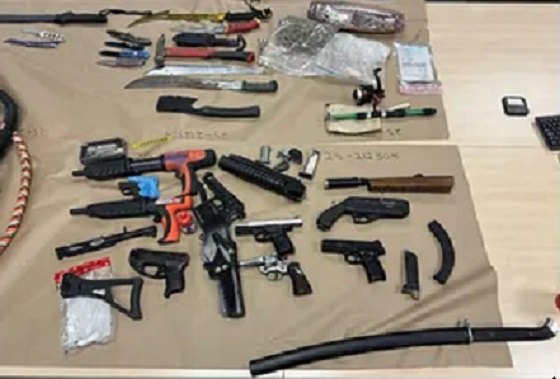

Vancouver police say they have seized a grenade launcher, four guns, and nearly 500 grams of fentanyl and other hard drugs from a fortified Downtown Eastside rooming house that was allegedly feeding a synthetic opioid supply line through the city’s most drug-ravaged blocks.
“Task Force Barrage has come to an end, but our work to curb violence and disrupt organized crime in the Downtown Eastside continues,” Sergeant Steve Addison said, adding “the proliferation of violence and weapons in some residential buildings continues to put the neighbourhood at risk.”
The latest investigation began November 13, when a 42-year-old man suffered serious injuries in an assault near Carrall Street and East Cordova and was taken to hospital. Officers followed leads to a rooming house at 50 East Cordova Street, in the heart of a street-level open drug market that has become notorious in photos and news clips around the world.
On November 18, police say they uncovered a stockpile of illicit drugs, guns and weapons in three rooms of the East Cordova building. According to Addison, there are signs that parts of the property, which is supposed to house low-income residents, were repurposed as a hub to store weapons and distribute contraband throughout the neighbourhood, with some areas “fortified with countersurveillance measures to avoid detection from law enforcement.”
Items seized include four firearms, two imitation guns, a grenade launcher, a firearm suppressor, seven machetes, four flare guns, bullwhips, baseball bats, body armour, handcuffs and ammunition. Officers also seized 486 grams of fentanyl, cannabis, Dilaudid pills and methamphetamine – a quantity police say represents more than 2,500 single doses.
Meanwhile, in a separate update posted November 26 — the day before VPD announced the Cordova Street raid — Vancouver Fire Rescue Services said that on Tuesday, November 21, firefighters responded to 54 overdoses, the highest single-day total in the department’s history. The service said it averaged about 16 overdose calls per day in May, but that figure has surged in recent weeks, and during the most recent income-assistance week, firefighters were averaging roughly 45 overdose responses per day.
While police have not publicly linked the East Cordova seizure to any specific cartel, the mix of fentanyl, fortified real estate and a small armoury of weapons closely tracks the profile of a separate, high-profile British Columbia case in which provincial authorities say a Sinaloa Cartel–aligned cell embedded itself just south of Vancouver.
In that case, a civil forfeiture lawsuit alleged a Sinaloa Cartel–linked fentanyl and cocaine trafficking group set up in a multi-million-dollar mansion near the U.S. border, capable of negotiating major cocaine import deals with Ismael Garcia—known as “El Mayo”—the reputed Sinaloa Cartel chief. According to the filings, the Canada-based syndicate involved at least three men, and belonged to a violent drug trafficking organization that “used and continues to use violence, or threats of violence, to achieve its aims.”
Investigators alleged the Surrey-based group trafficked ketamine, methamphetamine, Xanax, oxycodone, MDMA and fentanyl. “As part of these efforts, the drug trafficking organization has agreed to, and made arrangements to, purchase cocaine from the Cártel de Sinaloa in Mexico,” the filings stated. They added: “the Sinaloa Cartel is a terrorist entity, and the government of Canada listed it as such on February 20, 2025.”
RCMP said they uncovered a substantial cache of weapons and narcotics during a search of the Surrey property on 77th Avenue on September 23, 2024. Opioids seized from the mansion included 400 grams of counterfeit Xanax, 810 oxycodone pills, 5.5 grams of fentanyl and nearly a kilogram of Ecstasy. The province is now seeking forfeiture of the house, which sits about 20 minutes from the Peace Arch border crossing north of Seattle.
Court submissions detailed an arsenal of 23 weapons – ten handguns, two sawed-off shotguns, two hunting rifles, seven assault rifles (two reportedly fitted with screw-on suppressors), and a speargun – alongside about 3.5 kilograms of ketamine and methamphetamine hidden in a compartment in one suspect’s room, hundreds of counterfeit alprazolam pills, a stash of oxycodone, and nearly CAD 15,000 in bundled cash “not consistent with standard banking practices.”
Viewed together, the Downtown Eastside raid and the Surrey mansion case sketch out different ends of what appears to be the same continuum, ultimately pointing to senior criminal leaders in Mexico and China.
The Bureau is a reader-supported publication.
To receive new posts and support my work, consider becoming a free or paid subscriber.
Crime
B.C.’s First Money-Laundering Sentence in a Decade Exposes Gaps in Global Hub for Chinese Drug Cash

Port Coquitlam Mayor Brad West met with Biden Secretary of State Antony Blinken in 2023, to discuss Canada’s enforcement gap on fentanyl money laundering.
Chinese underground-banking conviction is a baby step in a jurisdiction that some experts see as North America’s center of gravity for transnational crime.
In a milestone that is staggering for its rarity in a jurisdiction regarded as a global nexus of Chinese transnational money laundering that facilitates fentanyl trafficking for Mexican and Iranian gangs, British Columbia’s anti-gang unit has finally secured its first money laundering sentencing in a decade.
On Monday, a B.C. Supreme Court judge sentenced 37-year-old Richmond resident Alexandra Joie Chow to 18 months in jail for laundering the proceeds of crime, following a six-year investigation that targeted illegal Chinese underground casinos and unlicensed money transfer businesses in Metro Vancouver. The court also ordered the forfeiture of cash and bank drafts seized during the probe, the Combined Forces Special Enforcement Unit of B.C. (CFSEU) says.
Chow’s case marks the first time in roughly ten years that a money-laundering investigation in British Columbia has actually resulted in a sentencing — a remarkable data point in a province where hundreds of billions have washed through casinos, banks and real estate, according to The Bureau’s estimates, yet almost no one has been successfully prosecuted for the underlying financial crime.
While Chow’s case in itself is relatively small in dollar terms, it followed the catastrophic collapse of the RCMP’s E-Pirate probe into a Richmond underground bank called Silver International, which was alleged to have laundered over $1 billion through a network of Chinese Triad leaders known as “Sam Gor” or “The Company” — a scheme that moved drug cash collected in Chinese diasporas across North and Latin America, cycling the funds back to hundreds of accounts in China, in part through lending gang cash to Asian high-rollers who washed massive sums through B.C. government casinos.
The collapse of E-Pirate raised significant concerns in Washington around Canada’s capacity to prosecute fentanyl money laundering and trafficking. Vancouver-area Mayor Brad West has told The Bureau that the failure of Canadian authorities to secure convictions in that case was explicitly noted in 2023 by senior figures in the Biden administration, including Secretary of State Antony Blinken, in discussions about Canada’s role in North American drug trafficking.
Chow pleaded guilty in February 2025 to one count of laundering proceeds of crime after prosecutors alleged she was part of an underground loan-sharking and money-services scheme that operated in the Lower Mainland. Her plea came almost two years after B.C.’s Joint Illegal Gaming Investigation Team first announced charges.
The trail to that conviction began in August 2019, when B.C.’s Joint Illegal Gaming Investigation Team (JIGIT) quietly launched an investigation into the alleged loan-sharking and money-laundering activities of a man and a woman. Investigators believed the suspects were charging criminal interest rates and operating an unlicensed money services business.
Over the course of the probe, police say they developed evidence that the suspects allegedly laundered more than $828,000 in Canadian cash. On November 5, 2021, JIGIT executed a series of search warrants on properties in Richmond and Burnaby, as well as three vehicles associated to the investigation.
The searches resulted in the seizure of a number of items believed to be tied to money laundering and loan-sharking, including score sheets with client names and payment due dates, four cellular phones, two bank drafts totaling $50,000, and $10,680 in Canadian currency and three high-end vehicles.
Two years later, on November 1, 2023, the B.C. Prosecution Service approved four sets of charges against Chow: money laundering, possessing proceeds of crime, and entering into agreements to receive criminal-rate interest — classic loan-sharking. No other individuals were ultimately charged in the case.
As CFSEU-BC media officer Sgt. Sarbjit Sangha put it in the unit’s statement Monday, this is “the first time in a decade that a money laundering investigation in British Columbia has resulted in a sentencing,” and it “underscores the impact of collaborative investigative work” and JIGIT’s mandate to tackle illegal gaming tied to organized crime, loan-sharking and sophisticated bookmaking.
The scale of the enforcement gap this case exposes is critical to understanding current irritants between Washington and Ottawa, and the Trump administration’s leverage of tariffs on Canada. That campaign of economic pressure, some U.S. and Canadian officials have informed The Bureau, apparently extends from deep concerns in both the Biden and Trump administrations over Ottawa’s lack of meaningful action against massive money laundering through Canada’s financial system — including the TD Bank fentanyl money laundering case prosecuted in the Tri-State area, which exposed transactions similar to those revealed in the Chow investigation in Richmond.
The Cullen Commission into money laundering in B.C. found that by 2014, casinos in the province were accepting nearly $1.2 billion in cash transactions of $10,000 or more in a single year, many involving patrons who showed classic indicators of criminal cash — bricks of small bills delivered in bags by couriers closely watched by organized-crime investigators. JIGIT itself was created as part of the province’s response to that crisis. In a 2021 presentation to the Cullen Commission, then-Unit Commander Staff Sgt. Joel Hussey explained that JIGIT’s money-laundering and loan-sharking probes were focused on “top-tier” organized criminals exploiting casinos and banks, particularly at Richmond’s River Rock Casino Resort, Vancouver’s Parq Casino and Burnaby’s Grand Villa, where investigators saw the most entrenched high-roller criminal activity.
Yet the province’s record in actually getting such cases to the finish line has been abysmal. The most notorious example remains E-Pirate, the massive RCMP investigation that targeted Silver International, a Richmond underground bank alleged to be moving over $1 billion a year in drug and casino cash for Chinese and Mexican cartels and Middle Eastern networks. That case collapsed in 2018–2019 after federal prosecutors mistakenly exposed a confidential informant, leading to a stay of charges despite years of work and huge evidence seizures.
International bodies such as the Financial Action Task Force later used E-Pirate as a case study, describing a “professional” Richmond-hub laundering network that allegedly used B.C. casinos and real estate to clean and move drug proceeds on a global scale. Cullen’s final report, released in 2022, concluded that sophisticated money-laundering networks were moving “staggering amounts” of illicit funds through B.C., while law-enforcement and regulatory agencies failed to respond in a timely or coordinated way.
Whether Chow’s 18-month sentence becomes a template for future Vancouver Model prosecutions — or remains an isolated success in a province still struggling to hold money launderers to account — will be the next test for B.C.’s anti-gang and financial-crime enforcement regime.
Those questions are not just academic in Ottawa. As The Bureau has previously reported, senior officials in Washington — Democrats and Republicans alike — have for years warned that Canada’s failure to deliver sustained proceeds-of-crime prosecutions, and its lack of a RICO-style racketeering law, has turned the country into a structural weak point in North America’s fight against cartel-linked fentanyl networks.
As reported previously by The Bureau, in a high-level meeting in 2023, according to Vancouver-area Mayor Brad West, a longstanding critic of transnational drug networks in his province, Secretary of State Antony Blinken stressed that Washington believes Beijing is effectively weaponizing fentanyl against North Americans—and that Canada stands out as a worrisome weak link in the global supply chain.
West, reflecting on his encounter with Blinken, argued that only bold legislative change, coupled with a willingness to challenge entrenched legal barriers, can dispel the U.S. government’s unease over Canada’s approach. “Secretary Blinken specifically noted the lack of a RICO-style law in Canada,” West said. “He talked about how, in the United States, that law had been used to take down large portions of the mafia. Then he looked at us—one of America’s closest allies—and saw a very concerning weak link.”
According to West, Blinken pointed to China’s role in funneling precursor chemicals into fentanyl labs. He warned that China’s government, if inclined, could stem the flow but has little interest in doing so. “He was incredibly candid,” West recalled. “He confirmed the connection between the Chinese Communist Party, the triads, and the Mexican cartels, telling me these groups are working together—and it’s Canada where they’re finding a safe operating base.”
Blinken also conveyed to West that U.S. agencies had grown hesitant to share certain intelligence with their Canadian counterparts. “He told me that U.S. intelligence and law enforcement are withholding some evidence because they don’t believe we’ll act on it,” West explained. “They’ve lost confidence.”
West added that in ongoing communications, he had learned American officials are shocked that major figures in Asian organized crime “seem to have so much access to our political class. They’re basically saying, ‘What’s going on in Canada?’”
A major concern, according to West, is how known criminals manage to appear at political events or fundraisers with little oversight. “It’s not necessarily that politicians are complicit, but our political structures have weak guardrails,” West said. “The Americans see pictures of transnational criminals mingling at official gatherings and find it baffling.”
The Bureau is a reader-supported publication.
To receive new posts and support my work, consider becoming a free or paid subscriber.


Media bound to pay the price for selling their freedom to (selectively) offend

Sometimes An Ingrate Nation Pt. 2: The Great One Makes His Choice

Recent price declines don’t solve Toronto’s housing affordability crisis

From Exception to Routine. Why Canada’s State-Assisted Suicide Regime Demands a Human-Rights Review
-
Business2 days ago
Recent price declines don’t solve Toronto’s housing affordability crisis
-
MAiD20 hours ago
From Exception to Routine. Why Canada’s State-Assisted Suicide Regime Demands a Human-Rights Review
-
 MAiD2 days ago
Health Canada report finds euthanasia now accounts for over 5% of deaths nationwide
-
 Daily Caller2 days ago
Tech Mogul Gives $6 Billion To 25 Million Kids To Boost Trump Investment Accounts
-
 Automotive2 days ago
Power Struggle: Governments start quietly backing away from EV mandates
-
 Energy2 days ago
Unceded is uncertain
-
 Business18 hours ago
Carney government should privatize airports—then open airline industry to competition
-
 Business2 days ago
New Chevy ad celebrates marriage, raising children