
Opinion
Opinion: The New Environmental Master Plan means City must move some major developments away from 30th Avenue


This opinion piece was submitted by Red Deer Opinion Writer Garfield Marks
July 8 2019 Red Deer city council unanimously accepted an updated Environmental Master Plan which if followed would reverse a serious environmental misstep in their east end plans.
The city’s current plans and discussions could see maximum traffic noise, commuting and emissions, unintended consequences committing too much in one small area.
The potential trouble spot is a 4km. stretch or 40 blocks along 30th Avenue, at the east end of the city. Currently the discussion and plans suggest the locating of 4 shopping centres, 4 gas stations, 4 grocery stores, numerous restaurants, bars, liquor stores, 5 high schools, 2 fire halls, pickle ball courts, Collicutt Centre and possibly the new multi-use aquatic centre.
Forget the downtown, forget Gaetz Avenue, the new “Strip” will be 30 Avenue between 28 Street and 68 Street.
The traffic on 30 Avenue will be heavy, the noise loud and the emissions extreme for the residents along that stretch but then comes the commuting from the other 2/3 of the city.
A city of over 100,000 residents to plan 5 out of 6 high schools in such a small east-end space with the 6th high school only 10 blocks away on 40th Ave. is contradictory to the new updated Environmental Master Plan they unanimously accepted, so there is hope. The plan suggests building facilities like high schools throughout the city.
Collicutt Ctr. is the most popular recreation centre in Red Deer, used by 60% of the recreational sector of society and it is as I previously mentioned on the south-east corner of the city. This is unfortunate for those who do not live in that quarter of the city.
If the city continues down the road of focusing on the 4km. stretch of 30 Ave, then everyone could suffer. The long commutes, the increased traffic, the congestion, the emissions and the noise will affect everyone especially those living near 30 Ave.
There is hope. Perhaps the next high school will be built on the other side of town, perhaps the new aquatic centre will be built on the north-west corner of the city to book-end the highly popular Collicutt Ctr.
There is hope, the city spent $150,000 updating the Environmental Master Plan that the council unanimously accepted, so there is hope.
Or it could just sit on a shelf but I hope not.

Garfield Marks



AI-driven surveillance is shifting from spotting suspects to mapping ordinary life, turning everyday travel into a stream of behavioral data
|
|
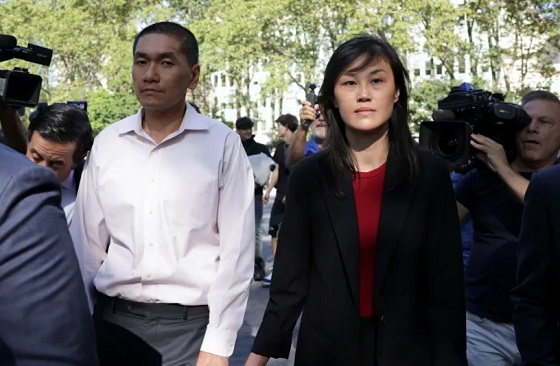


U.S. District Judge Brian Cogan declared a mistrial Monday afternoon in the high-profile foreign-agent and corruption case against former New York state official Linda Sun and her husband Chris Hu, after jurors reported they were hopelessly deadlocked on all 19 counts.
After restarting deliberations Monday morning with an alternate juror, the panel sent a note to Judge Cogan stating:
“Your honor, after extensive deliberations and redeliberations the jury remains unable to reach a unanimous verdict. The jurors’ positions are firmly held.”
Cogan brought the jury into court and asked the foreman whether they had reached agreement on any counts. They replied that they were deadlocked on every one. The judge then declared a mistrial.
Assistant U.S. Attorney Alexander Solomon immediately told the court that the government intends to retry the case “as soon as possible.” A status conference is scheduled for January 26, 2026, to determine next steps.
Jury selection began November 10, 2025, and the government called 41 witnesses to the stand, compared with eight for the defense and one rebuttal witness for the prosecution. Deliberations began on December 12, and by this afternoon the jurors had sent three notes to the court — each indicating deadlock.
As The Bureau reported in its exclusive analysis Friday, the panel’s fracture had become visible as jurors headed into a second week of deliberations in a landmark foreign-agent and corruption trial that reached into two governors’ offices — a case asking a jury of New Yorkers to decide whether Sun secretly served Beijing’s interests while she and Hu built a small business and luxury-property empire during the pandemic, cashing in on emergency procurement as other Americans were locked down.
Prosecutors urged jurors to accept their account of a dense web of family and Chinese-community financial transactions through which Sun and Hu allegedly secured many millions of dollars in business deals tied to “United Front” proxies aligned with Beijing. The defense, by contrast, argued that Sun and Hu were simply successful through legitimate, culturally familiar transactions, not any covert scheme directed by a foreign state.
Sun and Hu face 19 charges in total, including allegations that Sun acted as an unregistered foreign agent for the People’s Republic of China; visa-fraud and alien-smuggling counts tied to a 2019 Henan provincial delegation; a multimillion-dollar pandemic PPE kickback scheme; bank-fraud and identity-misuse allegations; and multiple money-laundering and tax-evasion counts.
Prosecutors have argued that the clearest money trail ran through New York’s COVID procurement scramble and a pair of Jiangsu-linked emails. In closing, Solomon told jurors that Sun’s “reward” for steering contracts was “millions of dollars in kickbacks or bribes,” contending the money was routed through accounts opened in Sun’s mother’s name and via friends and relatives.
The government has tied those claims to a broader narrative — laid out in Solomon’s summation and dissected in The Bureau’s reporting — that Sun functioned as a “trusted insider” who repurposed state access and letterhead to advance Beijing’s priorities, including by allegedly forging Governor Kathy Hochul’s signature on invitation letters used for Chinese provincial delegations, while keeping those relationships hidden from colleagues. The defense, in turn, urged jurors to reject the government’s picture of clandestine agency and argued prosecutors had overreached by treating ordinary diaspora networking, trade promotion, and pandemic procurement as criminal conduct — insisting none of the evidence proved the “direction or control” element central to the Foreign Agents Registration Act.
Whether a future jury will see the same evidence as corruption and covert foreign agency or as culturally familiar commerce and politics — will now be tested again, on a new timetable, in a courtroom that has already shown just how difficult this record is to unanimously interpret.
The Bureau is a reader-supported publication.
To receive new posts and support my work, consider becoming a free or paid subscriber.


Death by a thousand clicks – government censorship of Canada’s internet

Chinese Billionaire Tried To Build US-Born Baby Empire As Overseas Elites Turn To American Surrogates

Viral TikTok video shows 7-year-old cuddling great-grandfather before he’s euthanized

Politicians should be honest about environmental pros and cons of electric vehicles
-
 Alberta2 days ago
Alberta’s huge oil sands reserves dwarf U.S. shale
-
 Energy2 days ago
Canada’s sudden rediscovery of energy ambition has been greeted with a familiar charge: hypocrisy
-
 armed forces2 days ago
Ottawa’s Newly Released Defence Plan Crosses a Dangerous Line
-
 Alberta2 days ago
Canada’s New Green Deal
-
 Business2 days ago
COP30 finally admits what resource workers already knew: prosperity and lower emissions must go hand in hand
-
 Business2 days ago
Ottawa Pretends To Pivot But Keeps Spending Like Trudeau
-
 Agriculture8 hours ago
Why is Canada paying for dairy ‘losses’ during a boom?
-
 Indigenous2 days ago
Residential school burials controversy continues to fuel wave of church arsons, new data suggests