
International
New U.S. Intelligence: ‘Endemic’ CCP Corruption, Organized Crime, and Graft Tied to Xi’s Network

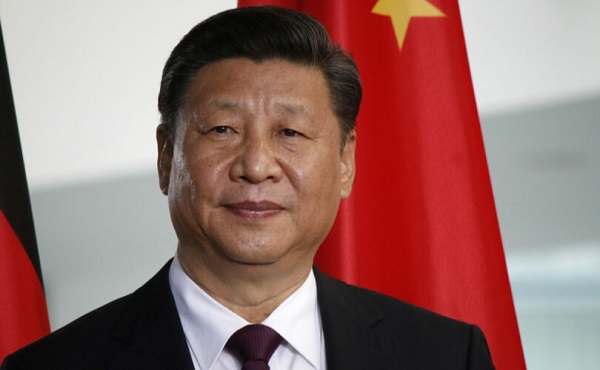



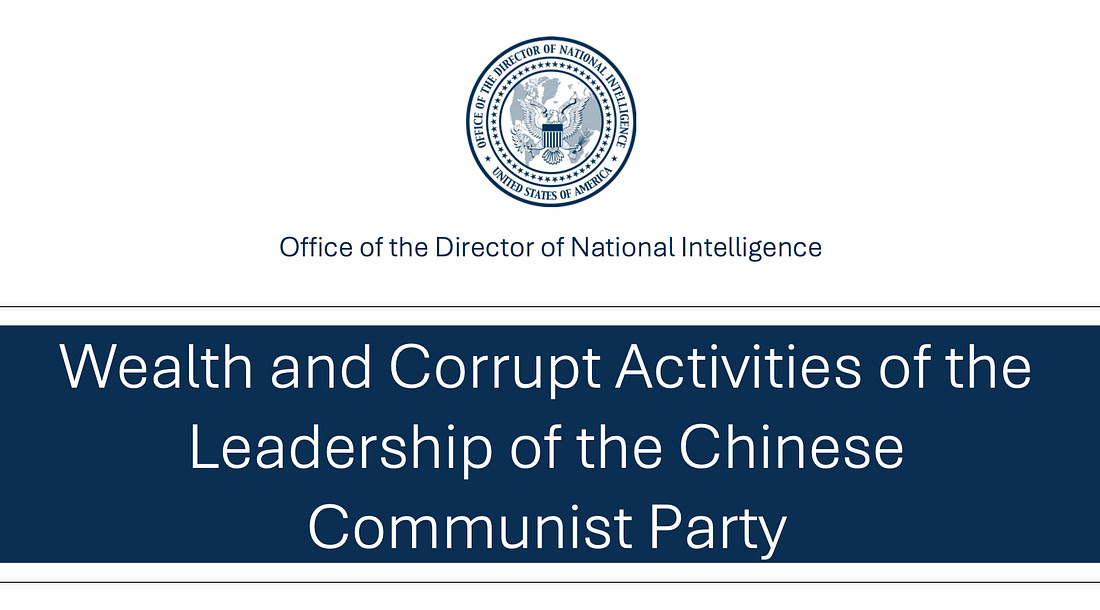
WASHINGTON — An explosive new disclosure by the Office of the Director of National Intelligence has pulled back the curtain on endemic corruption in the Chinese Communist Party—reaching the top echelons of power, including President Xi Jinping. Released as an unclassified document and drafted by ODNI’s National Intelligence Council, the report explains how graft, bribery, and political favoritism are an essential feature of CCP power structures, festering for decades, involving organized crime and factional struggles—even under Xi’s trademark anti-corruption campaign.
By publicly releasing these findings, U.S. officials are signaling a readiness to reveal what intelligence agencies have long documented but kept classified. Sources with knowledge of the matter indicate Washington appears increasingly willing to trace corruption and international money laundering directly to the Politburo, citing explosive cases such as a Western intelligence investigation that allegedly linked Xi Jinping’s cousin, Ming Chai, to a casino money-laundering junket in Australia.
In an era of sharply escalating tensions—spanning trade, technology, and territorial disputes—Washington’s move seems aimed at exposing internal vulnerabilities in Xi’s regime while also undermining the offshore money laundering and strategic corruption Beijing is believed to use for influence-building across the Western Hemisphere and the South Pacific. It offers American citizens a transparent glimpse into what the U.S. government views as key fault lines within China’s ruling party, as the world’s two most powerful states appear set on a collision course—driven in no small part by Xi’s urgent push to subsume Taiwan.
In a striking detail, the ODNI cites journalistic research, initially blocked by Bloomberg before eventually being reported by The New York Times in 2012, that tied immense family wealth to both then-Premier Wen Jiabao and the incoming President Xi. The Times reported that Wen’s immediate family controlled at least $2.7 billion in assets, while Xi’s siblings, nieces, and nephews collectively held more than $1 billion in business and real-estate holdings. Beijing promptly tightened its censorship apparatus in the report’s aftermath, curtailing foreign news outlets that delved into elite wealth.
“Xi may have urged family members to divest holdings as he came into power. However, industry research provides evidence that, as of 2024, Xi’s family retains millions in business interests and financial investments,” the ODNI report says. It adds that corruption cases reaching the highest levels—relying on open-source rather than classified U.S. intelligence—“shows corruption cases within the CCP Central Committee span leading officials overseeing a range of portfolios and projects.”

Among the examples cited is Zhang Wei, a Chinese businessman arrested in 2020 for “organizing, leading, and participating in organized crime; illegal detention; and illegal possession of firearms and ammunition,” before being found guilty the following year of illegally absorbing public deposits.
Another high-profile instance is Chen Gang, who was accused in 2019 of accepting over $18 million in bribes—some tied to his oversight of 2008 Beijing Olympics construction projects. More recently, in April 2024, Yao Qian, Director of the China Securities Regulatory Commission was investigated for “serious violations of discipline and law,” possibly connected to China’s Central Bank Digital Currency initiative.
The fact that Xi—who carefully cultivates an image of austere probity—has family members reportedly retaining millions of dollars in investments remains a deeply sensitive topic for Beijing. In highlighting these details, U.S. intelligence appears to be drawing attention to a broader governance model that incentivizes graft, even as Xi’s “tigers and flies” campaign claims to have taken down nearly five million officials since 2012.
The ODNI’s document underscores how Xi’s crackdown is not merely a legal imperative but also a party-directed instrument for punishing “political indiscipline and ideological impurity.”
“Although Xi has not used the campaign primarily to target his political rivals, a drive to eliminate competing power centers factored significantly into decisions made in the initial phases of the campaign. Early in Xi’s tenure, senior officials with ties to his predecessors were targeted with investigations and arrests,” the report says. “More significantly, political connections to high-ranking officials have not protected officials from prosecution, including those with close personal ties to Xi himself; the anti-corruption campaign has purged top officials considered loyal to Xi and who had risen under his patronage.”
Significantly, the ODNI highlights persistent corruption in the People’s Liberation Army—and a surge of high-level purges driven by Xi’s effort to consolidate control before the PLA’s target of full combat readiness by 2027, with Taiwan looming as the central focus. “In 2024, Xi stressed during a speech to military commanders that ‘the barrels of guns must always be in the hands of those who are loyal and dependable to the Party,’” the report states, adding that Xi’s emphasis on PLA loyalty “may also reflect concerns that corrupt practices will prevent the military from acquiring the capabilities and readiness he has directed it to achieve by 2027, in preparation for a potential conflict over Taiwan.”
The ODNI’s broader assessment emphasizes that corruption is not merely an occasional lapse but a systemic challenge to China’s governance, facilitated by centralized CCP power, a Party-centric concept of law, and minimal transparency. Studies suggest that corruption has persisted in China since its founding, intensified by rapid economic growth in the 1980s and 1990s, and has been so pervasive since 2000 that it threatens the very legitimacy of the regime.
The Bureau is a reader-supported publication.
To receive new posts and support my work, consider becoming a free or paid subscriber.

Business
Largest fraud in US history? Independent Journalist visits numerous daycare centres with no children, revealing massive scam


A young journalist has uncovered perhaps the largest fraud scheme in US history.
He certainly isn’t a polished reporter with many years of experience, but 23 year old independent journalist Nick Shirley seems to be getting the job done. Shirley has released an incredible video which appears to outline fraud after fraud after fraud in what appears to be a massive taxpayer funded scheme involving up to $9 Billion Dollars.
In one day of traveling around Minneapolis-St. Paul, Shirley appears to uncover over $100 million in fraudulent operations.
🚨 Here is the full 42 minutes of my crew and I exposing Minnesota fraud, this might be my most important work yet. We uncovered over $110,000,000 in ONE day. Like it and share it around like wildfire! Its time to hold these corrupt politicians and fraudsters accountable
We ALL… pic.twitter.com/E3Penx2o7a
— Nick shirley (@nickshirleyy) December 26, 2025
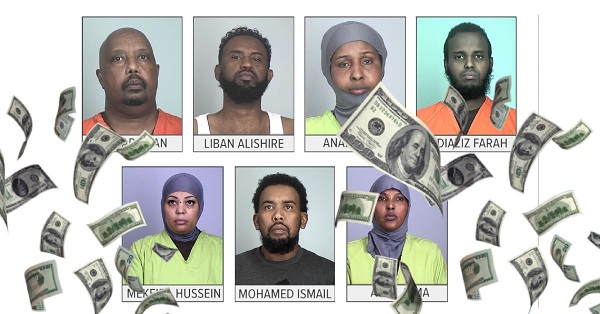

Federal prosecutors say Minnesota’s exploding social-services fraud scandal may now rival nearly the entire economy of Somalia, with as much as $9 billion allegedly stolen from taxpayer-funded programs in what authorities describe as industrial-scale abuse that unfolded largely under the watch of Democrat Gov. Tim Walz. The staggering new estimate is almost nine times higher than the roughly $1 billion figure previously suspected and amounts to about half of the $18 billion in federal funds routed through Minnesota-run social-services programs since 2018, according to prosecutors. “The magnitude cannot be overstated,” First Assistant U.S. Attorney Joe Thompson said Thursday, stressing that investigators are still uncovering massive schemes. “This is not a handful of bad actors. It’s staggering, industrial-scale fraud. Every day we look under a rock and find another $50 million fraud operation.”
Authorities say the alleged theft went far beyond routine overbilling. Dozens of defendants — the vast majority tied to Minnesota’s Somali community — are accused of creating sham businesses and nonprofits that claimed to provide housing assistance, food aid, or health-care services that never existed, then billing state programs backed by federal dollars. Thompson said the opportunity became so lucrative it attracted what he called “fraud tourism,” with out-of-state operators traveling to Minnesota to cash in. Charges announced Thursday against six more people bring the total number of defendants to 92.
BREAKING: First Assistant U.S. Attorney Joe Thompson revealed that 14 state Medicaid programs have cost Minnesota $18 billion since 2018, including more than $3.5 billion in 2024 alone.
Thompson stated, "Now, I'm sure everyone is wondering how much of this $18 billion was… pic.twitter.com/hCNDBuCTYH
— FOX 9 (@FOX9) December 18, 2025
Among the newly charged are Anthony Waddell Jefferson, 37, and Lester Brown, 53, who prosecutors say traveled from Philadelphia to Minnesota after spotting what they believed was easy money in the state’s housing assistance system. The pair allegedly embedded themselves in shelters and affordable-housing networks to pose as legitimate providers, then recruited relatives and associates to fabricate client notes. Prosecutors say they submitted about $3.5 million in false claims to the state’s Housing Stability Services Program for roughly 230 supposed clients.
Other cases show how deeply the alleged fraud penetrated Minnesota’s health-care programs. Abdinajib Hassan Yussuf, 27, is accused of setting up a bogus autism therapy nonprofit that paid parents to enroll children regardless of diagnosis, then billed the state for services never delivered, netting roughly $6 million. Another defendant, Asha Farhan Hassan, 28, allegedly participated in a separate autism scheme that generated $14 million in fraudulent reimbursements, while also pocketing nearly $500,000 through the notorious Feeding Our Future food-aid scandal. “Roughly two dozen Feeding Our Future defendants were getting money from autism clinics,” Thompson said. “That’s how we learned about the autism fraud.”
The broader scandal began to unravel in 2022 when Feeding Our Future collapsed under federal investigation, but prosecutors say only in recent months has the true scope of the alleged theft come into focus. Investigators allege large sums were wired overseas or spent on luxury vehicles and other high-end purchases. The revelations have fueled political fallout in Minnesota and prompted renewed federal scrutiny of immigration-linked fraud as well as criticism of state oversight failures. Walz, who is seeking re-election in 2026 after serving as Kamala Harris’ running mate in 2024, defended his administration Thursday, saying, “We will not tolerate fraud, and we will continue to work with federal partners to ensure fraud is stopped and fraudsters are caught.” Prosecutors, however, made clear the investigation is far from finished — and warned the final tally could climb even higher.


Why is Canada paying for dairy ‘losses’ during a boom?

Ottawa’s Newly Released Defence Plan Crosses a Dangerous Line

Hunting Poilievre Covers For Upcoming Demographic Collapse After Boomers
Carney Floor Crossing Raises Counterintelligence Questions aimed at China, Former Senior Mountie Argues
-
 International16 hours ago
Ottawa is still dodging the China interference threat
-
 Business14 hours ago
There’s No Bias at CBC News, You Say? Well, OK…
-
 Automotive13 hours ago
Canada’s EV gamble is starting to backfire
-
 International15 hours ago
2025: The Year The Narrative Changed
-
 Fraser Institute1 day ago
Carney government sowing seeds for corruption in Ottawa
-
 Business1 day ago
Residents in economically free states reap the rewards
-
 Alberta1 day ago
Alberta Next Panel calls for less Ottawa—and it could pay off
-
 Daily Caller1 day ago
While Western Nations Cling to Energy Transition, Pragmatic Nations Produce Energy and Wealth