
Censorship Industrial Complex
New federal legislation should remind Canadians of Orwell’s 1984


From the Fraser Institute
By Jake Fuss and Alex Whalen
The legislation seeks to punish citizens not just for what the governments deems as “hate speech” but also grants the state power to bring Canadians before tribunals on suspicion that they might say something hateful in the future.
This year marks the 75th anniversary of George Orwell’s classic novel 1984 (and it’s been 40 years since the actual year 1984). In the novel, Orwell explains the dangers of totalitarianism by exploring what happens when government exercises extreme levels of control over citizens including censoring and controlling language. While Canada is a relatively free country in 2024, there are aspects of Orwell’s world reflected in government policy today.
The Human Freedom Index, published annually by the Fraser Institute and Cato Institute, defines freedom as a social concept that recognizes the dignity of individuals by the absence of coercive constraint. In a free society, citizens are free to do, say or think almost anything they want, provided it does not infringe on the right of others to do the same.
Canada currently fares relatively well compared to other countries on the Human Freedom Index, placing 13th out of 165 countries. However, our score has dropped six spots on the index since 2008 when Canada recorded its highest ever rank.
This is not surprising given the Trudeau government’s recent efforts to control and manage the free exchange of ideas. The recent Online Streaming Act imposes various content rules on major streaming services such as Netflix, and requirements to extract funds to be redirected toward favoured groups. The Act seemingly seeks to bring the entire Internet under the regulation of a government body.
In another piece of recent legislation, the Online News Act, the government attempted to force certain social media platforms to pay other legacy news outlets for carrying content. In response, the social media platforms chose simply not to allow content from those news providers on their platforms, resulting in a dramatic reduction of Canadians’ access to news.

Now, a new piece of federal legislation—Bill C-63, the Online Harms Act—seeks to control language and grant government power to punish citizens for what the government deems to be unfavourable speech.
The government has sold Bill C-63 as a way to promote the online safety of Canadians, reduce harms, and ensure the operators of social media services are held accountable. In reality, however, the bill is Orwell’s Big Brother concept brought to life, where government controls information and limits free exchange. The legislation seeks to punish citizens not just for what the governments deems as “hate speech” but also grants the state power to bring Canadians before tribunals on suspicion that they might say something hateful in the future. Not surprisingly, many have raised concerns about the constitutionality of the Bill, which will surely be tested in court.
Put differently, the Bill dictates that citizens may not only be punished for speech crimes, but also punished when another person or group of individuals believes they are likely to commit such a crime. The legislation outlines punishment mechanisms at the government’s disposal, including electronic monitoring devices, house arrest or jail time. Frighteningly, if the government doesn’t like what you say or even suspects they won’t like what you might say, then you could face serious repercussions.
That sounds eerily similar to Orwell’s concept of the Thought Police. In 1984, a secret police force investigates and punishes “thoughtcrimes,” which are personal and political thoughts unapproved by the state. The Thought Police monitor citizens and arrest anyone who engages in such crimes, to prevent personal autonomy and freedom of thought, thus providing the state with immense power and control over the populace.
The big government approach inherent in the Online Harms Act and others is antithetical to the idea of personal freedom. Famed English philosopher J.S. Mill was particularly observant in recognizing the perils of controlling and punishing speech government officials deem “dangerous.” In his book On Liberty, Mill stated “If any opinion is compelled to silence, that opinion may, for aught we can certainly know, be true. To deny this is to assume our own infallibility. Secondly, though the silenced opinion be an error, it may, and very commonly does, contain a portion of the truth; and since the general of prevailing opinion on any subject is rarely or never the whole truth, it is only by the collision of adverse opinions that the remainder of the truth has any chance of being supplied.”
Orwell’s famous novel provides a guidebook for what governments should avoid doing at all costs. Unfortunately, hints of 1984 have seeped into government policy in Canada today. The erosion of personal freedom is not something we should take for granted anymore.

Censorship Industrial Complex
Conservative MP Leslyn Lewis slams Liberal plan targeting religious exemption in hate speech bil
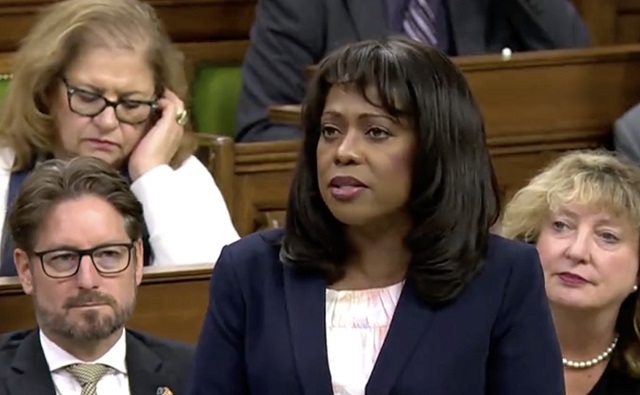
From LifeSiteNews
Bill C-9 is being called an attempt to criminalize sections of the Bible, Quran, Torah, and other sacred texts in Canada.
Canadian Conservative MP Leslyn Lewis blasted a federal government plan to criminalize parts of the Bible as an attack on “Christians,” warning it sets a “dangerous precedent” for Canadian society.
“The Liberal government has agreed to remove the religious exemption in their hate speech bill, C-9, to secure Bloc support and push this bill through Parliament,” Lewis wrote Tuesday on X.
“This is not a minor adjustment. This shift comes at the direct expense of Christians and other religious communities across Canada.”
As reported by LifeSiteNews, a government insider revealed that the Liberal government of Prime Minister Mark Carney plans to remove religious exemptions from Canada’s hate-speech laws by modifying a bill.
Bill C-9, the Combating Hate Act, as reported by LifeSiteNews, has been blasted by constitutional experts as allowing empowered police and the government to go after those it deems have violated a person’s “feelings” in a “hateful” way.
A recent media report states that the Carney Liberals and the separatist Bloc Québécois want to amend Bill C-9, which would “criminalize sections of the Bible, Quran, Torah, and other sacred texts,” Conservative leader Pierre Poilievre noted yesterday on X.
Lewis warned that “no government” should “ever negotiate away religious liberty in exchange for political support.”
“No party should decide which beliefs are acceptable and which ones carry criminal risk,” she warned.
She added that the Liberal government of Carney’s plan to amend Bill C-9 is a “dangerous precedent.”
“Religious freedom is not a political tool. It is a Charter right, a constitutional protection, and a cornerstone of our society,” she warned.
Poilievre blasted the Liberals’ plan as well, warning Liberal-Bloc amendments to C-9 will “criminalize sections of the Bible, Quran, Torah, and other sacred texts.”
“Conservatives will oppose this latest Liberal assault on freedom of expression and religion,” he noted on X earlier this week.
In response, the party launched a petition over fear that religious texts could be criminalized.
Liberal MP Marc Miller had said earlier in the year that certain passages of the Bible are “hateful” because of what it says about homosexuality and those who recite the passages should be jailed. As reported by LifeSiteNews, he was recently appointed as a government minister by Prime Minister Mark Carney.

From the Frontier Centre for Public Policy
By Collin May
Targeting comedians is a sign of political insecurity
A democracy that fears its comedians is a democracy in trouble. That truth landed hard when Graham Linehan, the Irish writer behind Father Ted and The IT Crowd, stepped off a plane at Heathrow on Sept. 1, 2025, and was met by five London Metropolitan Police officers ready to arrest him for three posts on X.
Returning to the UK from Arizona, he was taken into custody on the charge of “suspicion of inciting violence”, an allegation levelled with increasing ease in an age wary of offence. His actual “crime” amounted to three posts, the most contentious being a joke about trans-identified men in exclusively female spaces and a suggestion that violated women respond with a swift blow to a very sensitive part of the male’s not-yet-physically-transitioned anatomy.
The reaction to Linehan’s arrest, from J.K. Rowling to a wide array of commentators, was unqualified condemnation. Many wondered whether free speech had become a museum piece in the UK. Asked about the incident, British Prime Minister Keir Starmer defended his country’s reputation for free expression but declined to address the arrest itself.
Canada has faced its own pressures on comedic expression. In 2022, comedian Mike Ward saw a 12-year legal saga end when the Supreme Court of Canada ruled five-to-four that the Quebec Human Rights Commission had no jurisdiction to hear a complaint about comments Ward made regarding a disabled Quebec boy. The ruling confirmed that human rights bodies cannot police artistic expression when no discrimination in services or employment has occurred. In that case, comic licence survived narrowly.
These cases reveal a broader trend. Governments and institutions increasingly frame comedy as a risk rather than a social pressure valve. In an environment fixated on avoiding perceived harm, humour becomes an easy and symbolic target. Linehan’s arrest underscores the fragility of free speech, especially in comedic form, in countries that claim to value democratic openness.
Comedy has long occupied an unusual place in public life. One of its earliest literary appearances is in Homer’s Iliad. A common soldier, Thersites, is ugly, sharp-tongued and irreverent. He speaks with a freedom others will not risk, mocking Agamemnon and voicing the frustrations of rank-and-file soldiers. He represents the instinct to puncture pretension. In this sense, comedy and philosophy share a willingness to speak uncomfortable truths that power prefers to avoid.
Aristotle, in his Poetics, noted that tragedy imitates noble actions and depicts people who are to be taken seriously. Comedy, by contrast, imitates those who appear inferior. Yet this lowly status is precisely what gives comedy its political usefulness. It allows performers to say what respectable voices cannot, revealing hypocrisies that formal discourse leaves untouched.
In the Iliad, Thersites does not escape punishment. Odysseus, striving to restore order, strikes him with Agamemnon’s staff, and the soldiers laugh as Thersites is silenced. The scene captures a familiar dynamic. Comedy can expose authority’s flaws, but authority often responds by asserting its dominance. The details shift across history, but the pattern endures.
Modern democracies are showing similar impatience. Comedy provides a way to question conventions without inviting formal conflict. When governments treat jokes as misconduct, they are not protecting the public from harm. They are signalling discomfort with scrutiny. Confident systems do not fear irreverence; insecure ones do.
The growing targeting of comedians matters because it reflects a shift toward institutions that view dissent, even in comedic form, as a liability. Such an approach narrows the space for open dialogue and misunderstands comedy’s role in democratic life. A society confident in itself tolerates mockery because it trusts its citizens to distinguish humour from harm.
In October, the British Crown Prosecution Service announced it would not pursue charges against Linehan. The London Metropolitan Police Service also said it would stop recording “non-crime hate incidents”, a controversial category used to document allegations of hateful behaviour even when no law has been broken. These reversals are welcome, but they do not erase the deeper unease that allowed the arrest to happen.
Comedy survives, but its environment is shifting. In an era where leaders are quick to adopt moral language while avoiding meaningful accountability, humour becomes more necessary, not less. It remains one of the few public tools capable of exposing the distance between political rhetoric and reality.
The danger is that in places where Agamemnon’s folly, leadership driven by pride and insecurity, takes root, those who speak uncomfortable truths may find themselves facing not symbolic correction but formal sanctions. A democracy that begins by targeting its jesters rarely stops there.
Collin May is a Senior Fellow with the Frontier Centre for Public Policy, a lawyer, and Adjunct Lecturer in Community Health Sciences at the University of Calgary, with degrees in law (Dalhousie University), a Masters in Theological Studies (Harvard) and a Diplome d’etudes approfondies (Ecole des hautes etudes, Paris).


Landmark 2025 Study Says Near-Death Experiences Can’t Be Explained Away

STUDY: TikTok, Instagram, and YouTube Shorts Induce Measurable “Brain Rot”
Blacked-Out Democracy: The Stellantis Deal Ottawa Won’t Show Its Own MPs
Red Deer’s Jason Stephan calls for citizen-led referendum on late-term abortion ban in Alberta
-
 Business2 days ago
Recent price declines don’t solve Toronto’s housing affordability crisis
-
 Daily Caller2 days ago
Tech Mogul Gives $6 Billion To 25 Million Kids To Boost Trump Investment Accounts
-
 Alberta1 day ago
Alberta will defend law-abiding gun owners who defend themselves
-
 Business2 days ago
Canada’s future prosperity runs through the northwest coast
-
 Business2 days ago
Ottawa’s gun ‘buyback’ program will cost billions—and for no good reason
-
 National2 days ago
Canada Needs an Alternative to Carney’s One Man Show
-
 Alberta1 day ago
This new Canada–Alberta pipeline agreement will cost you more than you think
-
 MAiD16 hours ago
From Exception to Routine. Why Canada’s State-Assisted Suicide Regime Demands a Human-Rights Review