
Health
Mel Gibson Drops Two Medical Bombshells on the Joe Rogan Podcast



From The Vigilant Fox
Being familiar with alternative cancer therapies, Rogan concluded Gibson was talking about antiparasitic drugs Ivermectin and Fenbendazole, which Gibson confirmed with a nod.
In the final hour of episode #2254 of The Joe Rogan Experience, actor Mel Gibson shared two shocking medical experiences that defy mainstream knowledge.
It all started the moment Anthony Fauci’s name lept out of Gibson’s mouth.
“I don’t know why Fauci’s still walking around… or at least free,” Gibson remarked before revealing that he had “road rage” after listening to RFK Jr.’s book about Anthony Fauci.
Piling on, Joe Rogan quickly dismantled any doubts about the book’s accuracy, arguing that if it were full of lies, RFK Jr. would have been sued into the ground and publicly humiliated.
“First of all, people that don’t believe it. How come RFK Jr. didn’t get sued? How come there’s no lawsuits? If there were lies, there would be lawsuits. You’d be publicly humiliated,” Rogan pointed out.
“That book is an accurate depiction of what Anthony Fauci did during the AIDS crisis, which probably was an AZT crisis. It wasn’t an AIDS crisis.”

The first bombshell dropped when Gibson shared that he “couldn’t walk for three months” after taking Fauci’s pet drug for COVID.
“[Remdesivir] kills you. I found out that afterward. And that’s why I wonder about Fauci,” Gibson said.
“Remdesivir is so lethal it got nicknamed ‘Run Death Is Near’ after it started killing thousands of COVID patients in the hospital,” Stella Paul wrote in a previous report.
“The experts claimed that remdesivir would stop COVID; instead, it stopped kidney function, then blasted the liver and other organs.”
Unfortunately, Gibson’s gardener wasn’t as fortunate. After reportedly receiving the kidney-toxic treatment, he tragically passed away.
“I knew the guy for 20 years, and we both went to the same hospital, and he died, and I didn’t,” Gibson lamented. “I think we both got remdesivir, which is not good.”

While you’re here, please take a few seconds to subscribe for more
reports like this one.
The most jaw-dropping moment happened when Gibson made a statement that could threaten the entire cancer industry.
Gibson revealed that he has three friends who had “stage four cancer,” and now “all three of them don’t have cancer right now at all.”
“And they had some serious stuff going on,” Gibson added.
Rogan asked, “What did they take?”—to which Gibson hesitantly replied, “They took what you’ve heard they’ve taken.”
Being familiar with alternative cancer therapies, Rogan concluded Gibson was talking about antiparasitic drugs Ivermectin and Fenbendazole, which Gibson confirmed with a nod.

Corroborating what Gibson reported to Rogan, cancer surgeon Dr. Kathleen Ruddy revealed to The Epoch Times last year that she has seen several late-stage cancer patients make dramatic recoveries after taking Ivermectin.
One patient had a grim future, and then something remarkable happened. This man had stage four prostate cancer and tried all the conventional protocols before doctors told him that there was nothing they could do.
Then, he started taking ivermectin…
Within six months, the metastatic lesions began to disappear, and in less than a year, “he was out dancing for four hours” three nights per week, according to Dr. Ruddy.
A similar scenario unfolded for another man named Eddie. He was also in bad shape.
Eddie was diagnosed with two unresectable esophageal tumors that surgeons wouldn’t go near. He was a smoker, couldn’t swallow, and had lost 40 pounds in a year and a half.
“Within a couple of weeks, he sounded stronger. He could swallow. He had gained six pounds. His voice was better,” reported Dr. Ruddy.

Several weeks later, Dr. Ruddy said to Eddie, “You need to get a scan.”
Guess what happened?
“We got the scan. No tumors. Gone. Gone. The problem was that he had sold his fishing boat. That was the biggest problem. He was getting better. His tumor was gone. Now he’s got to buy another fishing boat … I was like, ‘Well, now, that’s interesting.’”
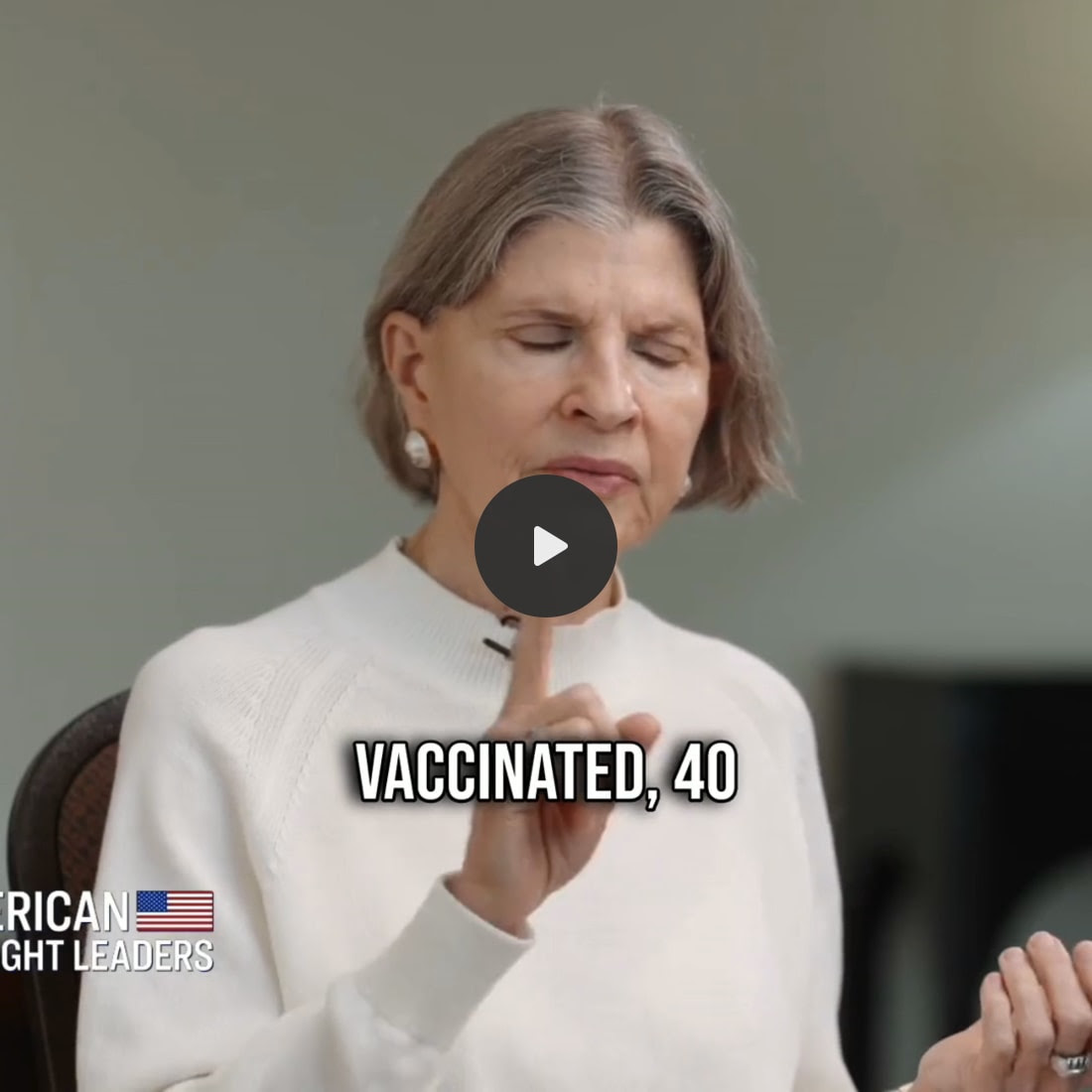
Recently, anecdotal reports have also praised Fenbendazole as a potentially miraculous anti-cancer drug.
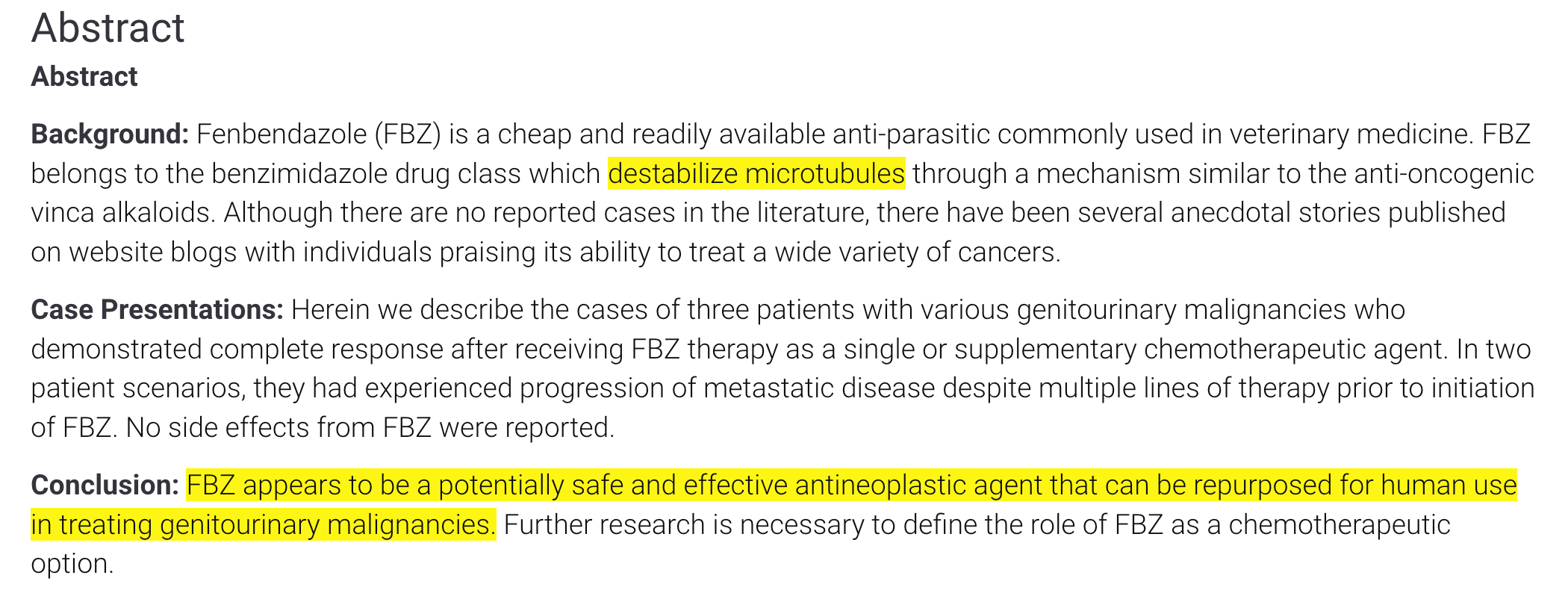
It reportedly works by destabilizing microtubules, the structures that help cancer cells divide and grow.
By disrupting this process, Fenbendazole is believed to effectively halt cancer cell division and slow or stop tumor growth.

A case series published in 2020 documented three cancer patients who experienced complete remission after taking Fenbendazole.
“FBZ (Fenbendazole) appears to be a potentially safe and effective antineoplastic agent that can be repurposed for human use in treating genitourinary malignancies.’”
 |
Adding to the growing evidence in support of Fendendazole’s use case against cancer, an Oklahoma man credited his miraculous cancer recovery to the pet med after overcoming terminal small cell lung cancer, defying a less than 1% survival rate and leaving doctors baffled.
EDMOND, Okla. — When you tell someone a medicine for dogs cured your cancer, you better be ready for some skeptics, but Joe Tippens says it saved his life, and the lives of others.
Now, even cancer researchers are open to the possibility it might be true.
“My stomach, my neck, my liver, my pancreas, my bladder, my bones — it was everywhere,” Tippens said.
Tippens said he was told to go home, call hospice and say his goodbyes two years ago.
The doctors were unanimous, he was going to die of small cell lung cancer.
“Once that kind of cancer goes that far afield, the odds of survival are less than 1 percent, and median life expectancy is three months,” Tippens said.
Tippens said he went from 220 pounds to 110.
“I was a skeleton with skin hanging off of it,” he said. “It was difficult.”
But that was January of 2017. Today, Tippens is very much alive and what he credits for his survival has doctors scratching their heads, and the rest of us raising eyebrows.
“About half the people think I’m just crazy,” he said. “And about half the people want to know more and dig deeper.”
Tippens said he received a tip from a veterinarian, of all people. And in his desperation, he turned from people medicine to dog medicine.
Specifically, something you give your dog when it has worms.
“The truth is stranger than fiction, you know?” Tippens said, laughing.
Just three months later, Tippens says, his cancer was gone.

Thanks for reading! If you enjoyed this post, please do me a quick favor and follow this page (@VigilantFox) for more reports like this one.

Health
All 12 Vaccinated vs. Unvaccinated Studies Found the Same Thing: Unvaccinated Children Are Far Healthier


I joined Del Bigtree in studio on The HighWire to discuss what the data now make unavoidable: the CDC’s 81-dose hyper-vaccination schedule is driving the modern epidemics of chronic disease and autism.
This was not a philosophical debate or a clash of opinions. We walked through irrefutable, peer-reviewed evidence showing that whenever vaccinated and unvaccinated children are compared directly, the unvaccinated group is far healthier—every single time.
Reanalyzing the Largest Vaccinated vs. Unvaccinated Birth-Cohort Study Ever Conducted
At the center of our discussion was our peer-reviewed reanalysis of the Henry Ford Health System vaccinated vs. unvaccinated birth-cohort study (Lamerato et al.)—the largest and most rigorous comparison of its kind ever conducted.
 |
 |
|
The original authors relied heavily on Cox proportional hazards models, a time-adjusted approach that can soften absolute disease burden. Even so, nearly all chronic disease outcomes were higher in vaccinated children.
Our reanalysis used direct proportional comparisons, stripping away the smoothing and revealing the full magnitude of the signal.
- All 22 chronic disease categories favored the unvaccinated cohort when proportional disease burden was examined
- Cancer incidence was 54% higher in vaccinated children (0.0102 vs. 0.0066)
- When autism-associated conditions were grouped appropriately—including autism, ADHD, developmental delay, learning disability, speech disorder, neurologic impairment, seizures, and related diagnoses—the vaccinated cohort showed a 549% higher odds of autism-spectrum–associated clinical outcomes
The findings are internally consistent, biologically coherent, and concordant with every prior vaccinated vs. unvaccinated study, all of which show drastically poorer health outcomes among vaccinated children
The 12 Vaccinated vs. Unvaccinated Studies Regulators Ignore
In the McCullough Foundation Autism Report, we compiled all 12 vaccinated vs. unvaccinated pediatric studies currently available. These studies span different populations, countries, study designs, and data sources.
 |
Every single one reports the same overall pattern. Across all 12 studies, unvaccinated children consistently exhibit substantially lower rates of chronic disease, including:
- Autism and other neurodevelopmental disorders
- ADHD, tics, learning and speech disorders
- Asthma, allergies, eczema, and autoimmune conditions
- Chronic ear infections, skin disorders, and gastrointestinal illness
This level of consistency across independent datasets is precisely what epidemiology looks for when assessing causality. It also explains why no federal agency has ever conducted—or endorsed—a fully vaccinated vs. fully unvaccinated safety study.
Flu Shot Failure
We also addressed the persistent failure of seasonal influenza vaccination.
A large Cleveland Clinic cohort study of 53,402 employees followed participants during the 2024–2025 respiratory viral season and found:
- 82.1% of employees were vaccinated against influenza
- Vaccinated individuals had a 27% higher adjusted risk of influenza compared with the unvaccinated state (HR 1.27; 95% CI 1.07–1.51; p = 0.007)
- This corresponded to a negative vaccine effectiveness of −26.9% (95% CI −55.0 to −6.6%), meaning vaccination was associated with increased—not reduced—risk of influenza
 |
When vaccination exposure increases, chronic disease, neurodevelopmental disorders, and inflammatory illness increase with it. When children are unvaccinated, they are measurably healthier across virtually every outcome that matters.
The science needed to confront the chronic disease and autism epidemics already exists. What remains is the willingness to acknowledge it.
Epidemiologist and Foundation Administrator, McCullough Foundation
Support our mission: mcculloughfnd.org
Please consider following both the McCullough Foundation and my personal account on X (formerly Twitter) for further content.
FOCAL POINTS (Courageous Discourse) is a reader-supported publication.
To receive new posts and support my work, consider becoming a free or paid subscriber.

From the Fraser Institute
By Nadeem Esmail and Mackenzie Moir
It’s an exciting time in Canadian health-care policy. But even the slew of new reforms in Alberta only go part of the way to using all the policy tools employed by high performing universal health-care systems.
For 2026, for the sake of Canadian patients, let’s hope Alberta stays the path on changes to how hospitals are paid and allowing some private purchases of health care, and that other provinces start to catch up.
While Alberta’s new reforms were welcome news this year, it’s clear Canada’s health-care system continued to struggle. Canadians were reminded by our annual comparison of health care systems that they pay for one of the developed world’s most expensive universal health-care systems, yet have some of the fewest physicians and hospital beds, while waiting in some of the longest queues.
And speaking of queues, wait times across Canada for non-emergency care reached the second-highest level ever measured at 28.6 weeks from general practitioner referral to actual treatment. That’s more than triple the wait of the early 1990s despite decades of government promises and spending commitments. Other work found that at least 23,746 patients died while waiting for care, and nearly 1.3 million Canadians left our overcrowded emergency rooms without being treated.
At least one province has shown a genuine willingness to do something about these problems.
The Smith government in Alberta announced early in the year that it would move towards paying hospitals per-patient treated as opposed to a fixed annual budget, a policy approach that Quebec has been working on for years. Albertans will also soon be able purchase, at least in a limited way, some diagnostic and surgical services for themselves, which is again already possible in Quebec. Alberta has also gone a step further by allowing physicians to work in both public and private settings.
While controversial in Canada, these approaches simply mirror what is being done in all of the developed world’s top-performing universal health-care systems. Australia, the Netherlands, Germany and Switzerland all pay their hospitals per patient treated, and allow patients the opportunity to purchase care privately if they wish. They all also have better and faster universally accessible health care than Canada’s provinces provide, while spending a little more (Switzerland) or less (Australia, Germany, the Netherlands) than we do.
While these reforms are clearly a step in the right direction, there’s more to be done.
Even if we include Alberta’s reforms, these countries still do some very important things differently.
Critically, all of these countries expect patients to pay a small amount for their universally accessible services. The reasoning is straightforward: we all spend our own money more carefully than we spend someone else’s, and patients will make more informed decisions about when and where it’s best to access the health-care system when they have to pay a little out of pocket.
The evidence around this policy is clear—with appropriate safeguards to protect the very ill and exemptions for lower-income and other vulnerable populations, the demand for outpatient healthcare services falls, reducing delays and freeing up resources for others.
Charging patients even small amounts for care would of course violate the Canada Health Act, but it would also emulate the approach of 100 per cent of the developed world’s top-performing health-care systems. In this case, violating outdated federal policy means better universal health care for Canadians.
These top-performing countries also see the private sector and innovative entrepreneurs as partners in delivering universal health care. A relationship that is far different from the limited individual contracts some provinces have with private clinics and surgical centres to provide care in Canada. In these other countries, even full-service hospitals are operated by private providers. Importantly, partnering with innovative private providers, even hospitals, to deliver universal health care does not violate the Canada Health Act.
So, while Alberta has made strides this past year moving towards the well-established higher performance policy approach followed elsewhere, the Smith government remains at least a couple steps short of truly adopting a more Australian or European approach for health care. And other provinces have yet to even get to where Alberta will soon be.
Let’s hope in 2026 that Alberta keeps moving towards a truly world class universal health-care experience for patients, and that the other provinces catch up.


Alberta Next Panel calls to reform how Canada works

Canadian government launches trial version of digital ID for certain licenses, permits

Georgia county admits illegally certifying 315k ballots in 2020 presidential election

End Supply Management—For the Sake of Canadian Consumers
-
International2 days ago
Georgia county admits illegally certifying 315k ballots in 2020 presidential election
-
 Energy2 days ago
‘The electric story is over’
-
 Energy2 days ago
The Top News Stories That Shaped Canadian Energy in 2025 and Will Continue to Shape Canadian Energy in 2026
-
 Daily Caller1 day ago
US Halts Construction of Five Offshore Wind Projects Due To National Security
-
 Alberta1 day ago
Alberta Next Panel calls for less Ottawa—and it could pay off
-
 Daily Caller1 day ago
While Western Nations Cling to Energy Transition, Pragmatic Nations Produce Energy and Wealth
-
 Fraser Institute2 days ago
Carney government sowing seeds for corruption in Ottawa
-
 Bruce Dowbiggin1 day ago
Be Careful What You Wish For In 2026: Mark Carney With A Majority