
Bruce Dowbiggin
It Gets Late Early These Days: Time To Bounce Biden & Trudeau?

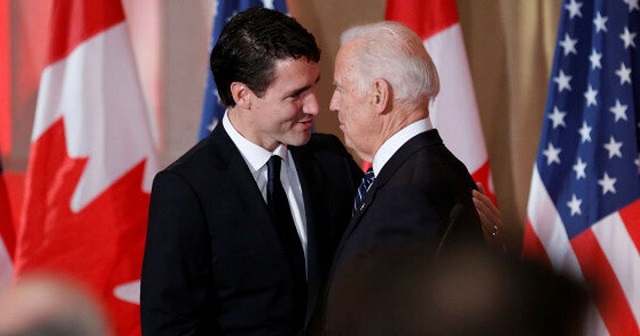

“Take out the papers and the trash, or you don’t get no spending cash.”
Whether you’re in the stock market or real estate the question of when to sell is paramount. When to dump a tanking investment or sell a house in a bad market is an art form. Hence the expression, Timing is everything.
For the incumbent governments in Canada and the U.S. the time has come to make that risky decision of when to fish or when to cut bait with their respective leaders.
In Canada the federal Liberals, still shacked up with the NDP in a common-law embrace, have been doing denial for an extended period since they used the Covid-19 lockdown to sneak out a minority government in 2021. As soon as voters awoke to the lockdown hoax they’d lived through— courtesy of Justin Trudeau— they began to abandon him as a marketable product.
With five years to procrastinate, however, they indulged their radical agenda of climate and culture rather than address how they might be re-elected with Trudeau and his Quebec-dominated cabinet. They blew black holes in Canada’s debt load. There was a PR strategy to label Pierre Poilievre as a mini-Trump. And to buy up the floundering legacy media sources before there 2025 vote.

But for the most part the Liberals still saw Happy Ways where the mainstream saw an intellectual lightweight tilting at every Woke windmill. Since 2021 the polls have shown a steady erosion to the point where they see a Conservative majority— maybe even super-majority— if an election were called today.
Now all governments get tired over time. The biggest complaint about Stephen Harper from the talking classes in 2015 was the sense of fatigue he projected to Canadians who want their PM to be a rock star. But the collapse in Trudeau’s support has come via other very serious underpinnings from corruption (Lavalin, ME Charity, Chinese influence) to entitlement (the Carbon Tax, deficit).
However you see these issues they have led to the point where Liberals, more than half of whom will lose in the next election, must decide if they want to go to Davy Jones locker on the HMCS Skippy. Many of them will qualify for federal pensions if they hold on to the bitter end with Trudeau in October of next year. So he has that assurance of support. But if he is punted by the party he resurrected in 2010, who will succeed him? The taint of Trudeau on his most loyal sycophants will disqualify anyone in cabinet from being taken seriously for the top job.
Outside the immediate junta, names like Mark Carney— former Bank of Canada head— and deposed justice minister Jody Wilson Raybould have been put forward. The problem for anyone aspiring to replace Trudeau is they will have to face his fanatical loyalists in the PMO who’ve slapped down any pretenders so far.
The most recent forlorn hope for Trudeau was that the Federal Budget might calm the waters. Running up the deficit to perilous numbers with a menu of profligate policies to slake the restless NDP was going to force Poilievre on the defensive. So were limp attacks such as this from Trudeau cabinet pal Marc Miller.

For a brief fortnight the polling seemed to stabilize. But now more recent polls show that Trudeau’s popularity bottom was not a bottom at all, just a transfer station en route to the Marianas Trench of politics. Leaving the question of who and when as the only measurables in the equation. How much runway does he deserves and how much his successor gets are the operative problems when Liberals spend the summer in their ridings.
Meanwhile Joe Biden’s faint hope of putting his opponent in jail before the November election has done nothing to move his polling. If anything the prosecution of Donald Trump as he runs against Biden in 2024 is seen as a distinctly underhanded tactic by many outside the MSNBC mouth breathers.
While polls are a mugs’ game, the news that Biden trails Trump in all seven of the swing states he needs to be re-elected has sent shock through Team Obama, which runs the Democratic Party at the moment. There are a lot of sinecures and cushy salaries at risk here. The addition of Robert Kennedy Jr. to the presidential ballot in key states like California is further diluting the DEMs base. While RFK Jr. draws from both parties it’s expected he’ll hurt Biden most.
As if that wasn’t enough the recent pro-Palestine occupations by students and paid agitators is seen as a referendum on Biden’s support for Israel among the fanatical left-wing base of the DEMs. And polls indicate the effect has been disastrous.

Unlike the Liberals who have time to effect a palace coup, the DEMs are up against the clock with their convention coming in July. While he still plays to the Hollywood and Wall Street donors, the general public sees Biden getting more decrepit by the day. His persona as a pleasantly dazed crossing guard has worn thin.
While replacement scenarios have dogged Biden since his election (saved only by the utter dislike for his VP Kamala Harris) the party pros are talking about one last pierce of theatre: letting Biden take the nomination in July, replace Harris with a star candidate like Michelle Obama or Tom Hanks and have Biden then take a knee for health reasons.
Let the untainted replacement take on Trump, who produces a puke-in-your-mouth reaction with half the American electorate. A squishy Obama/ Bill Clinton replacement could rout Trump in a debate and bring single white women and blacks/ latinos back home to the DEMs. Seems like a longshot?
This is the party that orchestrated at least four separate legal assaults on Trump, coincidentally in the year of the election. Don’t under-estimate their chicanery. And while they didn’t pay off the media as Trudeau has done, they don’t need to. They get the love for free.
Give them credit if they do, because doing nothing is a ticket to four years of The Don.
Bruce Dowbiggin @dowbboy is the editor of Not The Public Broadcaster A two-time winner of the Gemini Award as Canada’s top television sports broadcaster, he’s a regular contributor to Sirius XM Canada Talks Ch. 167. Now for pre-order, new from the team of Evan & Bruce Dowbiggin . Deal With It: The Trades That Stunned The NHL & Changed Hockey. From Espo to Boston in 1967 to Gretz in L.A. in 1988 to Patrick Roy leaving Montreal in 1995, the stories behind the story. Launching in paperback and Kindle on #Amazon this week. Destined to be a hockey best seller. https://www.amazon.ca/Deal-Trades-Stunned-Changed-Hockey-ebook/dp/B0D236NB35/


For those not familiar with hunting seasons in Canada it may come as a surprise that the nation has a year-round hunting season. That would be the targeting of Conservative leader Pierre Poilievre by the massed army of Liberals, their bots and the richly endowed media pack. Forget he’s never held power. He’s to blame for the ills in Canadian society.
It has been a good hunt. After floor-crossing by dissident CPC, the Liberals are one seat from the majority that Canadian voters denied them in the spring. (They’ll likely get the majority soon.) MPs who a day earlier were at Conservative Xmas parties suddenly sang the praises of Carney. MPs in ridings targeted by the Chinese suddenly joined Team Elbow Up.
All the while the media corps landed blows from their perch. Robert Benzie: “I know that Premier [Danielle] Smith is very unhappy privately with Pierre Poilievre because she thinks that [MOU motion] is undermining this [pipeline] project.” The nadir of the media dog pile was formerly eminent scribe Robert Fife who sniped, “Conservatives persist with cute legislative tricks, while the government tries to run a country.” Run a country. That’s rich.
From his lips to Liberal brains, however. “.@CBCNews and @AlJazeeraWorld viewers consider themselves uniquely informed, says @ElectionsCan_E report. The two TV networks were named by self-described “informed” voters when asked where they got their news. “
It is, seemingly, a great time to be a Liberal. Or not. While Operation Poilievre was gathering steam for Xmas polling revealed that Liberals and Conservatives remain locked in a tie, and Canadians continue to express ambivalence about the country’s direction, mixed feelings about their leaders, and sharp divides by generation, region, and policy concern. These generational discrepancies continue to be buried.

As was the case in the spring, the Liberals are supported only by the Boomer generation that swallowed Elbows Up nostalgia like a fat man on a donut. The under 60s demo at every level shows the current Carney agenda is a loser for them. In the segment of house-rich Boomers the Libs lead 50-31 over CPC. But in every other category it’s “how can I get out of here faster?”
The 45-59 demo it’s 46-36 Conservatives; 30-44 it’s a whopping 48-31 CPC; 18-29 it’s 40-39 CPC. A healthy chunk of Liberal supporting from the collapse of NDP vote. Where they used to poll in the 20s, the highest demo shows 11 percent support. Otherwise Poilievere would be PM.
Meanwhile, research now finds that 54 percent of Canadians say the growing number of newcomers to the country threatens our traditional customs and values— an increase of sixteen points since 2020. Over the same period, the share of Canadians who say immigration strengthens our society fell thirteen points to 35%
In short, the Carney Circus of marrying Canada to China and the EU is a card trick that will be exposed shortly. But where do we see the Ottawa press corps attention to this impending demographic snow plow? As we wrote in March “It’s not hard to see the (under 60s) looking at the Mike Myers obsession with a long-gone Canada and saying let’s get out of here.
Recently former TVOntario host Steve Pakin attended two convocations. The first at the former Ryerson University, (switched to Toronto Metropolitan University in a fit of settler colonizer guilt.) The second at Queens University, traditionally one of the elite schools in the nation. Here’s what he saw.
“At the end of the (TMU) convocation, when Charles Falzon, on his final day as dean of TMU’s Creative School, asked students to stand and sing the national anthem, many refused. They remained seated. Then, when the singing began, it was abundantly noticeable that almost none of the students sang along. And it wasn’t because they didn’t know the words, which were projected on a big screen. The unhappy looks on their faces clearly indicated a different, more political, explanation.
“I asked some of the TMU staff about it after the ceremony was over, and they confirmed what I saw happens all the time at convocations. Then I texted the president of another Ontario university who agreed: this is a common phenomenon among this generation at post-secondary institutions.”
At Queens, where Canadian flags were almost non-existent, O Canada was sung, but the message of unrest was clear: “Convocation sends a message of social stability,” Queen’s principal Patrick Deane began in his speech. “It is a ceremony shaped in history. You should value your connection to the past, but question that inheritance. Focus on the kind of society you’d like to inhabit.”
You can bet Deane is not telling them to question climate change and trans rights. As Paikin observes, “if we fail to create a more perfect union, we shouldn’t be surprised when a vast swath of young people don’t sing our anthem the way so many of the rest of us do.” So why are the best and brightest so reluctant to see as future in becoming the new professional class that runs society?
In the Free Press River Page searched the source of their discontent. “If the Great Recession, Covid-19, and the spectre of an artificial intelligence-assisted ‘white collar bloodbath’ has taught the professional class anything, it is that their credentials cannot save them. This insecurity, compounded by the outrageous cost of living in many large cities, has pushed the PMC’s anxieties to the breaking point.

“Add that to the triumph of identity politics in professional class institutions like universities, corporate C-suites, non-governmental organizations, and media—itself a byproduct of inter-elite competition as many have observed—and what you have is the modern left.
“… they’ve already come to the baffling conclusion that there’s no difference between class struggle and child sex changes. More to the point, the socialist mantra “From each according to his ability, to each according to his need” has only ever stood the test of time in Anabaptist sects. It requires a religious devotion to self-sacrifice that is not characteristic of this anxious and hyper-competitive class—as many actual socialists have spent the last decade warning.”
The tsunami over immigration has caused severe dislocations— as PM Steven Harper predicted in the 2015 election debate. He was shouted down by the dopey dauphin Justin Trudeau who opened the sluice gates to every kind of progressive nonsense. Which is now evident.
Like all people addicted, CDN Boomers don’t want the truth. They want performance theatre, T-shirts and hockey games. They blame Trump for their predicament, caught between grim realities. Will they take the 12 steps? Or will their kids have to tell them the facts as they escort them to the home?” We’re now seeing the likely answer to that question everywhere in Canadian society.
Bruce Dowbiggin @dowbboy is the editor of Not The Public Broadcaster A two-time winner of the Gemini Award as Canada’s top television sports broadcaster, his 2025 book Deal With It: The Trades That Stunned The NHL And Changed hockey is now available on Amazon. Inexact Science: The Six Most Compelling Draft Years In NHL History, his previous book with his son Evan, was voted the seventh-best professional hockey book of all time by bookauthority.org . His new poetry collection In Other Words is available via brucedowbigginbooks.ca and on Kindle books
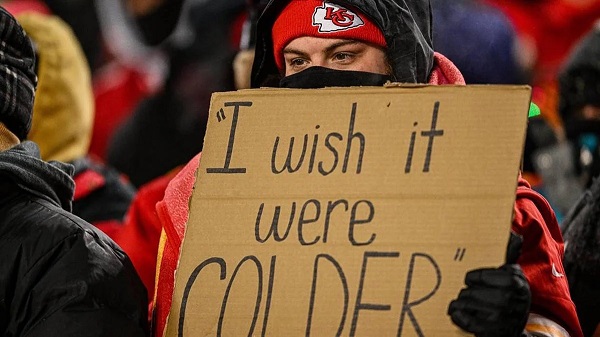
Oh, the weather outside was frightful. But the football was so delightful. Week 15 of the NFL season was a cryogenic success of snow and sub-zero temperatures. Here were the temperatures at game time this weekend.
Chicago: -11 degrees C.
Cincinnati: -12 degrees F.
Kansas City: -8 degrees C.
New England: -2 C (with an 87 percent chance of snow).
Philadelphia: -2 degrees C.
New York -1 degree C.
Pittsburgh: -7 degrees C.
For fans of NFL football none of this seemed out of character with late-season football. There are legendary games played in arctic conditions. The windchill for the 1967 Dallas/ Green Bay NFC championship was -25 C.
Chargers at Bengals: Jan. 10, 1982 (-24 C, feels like -39 C).
Seahawks at Vikings in NFC wild-card matchup Jan 10, 2016. -21 C with wind chill -25C
Dolphins at Chiefs: Jan. 13, 2024 (-4 degrees, feels like -27 degrees)
As recently as last week’s Bills win over the Bengals games are often played with drifts of snow on the field and the mercury bottoming out. While Canada’s Grey Cup game is played at the end of November it’s still had some brutal weather history of its own.
The point of this meteorology meandering is that, according to our good King Charles III and many other doomsday cultists the concept of snow and cold was supposed to be a figment of the past by now. For almost half a century Michael Mann and the climate prophets of IPCC have been predicting the end of snow and the onset of warmist floods and burning forests. They gambled trillions of the public’s dollars on the certainty that the public would buy computer modelling and data-distortion predicting doom.
For decades it has worked. The careers of people like critic Mark Steyn have been ruined, heretics declared and fortunes dissipated by the trust-fund fanatics who bankroll wackadoodles like Stephen Guilbeault, the convicted felon who Trudeau made Minister of the Environment. No matter how absurd or devious the source, it was a gospel that the fiery inferno was coming next Tuesday. But the weather has remained stubbornly resistant to Elizabeth May’s catechism of climate.

Yet, some dedicated climate advocates and their followers are finally changing their tune in the face of their own observation of lying liars like Al Gore and Greta Thunberg. The share of Americans who say climate scientists understand very well whether climate change is occurring decreased from 37 percent in 2021 to 32 percent this year. A similar October study from the University of Chicago’s Energy Policy Institute found that “belief in human-driven climate change declined overall” since 2017.
Reports the uber-liberal L.A. Times: “The unraveling of climate catastrophism got another jolt recently with the formal retraction of a high-profile 2024 study published in the journal Nature. That study — which had predicted a calamitous 62% decline in global economic output by 2100 if carbon emissions were not sufficiently reduced — was widely cited by transnational bodies and progressive political activists alike as justification for the pursuit of aggressive decarbonization.
But the authors withdrew the paper after peer reviewers discovered that flawed data had skewed the result. Without that data, the projected decline in output collapses to around 23%. Oops.”
Even stalwart media apologists for climate hysteria like the Times are starting to have doubts. Under the headline “The left’s climate panic is finally calming down” they describes “Erstwhile ardent climate-change evangelist Bill Gates published a remarkable blog post addressing climate leaders at the then-upcoming COP30 summit. Gates unloaded a blistering critique of what he called ‘the doomsday view of climate change,’ which he said is simply “wrong.”
Trump-besotted American Democrats seeking to soften their Woke image before the 2026 midterms are likewise carving out more moderate positions on climate “that could well deprive Republicans of a winning political issue with which to batter out-of-touch, climate-change-besotted Democrats. But for the sake of good governance, sound public policy and the prosperity of the median American citizen, it would be the best thing to happen in a decade.”
Sadly Canada under Mark Carney remains a staunch climate warrior. The removal of Guilbeault as federal Environmental Minister may have seemed a step toward sanity, but there is no hint that the billions of dollars from hidden money spigots will be closed down any time soon. The B.C. government’s acquiescence to the climate propaganda of Indigenous bands shows no sign of abating. Indeed, it is just ramping up in the land claims that threaten to make home ownership a thing of the past.

PM Mark Carney is a dedicated temperature fabulist going back to his days as governor of the Bank of England. His first fights in Canada were over taxing carbon and hobbling her energy industry. As we wrote in this November 2024 column, the certainty in which the Canadian Left revels is actually dividing, not uniting citizens.
So perhaps if enough citizens spend an afternoon shivering in the stands of a wintertime football game we might achieve a small piece of sanity and learn that that , while climate is always changing, it’s not worth the price we’ve paid this century.
Bruce Dowbiggin @dowbboy is the editor of Not The Public Broadcaster A two-time winner of the Gemini Award as Canada’s top television sports broadcaster, his 2025 book Deal With It: The Trades That Stunned The NHL And Changed hockey is now available on Amazon. Inexact Science: The Six Most Compelling Draft Years In NHL History, his previous book with his son Evan, was voted the seventh-best professional hockey book of all time by bookauthority.org . His new poetry collection In Other Words is available via brucedowbigginbooks.ca and on Kindle books.


Death by a thousand clicks – government censorship of Canada’s internet

Chinese Billionaire Tried To Build US-Born Baby Empire As Overseas Elites Turn To American Surrogates

Viral TikTok video shows 7-year-old cuddling great-grandfather before he’s euthanized

Politicians should be honest about environmental pros and cons of electric vehicles
-
 Agriculture1 day ago
Why is Canada paying for dairy ‘losses’ during a boom?
-
 Automotive2 days ago
Ford’s EV Fiasco Fallout Hits Hard
-
 Alberta1 day ago
Alberta’s new diagnostic policy appears to meet standard for Canada Health Act compliance
-
 Alberta14 hours ago
Housing in Calgary and Edmonton remains expensive but more affordable than other cities
-
 Business13 hours ago
State of the Canadian Economy: Number of publicly listed companies in Canada down 32.7% since 2010
-
 Censorship Industrial Complex11 hours ago
Canadian university censors free speech advocate who spoke out against Indigenous ‘mass grave’ hoax
-
Bruce Dowbiggin15 hours ago
Hunting Poilievre Covers For Upcoming Demographic Collapse After Boomers
-
 Censorship Industrial Complex1 day ago
Top constitutional lawyer warns against Liberal bills that could turn Canada into ‘police state’