
David Clinton
How would provinces and cities survive if the federal government collapsed?




How Resilient Are Canadian Provinces?
Suppose one fine day the federal government was unable to show up for work. Perhaps it wasn’t feeling well. Or maybe it had borrowed so much money that it maxed out its line of credit, defaulted on its interest payments, and just couldn’t pay its bills. What then?
Let’s say – and I’m just spitballing here – let’s say that exploding, uncontrolled public debt is a bad thing. All the smart people tell us that taking on too much credit card debt won’t end well, right? Well I can’t think of any solid reason that such logic shouldn’t also apply to governments.¹
The Audit is a reader-supported publication. To receive new posts and support my work, consider becoming a free or paid subscriber.
As you can see from the graph, our federal public debt climbed from $351 billion in 1990 all the way to $884 billion in 2024. The 50 percent leap between Q4 2019 and Q4 2021 was the generous gift of COVID. Things started to recover in mid-2023, but they’ve since nose dived once again.
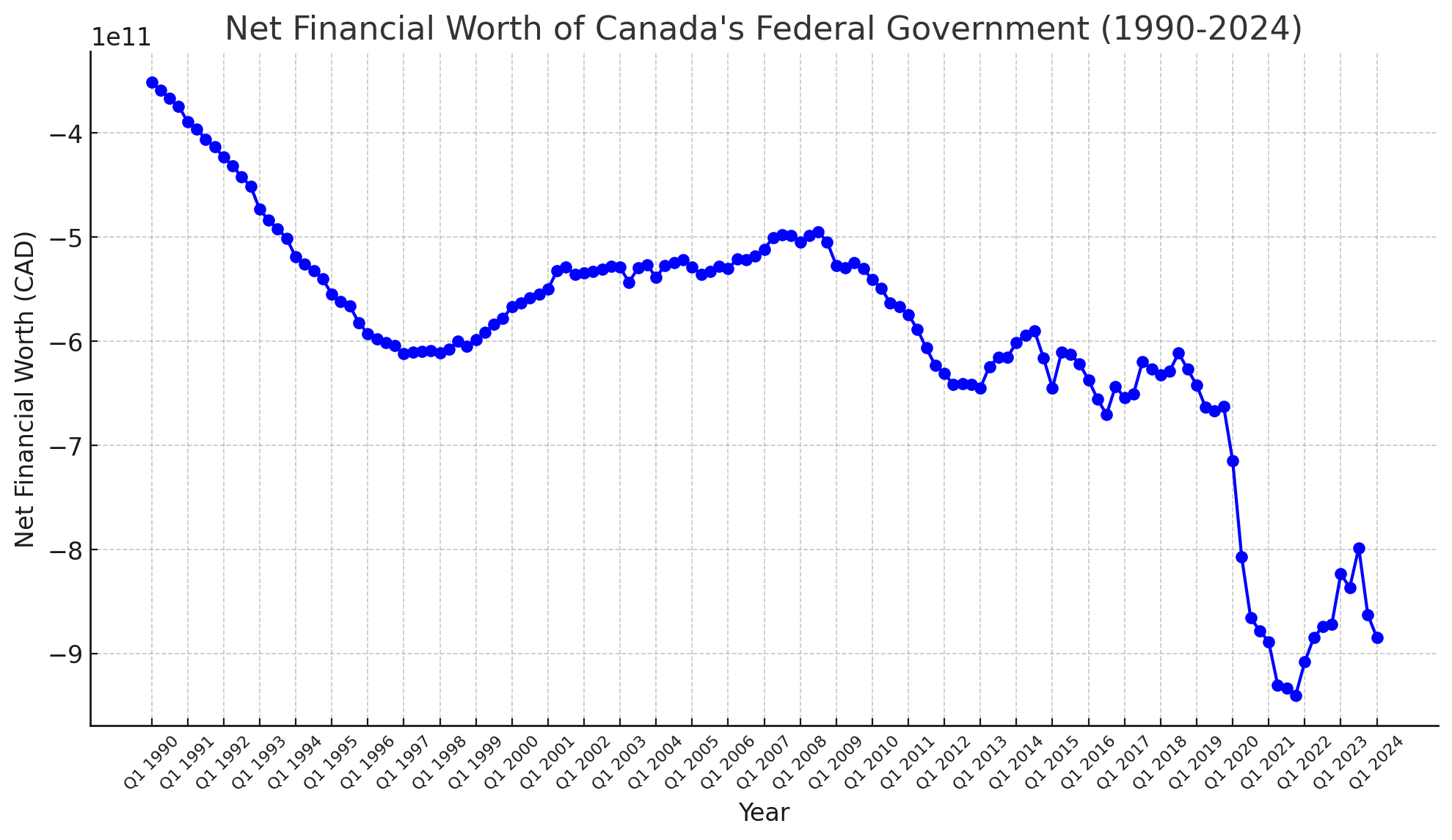 |
Ah, but that’s just debt you say. It’s someone else’s problem.
Not exactly. You see, even if we’re not paying down the principle on the debt, you can be sure that we’re covering interest payments. Which, it just so happens, have become a lot more expensive ever since massive government borrowing drove up interest rates.
How much more expensive? As of Q1 2024, our annual interest payments totaled $11.7 billion, compared with $6.2 billion back in Q1 2022. Put differently, the interest we pay each year comes to seven percent of our total federal budget.
I’m certainly not going to confidently predict that the federal government will soon default on interest payments, lose access to capital markets, and begin laying off government workers and shutting down services. But I wouldn’t say that it can’t happen either.
Given that possibility, what can provinces and cities do right now to prepare for a sudden (hopefully brief) disruption? First off, though, what exactly is a province?
As defined by the British North America Acts, areas of the exclusive responsibility of the federal government include:
- Public debt and property
- Regulation of trade and commerce
- Criminal law
- Militia, military and naval service, and defense
- Navigation and shipping
- Banking, incorporation of banks, and the issue of paper money
- Bankruptcy and insolvency
- Naturalization and aliens
- Unemployment insurance
Provinces are responsible for:
- Property and civil rights
- Administration of justice (including policing)
- Municipal institutions
- Education
- Health and welfare
- Natural resources
So a short-term federal disruption might not have much of an impact on most Canadians’ day-to-day activities. Federal employees and UI recipients would have to figure out how to survive without their paychecks and border entry points would shut down. But great news! Your criminal prosecution can go ahead on schedule because, while criminal law is controlled by the feds, lower criminal courts are provincial.
On the other hand, consider how federal transfers contribute between around 15 percent (Alberta) and 40 percent (Atlantic provinces) of provincial budgets. And Toronto’s municipal budget, for instance, includes around 15 percent in transfers from the province, and another five percent from the federal government. So it wouldn’t take long before all levels of government begin to feel the heat.
I’m not suggesting we change Canadian federalism (good luck trying). But a province that’s reduced or eliminated its own budget deficit and successfully weaned itself from incoming federal transfers would probably enjoy a smoother trip through a shutdown. Exploring the legality of temporarily taking over the payroll for critical federal roles (like Border Services), for instance, might also pay dividends when push came to shove.
I would suggest that thinking formally about these issues would be an important part of any government’s emergency planning preparedness. Yesterday was the best time to start. But today is the next best option.
The Audit is a reader-supported publication. To receive new posts and support my work, consider becoming a free or paid subscriber.
Post-COVID, the claims of Modern Monetary Theory proponents didn’t age well.
Invite your friends and earn rewards




IMPACT-se just released their Review of the 2025-2026 Palestinian Authority School Curriculum (Grades 1-12). They reviewed 290 text books and 71 teacher guides (both printed and digital) currently in use by schools charged with educating Palestinian children. The results were unambiguous:
“The review finds that the 2025–2026 Palestinian Authority curriculum continues to systematically violate UNESCO principles and educational standards. Published in September 2025, the curriculum incites antisemitism and violence, promotes jihad and martyrdom, glorifies terrorism, rejects peacemaking and the two-state solution, and erases Israel from maps. It has not been substantively modified since the 2020–2021 school year, maintaining the same ideological framework first established in the 2016 reform cycle.”
In other words, the glorification of violence and deep racial hatred is, by design, woven into the fabric of every topic and virtually every lesson Palestinian children are taught.
The offensive examples were hardly rare exceptions throughout those 361 books. There were, for example:
- 50 examples (taking up a full 70 pages in the report) depicting Israelis or Jews as demonic or motiveless aggressors
- 47 examples of erasure of Israel from maps and language (declaring Palestine “from river to sea”)
- 56 examples of the encouragement of martyrdom and violent jihad
- 12 examples of the overt politicization of science and math
In addition, since 2016, 29 references to peace agreements, Israel, and Jews were removed from PA curriculum texts.
Overall, around 60 percent of the report’s examples come from material aimed at grades 9-11. Nevertheless, 17 examples of indoctrination (around 4 percent of the total) came from grades 1-4.
But what does all that have to do with Canada? Well, Canada has been a steady and reliable funder for UNRWA (United Nations Relief and Works Agency for Palestine Refugees in the Near East), UNICEF (United Nations Children’s Fund), UNESCO (United Nations Educational, Scientific and Cultural Organization), and the World Bank’s provision of educational services to Palestinians.
So what? Don’t all Western nations provide the same support? Not exactly.
- A May 2025 resolution adopted by the European Parliament demanded that EU financial assistance be made conditional on removal of hate material, and urged full compliance with standards of peace and tolerance for education.
- The U.K. has, in past years, cut or reduced its funding to UNRWA over concerns about incitement in educational textbooks.
- The U.S. hasn’t provided any support for UNRWA since the Biden administration paused funding in January, 2024.
- It seems that both Sweden and the Netherlands have either cut or are phasing out their UNRWA funding.
But in May 2024, Canada committed to $65 million in new funding – which follows a brief and meaningless “pause” in UNRWA funding (where no scheduled payments were actually interrupted). That brings the funding total since 2016 to $259 million. And there’s no public record of any of that money being conditional on changes to educational textbooks.
The Global Affairs Canada officials who make these spending decisions are the ones responsible for applying official government policy. And the message driving that policy is pretty clear (pro forma “antisemitism is not who we are” press releases notwithstanding). The Government of Canada is absolutely down with pouring millions into the promotion of race-driven violence.
Is Global Affairs Canada Wasting Your Tax Dollars Abroad?

It seems like forever since I last wrote about program spending at Global Affairs Canada (GAC). I’m not aware of any big-picture changes to department policy in the meantime, but their Project Browser tool is still there – and it’s still a welcome resource for transparency.
How Does UNRWA Spend the Funding it Receives From the Canadian Government?

The government of Canada – through Global Affairs Canada – has long been among the major financial supporters of The United Nations Relief and Works Agency for Palestine Refugees in the Near East (UNRWA). The 75 year-old United Nations agency has a yearly budget that’s grown to more than 900 million US dollars, and has long been accused of antisemitism,…
Paying for Bad Government Choices

Who picks up the tab when budgetary bets go horribly wrong? Taxpayers, of course. Duh.



Based mostly on their 2024 budget, the federal government has promised $2.4 billion in support of artificial intelligence (A.I.) innovation and research. Given the potential importance of the A.I. sector and the universal expectation that modern governments should support private business development, this doesn’t sound all that crazy.
But does this particular implementation of that role actually make sense? After all, the global A.I. industry is currently suffering existential convulsions, with hundreds of billions of dollars worth of sector dominance regularly shifting back and forth between the big corporate players. And I’m not sure any major provider has yet built a demonstrably profitable model. Is Canada in a realistic position to compete on this playing field and, if we are, should we really want to?
First of all, it’s worth examining the planned spending itself.
- $2 billion over five years was committed to the Canadian Sovereign A.I. Compute Strategy, which targets public and private infrastructure for increasing A.I. compute capacity, including public supercomputing facilities.
- $200 million has been earmarked for the Regional Artificial Intelligence Initiative (RAII) via Regional Development Agencies intended to boost A.I. startups.
- $100 million to boost productivity is going to the National Research Council Canada’s A.I. Assist Program
- The Canadian A.I. Safety Institute will receive $50 million
In their goals, the $300 million going to those RAII and NRC programs don’t seem substantially different from existing industry support programs like SR&ED. So there’s really nothing much to say about them.
And I wish the poor folk at the Canadian A.I. Safety Institute the best of luck. Their goals might (or might not) be laudable, but I personally don’t see any chance they’ll be successful. Once A.I. models come on line, it’s only a matter of time before users will figure out how to make them do whatever they want.
But I’m really interested in that $2 billion for infrastructure and compute capacity. The first red flag here has to be our access to sufficient power generation.
Canada currently generates more electrical power than we need, but that’s changing fast. To increase capacity to meet government EV mandates, decarbonization goals, and population growth could require doubling our capacity. And that’s before we try to bring A.I. super computers online. Just for context, Amazon, Microsoft, Google, and Oracle all have plans to build their own nuclear reactors to power their data centers. These things require an enormous amount of power.
I’m not sure I see a path to success here. Plowing money into A.I. compute infrastructure while promoting zero emissions policies that’ll ensure your infrastructure can never be powered isn’t smart.
However, the larger problem here may be the current state of the A.I. industry itself. All the frantic scrambling we’re seeing among investors and governments desperate to buy into the current gold rush is mostly focused on the astronomical investment returns that are possible.
There’s nothing wrong with that in principle. But “astronomical investment returns” are also possible by betting on extreme long shots at the race track or shorting equity positions in the Big Five Canadian banks. Not every “possible” investment is appropriate for government policymakers.
Right now the big players (OpenAI, Anthropic, etc.) are struggling to turn a profit. Sure, they regularly manage to build new models that drop the cost of an inference token by ten times. But those new models consume ten or a hundred times more tokens responding to each request. And flat-rate monthly customers regularly increase the volume and complexity of their requests. At this point, there’s apparently no easy way out of this trap.
Since business customers and power users – the most profitable parts of the market – insist on using only the newest and most powerful models while resisting pay-as-you-go contracts, profit margins aren’t scaling. Reportedly, OpenAI is betting on commoditizing its chat services and making its money from advertising. But it’s also working to drive Anthropic and the others out of business by competing head-to-head for the enterprise API business with low prices.
In other words, this is a highly volatile and competitive industry where it’s nearly impossible to visualize what success might even look like with confidence.
Is A.I. potentially world-changing? Yes it is. Could building A.I. compute infrastructure make some investors wildly wealthy? Yes it could. But is it the kind of gamble that’s suitable for public funds?
Perhaps not.


Media bound to pay the price for selling their freedom to (selectively) offend

Sometimes An Ingrate Nation Pt. 2: The Great One Makes His Choice

Recent price declines don’t solve Toronto’s housing affordability crisis

From Exception to Routine. Why Canada’s State-Assisted Suicide Regime Demands a Human-Rights Review
-
MAiD2 days ago
From Exception to Routine. Why Canada’s State-Assisted Suicide Regime Demands a Human-Rights Review
-
 Business2 days ago
Carney government should privatize airports—then open airline industry to competition
-
 Business2 days ago
What’s Going On With Global Affairs Canada and Their $392 Million Spending Trip to Brazil?
-
 Energy2 days ago
Canada following Europe’s stumble by ignoring energy reality
-
 Bruce Dowbiggin10 hours ago
Integration Or Indignation: Whose Strategy Worked Best Against Trump?
-
 COVID-1911 hours ago
University of Colorado will pay $10 million to staff, students for trying to force them to take COVID shots
-
 Banks2 days ago
To increase competition in Canadian banking, mandate and mindset of bank regulators must change
-
Business2 days ago
Why Does Canada “Lead” the World in Funding Racist Indoctrination?