
Censorship Industrial Complex
‘Don’t Write About The Laptop’: Two Reporters Allege Outlets Killed Stories About Bidens



From the Daily Caller News Foundation
By Harold Hutchison
“I was covering Biden at the time, and I remember coming to my editor and saying, ‘Hey, we need to write about the Hunter Biden laptop.’ And I was told this came from on high at Politico: Don’t write about the laptop, don’t talk about the laptop, don’t tweet about the laptop.
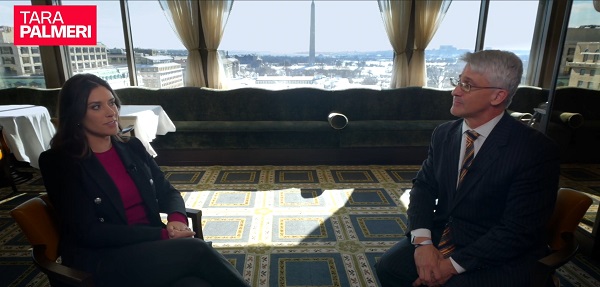
Two former reporters with Politico accused the outlet of suppressing negative stories about former President Joe Biden and his son, Hunter Biden during the 2020 presidential election in a video clip posted to YouTube Thursday.
Dozens of former intelligence officials signed an October 2020 letter published by Politico that claimed a bombshell New York Post report about emails from a laptop supposedly abandoned by Hunter Biden “has all the classic earmarks of a Russian information operation.” Puck News reporter Tara Palmeri and Axios reporter Marc Caputo discussed the Politico newsroom’s alleged approach to unflattering reports about the Bidens on Palmeri’s podcast, “Somebody’s Gotta Win,” though the outlet has denied their allegations.
“Politico did that terrible, ill-fated headline: 51 intelligence agents, or former intelligence agents, say that the Hunter Biden laptop was disinformation, or bore the hallmarks of disinformation. Turns out that story was closer to disinformation because the Hunter Biden laptop appeared to be true,” Caputo told Palmeri, who responded. “But then Facebook also pulled all stories down about the Hunter Biden laptop, and I think Twitter did at the same time, too.”
WATCH:
Twitter locked multiple accounts, including the New York Post’s and the personal account of then-White House Press Secretary Kayleigh McEnany for sharing the Oct, 14, 2020 report, citing a “hacked materials” policy. Documents released to journalist Michael Shellenberger by Elon Musk show that the FBI contacted Twitter about the potential for leaks involving Hunter Biden prior to the New York Post’s report.
“Correct, they punished The New York Post, that didn’t help. I mean, Politico, my former employer and I knew at the time, didn’t do itself any favors,” said Caputo. “I was covering Biden at the time, and I remember coming to my editor and saying, ‘Hey, we need to write about the Hunter Biden laptop.’ And I was told this came from on high at Politico: Don’t write about the laptop, don’t talk about the laptop, don’t tweet about the laptop. And the only thing Politico wound up writing was that piece that called it disinformation, which charitably could be called misinformation, at the least.”
Palmeri claimed to have experienced difficulty getting a story regarding Hunter Biden’s purchase of a .38-caliber revolver in 2018 published. Hunter Biden was convicted on three felony counts related to buying the gun in June 2024, but received a pardon from his father on Dec. 1.
Biden pardoned five other family members shortly before his term ended.

“Yeah, I mean, I had a hard time — you know I wrote some pretty serious reporting on Hunter Biden, which actually ended up getting him prosecuted — the story on the gun,” Palmeri said, with Caputo responding, “Yeah! And I remember you consulted with me cause you had, you did the original report on the gun and you came to me like, ‘How do I write about this?’ I’m like, ‘Honestly, I don’t know.’”
“Cause it was hard to get it done. I spent three months on it, I went to the laptop shop, and I did all of the reporting in Delaware, and I did all of that. But yeah it had, it had to be like much, it had to be 100% nailed down. I had everything, you know, the police reports, every, like, you know, I’m a solid reporter. But I do wonder if it could have, if it would have been published a little quicker if it was a different type of story,” Palmeri said. “It was the beginning of his administration, it was a honeymoon period — you know what I mean?”
Caputo recounted that Hunter Biden’s laptop was not the only story regarding the Bidens that was allegedly killed by Politico’s editors.
“Since we’re spilling tea about our former employer, I still have a copy of the story on my external hard drive. In 2019, a rival presidential Democratic campaign of Joe Biden’s gave to me the tax lien — the oppo research — the tax lien on Hunter Biden for the period of time that he worked at Burisma,” Caputo said. “And I wrote what would have been a classic story saying, you know, ‘The former vice president’s son was slapped with a big tax lien for the period of time that he worked for this controversial Ukrainian oil concern, or natural gas concern, which is haunting his father on the campaign trail.’ That story was killed by the editors, and they gave no explanation for that either.”
“We just get called, like, ‘the terrible mainstream media.’ It’s like you don’t understand the process there,” Palmeri said, with Caputo responding, “Well, you also don’t understand the dumb decisions of cowardly editors that are made above us.”
Politico disputed Caputo’s recollections in response to a request for comment from the Daily Caller News Foundation and sent a list of references to their past reporting on the Biden family.
“It’s bullshit. During the years referenced, POLITICO journalists lead the way on wide-ranging reporting on the business dealings of Joe Biden’s closest relatives. Ben Schreckinger was probably the top reporter in the country reporting on these matters—he literally wrote the book on it,” a Politico spokesperson told the DCNF. “Through deeply reported coverage—both pre- and post-election—POLITICO provided readers with a nuanced understanding of the dealings of James Biden, Hunter Biden, and other relatives of the president, along with the ethical questions they raised. Notably, POLITICO was the first to confirm that Hunter Biden’s laptop contained genuine material and to report on the gun incident that led to his conviction.”

Censorship Industrial Complex
US Slams UK and EU Over Online Speech Regulation, Announces Release of Files on Past Censorship Efforts

Sarah Rogers’ comments draw a new line in the sand between America’s First Amendment and Europe’s tightening grip on online speech.
|
|
Censorship Industrial Complex
Canadian university censors free speech advocate who spoke out against Indigenous ‘mass grave’ hoax
From LifeSiteNews
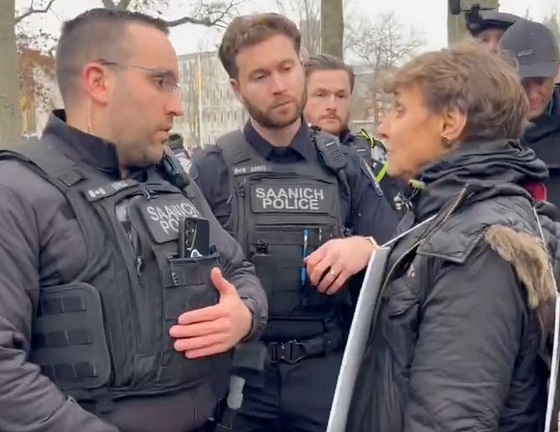
Dr. Frances Widdowson was arrested and given a ticket at the University of Victoria campus after trying to engage in conversation about ‘the disputed claims of unmarked graves in Kamloops.’
A Canadian academic who spoke out against claims there are mass unmarked graves of kids on former Indigenous residential schools, and who was arrested on a university campus as a result for trespassing, is fighting back with the help of a top constitutional group.
Dr. Frances Widdowson was arrested and given a ticket on December 2, 2025, at the University of Victoria (UVic) campus after trying to engage in conversation about “the disputed claims of unmarked graves in Kamloops,” noted the Justice Centre for Constitutional Freedoms (JCCF) in a recent news release.
According to the JCCF, Widdowson was trying to initiate a “good faith” conversation with people on campus, along with the leader of OneBC provincial party, Dallas Brodi.
“My arrest at the University of Victoria is an indication of an institution that is completely unmoored from its academic purpose,” said Widdowson in a statement made available to LifeSiteNews.
She added that the “institution” has been “perpetuating the falsehood” of the remains of 215 children “being confirmed at Kamloops since 2021, and is intent on censoring any correction of this claim.”
“This should be of concern for everyone who believes that universities should be places of open inquiry and critical thinking, not propaganda and indoctrination,” she added.
UVic had the day before Widdowson’s arrest warned on its website that those in favor of free speech were “not permitted to attend UVic property for the purpose of speaking publicly.”
Despite the warning, Widdowson, when she came to campus, was met with some “100 aggressive protesters assembled where she intended to speak at Petch Fountain,” noted the JCCF.
The protesters consisted of self-identified Communists, along with Antifa-aligned people and Hamas supporters.
When Widdowson was confronted by university security, along with local police, she was served with a trespass notice.
“When she declined to leave, she was arrested, detained for about two hours, and charged under British Columbia’s Trespass Act—an offence punishable by fines up to $2,000 or up to six months’ imprisonment,” said the JCCF.
According to Constitutional lawyer Glenn Blackett, UVic actions are shameful, as it “receives hundreds of millions of taxpayer dollars annually while it facilitates the arrest of Canadians attempting to engage in free inquiry on campus.”
Widdowson’s legal team, with the help of the JCCF, will be defending her ticket to protect her “Charter-protected freedoms of expression and peaceful assembly.”
Widdowson served as a tenured professor at Mount Royal University in Calgary, Alberta, before she was fired over criticism of her views on identity politics and Indigenous policy, notes the JCCF. She was vindicated, however, as an arbitrator later found her termination was wrongful.
In 2021 and 2022, the mainstream media ran with inflammatory and dubious claims that hundreds of children were buried and disregarded by Catholic priests and nuns who ran some Canadian residential schools. The reality is, after four years, there have been no mass graves discovered at residential schools.
However, as the claims went unfounded, over 120 churches, most of them Catholic and many of them on Indigenous lands that serve the local population, have been burned to the ground, vandalized, or defiled in Canada since the spring of 2021.
Last year, retired Manitoba judge Brian Giesbrecht said Canadians are being “deliberately deceived by their own government” after blasting the former Trudeau government for “actively pursuing” a policy that blames the Catholic Church for the unfounded “deaths and secret burials” of Indigenous children.
As reported by LifeSiteNews, new private members’ Bill C-254, “An Act To Amend The Criminal Code” introduced by New Democrat MP Leah Gazan, looks to give jail time to people who engage in so-called “Denialism.” The bill would look to jail those who question the media and government narrative surrounding Canada’s “Indian Residential School system” that there are mass graves despite no evidence to support this claim.
Georgia county admits illegally certifying 315k ballots in 2020 presidential election
Alberta Next Panel calls to reform how Canada works

Canadian government launches trial version of digital ID for certain licenses, permits

End Supply Management—For the Sake of Canadian Consumers
-
International1 day ago
Georgia county admits illegally certifying 315k ballots in 2020 presidential election
-
 Alberta2 days ago
Alberta project would be “the biggest carbon capture and storage project in the world”
-
 Energy2 days ago
Canada’s debate on energy levelled up in 2025
-
 Haultain Research1 day ago
Sweden Fixed What Canada Won’t Even Name
-
 Business1 day ago
What Do Loyalty Rewards Programs Cost Us?
-
 Energy2 days ago
New Poll Shows Ontarians See Oil & Gas as Key to Jobs, Economy, and Trade
-
 Business2 days ago
Socialism vs. Capitalism
-
 Energy1 day ago
Why Japan wants Western Canadian LNG