
Business
Dominic Barton’s Shadow Over $1-Billion PRC Ferry Deal: An Investigative Op-Ed



Ottawa’s story never added up. When the Canada Infrastructure Bank pushed through a $1-billion loan to BC Ferries for vessels built at a Chinese state-owned shipyard, federal ministers claimed they were “dismayed” and blindsided. Chrystia Freeland even wrote a letter to the BC government citing national security concerns. In hindsight, she and her staff were engaged in political theatre, performing shock to deflect responsibility onto Premier David Eby.
Documents later showed Freeland’s own ministry of transport had been briefed six weeks before the public rollout. In one internal exchange, her staff admitted officials had received “a confidential heads-up” well in advance. Then came testimony from Housing and Infrastructure Minister Gregor Robertson — also responsible for the Infrastructure Bank — acknowledging the loan was already “inked” in March, before he supposedly raised concerns, a claim as hollow as Freeland’s staged outrage.
The $1-billion Canadian Infrastructure Bank loan to BC Ferries flows directly to China Merchants Industry Weihai — a dual-use shipyard central to Beijing’s military-civil fusion strategy. Critics have long warned that such contracts risk entangling Canadian taxpayers with Chinese state enterprises linked to the People’s Liberation Army.
Those concerns take on new urgency with fresh revelations from Australia. ABC News reported yesterday on a classified U.S. Defense Intelligence Agency assessment showing that China’s commercial ferry fleet is being militarized for amphibious operations against Taiwan. These are not neutral passenger vessels but dual-use platforms modified to carry tanks and PLA troops. The timing of the four-ship build for BC Ferries, the nature of the shipyard, and the class of vessel all suggest that Canada could be indirectly bolstering Beijing’s invasion platform — and, at the very least, injecting Canadian funds into the industrial ecosystem driving the PLA’s buildup.
The nature of CIB’s involvement, and Ottawa’s actions that fit the pattern of an emerging cover-up, point to a deeper story that has been bubbling in the capital for nearly a decade: former McKinsey global director and Canadian ambassador to China Dominic Barton, his deep ties to Chinese state-owned and dual-use enterprises, and his founding role in the CIB.
 |
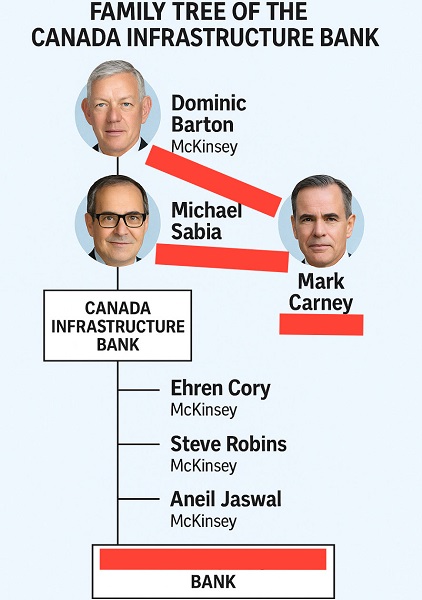
Defensive “talking points” prepared for Gregor Robertson’s August 1, 2025 testimony provide a revealing glimpse. The records, obtained through freedom of information by The Bureau, are mostly boilerplate answers. But two pages on the CIB’s structure show clearly what outside reporting has long established: the Bank carries Barton’s DNA, and the imprint of his McKinsey network continues to this day. That raises a plausible theory — that Canada’s pro-Beijing trade lobby, a circle of business leaders revolving around Barton, Sabia, McKinsey, and now Prime Minister Mark Carney, looks like the hidden hand guiding this supposedly arm’s-length deal.
The records that anchor this OpEd show the Infrastructure Bank’s story can be traced like a family tree. At the top is Dominic Barton. In 2016, while serving as McKinsey’s global managing director, he chaired the federal Advisory Council on Economic Growth. That council produced the blueprint for the Canada Infrastructure Bank — and McKinsey itself was paid as a consultant during its creation. Sitting beside Barton on the council was Michael Sabia, who would later become chair of the Bank in 2020 and today serves as chief of staff to Prime Minister Mark Carney.
As the Bank moved from paper to practice, Sabia’s role became pivotal. When he took over as chair, he pulled Barton back into the fold. In June 2020, Barton joined a “strategic refresh” meeting of the CIB. Emails later revealed that McKinsey staff had arranged the session so that “Dom” could “speak freely,” even though he was then serving as Canada’s ambassador to China.
The pattern deepened as new leadership arrived. In November 2020, Ehren Cory was appointed CEO. Cory, too, had worked at McKinsey. Around him, other alumni filled senior posts: Steve Robins, now head of strategy; Aneil Jaswal, director of strategic sectors; even Cory’s executive assistant came directly from McKinsey, according to notes prepared for Gregor Robertson’s August testimony and obtained by The Bureau.
Running alongside this McKinsey chain is a side branch that loops back into the heart of Ottawa. Sabia, Barton’s colleague from the Advisory Council, now serves as Mark Carney’s right hand in the Prime Minister’s Office.
Seen this way, the CIB is not just a Crown corporation with a neutral mandate. It is an institution shaped from the start by Barton’s hand, nurtured by Sabia, and still run day to day by McKinsey-trained managers. The government’s defensive claim — that McKinsey’s influence ended in 2017, as set out in notes for Robertson’s testimony — is impossible to believe. It is as false as Chrystia Freeland’s June 2025 letter to David Eby’s government.
 |
The continuity of influence is not just structural — it’s personal. On June 23, 2020, while serving as ambassador to China, Barton joined a CIB “strategic refresh” meeting. He says it was at Sabia’s invitation. But emails tabled in committee show McKinsey staff helped arrange the call and even discussed limiting participants so “Dom” could “speak freely.” Pressed in Parliament during May 2023 testimony, Barton initially failed to disclose the meeting. Only after documents surfaced did he confirm it.
That evasiveness set off a bruising clash. Conservative MP Leslyn Lewis told him flatly: “We have testimony that you gave before, and that was false indeed.” She added: “Mr. Sabia, the former chair of the CIB, testified here on Tuesday that you participated in a McKinsey seminar, led by McKinsey, while you were ambassador — and you have now confirmed this information today.”

Garnett Genuis drove the point home: “Mr. Barton is clearly lying to this committee. We have the emails in black and white. It seems McKinsey was able to infiltrate the government and shape decision making. Your presence and close relationship with the government allowed that to happen.”
Three years earlier, Barton had faced an even higher-profile grilling before the Canada–China Committee — testimony with direct geographical and geopolitical relevance to the CIB’s mysterious $1-billion loan to CMC Weihai.
Back in 2020, Genuis pressed him on McKinsey’s advisory work for Chinese state-owned enterprises, including the China Communications Construction Company — sanctioned by the World Bank for corruption and implicated in Beijing’s militarized islands in the South China Sea. Barton ducked, dissembled, and insisted he was unaware.
“At the time you were in charge of McKinsey, from 2009, it’s my understanding that you advised almost two dozen Chinese state-owned companies. According to The New York Times, one of those companies was the China Communications Construction Company,” Genuis prodded. “When you signed the China Communications Construction Company as a client in 2015, they were still under World Bank sanctions because of the corruption and bid-rigging they engaged in in the Philippines.”
Next, the Conservative MP asked directly: “McKinsey was advising a company that was carrying out the Chinese government’s policy of building militarized islands in the South China Sea. Was it your position that those islands are a violation of international law?”
“What I would say is that I am not familiar at all with our being involved in designing the islands in the South China Sea,” Barton answered. “If you want to talk to someone at McKinsey to find out more information, I’m sure we’d be happy to get someone to talk to you about it.”
McKinsey did not return with information on China’s military action in the South China Sea — the very same theater where Beijing now threatens Taiwan with its civilian ferry buildup plan.
Genuis also asked: “Would you be prepared to submit to this committee a list of all of the Chinese state-owned companies that you did work for at McKinsey?”
“McKinsey’s pretty careful about client confidentialities,” Barton answered. “I’d be happy if there were some mechanism so that it isn’t in the public domain but that some people could look at it. I’m open to that.”
That list was never provided, based on The Bureau’s follow-up in Ottawa. Given the questions surrounding the CIB’s loan to fund CMC Weihai ferries, this lack of transparency takes on a more ominous colour.
The historical record of testimony, going back to the Genuis–Barton stand-off, now casts a long shadow. There is a clear through line to the questioning still to come for Carney’s responsible ministers in the BC Ferries deal — Chrystia Freeland and Gregor Robertson. After revelations that Freeland and her staff staged their supposed shock at the deal with a Chinese military-linked shipbuilder, Freeland has been recalled.
Savvy questioners will likely look beyond her — and above her — in their probing. The CIB, seeded by Barton, staffed by McKinsey alumni, and previously steered by Mark Carney’s chief of staff Michael Sabia, has financed a project that objectively strengthens Beijing’s naval-industrial complex. Who really profits, in conjunction with Beijing? Certainly not Canadian workers, shipbuilders, or citizens, who are left carrying the burden of their government’s deals with China.
This is not just about procurement missteps or potential conflicts of interest. It is the culmination of a decade of weak, negligent thinking on China’s military aggression — stretching from the South China Sea to Canada’s Pacific, Atlantic, and Arctic coasts. Until Canadians confront Barton’s enduring imprint on the CIB, they will continue to discover — too late — that their money is underwriting Beijing’s rise.
The Bureau is a reader-supported publication.
To receive new posts and support my work, consider becoming a free or paid subscriber.


From the Fraser Institute
According to a recent study, living standards in Canada have declined over the past five years. And the country’s economic growth has been “ugly.” Crucially, all 10 provinces are experiencing this economic stagnation—there are no exceptions to Canada’s “ugly” growth record. In 2026, reversing this trend should be the top priority for the Carney government and provincial governments across the country.
Indeed, demographic and economic data across the country tell a remarkably similar story over the past five years. While there has been some overall economic growth in almost every province, in many cases provincial populations, fuelled by record-high levels of immigration, have grown almost as quickly. Although the total amount of economic production and income has increased from coast to coast, there are more people to divide that income between. Therefore, after we account for inflation and population growth, the data show Canadians are not better off than they were before.
Let’s dive into the numbers (adjusted for inflation) for each province. In British Columbia, the economy has grown by 13.7 per cent over the past five years but the population has grown by 11.0 per cent, which means the vast majority of the increase in the size of the economy is likely due to population growth—not improvements in productivity or living standards. In fact, per-person GDP, a key indicator of living standards, averaged only 0.5 per cent per year over the last five years, which is a miserable result by historic standards.
A similar story holds in other provinces. Prince Edward Island, Nova Scotia, Quebec and Saskatchewan all experienced some economic growth over the past five years but their populations grew at almost exactly the same rate. As a result, living standards have barely budged. In the remaining provinces (Newfoundland and Labrador, New Brunswick, Ontario, Manitoba and Alberta), population growth has outstripped economic growth, which means that even though the economy grew, living standards actually declined.
This coast-to-coast stagnation of living standards is unique in Canadian history. Historically, there’s usually variation in economic performance across the country—when one region struggles, better performance elsewhere helps drive national economic growth. For example, in the early 2010s while the Ontario and Quebec economies recovered slowly from the 2008/09 recession, Alberta and other resource-rich provinces experienced much stronger growth. Over the past five years, however, there has not been a “good news” story anywhere in the country when it comes to per-person economic growth and living standards.
In reality, Canada’s recent record-high levels of immigration and population growth have helped mask the country’s economic weakness. With more people to buy and sell goods and services, the overall economy is growing but living standards have barely budged. To craft policies to help raise living standards for Canadian families, policymakers in Ottawa and every provincial capital should remove regulatory barriers, reduce taxes and responsibly manage government finances. This is the great policy challenge for governments across the country in 2026 and beyond.

Ben Eisen
Senior Fellow, Fraser Institute

Jake Fuss
Director, Fiscal Studies, Fraser Institute


A Minneapolis day care run by Somali immigrants is claiming that a mysterious break-in wiped out its most sensitive records, even as police say officers were never told that anything was actually stolen — a discrepancy that’s drawing sharp attention amid Minnesota’s spiraling child care fraud scandal.
According to the center’s manager, Nasrulah Mohamed, someone forced their way into Nakomis Day Care Center earlier this week by entering through a rear kitchen area, damaging a wall and accessing the office. Mohamed told reporters the intruder made off with “important documentation,” including children’s enrollment records, employee files, and checkbooks tied to the facility’s operations.
But a preliminary report from the Minneapolis Police Department tells a different story. Police say no loss was reported to officers at the time of the call. While the department confirmed the center later contacted police with additional information, an updated report was not immediately available.
Video released by the day care purporting to show damage from the incident depicts a hole punched through drywall inside what appears to be a utility closet, with stacks of cinder blocks visible just behind the wall — imagery that has only fueled skepticism as investigators continue to unravel what authorities have described as one of the largest fraud schemes ever tied to Minnesota’s human services programs.
Mohamed blamed the alleged break-in on fallout from a viral investigation by YouTuber Nick Shirley, who recently toured nearly a dozen Minnesota day care sites while questioning whether they were legitimately operating. Shirley’s video has racked up more than 110 million views. Mohamed insisted the coverage unfairly targeted Somali operators and said his center has since received what he described as hateful and threatening messages.
A manager at the Nokomis Daycare Center in Minneapolis detailed "extensive vandalism" at the facility during a Wednesday news conference.
Manager Nasrulah Mohamed reported that the suspect stole important employee and client documents, an incident he attributed to YouTuber Nick… pic.twitter.com/71nNTSXdTT
— FOX 9 (@FOX9) December 31, 2025
“This is devastating news, and we don’t know why this is targeting our Somali community,” Mohamed said, calling Shirley’s reporting false. Nakomis Day Care Center was not among the facilities featured in the video.
The break-in claim surfaced as law enforcement and federal officials continue to expose a massive fraud network centered in Minneapolis, involving food assistance, housing, and child care payments. Authorities say at least $1 billion has already been identified as fraudulent, with federal prosecutors warning the total could climb as high as $9 billion. Ninety-two people have been charged so far, 80 of them Somali immigrants.
Late Tuesday, the U.S. Department of Health and Human Services announced it was freezing all federal child care payments to Minnesota unless the state can prove the funds are being used lawfully. The payments totaled roughly $185 million in 2025 alone.
Minnesota Gov. Tim Walz, under intensifying scrutiny for allowing fraud to metastasize for years, responded by attacking the Trump administration rather than addressing the substance of the findings. “This is Trump’s long game,” Walz wrote on X Tuesday night, claiming the administration was politicizing fraud enforcement to defund programs — despite federal officials pointing to documented abuse and ongoing criminal cases.
Meanwhile, questions continue to swirl around facilities already flagged by investigators. Reporters visiting several sites highlighted in Shirley’s video found at least one — Quality “Learing” Center — operating with children inside despite state officials previously saying it had been shut down. The Minnesota Department of Children, Youth, and Families later issued a confusing clarification, saying the center initially reported it would close but later claimed it would remain open.
As Minnesota scrambles to respond to the funding freeze and mounting arrests, the conflicting accounts surrounding the Nakomis Day Care incident underscore a broader problem confronting state leaders: a system so riddled with gaps and contradictions that even basic facts — like whether records were actually stolen — are now in dispute, while taxpayers are left holding the bill.

Georgia county admits illegally certifying 315k ballots in 2020 presidential election

Alberta Next Panel calls to reform how Canada works

Canadian government launches trial version of digital ID for certain licenses, permits

End Supply Management—For the Sake of Canadian Consumers
-
International1 day ago
Georgia county admits illegally certifying 315k ballots in 2020 presidential election
-
 Energy2 days ago
Canada’s debate on energy levelled up in 2025
-
 Haultain Research1 day ago
Sweden Fixed What Canada Won’t Even Name
-
 Business1 day ago
What Do Loyalty Rewards Programs Cost Us?
-
 Business2 days ago
Socialism vs. Capitalism
-
 Energy1 day ago
Why Japan wants Western Canadian LNG
-
 Business1 day ago
Land use will be British Columbia’s biggest issue in 2026
-
 Business1 day ago
The Real Reason Canada’s Health Care System Is Failing