
Frontier Centre for Public Policy
Did the CBC prove in 1962 that no children are buried at Kamloops?


From the Frontier Centre for Public Policy
By Nina Green
The inclusion of extensive footage from the CBC’s 1962 documentary The Eyes of Children establishes that the CBC has proved that nothing nefarious was happening at the Kamloops Indian Residential School in the early 1960s
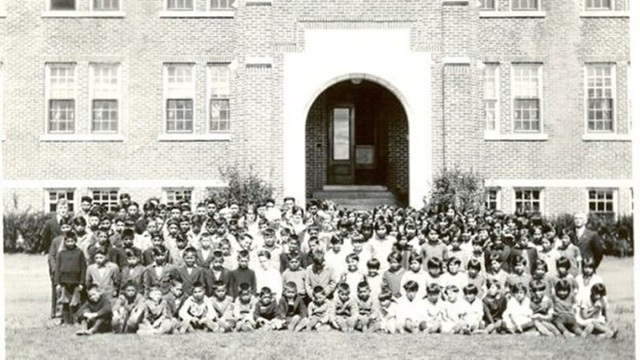
The new documentary Sugarcane uses extensive footage from the CBC documentary, The Eyes of Children, filmed in late 1962 at the Kamloops Indian Residential School.
The CBC film crew had access to the entire school and grounds for an extensive period of time, filming girls flocking to walk with the principal, Father Dunlop, senior and junior classes in session, playground activities, bedtime routines, religious services, Christmas preparations, children staying behind at the school during the holiday season because they had no home to go to, and much more.
All these activities at the school are featured in shots and video clips in the new documentary Sugarcane, including a clip of Indigenous teacher Mabel Caron teaching a senior class about telephone manners. In fact there were three Indigenous teachers at the Kamloops Indian Residential School in late 1962 – Mabel Caron, Benjamin Paul, and Joe Stanley Michel, the first graduate of the Kamloops Indian Residential School who returned there to teach and lived with his wife, Anna Soule, another graduate of the school, and their children in a teacherage on the school grounds.
The reason for using extensive footage from The Eyes of Children is not explained in Sugarcane, and is obviously confusing to viewers as Sugarcane is ostensibly about events which occurred at St Joseph’s Indian Residential School in Williams Lake. Why a film about a residential school in Williams Lake includes extensive footage from a decades-old CBC documentary about the Kamloops Indian Residential School is a mystery.
But leaving that mystery aside for explanation by the people who made Sugarcane, the inclusion of extensive footage from the CBC’s 1962 documentary The Eyes of Children establishes that the CBC has proved that nothing nefarious was happening at the Kamloops Indian Residential School in the early 1960s at a time when Canadians are now led to believe 215 children were being murdered and clandestinely buried by fellow students in the apple orchard.

In fact what was happening at the Kamloops Indian Residential School in the early 1960s, in addition to the regular school activities filmed by the CBC, was integration. A residence had been built for senior students, and they were being bussed into downtown Kamloops to attend St Ann’s Academy.
Obviously, the CBC knew all this in 1962 and knows it now.
Is the CBC implying by its silence that three Indigenous teachers and their families at the Kamloops Indian Residential School covered up the murder and clandestine burial in the apple orchard of 215 children? Did the CBC itself cover up these murders and secret burials in 1962?
Or did the CBC know in 1962 and now that nothing of the kind ever happened?
Nina Green is an independent researcher who lives in British Columbia.

From the Frontier Centre for Public Policy
By Jay Goldberg
Rosy projections, chronic deficits, and opaque budgeting. If nothing changes, Carney’s credibility could collapse under the same weight.
Carney promised a fresh start. His budget makes it look like we’re still stuck with the same old Trudeau playbook
It turns out the Trudeau government really did look at Canada’s economy through rose-coloured glasses. Is the Carney government falling into the same pattern?
New research from the Frontier Centre for Public Policy shows that federal budgets during the Trudeau years “consistently overestimated [Canada’s] fiscal health” when it came to forecasting the state of the nation’s economy and finances over the long term.
In his research, policy analyst Conrad Eder finds that, when looking specifically at projections of where the economy would be four years out, Trudeau-era budgets tended to have forecast errors of four per cent of nominal GDP, or an average of $94.4 billion.
Because budgets were so much more optimistic about long-term growth, they consistently projected that government revenue would grow at a much faster pace. The Trudeau government then made spending commitments, assuming the money would be there. And when the forecasts did not keep up, deficits simply grew.
As Eder writes, “these dramatic discrepancies illustrate how the Trudeau government’s longer-term projections consistently underestimated the persistence of fiscal challenges and overestimated its ability to improve the budgetary balance.”
Eder concludes that politics came into play and influenced how the Trudeau government framed its forecasts. Rather than focusing on the long-term health of Canada’s finances, the Trudeau government was focused on politics. But presenting overly optimistic forecasts has long-term consequences.
“When official projections consistently deviate from actual outcomes, they obscure the scope of deficits, inhibit effective fiscal planning, and mislead policymakers and the public,” Eder writes.
“This disconnect between projected and actual fiscal outcomes undermines the reliability of long-term planning tools and erodes public confidence in the government’s fiscal management.”
The public’s confidence in the Trudeau government’s fiscal management was so low, in fact, that by the end of 2024 the Liberals were polling in the high teens, behind the NDP.
The key to the Liberal Party’s electoral survival became twofold: the “elbows up” rhetoric in response to the Trump administration’s tariffs, and the choice of a new leader who seemed to have significant credibility and was disconnected from the fiscal blunders of the Trudeau years.
Mark Carney was recruited to run for the Liberal leadership as the antidote to Trudeau. His résumé as governor of the Bank of Canada during the Great Recession and his subsequent years leading the Bank of England seemed to offer Canadians the opposite of the fiscal inexperience of the Trudeau years.
These two factors together helped turn around the Liberals’ fortunes and secured the party a fourth straight mandate in April’s elections.
But now Carney has presented a budget of his own, and it too spills a lot of red ink.
This year’s deficit is projected to be a stunning $78.3 billion, and the federal deficit is expected to stay over $50 billion for at least the next four years.
The fiscal picture presented by Finance Minister François-Philippe Champagne was a bleak one.
What remains to be seen is whether the chronic politicking over long-term forecasts that plagued the Trudeau government will continue to be a feature of the Carney regime.
As bad as the deficit figures look now, one has to wonder, given Eder’s research, whether the state of Canada’s finances is even worse than Champagne’s budget lets on.
As Eder says, years of rose-coloured budgeting undermined public trust and misled both policymakers and voters. The question now is whether this approach to the federal budget continues under Carney at the helm.
Budget 2025 significantly revises the economic growth projections found in the 2024 fall economic statement for both 2025 and 2026. However, the forecasts for 2027, 2028 and 2029 were left largely unchanged.
If Eder is right, and the Liberals are overly optimistic when it comes to four-year forecasts, then the 2025 budget should worry Canadians. Why? Because the Carney government did not change the Trudeau government’s 2029 economic projections by even a fraction of a per cent.
In other words, despite the gloomy fiscal numbers found in Budget 2025, the Carney government may still be wearing the same rose-coloured budgeting glasses as the Trudeau government did, at least when it comes to long-range fiscal planning.
If the Carney government wants to have more credibility than the Trudeau government over the long term, it needs to be more transparent about how long-term economic projections are made and be clear about whether the Finance Department’s approach to forecasting has changed with the government. Otherwise, Carney’s fiscal credibility, despite his résumé, may meet the same fate as Trudeau’s.
Jay Goldberg is a fellow with the Frontier Centre for Public Policy.

From the Frontier Centre for Public Policy
By Collin May
Targeting comedians is a sign of political insecurity
A democracy that fears its comedians is a democracy in trouble. That truth landed hard when Graham Linehan, the Irish writer behind Father Ted and The IT Crowd, stepped off a plane at Heathrow on Sept. 1, 2025, and was met by five London Metropolitan Police officers ready to arrest him for three posts on X.
Returning to the UK from Arizona, he was taken into custody on the charge of “suspicion of inciting violence”, an allegation levelled with increasing ease in an age wary of offence. His actual “crime” amounted to three posts, the most contentious being a joke about trans-identified men in exclusively female spaces and a suggestion that violated women respond with a swift blow to a very sensitive part of the male’s not-yet-physically-transitioned anatomy.
The reaction to Linehan’s arrest, from J.K. Rowling to a wide array of commentators, was unqualified condemnation. Many wondered whether free speech had become a museum piece in the UK. Asked about the incident, British Prime Minister Keir Starmer defended his country’s reputation for free expression but declined to address the arrest itself.
Canada has faced its own pressures on comedic expression. In 2022, comedian Mike Ward saw a 12-year legal saga end when the Supreme Court of Canada ruled five-to-four that the Quebec Human Rights Commission had no jurisdiction to hear a complaint about comments Ward made regarding a disabled Quebec boy. The ruling confirmed that human rights bodies cannot police artistic expression when no discrimination in services or employment has occurred. In that case, comic licence survived narrowly.
These cases reveal a broader trend. Governments and institutions increasingly frame comedy as a risk rather than a social pressure valve. In an environment fixated on avoiding perceived harm, humour becomes an easy and symbolic target. Linehan’s arrest underscores the fragility of free speech, especially in comedic form, in countries that claim to value democratic openness.
Comedy has long occupied an unusual place in public life. One of its earliest literary appearances is in Homer’s Iliad. A common soldier, Thersites, is ugly, sharp-tongued and irreverent. He speaks with a freedom others will not risk, mocking Agamemnon and voicing the frustrations of rank-and-file soldiers. He represents the instinct to puncture pretension. In this sense, comedy and philosophy share a willingness to speak uncomfortable truths that power prefers to avoid.
Aristotle, in his Poetics, noted that tragedy imitates noble actions and depicts people who are to be taken seriously. Comedy, by contrast, imitates those who appear inferior. Yet this lowly status is precisely what gives comedy its political usefulness. It allows performers to say what respectable voices cannot, revealing hypocrisies that formal discourse leaves untouched.
In the Iliad, Thersites does not escape punishment. Odysseus, striving to restore order, strikes him with Agamemnon’s staff, and the soldiers laugh as Thersites is silenced. The scene captures a familiar dynamic. Comedy can expose authority’s flaws, but authority often responds by asserting its dominance. The details shift across history, but the pattern endures.
Modern democracies are showing similar impatience. Comedy provides a way to question conventions without inviting formal conflict. When governments treat jokes as misconduct, they are not protecting the public from harm. They are signalling discomfort with scrutiny. Confident systems do not fear irreverence; insecure ones do.
The growing targeting of comedians matters because it reflects a shift toward institutions that view dissent, even in comedic form, as a liability. Such an approach narrows the space for open dialogue and misunderstands comedy’s role in democratic life. A society confident in itself tolerates mockery because it trusts its citizens to distinguish humour from harm.
In October, the British Crown Prosecution Service announced it would not pursue charges against Linehan. The London Metropolitan Police Service also said it would stop recording “non-crime hate incidents”, a controversial category used to document allegations of hateful behaviour even when no law has been broken. These reversals are welcome, but they do not erase the deeper unease that allowed the arrest to happen.
Comedy survives, but its environment is shifting. In an era where leaders are quick to adopt moral language while avoiding meaningful accountability, humour becomes more necessary, not less. It remains one of the few public tools capable of exposing the distance between political rhetoric and reality.
The danger is that in places where Agamemnon’s folly, leadership driven by pride and insecurity, takes root, those who speak uncomfortable truths may find themselves facing not symbolic correction but formal sanctions. A democracy that begins by targeting its jesters rarely stops there.
Collin May is a Senior Fellow with the Frontier Centre for Public Policy, a lawyer, and Adjunct Lecturer in Community Health Sciences at the University of Calgary, with degrees in law (Dalhousie University), a Masters in Theological Studies (Harvard) and a Diplome d’etudes approfondies (Ecole des hautes etudes, Paris).

Blacked-Out Democracy: The Stellantis Deal Ottawa Won’t Show Its Own MPs

Health Canada pauses plan to sell unlabeled cloned meat

Is there a cure for Alzheimer’s Disease?

Google denies scanning users’ email and attachments with its AI software
-
 Alberta2 days ago
Alberta will defend law-abiding gun owners who defend themselves
-
 Business2 days ago
Canada’s future prosperity runs through the northwest coast
-
 National2 days ago
Canada Needs an Alternative to Carney’s One Man Show
-
 Alberta1 day ago
This new Canada–Alberta pipeline agreement will cost you more than you think
-
 MAiD1 day ago
From Exception to Routine. Why Canada’s State-Assisted Suicide Regime Demands a Human-Rights Review
-
 Business1 day ago
New Chevy ad celebrates marriage, raising children
-
 Automotive1 day ago
Power Struggle: Governments start quietly backing away from EV mandates
-
 Energy1 day ago
Unceded is uncertain