
Bruce Dowbiggin
Destroying The Development System: Expect Turbulence


News Item: Child golf phenom Xavier Perez has scored a major NIL deal before even becoming a teenager. The 12-year-old, who has won more than 250 tournaments since he began playing golf competitively nine years ago, landed a name, image and likeness deal with Cobra Puma.
NIL, to the uninitiated, means Name Image Likeness. And it’s about to blow up the development models for a number of sports— including hockey. The right of athletes to profit from NIL is the result of decades of legal challenges by “student” athletes in the U.S. who saw coaches, programs and networks get phenomenally rich while they received only a scholarship in return (only one percent of all collegiate student-athletes receive a full ride.)
If an athlete was seen to be receiving even a meal or a job from an outside party they lost their “amateur” status and were ineligible for play in the U.S. college system that supplies talent to the NFL, NBA, NHL and MLB. Ditto if they used an agent. For decades the system prevailed. Until the explosion in the digital world of video games, when greedy colleges reaped a fortune using the NIL of athletes— never thinking they’d need to compensate them.
The result was O’Bannon v NCAA, a challenge to U.S. antitrust law in which former UCLA star Ed O’Bannon and a number of other former NCAA athletes won the right in 2014 to be compensated for their NIL in the EA Sports series. That produced years of negotiations in which the NCAA tried to create a system that would preserve college athletics while staying within the terms of the decision.
On July 1, 2021, the NCAA announced it had agreed to rules that “removed restrictions on college athletes from entering paid endorsements and other sponsorship deals, and from using agents to manage their publicity”. The only caveat is that athletes can’t use the symbols, uniforms or logos of the school in their advertising. And universities can’t pay athletes directly.
What they created is a wide-open system that 12-year-old Xavier Perez is now exploiting. What does it mean? It means that the top prospects headed to the NFL, NBA, NHL and MLB could now be making millions even as they play FBS bowl games, March Madness, the Frozen Four etc. They will be able to make decisions on what school to attend based on financial remuneration as well as opportunity to play. They’ll also be able to make significant money years before they enter college.
Because the remuneration comes from booster groups, outsider sponsors and equipment companies, schools will not have the ultimate control they’ve exercised for over a century. An athlete who has financial security will not be forced to go pro before he/ she is ready or go to a team they don’t want to play for. (Or he/ she can use the new transfer portals to switch schools as they see fit.)
“I definitely would’ve stayed for a fifth year [if there were NIL laws],” said Cardale Jones, a former star quarterback at Ohio State. “With my draft status, and still having a household name in college football in Columbus, [Ohio,] I’m pretty sure I would’ve made a lot more money than being drafted in the fourth round.”
NIL is not a panacea for all athletes. Even at the top schools opportunities will be limited for low-profile players in the non-glamour positions. There will conceivably be millionaire QBs playing with OL grunts who might have a deal with a sandwich shop. Smaller schools will have trouble competing with the big boys of Div One.
ESPN reported on what Georgia Tech players received for becoming social influencers. “Swanky PJs are part of what Yellow Jackets players received in exchange for agreeing to promote TiVo on social media this month. They also got a prepaid debit card worth $404 (Atlanta’s area code is 404) and the company’s 4k streaming device… the total value is more than $100,000, according to TiVo, who said 90 of the team’s players have signed a contract for the endorsement.”
The system is only now being implemented; dramatic changes will doubtless appear. Already there is tension among the coaches who must now deal with the new rules. Alabama’s football legend Nick Sabin and Texas A&M’s Jimbo Fisher recently got into a heated public bitch slapping over the ethics and inducements of recruiting. “That creates a situation where you can basically buy players,” said Saban, who makes about $10 million a year. “You can do it in recruiting. I mean, if that’s what we want college football to be, I don’t know.”

Prize recruit Bryce Young, who had yet to start a game for Saban at Alabama, had NIL deals closing in on $1 million. Clearly, football and basketball will need to streamline their development system. If colleges are now a pay-for-play system, how does that affect their status as institutions of learning? What happens if excesses in NIL force government into stripping colleges of the development role and giving it to pro leagues?
There has been zero information on how NIL affects the development system of NHL prospects? At the moment a majority of them go to Canada’s low-paying CHL teams which play far more games a season than does the NCAA. One game in CHL disqualified a prospect from playing in the NCAA’s formerly simon-pure amateur system.

But now a Connor McDavid can sign an NIL contract at 14 years old, play in the NCAA and— rich already— still be drafted No. 1 overall. Yes, college hockey has a lower profile and fewer opportunities for endorsements. Some will want the CHL’s experience. But a McDavid-type player would be a prize catch for an equipment company or a video game manufacturer. Or even as an influencer. All things currently not allowed in the CHL.
NIL won’t kill the CHL but it could strip away a significant portion of its stars who choose guaranteed money over long bus rides and billeting with other players. It’s early days, of course, but be prepared for an NHL No. 1 draft pick being a millionaire before his name is even called in the draft.
Bruce Dowbiggin @dowbboy is the editor of Not The Public Broadcaster (http://www.notthepublicbroadcaster.com). The best-selling author was nominated for the BBN Business Book award of 2020 for Personal Account with Tony Comper. A two-time winner of the Gemini Award as Canada’s top television sports broadcaster, he’s also a regular contributor to Sirius XM Canada Talks Ch. 167. His new book with his son Evan Inexact Science: The Six Most Compelling Draft Years In NHL History is now available on http://brucedowbigginbooks.ca/book-personalaccount.aspx


Adin Hill. Jordan Binnington. Logan Thompson. Sam Montembeault. Four goalies considered for Canada’s Olympic mens hockey roster.
One of these players is not like the others. In fact, one of them is unlike anyone else on Canada’s team announced last week. Sam Montembault— who was on the Four Nations roster last February— would have been the only French Canadian player on the roster. The absence of Quebec players marks the first time no Quebeckers made a Canadian Olympic team. (They’ve averaged four players per Olympics post 1998.)
It’s no better at the junior level as only Caleb Desnoyers made Canada’s roster for the 2026 World Junior championships in Minnesota. Who knows if a couple of French players might have saved them from a third-straight ignominious exit at the WJC.
How is it that the province that has produced so many stars is now reduced to no Quebec players representing the country? Montreal author Brendan Kelly called the shutout an “indictment of Hockey Quebec… Why is it that the province is not producing NHL stars any more? Quebec is not producing the goalies like it used to?”

What is surprising is how little competition there is in Quebec for that Olympic berth these days. Hockey is blood and bone (sang et os) in Quebec. Always has been going back to the days of Aurel Joliat. It was built on the legacies of Rocket Richard, Jean Beliveau, Mario Lemieux and Vincent Lecavalier.
On defence there was Denis Potvin, Serge Savard, Jacques Laperriere and Guy Lapointe. There have been great goalies such as Jacques Plante, Bernie Parent and Patrick Roy. Now?
It’s probably safe to say the best French Canadians in the NHL at the moment are Jonathan Marchessault and Pierre-Luc Dubois. But they were hardly favourites to play in Turin. Ditto Calgary’s Jonathan Huberdeau, who once scored 115 points in 2022-23. Last February’s Four Nations Canadian roster had the single Quebec product— and that was goalie Montembeault.
It’s not like the QMJHL doesn’t produce players. Three star Maritimers on the Olympic squad— Sidney Crosby, Nathan MacKinnon and Brad Marchand— are products of the Quebec League. Since the NHL began allowing teams to send players to Olympic rosters, Canada has averaged four Quebec-born players per squad and each year featured at least one goalie from the province.

And it’s not like there are no Quebec players in the league. Last year, 6.1 percent of the NHL was Quebec-born players. That was the second-most of any region behind only Ontario (17.6 percent), and it’s up from the 5.3 percent from last season. And yet, you wouldn’t know it if you looked at the overall stats.
To find the root of the drought you can look at the draft where only one French Canadian player— Alex Lafreniere— has been taken No. 1 overall since Marc-Andre Fleury was taken in 2003. (No one seriously considered Lafreniere for Team Canada.) In 2025 three QMJHL players went first round. In 2024 none. In 2023 none. In 2022, two. In 2021 four (one non Quebecker). You get the idea.
Now look back a decade or longer. Only one French Canadian other that Dubois went in the first round in 2016. Just one French Canadian went in the 2017 first round, two in 2015, none in 2014, Drouin and three others in 2013, none in 2012, Huberdeau in 2011 and none in 2010.
As Boston star Michel Bergeron showed, you don’t have to be a first rounder to become a star. It’s also true that prospects are emerging from everywhere in the world, and so French Canadians— who used to have better odds— are having to compete in a far bigger talent pool. But that hasn’t kept the OHL from turning out a motherlode of young stars.
The culture of hockey in Quebec is in turmoil. Former Montreal goalie Jocelyn Thibault resigned as head of Hockey Quebec, citing a “resistance to change” among the regional associations.
There are many other factors in play. Access to elite training, cost, warmer winters eliminating outdoor rinks, cultural preferences for other sports— all play some part. But as we said in 2019, “the days when Canadiens GM Sam Pollock getting the top two French Canadians as protected draftees was considered a steal are long gone.”
Bruce Dowbiggin @dowbboy is the editor of Not The Public Broadcaster A two-time winner of the Gemini Award as Canada’s top television sports broadcaster, his 2025 book Deal With It: The Trades That Stunned The NHL And Changed Hockey is now available on Amazon. Inexact Science: The Six Most Compelling Draft Years In NHL History, his previous book with his son Evan, was voted the seventh-best professional hockey book of all time by bookauthority.org . His new poetry collection In Other Words is available via brucedowbigginbooks.ca and on Kindle books at https://www.amazon.ca/dp/1069802700
“Of all tyrannies, a tyranny sincerely exercised for the good of its victims may be the most oppressive. It would be better to live under robber barons than under omnipotent moral busybodies.” C.S. Lewis
One of the aims of logical positivism has been Boomers’ quest to kill Western religion and the pursuit of faith in order to make room for the state. Symbols are banned. Churches are burned. Infidels are rewarded. Esoteric faith systems applauded. Yet, as 2026 dawns, it appears that, not only is traditional religion not dead, it might just be making a comeback with younger generations who’ve grown skeptical of their parents’ faux religion of self.
How? In an age of victim status, traditional religion is suddenly a cuddly TikTok puppy. Hard to imagine that the force that spread imperialism and war across the globe for centuries being a victim. But yes. Only Christians and Jews are singled out for censure In Carney’s Canada The zeal to repeal God has backfired. Faith is off the canvas and punching back. (And we are NOT talking about the Woke pope.)
The purveyors of “old-time religion” will still find themselves facing a determined opponent well on the way to moral inversion. And a compliant population. As blogger Melanie in Saskatchewan points out, “Canadians were sold a calm, competent adult in the room. What they got was an unelected system engineer quietly converting moral claims into financial constraints. This is not leadership. It is non-consensual governance.

The freedoms that make dissent possible are being used to hollow out dissent. The protections meant to guard against abuse are being used to avoid scrutiny. And the law—stripped of its moral imagination—is asked to do what it cannot: resolve psychic conflict through paperwork.”
The sophistry of the superior class demands submission. C.S. Lewis warned of this inversion in God In The Dock. “To be “cured” against one’s will and cured of states which we may not regard as disease is to be put on a level of those who have not yet reached the age of reason or those who never will; to be classed with infants, imbeciles, and domestic animals.”
In Canada that compliant class has embraced Mark Carney as the great stabilizer. “Canadians keep asking the wrong question about Mark Carney,” says blogger Melanie in Saskatchewan. “They keep asking whether he is a good politician. That is like asking whether a locksmith is a good interior decorator.
Carney is not here to govern. He is here to re-engineer the operating system of the country while the Liberal Party provides the helpful stage props and applause track. And judging by how little scrutiny this government receives, the audience seems perfectly content to clap at whatever is placed in front of them, provided it comes with soothing words like “stability,” “resilience,” and “the experts agree”.
Adds Dr. Andrea Wagner, Canadians “hide behind procedure. Behind policy. Behind institutions. Behind NDAs. Behind committees, processes, protocols. Behind phrases like “we’re reviewing this internally” and “that’s beyond my authority.” They hide behind the pretense of empathy while quietly perpetuating injustice. They hide behind performative busy-ness: “I wish I had time,” “I’m swamped,” “I’ve been unwell.” There is enormous power in powerlessness—and Canadians wield it masterfully.”
The problem, says Melanie in Saskatchewan, is not that Mark Carney in full power is incompetent. The problem is that he is extremely competent at something Canadians never actually consented to. Technocrats redesign the machinery so that the outcome becomes inevitable. No messy debate. No inconvenient voters. No public reckoning. Just “the framework,” “the model,” “the standard,” and eventually the quiet conclusion that there is “no alternative.”
And this is precisely the world Mark Carney comes from. ”He did not rise through grassroots politics or party service. He rose through central banks, global finance institutions, and elite climate-finance bodies that speak fluent acronym and consider democracy an optional inconvenience. The man does not campaign. He architects.”
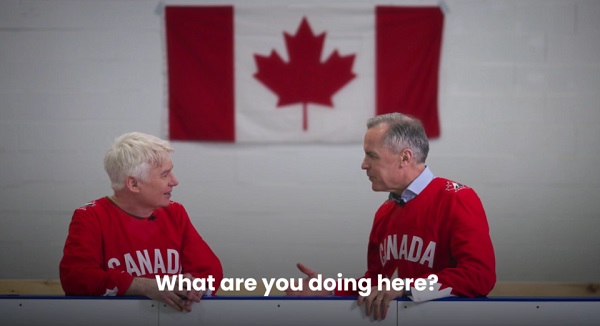
While the Conservative Party of Canada still polls evenly with the Liberals they are playing a different game, one they— with their traditional tactics— are not wired to win in a battle of systems with Carney. This cringeworthy “Keep It Up” endorsement of Carney by former CPC leader Erin O’Toole speaks to why they are further from power than ever.
The manufactured crisis over indigenous Rez school graves illustrates the method. “To call out intimidation or dehumanization is to risk being reframed as the aggressor. The person who names harm becomes the disturbance; the one who weaponizes grievance becomes the protected party. Justice no longer asks what happened, only who claims injury first. This is not accidental. It is the logical endpoint of a culture that has confused victimhood with virtue and pain with authority.

Suffering, once something to be alleviated, has become something to be curated. Identity now precedes evidence; accusation outruns inquiry. The system does not ask whether harm is real or proportional—only whether it can be procedurally contained. And containment, I am learning, is often preferred to truth.”
There are still some who believe there remains a way out of this. Here’s Paul Wells on Substack with a valid conclusion— which most sentient people reached by the end of Trudeau’s first term. “Canada has spent too long thinking of itself as a warehouse for the world instead of designing and building for itself. It’s time for a shared mindset of ambition quality and real investment in physical and human capital so Canadians become Canada’s designers and builders of livable cities rather than bystanders to our own future.”
But it’s hard to square that with the gap Carney’s already has. “The tragedy is that the Liberal Party is perfectly happy to hand (Carney) the country and then scold the public for noticing. If Canadians want a future where choices are still made by voters instead of algorithms and advisory panels, they are going to have to stop applauding this performance and start asking the one question that truly terrifies technocrats and their obedient political enablers.”

This system monolith taking over life is why the abrasive, defiant Donald Trump emerged. Vast segments of America employ him to defy the EU scolds with their censorship regimes. His defiance is categorical— which is why it frightens Canadians. The man from Mitch & Murray delivered a few truths to them and they soiled themselves. Paradise will never be the same!. Bad Trump! But an almost-octogenarian has little runway left himself. Who can continue the resistance to the Carney system engineers?
In the past organized religion was a refuge from the maelstrom of the secular storm. There was comfort in the message. Thus, the Liberals’ current need to destroy faith. So the epidemic of churches burned is ignored. The intrusive demonstrations of militant Islam are tolerated. (Carney says Muslim virtues are Canadian virtues.) History is re-written. Heroes debunked.
If Soviet Russia is any indication, the traditional faiths can survive and act as a bulwark against the technocrats— if they find their Pope John Paul II.. The Catholic and Orthodox faiths furnished a way out from behind the Iron Curtain. As organizations not co-opted by the state in the West religions can provide a moral backbone to expose and defeat the secular globalists.
Whether you are a believer or not they provide a pushback to restore the moral clarity C.S. described. It’s not too late as 2026 dawns. But if nothing is done in the West — if Canada accepts EU censorship and global ID— then writing this column in 2027 could well be defined as a criminal act.
“That which you most need will be found where you least want to look.” Carl Jung
Bruce Dowbiggin @dowbboy is the editor of Not The Public Broadcaster A two-time winner of the Gemini Award as Canada’s top television sports broadcaster, his 2025 book Deal With It: The Trades That Stunned The NHL And Changed Hockey is now available on Amazon. Inexact Science: The Six Most Compelling Draft Years In NHL History, his previous book with his son Evan, was voted the seventh-best professional hockey book of all time by bookauthority.org . His new poetry collection In Other Words is available via brucedowbigginbooks.ca and on Kindle books at https://www.amazon.ca/dp/1069802700

Rulings could affect energy prices everywhere: Climate activists v. the energy industry in 2026

The Global Push for Government Mandated Digital IDs And Why You Should Worry

Maduro says he’s “ready” to talk
The Rise Of The System Engineer: Has Canada Got A Prayer in 2026?
-
 Frontier Centre for Public Policy1 day ago
Is Canada still worth the sacrifice for immigrants?
-
Bruce Dowbiggin1 day ago
The Olympic Shutout: No Quebec Players Invited For Canada
-
 Canadian Energy Centre1 day ago
Five reasons why 2026 could mark a turning point for major export expansions
-
 International1 day ago
Network of Nonprofits with Marxist and CCP Ties, and Elected Socialists Race to Counter Washington’s Narrative of the Maduro Raid
-
 Business1 day ago
Policy uncertainty continues to damage Canada’s mining potential
-
 Alberta1 day ago
Trump’s Venezuela Geopolitical Earthquake Shakes up Canada’s Plans as a “Net Zero” Energy Superpower
-
 Energy1 day ago
Trump’s Venezuela Move: A $17 Trillion Reset of Global Geopolitics and a Pivotal Shift in US Energy Strategy
-
 COVID-192 days ago
A new study proves, yet again, that the mRNA Covid jabs should NEVER have been approved for young people.