
Business
Conservatives demand Brookfield Asset Management reveal Mark Carney’s compensation

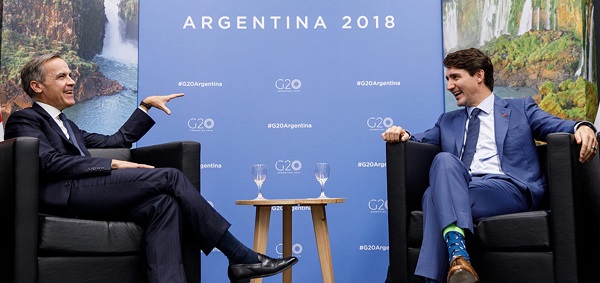

From Conservative Party Communications
Canadians Deserve to Know How Much Carney is Being Paid
Today, Common Sense Conservative MPs Michelle Rempel Garner and Michael Barrett wrote this letter to Bruce Flatt, the CEO of Brookfield, calling on him to fully disclose Carbon Tax Carney’s compensation for his role as Chair of Brookfield Asset Management. The full text can be found below:
Dear Mr. Flatt,
We are writing with regard to the Chair of Brookfield Asset Management, Mark Carney, who has acted in a senior leadership position for your company for some time now.
During the same time period, Mr. Carney has been advising Prime Minister Justin Trudeau’s government, and advocating for policies that have arguably wreaked havoc on Canada’s economy, like the carbon tax.
After nine years of this NDP-Liberal Government, which by their own very public admissions have relied on Mark Carney for advice, Canadians are witnessing the worst decline in living standards in forty years. The cost of housing has doubled, and record numbers of Canadians are having to depend on food banks to survive.
Since August 2020, Mr. Carney has helped the NDP-Liberal Government hike its carbon tax on the backs of working Canadians, even endorsing it in his book, saying “One of the most important initiatives is carbon pricing…The Canadian federal carbon pricing framework is a model for others.” And since September 2024, when Trudeau appointed Carney as the Liberal Party’s Chair of the Leader’s Taskforce on Economic Growth, he would have had input into the most recent Fall Economic Statement which plunged Canada into a $62 billion deficit, blowing past the NDP-Liberal Government’s own fiscal guardrails.
And all the while Carney was advising the Liberals to continue carrying out their agenda of economic vandalism, he remained the Chair of Brookfield Asset Management, posing grave ethical questions that could have real-life consequences for millions of Canadians.

For instance, just a few days after his official appointment as Chair of the Leader’s Taskforce on Economic Growth, The Logic reported that Brookfield Asset Management has been actively lobbying the same federal Liberal government he’s been advising for $10 billion from the Canadian taxpayer. And Mr. Carney has strongly advocated for policies that would destroy Canada’s oil and gas sector, while at the same time your company invested in oil companies in Brazil and the United Arab Emirates.
There are many other instances of questionable policy decisions the NDP-Liberal Government has made while Mark Carney was both advising them and acting as the Chair of Brookfield Asset Management – decisions that potentially could have resulted in Mr. Carney’s personal gain.
While we have written to the Federal Lobbying Commissioner to examine whether this arrangement broke any lobbying rules, that investigation may not shed public light on whether Mr. Carney was personally motivated by the structure of his compensation model with your company to advocate for certain policies in his senior advisory capacity with Justin Trudeau’s Liberal government.
Executive compensation for a Chair at a company the size of Brookfield can include salary, performance bonuses, stock options, lucrative expense accounts and more. Since Mr. Carney has a direct, senior, advisory line into Justin Trudeau’s government, and since your company has many interests which involve the type of policy on which Mr. Carney was advising the government, revealing the full scope of Mr. Carney’s compensation package to the public is essential to understanding what impact his access into the federal Liberal government had on his personal fortunes, if any.
For this reason, you must disclose Carney’s compensation structure with Brookfield Asset Management. This is especially important as Carney is now mounting a leadership campaign – with the help of members of Justin Trudeau’s inner circle – that could see him become the leader of the Liberal Party of Canada and the Prime Minister of this country, with even more power and more access.
It is vitally important for Canadians to know whether or not Mr. Carney’s compensation with Brookfield could increase if the Liberals implement his policy ideas. While food banks report over two million visits in a single month, Canadians have a right to know the fine details about the impact of insider access on their lives.
You must be transparent with Canadians on this matter. The stakes could not be higher.

Business
The world is no longer buying a transition to “something else” without defining what that is

From Resource Works
Even Bill Gates has shifted his stance, acknowledging that renewables alone can’t sustain a modern energy system — a reality still driving decisions in Canada.
You know the world has shifted when the New York Times, long a pulpit for hydrocarbon shame, starts publishing passages like this:
“Changes in policy matter, but the shift is also guided by the practical lessons that companies, governments and societies have learned about the difficulties in shifting from a world that runs on fossil fuels to something else.”
For years, the Times and much of the English-language press clung to a comfortable catechism: 100 per cent renewables were just around the corner, the end of hydrocarbons was preordained, and anyone who pointed to physics or economics was treated as some combination of backward, compromised or dangerous. But now the evidence has grown too big to ignore.
Across Europe, the retreat to energy realism is unmistakable. TotalEnergies is spending €5.1 billion on gas-fired plants in Britain, Italy, France, Ireland and the Netherlands because wind and solar can’t meet demand on their own. Shell is walking away from marquee offshore wind projects because the economics do not work. Italy and Greece are fast-tracking new gas development after years of prohibitions. Europe is rediscovering what modern economies require: firm, dispatchable power and secure domestic supply.
Meanwhile, Canada continues to tell itself a different story — and British Columbia most of all.
A new Fraser Institute study from Jock Finlayson and Karen Graham uses Statistics Canada’s own environmental goods and services and clean-tech accounts to quantify what Canada’s “clean economy” actually is, not what political speeches claim it could be.
The numbers are clear:
- The clean economy is 3.0–3.6 per cent of GDP.
- It accounts for about 2 per cent of employment.
- It has grown, but not faster than the economy overall.
- And its two largest components are hydroelectricity and waste management — mature legacy sectors, not shiny new clean-tech champions.
Despite $158 billion in federal “green” spending since 2014, Canada’s clean economy has not become the unstoppable engine of prosperity that policymakers have promised. Finlayson and Graham’s analysis casts serious doubt on the explosive-growth scenarios embraced by many politicians and commentators.
What’s striking is how mainstream this realism has become. Even Bill Gates, whose philanthropic footprint helped popularize much of the early clean-tech optimism, now says bluntly that the world had “no chance” of hitting its climate targets on the backs of renewables alone. His message is simple: the system is too big, the physics too hard, and the intermittency problem too unforgiving. Wind and solar will grow, but without firm power — nuclear, natural gas with carbon management, next-generation grid technologies — the transition collapses under its own weight. When the world’s most influential climate philanthropist says the story we’ve been sold isn’t technically possible, it should give policymakers pause.
And this is where the British Columbia story becomes astonishing.
It would be one thing if the result was dramatic reductions in emissions. The provincial government remains locked into the CleanBC architecture despite a record of consistently missed targets.
Since the staunchest defenders of CleanBC are not much bothered by the lack of meaningful GHG reductions, a reasonable person is left wondering whether there is some other motivation. Meanwhile, Victoria’s own numbers a couple of years ago projected an annual GDP hit of courtesy CleanBC of roughly $11 billion.
But here is the part that would make any objective analyst blink: when I recently flagged my interest in presenting my research to the CleanBC review panel, I discovered that the “reviewers” were, in fact, two of the key architects of the very program being reviewed. They were effectively asked to judge their own work.
You can imagine what they told us.
What I saw in that room was not an evidence-driven assessment of performance. It was a high-handed, fact-light defence of an ideological commitment. When we presented data showing that doctrinaire renewables-only thinking was failing both the economy and the environment, the reception was dismissive and incurious. It was the opposite of what a serious policy review looks like.
Meanwhile our hydro-based electricity system is facing historic challenges: long term droughts, soaring demand, unanswered questions about how growth will be powered especially in the crucial Northwest BC region, and continuing insistence that providers of reliable and relatively clean natural gas are to be frustrated at every turn.
Elsewhere, the price of change increasingly includes being able to explain how you were going to accomplish the things that you promise.
And yes — in some places it will take time for the tide of energy unreality to recede. But that doesn’t mean we shouldn’t be improving our systems, reducing emissions, and investing in technologies that genuinely work. It simply means we must stop pretending politics can overrule physics.
Europe has learned this lesson the hard way. Global energy companies are reorganizing around a 50-50 world of firm natural gas and renewables — the model many experts have been signalling for years. Even the New York Times now describes this shift with a note of astonishment.
British Columbia, meanwhile, remains committed to its own storyline even as the ground shifts beneath it. This isn’t about who wins the argument — it’s about government staying locked on its most basic duty: safeguarding the incomes and stability of the families who depend on a functioning energy system.
Resource Works News


“It’s a good a bet that high-speed rail between Toronto and Quebec City isn’t even among the top 1,000 priorities for most Canadians.”
The Canadian Taxpayers Federation is criticizing Prime Minister Mark Carney for borrowing billions more for high-speed rail between Toronto and Quebec City.
“Canadians need help paying for basics, they don’t need another massive bill from the government for a project that only benefits one corner of the country,” said Franco Terrazzano, CTF Federal Director. “It’s a good a bet that high-speed rail between Toronto and Quebec City isn’t even among the top 1,000 priorities for most Canadians.
“High-speed rail will be another costly taxpayer boondoggle.”
The federal government announced today that the first portion of the high-speed rail line will be built between Ottawa and Montreal with constructing starting in 2029. The entire high-speed rail line is expected to go between Toronto and Quebec City.
The federal Crown corporation tasked with overseeing the project “estimated that the full line will cost between $60 billion and $90 billion, which would be funded by a mix of government money and private investment,” the Globe and Mail reported.
The government already owns a railway company, VIA Rail. The government gave VIA Rail $1.9 billion over the last five years to cover its operating losses, according to the Crown corporation’s annual report.
The federal government is borrowing about $78 billion this year. The federal debt will reach $1.35 trillion by the end of this year. Debt interest charges will cost taxpayers $55.6 billion this year, which is more than the federal government will send to the provinces in health transfers ($54.7 billion) or collect through the GST ($54.4 billion).
“The government is up to its eyeballs in debt and is already spending hundreds of millions of dollars bailing out its current train company, the last thing taxpayers need is to pay higher debt interest charges for a new government train boondoggle,” Terrazzano said. “Instead of borrowing billions more for pet projects, Carney needs to focus on making life more affordable and paying down the debt.”


University of Colorado will pay $10 million to staff, students for trying to force them to take COVID shots

Wayne Gretzky’s Terrible, Awful Week.. And Soccer/ Football.
Integration Or Indignation: Whose Strategy Worked Best Against Trump?

Western Campuses Help Build China’s Digital Dragnet With U.S. Tax Funds, Study Warns
-
 International2 days ago
Trump admin wants to help Canadian woman rethink euthanasia, Glenn Beck says
-
 Local Business2 days ago
Red Deer Downtown Business Association to Wind Down Operations
-
 COVID-192 days ago
Trump DOJ seeks to quash Pfizer whistleblower’s lawsuit over COVID shots
-
 Alberta2 days ago
The case for expanding Canada’s energy exports
-
 Crime2 days ago
U.S. seizes Cuba-bound ship with illicit Iranian oil history
-
 Business1 day ago
Albertans give most on average but Canadian generosity hits lowest point in 20 years
-
 International2 days ago
Marjorie Taylor Greene’s ’60 Minutes’ interview reveals power struggle between populists and RINOs
-
 Censorship Industrial Complex1 day ago
Ottawa’s New Hate Law Goes Too Far