
Censorship Industrial Complex
Comedy writer Graham Linehan arrested in UK for criticizing gender ideology on social media



From LifeSiteNews
It is difficult to fathom the strategic insanity of arresting a popular comedian at the airport with five police officers over three anodyne X posts.
The transgender totalitarians still run the United Kingdom.
On September 1, Irish comedy writer Graham Linehan was arrested at Heathrow Airport in London by five police officers. According to Linehan, the police cited three X posts critical of transgender ideology as the reason for his arrest.
According to Linehan’s account, posted to his Substack on September 2, he noticed that something was amiss when he attempted to board his flight home in Arizona; he was told he had no seat, and had to be reticketed.
“The moment I stepped off the plane at Heathrow, five armed police officers were waiting,” he wrote. “They escorted me to a private area and told me I was under arrest for three tweets. In a country where paedophiles escape sentencing, where knife crime is out of control, where women are assaulted and harassed every time they gather to speak, the state had mobilised five armed officers to arrest a comedy writer…”
The three X posts that triggered his arrest included one on April 20, in which Linehan wrote that if a “trans-identified man is in a female-only space, he is committing a violent, abusive act” and made a joke about punching the offender in the crotch; another from April 19, featuring a photo of a transgender rally with the caption “a photo you can smell”; and a third on the same day in which Linehan stated that he hates “misogynists and homophobes.”

“When I first saw the cops, I actually laughed,” Linehan recounted. “I couldn’t help myself. ‘Don’t tell me! You’ve been sent by trans activists.’ The officers gave no reaction and this was the theme throughout most of the day. Among the rank-and-file, there was a sort of polite bafflement. Entirely professional and even kind, but most had absolutely no idea what any of this was about.”
The police read the comedian his rights without irony and then walked him to a van parked on the tarmac to collect him. At the Heathrow police station, his belt, bag, and devices were taken, and he was put in a “small green-tiled cell with a bunk [and] a silver toilet in the corner.” He was then interrogated about each of the three X posts “with the sort of earnest intensity usually reserved for discussing something serious like…oh, I dunno, a crime?” Linehan writes:
He mentioned “trans people”. I asked him what he meant by the phrase. “People who feel their gender is different than what was assigned at birth.” I said “Assigned at birth? Our sex isn’t assigned.” He called it semantics, I told him he was using activist language. The damage Stonewall has done to the UK police force will take years to mend.
Eventually, a nurse came to check on me and found my blood pressure was over 200—stroke territory. The stress of being arrested for jokes was literally threatening my life! So I was escorted to A&E, where I write this now after spending about eight hours under observation.
Linehan was given a single bail condition: that he could not go on X. He was also informed that he faced a follow-up interview in October. As he summarized his experience:
The civility of individual officers doesn’t alter the fundamental reality of what happened. I was arrested at an airport like a terrorist, locked in a cell like a criminal, taken to hospital because the stress nearly killed me, and banned from speaking online—all because I made jokes that upset some psychotic crossdressers. To me, this proves one thing beyond doubt: the UK has become a country that is hostile to freedom of speech, hostile to women, and far too accommodating to the demands of violent, entitled, abusive men who have turned the police into their personal goon squad.
It is difficult to fathom the strategic insanity of arresting a popular comedian at the airport with five police officers over three anodyne X posts—especially considering the unrest currently roiling the UK. As professor of international relations Yua Yi Zhu put it: “Whoever authorised his arrest should be arrested, as he’s clearly some sick accelerationist who is trying to undermine any leftover trust in the police.” Or as J.K. Rowling noted: “What the [expletive] has the UK become? This is totalitarianism. Utterly deplorable.”
Just last month, Prime Minister Keir Starmer—who has faced criticism from the Trump administration over crackdowns on freedom of speech in the United Kingdom—stated: “I am strongly in favour of free speech; we’ve had free speech in this country for a very long time and we protect it fiercely.” But as Conservative MP Neil O’Brien noted in the wake of Linehan’s arrest: “Britain is now a total laughing stock — a country where we arrest the authors of light comedies and interrogate them about their tweets. It would be laughable if it wasn’t so serious.”
The outcry has been nearly unanimous and is more evidence that trans activists desperately clinging to the institutional power they have accrued over the past decade have, yet again, wildly overplayed their hand. The transgender movement has already cost the Western institutions that embraced its agenda an enormous amount of credibility, and it appears that even as they face setback after setback, they want to permanently destroy any residual trust in the regime on their way out.


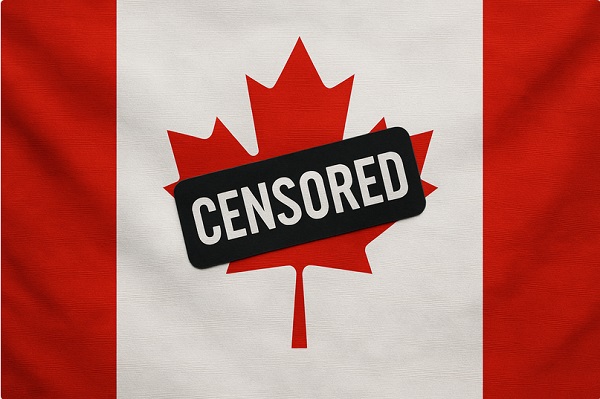
From the Frontier Centre for Public Policy
By Lee Harding
Ottawa says Bill C-9 fights hate. Critics say it turns ordinary disagreement into a potential crime.
Discriminatory hate is not a good thing. Neither, however, is the latest bill by the federal Liberal government meant to fight it. Civil liberties organizations and conservative commentators warn that Bill C-9 could do more to chill legitimate speech than curb actual hate.
Bill C-9 creates a new offence allowing up to life imprisonment for acts motivated by hatred against identifiable groups. It also creates new crimes for intimidation or obstruction near places of worship or community buildings used by identifiable groups. The bill adds a new hate propaganda offence for displaying terrorism or hate symbols.
The Canadian Civil Liberties Association (CCLA) warns the legislation “risks criminalizing some forms of protected speech and peaceful protest—two cornerstones of a free and democratic society—around tens of thousands of community gathering spaces in Canada.” The CCLA sees no need to add to existing hate laws.
Bill C-9 also removes the requirement that the Attorney General consent to lay charges for existing hate propaganda offences. The Canadian Constitution Foundation (CCF) calls this a major flaw, noting it removes “an important safeguard for freedom of expression that has been part of Canada’s law for decades.” Without that safeguard, decisions to prosecute may depend more on local political pressures and less on consistent national standards.
Strange as it sounds, hatred just will not be what it used to be if this legislation passes. The core problem begins with how the bill redefines the term itself.
Previously, the Supreme Court of Canada said hatred requires “extreme manifestations” of detestation or vilification that involve destruction, abhorrence or portraying groups as subhuman or innately evil. Instead, Bill C-9 defines hatred as “detestation or vilification,” stronger than “disdain or dislike.” That is a notably lower threshold. This shift means that ordinary political disagreement or sharp criticism could now be treated as criminal hatred, putting a wide range of protected expression at real risk.
The bill also punishes a hateful motivation more than the underlying crime. For example, if a criminal conviction prompted a sentence of two years to less than five years, a hateful motivation would add as much as an additional five years of jail time.
On paper, most Canadians may assume they will never be affected by these offences. In practice, the definition of “hate” is already stretched far beyond genuine threats or violence.
Two years ago, the 1 Million March for Children took place across Canada to protest the teaching of transgender concepts to schoolchildren, especially the very young. Although such opposition is a valid position, unions, LGBT advocates and even Newfoundland and Labrador Conservatives adopted the “No Space For Hate” slogan in response to the march. That label now gets applied far beyond real extremism.
Public pressure also shapes how police respond to protests. If citizens with traditional values protest a drag queen story hour near a public library, attendees may demand that police lay charges and accuse officers of implicit hatred if they refuse. The practical result is clear: officers may feel institutional pressure to lay charges to avoid being accused of bias, regardless of whether any genuine threat or harm occurred.
Police, some of whom take part in Pride week or work in stations decorated with rainbow colours in June, may be wary of appearing insensitive or intolerant. There have also been cases where residents involved in home invasion incidents were charged, and courts later determined whether excessive force was used. In a similar way, officers may lay charges first and allow the courts to sort out whether a protest crossed a line. Identity-related considerations are included in many workplace “sensitivity training” programs, and these broader cultural trends may influence how such situations are viewed. In practice, this could mean that protests viewed as ideologically unfashionable face a higher risk of criminal sanction than those aligned with current political priorities.
If a demonstrator is charged and convicted for hate, the Liberal government could present the prosecution as a matter for the justice system rather than political discretion. It may say, “It was never our choice to charge or convict these people. The system is doing its job. We must fight hate everywhere.”
Provincial governments that support prosecution will be shielded by the inability to show discretion, while those that would prefer to let matters drop will be unable to intervene. Either way, the bill could increase tensions between Ottawa and the provinces. This could effectively centralize political authority over hate-related prosecutions in Ottawa, regardless of regional differences in values or enforcement priorities.
The bill also raises concerns about how symbols are interpreted. While most Canadians would associate the term “hate symbol” with a swastika, some have linked Canada’s former flag to extremism. The Canadian Anti-Hate Network did so in 2022 in an educational resource entitled “Confronting and preventing hate in Canadian schools.”
The flag, last used nationally in 1965, was listed under “hate-promoting symbols” for its alleged use by the “alt-right/Canada First movement” to recall when Canada was predominantly white. “Its usage in modern times is an indicator of hate-promoting beliefs,” the resource insisted. If a historic Canadian symbol can be reclassified this easily, it shows how subjective and unstable the definition of a “hate symbol” could become under this bill.
These trends suggest the legislation jeopardizes not only symbols associated with Canada’s past, but also the values that supported open debate and free expression. Taken together, these changes do not merely target hateful behaviour. They create a legal framework that can be stretched to police dissent and suppress unpopular viewpoints. Rest in peace, free speech.
Lee Harding is a research fellow for the Frontier Centre for Public Policy.
Censorship Industrial Complex
Conservative MP calls on religious leaders to oppose Liberal plan to criminalize quoting Scripture

From LifeSiteNews
Quoting the Bible, Quran, or Torah to condemn abortion, homosexuality, or LGBT propaganda could be considered criminal activity
Conservatives are warning that Canadians should be “very afraid” of the Liberals’ proposal to punish quoting Scripture, while advising religious leaders to voice their opposition to the legislation.
During a December 6 session in Parliament, Conservative Member of Parliament (MP) Larry Brock warned Canadians of the very real threat to their religious freedom thanks to proposed amendments to Bill C-9, the “Combating Hate Act,” that would allow priests quoting Scripture to be punished.
“Do Christians need to be concerned about this legislation?” MP Bob Zimmer questioned. “Does it really threaten the Bible and free speech in Canada?”
“They should be very afraid,” Brock responded. “Every faith leader should be very afraid as to what this Liberal government with the support of the Bloc Quebecois wishes to do.”
“As I indicated, religious freedom is under attack at the hands of this Liberal government,” he declared.
Brock stressed the need for religious leaders to “speak out loud and clear” against the proposed amendment and contact their local Liberal and Bloc MPs.
Already, the Canadian Conference of Catholic Bishops penned an open letter to the Carney Liberals, condemning the proposed amendment and calling for its removal.
As LifeSiteNews reported earlier this week, inside government sources revealed that Liberals agreed to remove religious exemptions from Canada’s hate speech laws as part of a deal with the Bloc Québécois to keep Liberals in power.
Bill C-9, as reported by LifeSiteNews, has been blasted by constitutional experts as empowering police and the government to go after those it deems to have violated a person’s “feelings” in a “hateful” way.
Now, the Bloc amendment seeks to further restrict free speech. The amendment would remove the “religious exemption” defense, which has historically protected individuals from conviction for willful promotion of hatred if the statements were made “in good faith” and based on a “religious subject” or a “sincerely held” interpretation of religious texts such as passages from the Bible, Quran, or Torah.
As a result, quoting the Bible, Quran, or Torah to condemn abortion, homosexuality, or LGBT propaganda could be considered criminal activity.
Shortly after the proposed amendment was shared on social media, Conservatives launched a petition, calling “on the Liberal government to protect religious freedom, uphold the right to read and share sacred texts, and prevent government overreach into matters of faith.”
Already, in October, Liberal MP Marc Miller said that certain passages of the Bible are “hateful” because of what it says about homosexuality and those who recite the passages should be jailed.
“Clearly there are situations in these texts where these statements are hateful,” Miller said. “They should not be used to invoke or be a defense, and there should perhaps be discretion for prosecutors to press charges.”
His comments were immediately blasted by Conservative politicians throughout Canada, with Alberta provincial Conservative MLA and Minister of Municipal Affairs Dan Williams saying, “I find it abhorrent when MPs sitting in Ottawa – or anyone in positions of power – use their voice to attack faith.”


Wayne Gretzky’s Terrible, Awful Week.. And Soccer/ Football.

Western Campuses Help Build China’s Digital Dragnet With U.S. Tax Funds, Study Warns

Common Vaccines Linked to 38-50% Increased Risk of Dementia and Alzheimer’s
US podcaster Glenn Beck extends a lifeline to a Saskatchewan woman waiting for MAiD
-
Bruce Dowbiggin2 days ago
Wayne Gretzky’s Terrible, Awful Week.. And Soccer/ Football.
-
espionage1 day ago
Western Campuses Help Build China’s Digital Dragnet With U.S. Tax Funds, Study Warns
-
Focal Points22 hours ago
Common Vaccines Linked to 38-50% Increased Risk of Dementia and Alzheimer’s
-
 Opinion2 days ago
The day the ‘King of rock ‘n’ roll saved the Arizona memorial
-
 Automotive12 hours ago
The $50 Billion Question: EVs Never Delivered What Ottawa Promised
-
 Agriculture2 days ago
Canada’s air quality among the best in the world
-
 Business1 day ago
Canada invests $34 million in Chinese drones now considered to be ‘high security risks’
-
 Health20 hours ago
The Data That Doesn’t Exist